


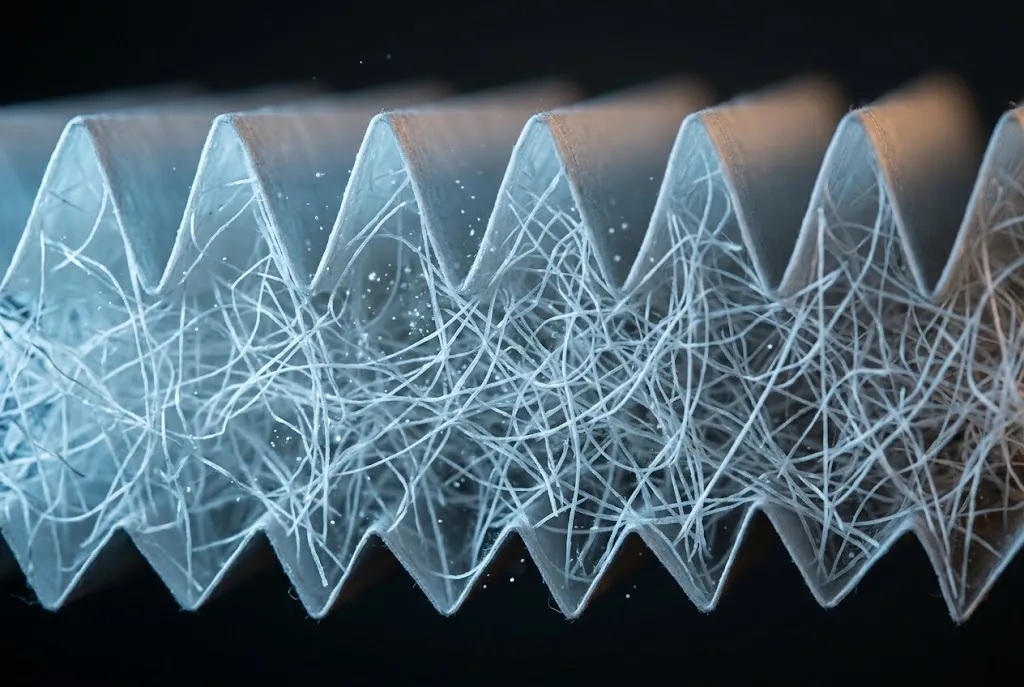
I cut open my first expensive air purifier filter during a week when wildfire smoke turned the sky outside into an eerie sepia wash. I expected to find something resembling a screen door on a molecular scale—a microscopic colander punched with millions of uniform, miniature holes.
That was not what was inside.
Instead of a neat grid, the filter media looked like a bird's nest flattened by a steamroller. Thousands of chaotic, tangled glass strands crisscrossed in every imaginable direction, leaving gaps between them that were noticeably larger than the soot particles drifting through my living room. It made no sense. If the gaps between the fibers were several times wider than smoke, bacteria, and virus droplets, why weren't the contaminants sailing straight through?
It felt backwards. But that intuition fails because we naturally picture air filtration as simple sieving.
The Sieve Fallacy: Why Filters Aren't Strainers
If you want to keep spaghetti in a pot while draining hot water, a colander works because every hole is smaller than the noodles. That mechanical straining is called sieving. Most people assume a HEPA standard (opens in a new tab) filter operates on the exact same premise, just scaled down to microscopic proportions.
Here is the fatal flaw with that idea: fluid dynamics.
If you engineered a solid membrane with holes small enough to catch a 0.1-micron virus purely by physical blockage, air couldn't pass through it without monstrous pressure. Your home air purifier would require an industrial jet turbine just to force a gentle breeze across the room. The motor would overheat, the energy bill would skyrocket, and the filter would clog completely within days.
True HEPA (which stands for High-Efficiency Particulate Air) does something far cleverer. It abandons the colander model altogether.
Rather than blocking particles with tiny holes, HEPA media uses a thick, disordered mat of randomly arranged borosilicate glass microfibers. These fibers typically measure between 0.5 and 2.0 micrometers in diameter. The spaces between those fibers, however, often measure 5 to 50 micrometers wide.
Think about that scale. The gaps are up to fifty times wider than the particles you want to catch. Yet, when air passes through that messy forest of glass, 99.97% of airborne matter never makes it out the other side.
The Sticky Physics of Van der Waals Forces
To understand why particles don't slip through those wide gaps, you have to look at what happens at microscopic distances. When an airborne dust mote or biological aerosol drifts close enough to brush against a glass strand, it doesn't bounce off like a billiard ball.
It simply sticks.
At the nanoscale, van der Waals forces (opens in a new tab)—the subtle electromagnetic attractions between neutral atoms and molecules—completely overpower a particle's tiny mass. On our human scale, gravity rules everything. You touch a wall, take your hand away, and nothing happens. For an airborne particle with virtually zero inertia, touching a microfiber is like slamming into flypaper coated in superglue.
The entire challenge of HEPA engineering isn't building holes small enough to block particles. It is designing an obstacle course that guarantees every floating speck collides with at least one fiber before reaching the back of the filter.
The Four Traps: How Air Physics Grabs Every Size
Air flowing through a filter does not move in straight lines. It curves around each glass strand, forming fluid contours called streamlines. Because different particles carry different masses, the filter exploits four separate aerodynamic mechanisms to pull them out of those airstreams.
1. Inertial Impaction (The Heavyweights)
Large particles—like pollen grains, mold spores, and coarse carpet dust—have relatively high mass and momentum. As the air approaches a glass fiber, the air itself splits smoothly around the obstacle.
The heavy particle cannot make that sharp turn. Its inertia carries it forward along its original trajectory, driving it straight into the front face of the fiber.
2. Interception (The Mid-Sized Drifters)
Medium particles, roughly 0.3 to 1.0 micron across, are light enough to stay in the air streamline without plowing straight ahead. But they still possess physical dimensions.
As the streamline carries the particle around the contour of a fiber, the particle passes within one radius of the fiber's surface. Its outer edge brushes the glass, van der Waals forces engage, and the particle gets snagged instantly.
3. Brownian Diffusion (The Microscopic Miracle)
This is where human intuition breaks down completely.
If you drop below 0.1 microns—into the realm of individual viral pathogens, ultrafine soot, and combustion exhaust—particles have virtually no inertia. You might assume these sub-microscopic specks would trace the curving airflow effortlessly and escape through the open gaps.
Not quite.
At that tiny scale, individual particles get hammered from every direction by surrounding nitrogen and oxygen molecules. This erratic thermal bombardment causes them to jitter in frantic, zigzag patterns known as Brownian motion (opens in a new tab).
Instead of gliding along a smooth streamline, the particle behaves like a pinball. It wanders wildly across the flow paths, covering far more physical space than its tiny size suggests. That endless bouncing makes an eventual collision with a nearby fiber practically guaranteed.
Smaller doesn't mean slipperier.
4. Electrostatic Attraction
Many modern synthetic filter fibers carry a persistent electrostatic charge, or become polarized by airflow friction. As polarized or charged particles drift through the mesh, static attraction pulls them toward the fiber surface even if their path wouldn't have produced a direct collision.
This is why your HEPA air purifier actually catches tiny respiratory viruses better than it catches medium-sized pollen grains.
(And honestly, the first time I saw the particle capture curve, I stared at that dip in the middle for five straight minutes).
| Particle Type | Typical Diameter | Dominant Capture Mechanism |
|---|---|---|
| Ragweed Pollen & Dust Mites | 10 – 30 µm | Inertial Impaction |
| Bacteria & Mold Spores | 1.0 – 5.0 µm | Impaction & Interception |
| Fine Smoke & Aerosols | 0.3 µm | Interception (Weakest Point) |
| Wildfire Soot & Smog | 0.05 – 0.2 µm | Brownian Diffusion |
| Viral Capsids & Protein Cores | 0.02 – 0.1 µm | Intense Brownian Diffusion |
The 0.3-Micron Paradox: The Hardest Particle to Catch
Look at any True HEPA packaging and you will spot the same exact benchmark: Captures 99.97% of particles down to 0.3 microns.
Most consumers misread that sentence as a cutoff limit, assuming the filter stops working on anything smaller than 0.3 microns. In reality, 0.3 microns is the filter's worst-case scenario.
Physics calls this the Most Penetrating Particle Size, or MPPS.
Think about the overlap between the mechanisms. As particles shrink down toward 0.3 microns, they become too light for inertial impaction to slam them into a fiber, and their physical diameter is too small for interception to easily graze the edge. Yet, they are still just heavy enough that molecular collisions from air molecules don't shake them into violent Brownian diffusion.
It is the aerodynamic twilight zone. Right around 0.2 to 0.3 micrometers, every capture mechanism is running at its relative minimum.
The standard doesn't test 0.3 microns because it's the smallest thing the filter can stop. It tests 0.3 microns because that is the hardest thing in the entire universe for the filter to trap. If a filter stops 99.97% of particles at their most elusive size, its capture rate for 0.05-micron viruses is actually closer to 99.99%.
Born from the Manhattan Project
This counterintuitive physics wasn't invented to clean living room air. It was forged in total secrecy during World War II.
In the early 1940s, scientists working on the Manhattan Project (opens in a new tab) at Oak Ridge and Los Alamos faced an unprecedented hazard: microscopic radioactive dust. Enriching uranium and handling plutonium generated volatile, sub-micron aerosols that could easily bypass standard military dust masks and settle deep inside workers' lungs, much like the toxic particulate problems that emerged with early radioactive materials processed in nuclear facilities.
The Army Chemical Corps collaborated with Nobel laureate chemist Irving Langmuir (opens in a new tab) to study aerosol dynamics mathematically. Langmuir proved that 0.3-micron aerosols would prove the most dangerous and penetrating particle size.
Engineers adapted dense, cellulose-asbestos filter papers originally captured from German army gas masks, replacing them with resilient borosilicate glass formulations. They called the result the "Absolute Filter." It wasn't until the 1950s that the military declassified the technology, christening it HEPA and licensing it to cleanrooms, hospitals, and commercial manufacturers.
Why Air Purifiers Fail in the Real World
If the filter material itself is an aerodynamic masterclass, why do so many rooms still smell like smoke during wildfire season?
The answer almost never lies in the glass fibers. It lies in the housing.
First, there is the bypass problem. A filter rated for 99.97% efficiency is only as good as the rubber gasket sealing it to the purifier frame. If even 1% of the air leaks around the edge of the filter frame through an unsealed seam, your effective room filtration plummets. Air follows the path of least resistance. It will gladly dodge a dense web of glass if it finds a loose plastic latch.
Second, HEPA filters are completely blind to gases. Volatile organic compounds (VOCs), formaldehyde off-gassing from furniture, cooking odors, and combustion byproducts like carbon monoxide are single molecules—orders of magnitude smaller than the sub-micron particles HEPA catches. They slip through the glass maze without pausing, just as sub-micron particles slip through ionization zones until they are registered by optical smoke detectors detecting airborne soot. To stop smells and toxic vapors, a purifier must pair its HEPA pleated sheet with a thick bed of activated charcoal.
Air changes matter more than marketing badges. A flawless HEPA filter running in a purifier that only cycles the room's air volume once every three hours leaves pollutants hanging in stagnant pockets.
Next time you hear that gentle fan hum in the corner of your bedroom, picture what is happening inside that pleated paper drum. It isn't a passive plastic mesh catching crumbs. It is a calculated labyrinth where fluid dynamics, chaotic molecular collisions, and invisible intermolecular forces join hands to strip the air clean.



Conversation0
No comments yet. Be the first to share a thought — the best questions often become new stories.