


The Cosmic Ray Collision in the Upper Atmosphere
I was twelve when I first stared at a charred wooden spear shaft inside a glass museum case, squinting at a little card that claimed it was carved exactly 4,200 years ago. Nobody was around to write down a timestamp when that hunter sharpened the wood. The tree grew before written alphabets reached northern Europe. How did anyone put an exact calendar year on dead timber?
They didn't read an inscription. They measured radioactive wreckage left behind by exploding stars.
Most people assume carbon dating starts in the dirt where archaeologists dig. It doesn't. It starts roughly ten to fifteen kilometers above your head, right where Earth's atmosphere meets deep space. Our planet is bombarded day and night by galactic cosmic rays—high-energy protons fired across the galaxy by ancient supernova explosions. When one of these cosmic protons violently collides with an air molecule, it splinters atomic nuclei and releases energetic free neutrons.
Those roaming neutrons slam straight into nitrogen-14 atoms, the most common gas in our atmosphere. When a neutron strikes a nitrogen nucleus with the right energy, it kicks out a proton and takes its place. What used to be a stable nitrogen atom with seven protons and seven neutrons suddenly has six protons and eight neutrons.
That turns it into Carbon-14 (opens in a new tab).
It is rare. Unstable. Radioactive. And it oxidizes rapidly into carbon dioxide molecules that blow across continents, drift over oceans, and settle into forests. Which brings us directly to how carbon dating works down on the ground: plants pull that radioactive carbon dioxide directly from the air during photosynthesis. Animals eat the plants. Predators eat those animals.
Every single living thing on this planet is woven out of cosmic fallout.
Why Living Things Stay in Radioactive Balance
Take a deep breath. Right now, your lungs are pulling in three distinct types of carbon atoms.
About 99% of the carbon inside your cells is regular carbon-12, packed with six protons and six neutrons. Another 1% is stable carbon-13. And an absurdly minuscule sliver—roughly one out of every trillion carbon atoms—is carbon-14.
One in a trillion. It sounds like an impossible needle in a haystack. But as long as you eat, breathe, and drink, your body constantly swaps carbon atoms with the global biosphere. Old atoms leave through your breath and skin; new atoms arrive in your lunch. That biological circulation keeps the ratio of carbon-14 to stable carbon-12 inside your living tissues locked in sync with the atmospheric ratio around you.
Then the organism dies. The heart stops pumping. The tree falls.
Metabolism halts in an instant. No more eating. No more breathing. No new carbon atoms ever enter the body again. The intake door slams shut, and the countdown begins.
The Ticking Half-Life: How Beta Decay Keeps Time
Once an organism dies, carbon-14 has no replacement pipeline. Because its nucleus carries two extra neutrons, it cannot stay together indefinitely. Over time, one of those extra neutrons spontaneously decays into a proton, spitting out a fast electron (a beta particle) and an antineutrino. Having gained a proton, the atom snaps back into stable nitrogen-14.
That decay happens at an unyielding, predictable pace defined by its half-life of 5,730 years.
If you start with 100,000 carbon-14 atoms in a scrap of bone, you will have 50,000 left after 5,730 years. After 11,460 years, you will have 25,000 left. After 17,190 years, just 12,500 remain.
When American chemist Willard Libby (opens in a new tab) invented the technique in the late 1940s—a discovery that won him the 1960 Nobel Prize—scientists had to place ancient samples inside heavily shielded tubes and wait for those rare beta particles to pop off. They relied on modified radiation counters, listening for the occasional ping much like how Geiger counters detect ionizing particles. But waiting for atoms to decay is painfully slow. You needed ounces of irreplaceable museum artifacts just to register enough clicks over several days.
Science found a much better way.
Inside the Accelerator: Counting Atoms One by One
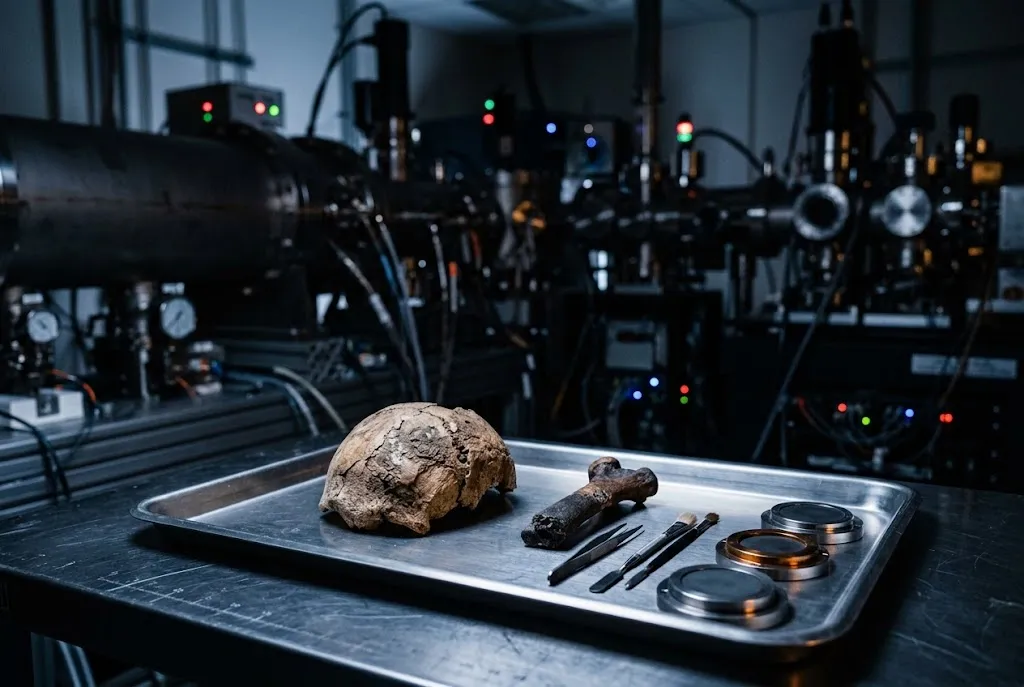
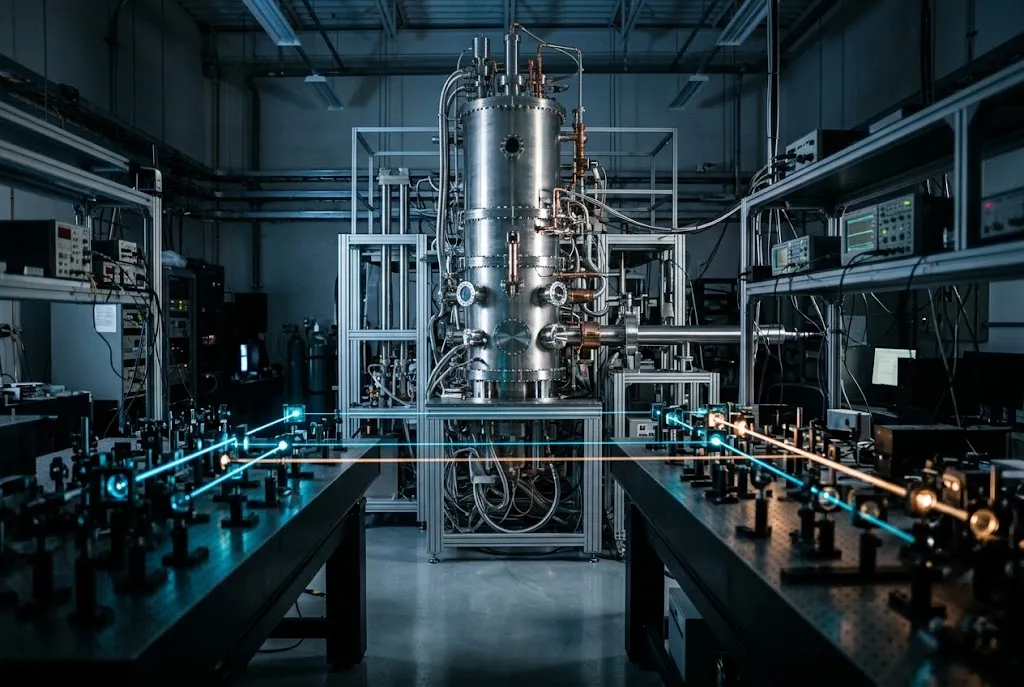
Modern laboratories don't sit around waiting for carbon-14 to decay. They count the atoms directly using accelerator mass spectrometry (opens in a new tab), or AMS.
First, a technician shaves off a tiny fleck of charcoal, linen, or bone—often smaller than a grain of rice. The sample goes through baths of acid and alkali to strip away dirt, modern oils, and soil acids. Next, the purified sample is converted into pure graphite, mounted onto an aluminum target, and bombarded by a cesium ion beam inside a vacuum chamber.
The ion beam knocks negative carbon ions out of the target. These ions get pulled into a particle accelerator that ramps them up to millions of electron volts before blasting them through a powerful bending electromagnet.
Momentum does the filtering. Because carbon-12, carbon-13, and carbon-14 have slightly different masses, the magnet's curved magnetic field bends their paths at distinct angles. The heavy carbon-14 ions curve less than the lighter carbon-12 ions.
What about nitrogen-14, which shares the exact same atomic mass as carbon-14? Here is the clever physics trick: nitrogen does not form stable negative ions in the source. It simply falls away before entering the beamline. That leaves carbon-14 ions to hit the final detector, where physicists count every single atom individually.
This is why modern wine and vintage whiskey counterfeiters get caught instantly by laboratory isotope specialists when trying to pass off cheap swill as a rare 1945 vintage.
Radiocarbon Dating Accuracy and the 50,000-Year Wall
People often ask if scientists can carbon date a Tyrannosaurus rex femur.
Not a chance.
The limits of radiocarbon dating accuracy come down to cold arithmetic. After 50,000 years, roughly nine half-lives have elapsed. That leaves less than 0.2% of the original carbon-14 behind. By 60,000 years, the remaining radiocarbon is so sparse that a stray speck of modern airborne dust can distort the reading by thousands of years.
Beyond that 50,000-year wall, radiocarbon flatlines. To date non-avian dinosaur fossils that lived 66 million years ago, geologists use completely different radiometric clocks based on volcanic rock layers—isotopes like uranium-238 or potassium-40, which possess half-lives stretching into billions of years.
This is why paleontologists can never run carbon dating on a Tyrannosaurus rex bone—any reading you get from a 66-million-year-old fossil is pure modern contamination.
There is another crucial catch: Willard Libby originally assumed the concentration of carbon-14 in Earth's atmosphere was constant throughout all history.
He was wrong.
Why Tree Rings Saved Radiocarbon Dating
Earth's magnetic shield constantly expands and contracts, changing how many cosmic rays punch into the upper atmosphere. Solar activity ramps up and down in cycles. When the sun is hyperactive, its magnetic field deflects incoming cosmic rays, causing atmospheric carbon-14 production to drop. When the sun quiets down, carbon-14 production spikes.
If you simply take raw isotope counts and calculate the age using Libby's baseline equation, your date can be off by several centuries, sometimes even millennia.
To rescue accuracy, scientists turned to ancient trees. Giant bristlecone pines and bog oaks add a distinct growth ring every single summer, locking the exact atmospheric chemistry of that specific calendar year in cellulose. By harvesting core samples from living trees and overlapping them with waterlogged fossilized logs, researchers constructed an unbroken annual chronology reaching back almost 14,000 years.
By measuring the raw carbon-14 in each individual tree ring of known age, scientists built empirical calibration curves (opens in a new tab).
Today, no peer-reviewed archaeologist publishes raw "radiocarbon years" without converting them through the international IntCal calibration curve. It allows researchers to anchor discoveries with unmatched precision, cross-referencing timeline puzzles like authenticating ancient artifacts like the Antikythera mechanism.
The Bomb Pulse and the Fossil Fuel Paradox
Human activity warped the atmospheric radiocarbon clock twice in the last two centuries.
First came the Industrial Revolution. Humanity burned millions of tons of ancient coal and petroleum. Because that fossil fuel had been buried underground for hundreds of millions of years, every trace of its original carbon-14 had decayed to zero eons ago. Pumping massive volumes of "dead" carbon dioxide into the sky diluted the natural atmospheric isotope ratio, making modern air look deceptively old—a phenomenon known as the Suess effect.
Then came the Cold War.
Between 1955 and 1963, the United States, the Soviet Union, and Britain conducted hundreds of above-ground nuclear detonations. The immense neutron flashes released by the physics behind nuclear bomb detonations transmuted massive volumes of atmospheric nitrogen into synthetic carbon-14, effectively doubling the global concentration of radiocarbon in less than a decade.
This sudden spike is known as the bomb pulse (opens in a new tab).
While atmospheric tests ruined natural baseline dating for modern samples, the bomb pulse gave forensic science an unexpected gift. Because atmospheric carbon-14 surged sharply and then began decaying following the 1963 test ban treaty, every year since 1955 carries its own distinct isotope fingerprint. Forensic pathologists now use bomb-pulse dating to pinpoint the birth and death years of unidentified human remains by testing tooth enamel, and wildlife officials use it to prove whether seized elephant tusks were poached yesterday or taken legally decades ago.
From supernova remnants showering the upper stratosphere to the growth rings of ancient pines, radiocarbon dating proves that time leaves a physical trail. All you need is an accelerator powerful enough to count the atoms.



Conversation0
No comments yet. Be the first to share a thought — the best questions often become new stories.