


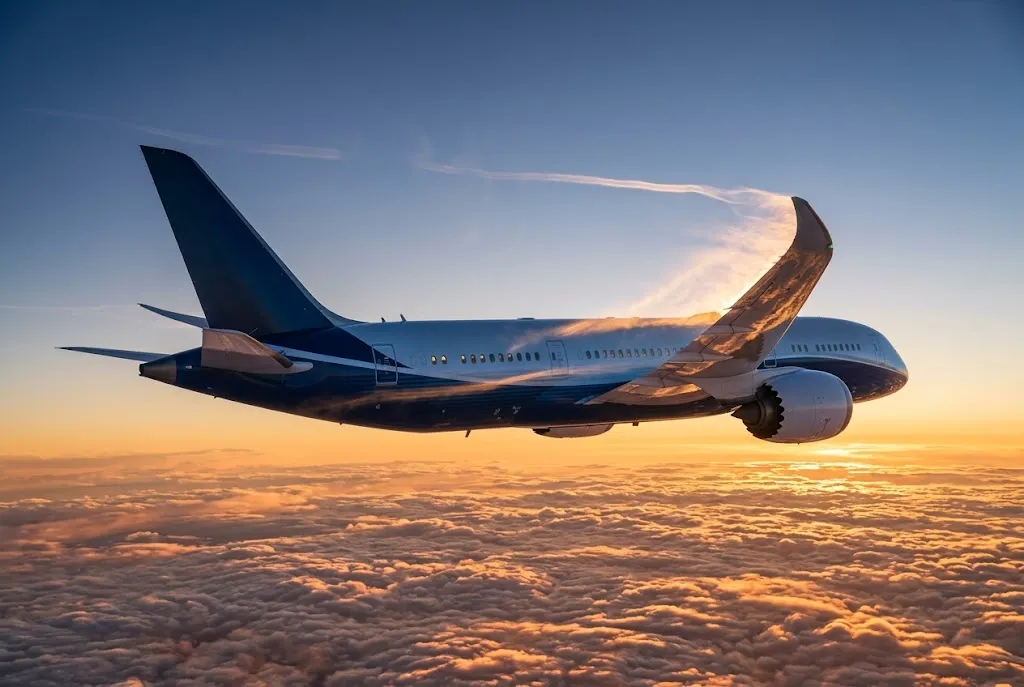
Staring at a 400-Ton Metal Giant Defying Gravity
I was sitting in a window seat just ahead of the wing on a Boeing 777 last winter, watching frost melt off the aluminum skin while the ground crew finished loading luggage. The sheer absurdity of commercial aviation hit me hard.
That machine, fully fueled and packed with passengers, weighed over 300 metric tons.
Three hundred tons of forged titanium, steel, avionics, and human bodies were about to climb into thin air at 500 miles per hour. Gravity does not negotiate. It pulls every gram toward Earth with relentless consistency, yet within twenty minutes, we were comfortably cruising seven miles above the Atlantic. How does an invisible, transparent soup of gas molecules hold up a flying office building?
If you ask most people, they will confidently repeat an explanation they memorized in fourth grade.
They are almost certainly wrong.
I believed that same explanation for years. Most grade school textbooks still print it, complete with tidy little diagrams showing split air particles racing to meet on the other side of an airfoil. But if you walk into an aerospace engineering department and offer that theory, professors will shake their heads. In fact, the standard classroom explanation is not just an oversimplification.
It is physically impossible.
The Equal Transit Myth You Were Probably Taught in School
The most pervasive myth in physics is called the equal transit time theory.
You have probably seen the drawing: an airplane wing has a curved upper surface and a flat lower surface. The story goes that when oncoming airflow strikes the leading edge of the wing, the air splits into two neat packets. One parcel travels across the longer, curved top, while the other travels along the shorter, flat bottom.
According to the myth, these two parcels must arrive at the trailing edge at the exact same instant. Because the top packet has further to go, it has to travel faster. And because it travels faster, Bernoulli's principle (opens in a new tab) dictates that its pressure drops. Lower pressure above, higher pressure below, and voila: instant aerodynamic lift.
It sounds elegant.
Except nature has zero obligation to make two separated packets of air reunite at the back of a wing.
There is no physical law requiring equal transit time. None. The engineers at the NASA Glenn Research Center (opens in a new tab) have even posted detailed educational archives explicitly debunking it as an aerodynamic fairy tale. When physicists put an airfoil into a wind tunnel and fire synchronized pulses of smoke through the intake, the top parcel does not stroll back to meet its twin.
It destroys it.
Why Smoke Trails in Wind Tunnels Shattered the Fairy Tale
The air racing across the curved upper surface reaches the back edge far ahead of the air sliding underneath. It is not an even race; it is a blowout. The upper air moves significantly faster than the equal-transit hypothesis predicts.
Even worse, the equal-transit myth fails basic common sense tests that any pilot can spot from a mile away. If a curved top and a flat bottom were required to generate lift, how could an aerobatic stunt plane fly upside down? In inverted flight, the curved surface faces the ground and the flat surface faces the clouds. Under the old textbook theory, the plane should be driven violently downward.
Yet stunt pilots fly inverted all the time.
Furthermore, simple flat plates can generate lift. Fold a balsa wood glider or a paper airplane with wings as flat as cardboard, give it a toss, and it glides smoothly across the room. If lift required unequal path lengths, your paper dart would drop like a stone. To get that massive airliner off the tarmac, the engines have to generate tens of thousands of pounds of thrust—a monstrous mechanical effort detailed in why jet engine turbine blades survive extreme heat—just to force the wings through the air fast enough for real physics to take over.
The Real Engine of Lift: Turning the Air Downward
If you want to understand how a 400-ton aircraft stays aloft, you have to stop thinking of air as empty space and start thinking of it as a heavy fluid.
Air has real mass. A standard Olympic-sized swimming pool volume of atmospheric air weighs more than three tons. When an airplane blasts through the sky at 500 miles per hour, its wings collide with tens of thousands of pounds of air molecules every single second.
Here is the core truth of flight: to keep an airplane up, the wing must force a massive river of air down.
This is pure Isaac Newton. Newton's third law of motion (opens in a new tab) dictates that for every action, there is an equal and opposite reaction. If you want the atmosphere to exert an upward force on your wings, your wings must exert a downward force on the atmosphere. The downward deflection of moving air behind a lifting wing is called downwash.
Pilots control this downward deflection primarily through the angle of attack—the tilt between the wing's chord line and the oncoming airflow.
This is why sticking your flat palm out of a speeding car window and tilting it upward immediately shoves your entire forearm toward the roof.
Your hand is acting as an inclined plane. The underside rams into oncoming air molecules, physically deflecting them downward. Because momentum must be conserved across the entire system, your hand is shoved directly upward.
Why Air Clings to the Curve: The Coandă Effect and Viscosity
If lift were simply air hitting the underside of a tilted board, we could make airplane wings out of flat sheets of plywood.
We don't, because pushing air from below is horribly inefficient. It produces massive aerodynamic drag and very little usable lift. The real magic happens on top.
Surprising as it sounds, roughly two-thirds of the total lift generated by an airliner wing comes from the upper surface, not the bottom. But why would air passing over a rounded top turn downward instead of continuing in a straight line?
The answer lies in fluid viscosity and the Coandă effect (opens in a new tab).
Air molecules are sticky. Because of intermolecular friction, air tends to cling to smooth, gently curving surfaces rather than tearing away into empty space. You can test this at your kitchen sink right now: turn on a gentle stream of tap water, take a smooth metal spoon, and bring the convex back of the bowl against the edge of the running water.
The water will not bounce off.
Instead, the stream hugs the curved curve of the spoon, bending around the bowl before falling off at an angle. And because the water is bent toward the spoon, the spoon is pulled sideways into the stream.
(And honestly, the first time I watched fluid streamlines curl around an obstacle in a physical flume, it looked like a magic trick rather than basic mechanics).
The Suction Zone Nobody Talks About
As oncoming air encounters the curved leading edge of an airplane wing, it is forced to bend around the contour. When fluid travels along a curved path, centrifugal effects create a low-pressure gradient perpendicular to the curve.
The wing literally starves the region directly above it of atmospheric pressure.
Because the air clings to the skin via the Coandă effect, it does not shoot straight backward. It follows the slope down toward the trailing edge. This downward bend turns the upper airstream into a massive downward jet. Because the pressure drops dramatically directly above the wing, normal atmospheric pressure underneath helps push the wing upward into that partial vacuum.
The wings are not resting on a cushion of air like a sled on snow.
They are being actively sucked upward and forward while continuously flinging a colossal curtain of air toward the dirt. That delicate kinetic balance is monitored down to millisecond intervals by flight instruments, all of which are tracked by hardened data units—a mechanical resilience mirrored in how airplane black boxes survive violent crashes.
Bernoulli Meets Newton: The Great Aerodynamic Peace Treaty
For decades, physics forums and flight instructors have argued over whether Bernoulli or Newton is responsible for airplane flight.
One camp insists that Bernoulli's pressure differential does all the work. The other camp argues that Newton's third law of action-reaction is the only true mechanism.
The argument is absurd. They are not competing physical theories; they are two mathematical languages describing the exact same physical event.
If you measure the velocity field of the air around the wing, Bernoulli's equation accurately calculates the local pressure drops across the upper skin. If you integrate those pressure drops across the total surface area of the wing, the upward net force matches the plane's weight.
Simultaneously, if you measure the downward momentum of the massive air curtain trailing behind the plane, Newton's third law reveals that the downward momentum transferred to the air per second matches that upward force down to the ounce.
Bernoulli describes the pressure mechanism occurring directly on the wing's surface. Newton describes the momentum exchange occurring in the air mass as a whole. You cannot have one without the other.
To formalize this, early 20th-century aerodynamicists developed circulation theory, governed by the Kutta condition (opens in a new tab). They proved that an airfoil creates a mathematical "bound vortex" around itself as it accelerates down the runway. This vortex speeds up the airflow over the top and slows it down underneath, enforcing smooth departure at the sharp trailing edge.
What Happens When Lift Collapses: The Anatomy of an Aerodynamic Stall
Because lift depends entirely on air smoothly hugging the wing, that relationship can shatter in a fraction of a second.
If a pilot pulls back on the control yoke too hard, the nose pitches up and the angle of attack steepens. Up to about 15 degrees, lift increases steadily. But push past that critical angle, and disaster strikes.
The air can no longer navigate the sharp downhill curve on the upper surface.
It tears away from the wing in violent, swirling eddies—a phenomenon called boundary layer separation. The smooth, low-pressure suction zone collapses instantly into chaotic turbulence. Lift plummets, drag skyrockets, and the wings stop functioning as aerodynamic lifters.
This is an aerodynamic stall.
It has nothing to do with the mechanical engine dying. You can stall a glider that has no engine at all. During a stall, the wing simply loses its grip on the moving fluid.
This is why stunt pilots can fly an airplane upside down for miles without immediately diving straight into the ground. They simply tilt the nose upward relative to the oncoming wind, turning air downward regardless of which side faces the clouds. The inverted wing has an inefficient camber, sure, but by increasing the angle of attack, the pilot forces the air to turn downward anyway. As long as air is shoved toward the ground, the plane stays in the sky.
Why We Can Finally Trust the Sky
The next time you settle into an airline seat and hear the turbines spool up for takeoff, look out at that long sheet of aluminum vibrating in the crosswind.
It is not resting on invisible bedrock. It is not exploiting an equal-transit loophole in elementary school textbooks.
Instead, it is a masterclass in applied fluid dynamics. It bends an invisible ocean of gas to its will, carving out low-pressure suction above while hurling millions of tons of air downward every single minute. The airplane flies because the atmosphere yields to geometry, speed, and momentum.
It is pure, honest kinetic physics—and it turns the impossible into routine travel.



Conversation0
No comments yet. Be the first to share a thought — the best questions often become new stories.