


The 600-Degree Thermal Cliff in Deep Space
I spent hours staring at the first deep-field images captured by the James Webb Space Telescope before an irritating engineering question popped into my head. How does this thing survive without cooking itself?
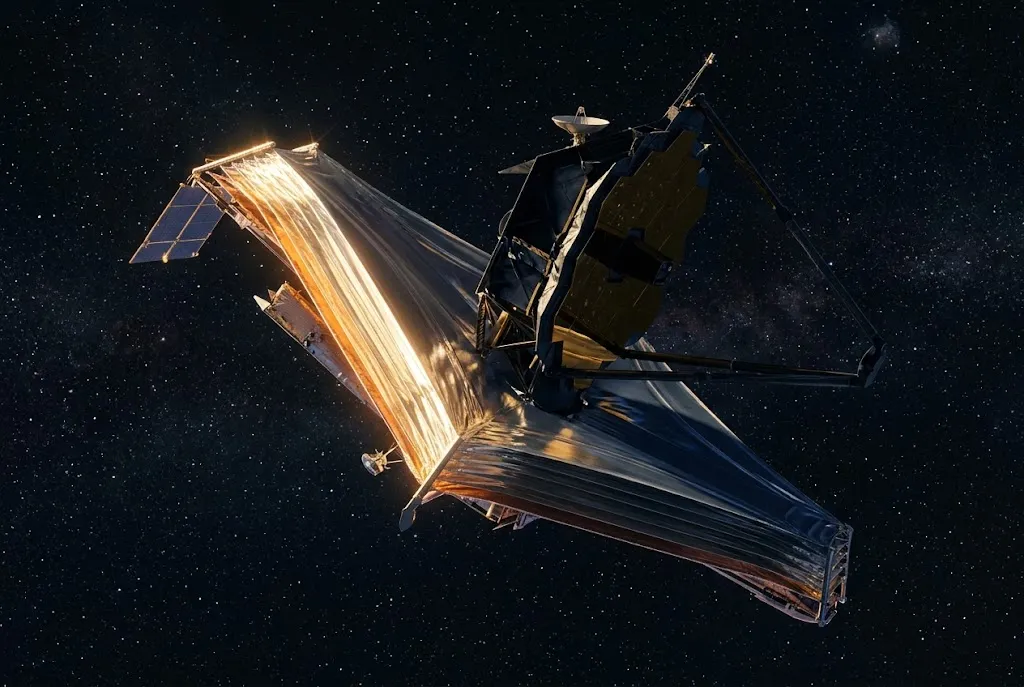
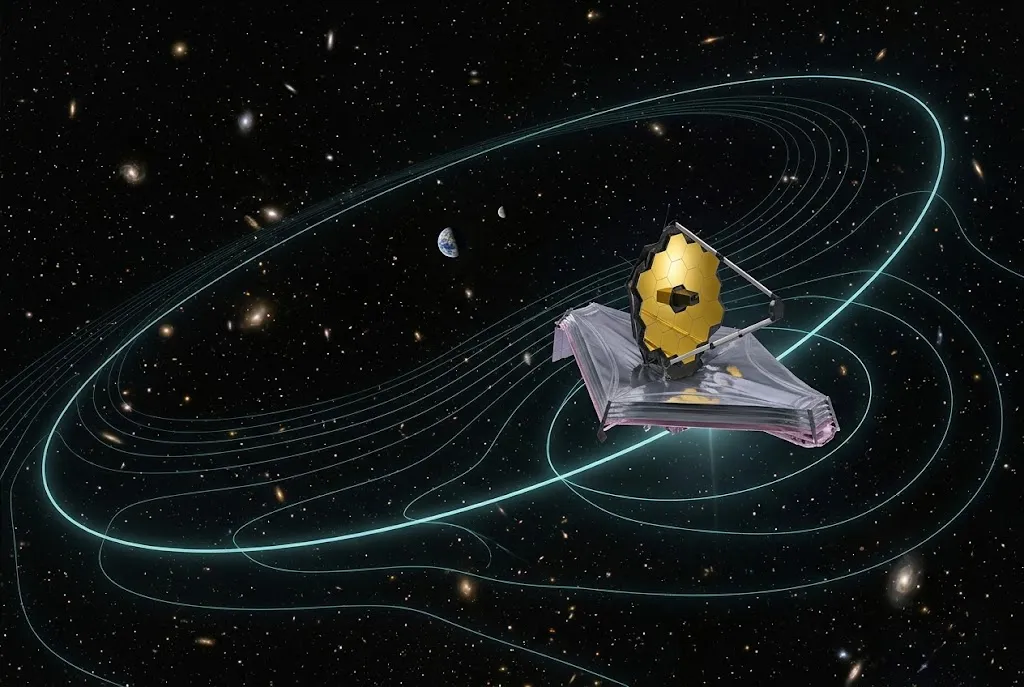
Webb orbits the Sun a million miles away from Earth. Out there, past the moon, sunlight is merciless. No atmosphere filters the radiation, and no tree or cloud offers shade. The sunny face of the spacecraft bakes continuously at roughly 185°F (85°C)—hot enough to scald skin. Yet less than six feet away, on the other side of the observatory, the mirrors sit plunged into an unearthly freeze of -388°F (40 Kelvin).
That is a 600-degree Fahrenheit thermal gradient across a structure separated by paper-thin foil.
Why go through such agony? Infrared astronomy demands it. Webb does not look at the universe through visible light. It hunts the faint, red-shifted infrared photons emitted by the earliest galaxies born right after the Big Bang.
Here is the catch: heat is infrared light.
If the telescope warmed up even slightly, its own gold-plated beryllium mirrors and support struts would begin glowing in the dark, swamping the sensors with blinding thermal static. It works on the exact same radiation principles behind how thermal cameras see heat in total darkness—except Webb needs to detect signals trillions of times fainter than a human body. An uncooled telescope in deep space is like trying to photograph the stars while someone shines a halogen spotlight straight down the barrel of your lens.
Why Normal Insulation Fails in a Pure Vacuum
On Earth, keeping things cold is straightforward. You wrap them in fiberglass, pour them into a styrofoam cooler, or surround them with dense polyurethane foam.
Those tricks rely on trapping stagnant air. Space does not have air.
Heat moves through three well-known pathways: conduction, convection, and radiation. Convection requires a fluid medium like water or air to carry thermal energy away, which makes it totally irrelevant in the vacuum of space. Conduction only happens where solid physical parts touch, such as the central mounting tower connecting the hot spacecraft bus to the cold optical deck.
That leaves thermal radiation.
Every warm object in the universe constantly spits out electromagnetic radiation. The hotter an object gets, the more aggressively it radiates, governed directly by the Stefan-Boltzmann law (opens in a new tab)—where radiated thermal power scales with the fourth power of temperature (). Double an object's absolute temperature, and its radiated energy surges sixteen-fold.
This is why emergency space blankets are made of paper-thin shiny foil instead of thick wool—when heat moves purely through radiation, surface reflectivity beats physical insulation thickness every single time.
NASA could not wrap Webb in a giant winter jacket. Thick foam would just conduct heat right through its porous bulk while adding thousands of pounds of dead weight to the launch rocket. The only workable solution was to use radiation against itself.
The Five-Layer Tennis Court: How Kapton Dumps Photons
The core of Webb's passive cooling system is a massive, kite-shaped shield measuring roughly 69 by 46 feet—the exact footprint of a regulation tennis court. It holds five ultra-thin sheets made of a specialty polyimide film known commercially as Kapton.
Kapton is an extraordinary polymer. It retains mechanical strength, flexibility, and stability across an absurd thermal range, from near absolute zero up to 750°F (400°C). Layer 1, the layer facing the Sun, is a mere 0.05 millimeters thick—about the thickness of two sheets of standard printer paper. The remaining four layers are even thinner, clocking in at 0.025 millimeters.
Every sheet receives a micro-thin vaporized aluminum coating to maximize reflectivity. On Layer 1 and Layer 2, NASA added a 50-nanometer layer of doped silicon on the sunward side to turn it into an electrical semiconductor, preventing static electrical charges from building up while reflecting harsh ultraviolet radiation that would otherwise degrade the film over time.
Yet the real engineering stroke is not the material. It is the empty space between each sheet.
If you simply stacked five sheets of Kapton tightly on top of one another, they would conduct heat directly through their contact points like a stack of metal pans on a hot stove. Instead, NASA spaced the layers apart with tensioned spreader booms, creating gaps that narrow at the center and flare outward toward the perimeter.
Think of each layer as a thermal mirror. Sunlight hits Layer 1. Around 90% of the solar heat is reflected straight back into space immediately.
The remaining 10% is absorbed and radiated inward toward Layer 2. But because the gap between Layer 1 and Layer 2 is wide open at the edges, that secondary heat does not pass directly through. It bounces off the reflective aluminum skin of Layer 2 and shoots out the open sides into the empty cosmic void.
Then the process repeats. Whatever tiny fraction of heat reaches Layer 3 encounters another angled gap and gets redirected outward. By the time thermal radiation crawls through to Layer 5, 99.999% of the Sun's 200,000 watts of radiant energy has been siphoned off into deep space. Only a fraction of a single milliwatt ever reaches the telescope's main deck.
It is passive cooling on an unprecedented scale. No pumps, no moving refrigerants, and no electricity needed. Just clever geometry and surface physics.
Fighting the Creep of Conductive Heat Bridges
Radiation is only half the battle. The sunshield cannot float detached in the void alongside the telescope; it must physically anchor to the central spacecraft bus.
That requirement introduces a terrifying thermal threat: conductive heat bridges. The hot side holds Webb's solar panels, attitude control thrusters, steering reaction wheels, and communication antennas. If heat from those electronics conducted along metal mounting bolts into the optical assembly, the mirrors would warm up within hours.
To choke off conduction, NASA turned to advanced carbon-fiber composites and titanium standoffs. Carbon-fiber reinforced polymers can be tuned during manufacturing to resist thermal expansion and drastically limit heat conductivity. The central Deployable Tower Assembly—the structural neck that shoved the telescope away from the sunshield after launch—uses thin-walled composite tubes separated by vacuum gaps.
Every electrical wire running across that boundary is an unwelcome thermal pipe. Standard copper wire is an exceptional conductor of electricity, but it is also an exceptional conductor of heat. Engineers replaced heavy copper runs with ultra-thin, stainless-steel-jacketed wiring looms containing high-resistance alloys like phosphor bronze wherever electrical currents were low enough to allow it.
Managing heat this way demands the same ruthless isolation found in how space suits work and the specialized non-conductive tiles behind how heat shields survive atmospheric reentry.
(and honestly, the first time I saw the thermal gradient diagram, I thought someone had mixed up Celsius and Kelvin).
Thanks to these thermal breaks, the main optical mirror, NIRCam (Near-Infrared Camera), and NIRSpec (Near-Infrared Spectrograph) naturally stabilize around 35 to 40 Kelvin purely by radiating their residual warmth into the black sky. For near-infrared vision, that is cold enough. But for Webb's most ambitious sensor, 40 Kelvin is still burning hot.
Breaking Below 40 Kelvin: The MIRI Helium Pulse Machine
Webb carries an instrument called MIRI—the Mid-Infrared Instrument. While the other cameras observe wavelengths between 0.6 and 5 microns, MIRI stares into the mid-infrared spectrum from 5 to 28 microns. This is where dense cosmic dust clouds become transparent, revealing infant stars condensing inside their molecular wombs.
MIRI uses arsenic-doped silicon detectors. At 40 Kelvin, the ambient thermal energy inside the detector itself shakes the silicon lattice so violently that electrons jump out of place without any light hitting them. Dark current floods the circuits, generating blinding digital noise.
To operate, MIRI must reach 6.7 Kelvin (-447.6°F)—less than seven degrees above absolute zero.
Passive radiation cannot achieve this. The second law of thermodynamics (opens in a new tab) forbids an object from passively cooling below the temperature of its surrounding environment. Even in deep space, scattered zodiacal dust, stray starlight, and minute heat leaks from the sunshield establish a firm passive floor right around 30 to 40 Kelvin.
Webb had to actively refrigerate MIRI.
Earlier space missions, like the Spitzer Space Telescope, carried huge dewars of liquid helium to stay cold. But liquid helium boils away into space over time. When the tank runs dry, the mission dies. NASA wanted Webb to run for decades, which ruled out consumable cryogenic tanks.
Engineers at NASA's Jet Propulsion Laboratory spent years developing an astonishing closed-loop acoustic refrigerator: the MIRI Cryocooler (opens in a new tab).
Here is how it pulls off active sub-kelvin refrigeration:
- Acoustic compression on the warm deck: Two horizontally opposed mechanical pistons on the warm spacecraft bus oscillate back and forth at roughly 30 Hertz. Instead of pumping liquid, they act like high-tech stereo subwoofers, generating powerful acoustic sound waves inside closed pipes filled with helium gas.
- Pulse tube cooling: The acoustic waves travel down narrow stainless-steel tubes spanning the length of the telescope tower. Inside a series of pulse tubes and heat exchangers, the oscillating helium gas alternately compresses (generating heat that gets dumped into warm-side radiators) and expands (absorbing heat from the cold stage).
- The Joule-Thomson expansion valve: After the helium reaches approximately 15 Kelvin, the gas is driven through a microscopic restriction called a Joule-Thomson valve located directly behind MIRI's detector bench. When the high-pressure gas forces its way through the tiny orifice into a low-pressure chamber, it expands violently. This rapid pressure drop steals thermal energy from the gas itself, plummeting the circulating helium to 6 Kelvin.
- Closed-loop recycling: The chilled helium loops through a cold-finger bracket mounted to MIRI's sensors, absorbs their excess heat, and flows all the way back up to the warm spacecraft bus to be compressed again.
This entire thermodynamic gymnastics routine happens without mechanical vibrations. Even a fraction of a micrometer of mechanical vibration from a compressor piston would turn Webb's ultra-sharp cosmic images into a smeared, blurry mess.
JPL solved this by mounting the compressor pistons in horizontally opposed pairs that fire against each other with sub-millimeter precision. When one piston pushes right, its twin pushes left with identical force, canceling vibrations down to near-zero.
The Fragile Physics Keeping Webb Alive
What happens when something goes wrong? Space is packed with micrometeoroids—tiny, microscopic grains of cosmic rock hurtling at tens of thousands of miles per hour.
NASA anticipated punctures. If a tiny pebble strikes a pressurized balloon, the whole membrane shatters. To prevent that disaster, every single layer of Webb's sunshield is built with a "rip-stop" pattern. Every few inches, heat-welded seams and reinforcing tape segment the Kapton into isolated grids.
A micrometeoroid can punch a clean hole through a layer, but the tear stops dead at the nearest reinforced border. A tiny pinhole lets in an inconsequential fraction of a watt of sunlight, well within the cooling system's thermal margin.
The final thermal rule is simple: never point the wrong way.
Webb can pitch and roll within a strictly defined field of regard, but it can never tip its mirrors toward the Sun or Earth. If direct sunlight ever glanced across the cold primary mirror, the gold-beryllium segments would warp, the cryocooler would instantly overwhelm, and volatile chemical residues from the thrusters would permanently condense onto the chilled optics.
It is an intricate, silent dance. A million miles from home, a fragile origami of plastic, gold, and sound waves holds back the blazing heat of a star, granting humanity clear vision straight into the dawn of time.


Conversation0
No comments yet. Be the first to share a thought — the best questions often become new stories.