


The Movie Myth of the Magic Needle
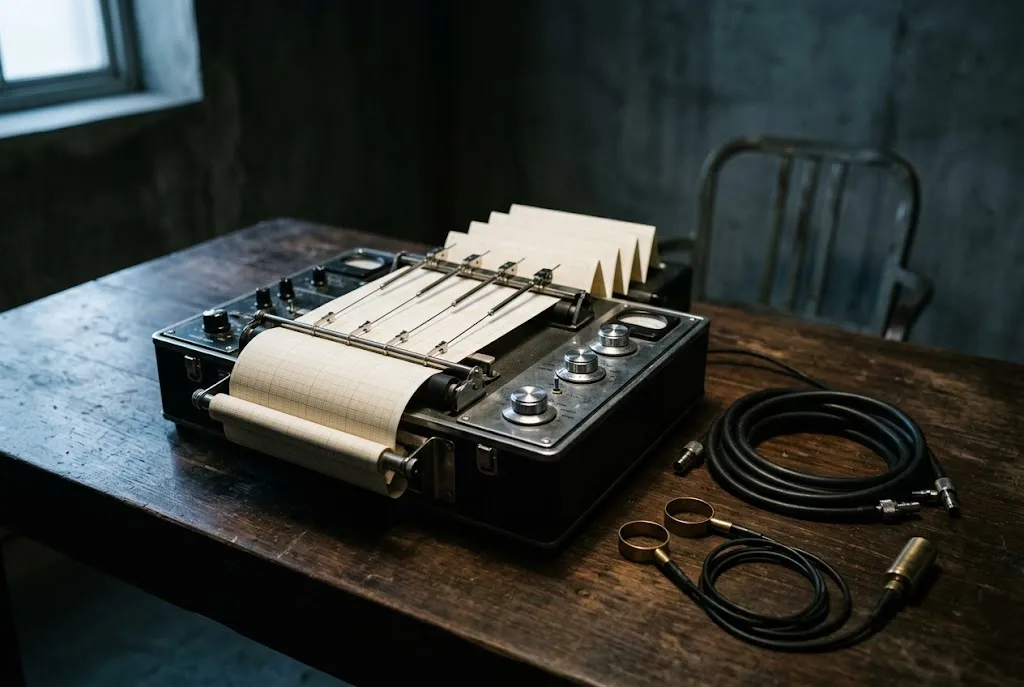
I spent years assuming that a polygraph (opens in a new tab) worked like a mechanical mind reader. You sit under the glare of a bare bulb, an interrogator straps rubber harnesses across your chest, clamps metal plates to your fingers, pumps up an arm cuff until your bicep aches, and the second a lie slips through your teeth, ink pens jerk violently across scrolling paper.
Hollywood loves that scene. It gives detectives a scientific sledgehammer.
Except the machine is not reading your thoughts. Not even close.
A lie detector cannot detect a lie. It has never detected one in its entire century of existence. What the machine actually tracks is the involuntary bodily panic triggered by your nervous system when an examiner puts you on the defensive. It is a biological voltmeter measuring distress, disguised as a truth-telling oracle. To understand why police still swear by it—and why scientists generally dismiss it—we need to strip away the interrogation drama and look straight at the transducers.
What the Sensors Are Actually Measuring
When you sit for a test, the examiner turns you into a living circuit board using four distinct physiological channels. None of them connect to the language centers of your brain.
First come the pneumograph tubes. These are two corrugated rubber bellows—one wrapped around your upper chest and another around your abdomen. Every time your lungs expand, the bellows stretch. That mechanical expansion shifts the air pressure inside the sealed rubber tube, which a digital transducer translates into a continuous breathing curve. When people feel acute stress, their breathing changes. They take shallower breaths or momentarily hold their air—a pattern forensic examiners call respiratory suppression.
Next are the finger clips. These two small metal plates measure galvanic skin response (opens in a new tab), or electrodermal activity. The machine passes an imperceptible micro-current of electricity between your index and ring fingers to measure electrical resistance. When emotional stress strikes, your brain stimulates microscopic eccrine sweat glands on your fingertips. More sweat means higher electrical conductivity. Those brass finger plates measure electrodermal activity across the ridged papillary dermis, the exact biological layer evaluated by biometric fingerprint scanners.
Then comes the cardiosphygmograph—the familiar blood pressure cuff wrapped around your bicep. The examiner inflates it to roughly 60 to 90 millimeters of mercury, keeping it continuously pressurized throughout questioning. It does not measure absolute blood pressure the way a doctor does. Instead, it tracks relative fluctuations in blood volume and pulse wave amplitude as your heart hammers against the resistance of the cuff.
Finally, modern computerized polygraphs clip a photoplethysmograph sensor onto your fingertip, using the identical infrared light-absorption principles that smartwatches use to track your heart rate.
The Biological Flaw: Fear Is Not a Deception Marker
The entire theoretical foundation of the polygraph rests on a single biological assumption: lying triggers an involuntary burst of the sympathetic nervous system.
When your brain perceives a threat, the hypothalamus signals your adrenal glands to release epinephrine and norepinephrine. Your bronchioles dilate, peripheral blood vessels constrict, heart contractions intensify, and sweat glands prime your skin for action. This is the classic fight-or-flight reflex.
Here lies the fatal problem. There is no unique "Pinocchio response" wired into human physiology.
Your sympathetic nervous system fires during deception, yes. But it fires with identical intensity during blind terror, confusion, anger, sexual arousal, or sheer embarrassment. If an examiner asks, "Did you steal the money from the company safe?" an innocent employee terrified of losing their career will experience the exact same surge of norepinephrine as a guilty thief calculating their odds of getting caught.
This is why your palms instantly turn clammy and your chest tightens when a patrol car rolls up behind you at a red light, even though you have done absolutely nothing wrong.
Your autonomic system reacts to perceived jeopardy, not moral culpability. The hardware cannot tell the difference between the terror of being framed and the guilt of being caught.
The Interrogation Theater: How Examiners Rig the Baseline
Because the hardware cannot isolate guilt, polygraphers rely on psychological choreography known as the Comparison Question Test (CQT). Without this protocol, the raw sensor tracings are meaningless squiggles.
The examiner starts by dividing their questions into three specific buckets:
- Irrelevant questions: Simple baseline queries designed to keep you calm ("Is your name David?" "Is today Tuesday?").
- Relevant questions: Direct accusations regarding the incident under investigation ("Did you take the envelope of cash off the counter?").
- Control questions: Deliberately broad, uncomfortable inquiries about past personal ethics ("Before age twenty-five, did you ever take something that did not belong to you?" or "Have you ever lied to someone in authority?").
The trick lives inside those control questions.
An examiner will look you in the eye during the pre-test interview and demand absolute honesty, implying that only a dishonest person would admit to having a history of deceit. In reality, almost every living person has told a lie or taken something petty. When you say "No" to the control question, the examiner assumes you are either lying or agonizing over past indiscretions.
The logic is surprisingly backward. The examiner expects an innocent person to produce a larger physiological spike on the control questions—because they know they did not commit the specific crime, yet they worry their broader moral history will brand them a liar. Meanwhile, a guilty subject is expected to panic primarily at the relevant question, dwarfing their reaction to the general moral inquiries.
And honestly, when you watch an experienced examiner calibrate this test, it feels less like objective laboratory measurement and more like psychological street theater. The machine acts as an amplifier for interrogation pressure.
Beating the Machine: The Mechanics of Countermeasures
Because polygraphs evaluate the ratio of stress between control questions and relevant questions, the machine has a glaring weakness.
You do not beat a polygraph by trying to stay calm. That rarely works.
You beat it by making yourself panic on purpose.
If you deliberately spike your heart rate and sweat production during the broad control questions, your bodily reaction to the relevant crime questions will appear smaller by comparison. To the scoring algorithm or the examiner's eye, a person whose control-question reaction dwarfs their crime-question reaction looks cleanly innocent.
Decades ago, suspects practiced physical countermeasures: hiding a thumb tack inside their shoe to step on it during control questions, or biting the side of their tongue. Pain triggers an immediate sympathetic spike. When modern testing facilities noticed this, manufacturers added motion-sensor seat pads to catch suspects clenching their gluteal muscles or curling their toes.
Mental countermeasures, however, leave no mechanical footprint. Silently counting backwards by sevens from a thousand, reciting dark memories, or doing rapid mental arithmetic during control questions produces the exact same spike in electrodermal activity and arterial pressure as physical pain. In testing trials, subjects trained in basic mental countermeasures beat polygraph scoring algorithms with alarming regularity.
Why the Courts Slammed the Door Shut
If lie detectors worked with scientific certainty, courts would use them to empty overcrowded dockets overnight. Instead, the legal system treats them as radioactive.
The defining moment arrived in 1998 with the Supreme Court ruling in United States v. Scheffer (opens in a new tab). Airman Edward Scheffer had passed a polygraph test after denying drug use, yet the military court barred the test from his trial. The Supreme Court upheld the exclusion 8–1, noting that there is simply no scientific consensus that polygraph examinations are reliable.
Five years later, the National Research Council (opens in a new tab) delivered the fatal blow. They reviewed nearly a century of polygraph data and concluded that when applied to civilian populations or general security screening, the test's accuracy is "far from high." Most damningly, they found that polygraphs produce an unacceptable volume of false positives—branding truthful, law-abiding citizens as deceptive because their autonomic systems simply ran hot.
Congress had already reached a similar verdict in 1988 when it passed the Employee Polygraph Protection Act (opens in a new tab). That federal law banned almost all private commercial employers from forcing job applicants to take lie detector tests.
The True Purpose of the Box
Why does the polygraph persist in intelligence agencies, federal hiring, and police interrogation rooms? Because as a psychological lever, it works wonders.
Suspects who believe the metal box can see inside their souls frequently break down and confess before the interrogation even concludes. In federal security clearances, the machine functions not as a definitive truth-teller, but as a confession funnel during the pre-test interview. People confess to espionage, drug habits, and unpaid debts simply because they dread the needles moving.
The hardware is real. The transducers are genuine medical tools. But the magic lie detector you watched in crime movies? That was always pure bluff.




Conversation0
No comments yet. Be the first to share a thought — the best questions often become new stories.