


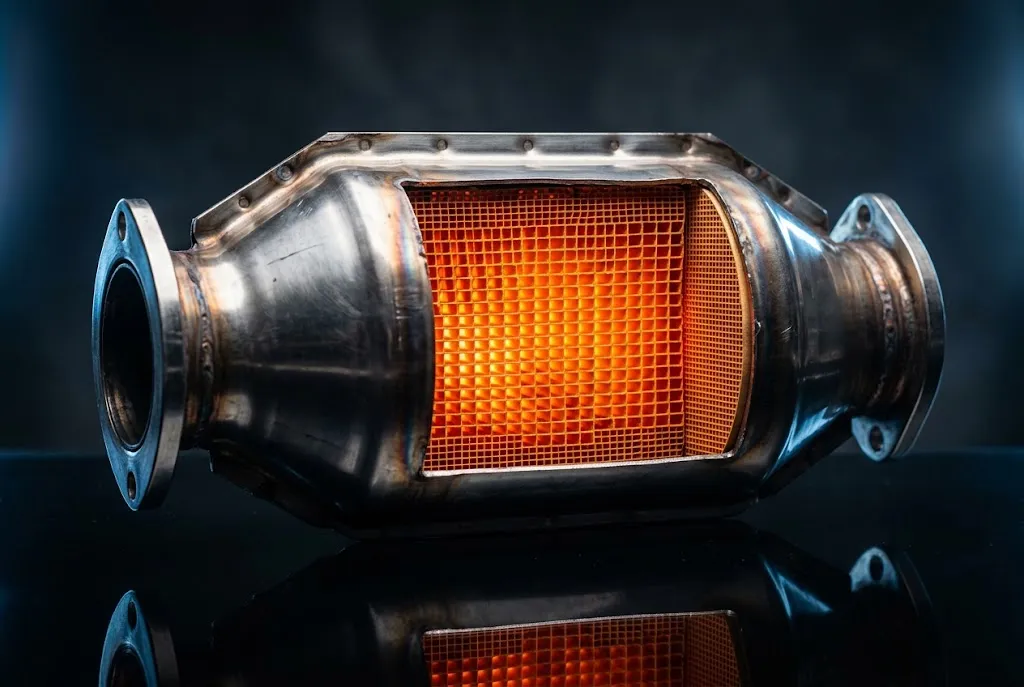
The Red-Hot Alchemy Under Your Floorboards
I used to think my car's exhaust pipe was just a dumb metal chimney dumping engine smoke into the morning air. Then I looked at what was happening directly beneath my feet. Inside that rusted, blistered steel bulge under the chassis sits an 800-degree chemical reactor that turns three distinct lethal gases into breathable air within a tenth of a second.
A tenth of a second.
Think about that speed. Every single minute your car idles at a stoplight, your engine's cylinders fire thousands of tiny, violent explosions. Gasoline meets air. Spark plugs ignite the mist. In an ideal universe, that combustion would produce only harmless carbon dioxide and clean water vapor. But real engines are messy.
They run too fast, get too hot, and swallow dirty air. The result is a toxic cocktail of unburnt fuel, choking carbon monoxide, and raw nitrogen oxides that would blanket every modern city in noxious smog within days if it vented straight out the back. Enter the catalytic converter (opens in a new tab), an emissions device mandated by the Environmental Protection Agency (opens in a new tab) that performs molecular surgery at highway speeds without a single moving part.
The Microscopic Honeycomb: A Football Field in a Can
If you cut open a catalytic converter with an angle grinder, you will not find a maze of filters or spinning turbines. You find a ceramic brick.
Specifically, it is an extruded monolith made of cordierite, a tough synthetic ceramic blend of magnesium, aluminum, and silicon chosen because it barely expands when scorched. Run your fingers over the face of the brick and it looks like a micro-grid of square channels. Standard automotive bricks pack roughly 400 to 600 tiny cells into every square inch of cross-section.
Exhaust gas rushing down the downpipe cannot afford to sit around waiting to be scrubbed. It screams through the canister at highway velocities. If the gas only rubbed against the smooth walls of the ceramic channels, over 95 percent of the pollutants would escape untouched. The contact time is simply too short.
Engineers solved this with an invisible layer called a washcoat. Manufacturers slurry aluminum oxide, cerium oxide, and zirconium oxide, then bake it directly onto the cordierite matrix. Under an electron microscope, that washcoat looks like a rugged mountain range full of cavernous craters and microscopic fissures.
By roughing up the surface at the nanoscale, the washcoat multiplies the internal surface area by several thousand times. That single, bread-loaf-sized ceramic brick suddenly possesses the total usable surface area of an entire football field. Pure surface area. Every passing gas molecule is forced to slam headfirst into an active catalytic site before it can reach the tailpipe.
The Two-Stage Gauntlet: Reduction Meets Oxidation
Surface area alone does not destroy poisons. For that, you need some of the rarest, most expensive elements on planet Earth: platinum, palladium, and rhodium (opens in a new tab). These precious metals are atomized and scattered across the washcoat in microscopic clusters.
A catalyst does not get consumed by a chemical reaction. Instead, it acts as a molecular matchmaker, lowering the energy barrier required for stubborn molecules to tear apart and recombine. In a modern "three-way" catalytic converter, that transformation happens in two successive stages.
Stage One: Stripping the Smog (The Reduction Catalyst)
The first section of the honeycomb handles nitrogen oxides, grouped chemically as NOx. When combustion temperatures spike above 1,300°C, atmospheric nitrogen bonds with oxygen to form nitric oxide (NO) and nitrogen dioxide (NO2). These are the caustic gases responsible for acid rain and respiratory damage.
The reduction catalyst uses a pairing of platinum and rhodium to fix this. When a molecule of NO strikes a rhodium atom, the rhodium holds the nitrogen atom tight while releasing the oxygen. The newly freed nitrogen atom sits on the catalyst surface until another nitrogen atom lands beside it. They snap together into harmless diatomic nitrogen gas (N2)—the very same gas that makes up 78 percent of our atmosphere—and float away.
Stage Two: Burning the Leftovers (The Oxidation Catalyst)
Immediately downstream sits the oxidation stage, coated with platinum and palladium. This zone targets the two remaining poisons: lethal carbon monoxide (CO) and raw, unburnt hydrocarbons (HC).
Here, the metals promote oxidation, burning the pollutants without an open flame. Carbon monoxide grabs a stray oxygen atom on the platinum surface to become carbon dioxide. Unburnt fuel hydrocarbons are ripped apart and joined with oxygen to yield carbon dioxide and harmless water vapor. This catalytic surface reaction works on the exact same chemical principle found in fuel cell breathalyzers, where platinum catalysts strip electrons from alcohol vapor to measure blood concentration.
The Stoichiometric Tightrope: Why Engines Dance at 14.7:1
And that creates a nasty paradox.
Think about what the two stages actually require. The reduction stage wants to strip oxygen away from nitrogen. It works best in an oxygen-starved environment. But the oxidation stage desperately needs oxygen to burn off carbon monoxide and raw fuel. How can both reactions happen simultaneously inside the very same pipe?
They cannot—unless the engine dances on a razor's edge.
Your car's engine control computer constantly fights to maintain an exact air-to-fuel ratio: 14.7 pounds of air for every 1 pound of gasoline. Engineers call this the stoichiometric ratio, or Lambda 1.0.
To keep that balance, an oxygen sensor (opens in a new tab) screwed into the exhaust manifold measures unburnt oxygen levels dozens of times per second. If the mixture runs lean (too much air), the oxidation stage thrives, but NOx reduction stops. If the mixture runs rich (too much fuel), NOx drops to zero, but unburnt hydrocarbons flood through unoxidized.
So the computer oscillates back and forth across the 14.7:1 line several times every second, creating micro-pulses of rich and lean exhaust. The cerium oxide in the washcoat acts like an oxygen sponge—storing oxygen during lean pulses and releasing it during rich pulses to keep both catalysts working simultaneously.
This is why your car smells faintly like rotten eggs when you floor the accelerator up a steep hill. Under heavy throttle, the computer deliberately enriches the fuel mixture to protect the engine from knocking. The converter runs out of stored oxygen, and trace sulfur compounds in the gasoline exit as foul hydrogen sulfide gas instead of odorless sulfur dioxide.
The 800-Degree Inferno: Cold Starts and Meltdowns
A catalytic converter is useless when it is cold.
Until the ceramic core reaches its "light-off" temperature—typically between 400°C and 800°C—the precious metals lack the thermal energy to kickstart the reactions. During the first two minutes after you start your car in the morning, the catalytic converter does almost nothing. In fact, over 70 percent of all pollutants emitted during an average commute escape during those first 120 seconds.
Modern cars use late ignition timing and secondary air injection pumps solely to torch the exhaust pipe and force the converter up to 600°C as quickly as possible. The internal temperatures inside that small canister often match the operating limits found in turbofan jet engine turbines, requiring heavy stainless steel heat shields to prevent the unit from setting your carpet or dry grass on fire.
Thermal stress is normal. Raw fuel is fatal.
If a spark plug fails or an ignition coil dies, unburnt liquid gasoline dumps directly into the red-hot ceramic honeycomb. It ignites inside the cells. Temperatures spike past 1,200°C within seconds. Cordierite ceramic melts into a solid, glassy slag, plugging the exhaust pipe completely and choking the engine to death.
Why Thieves Target That Rusted Cylinder
There is a reason thieves slide under parked SUVs with battery-powered saws in broad daylight (and honestly, the first time I checked the replacement bill for an OEM converter, I nearly choked on my coffee).
Inside that modest steel housing sits roughly 3 to 7 grams of platinum-group metals. While platinum and palladium are valuable, rhodium is the real prize. Rhodium is an ultra-rare byproduct of nickel and platinum mining, often trading at over 10,000 per troy ounce due to volatile industrial supply.
There is no cheap substitute. Base metals like copper or nickel oxidize and degrade within hours in an 800-degree sulfuric exhaust stream. Only the noble metals can survive millions of thermal cycles without breaking down.
Next time you hear that quiet, rhythmic exhaust hum from beneath your car, remember the invisible alchemy happening underneath. A football field of ceramic nano-pores, glowing red-hot in the dark, tearing lethal poisons apart before they ever reach the air you breathe.




Conversation0
No comments yet. Be the first to share a thought — the best questions often become new stories.