


The Hollywood Nightmare and the Steel Wire Reality
I stepped into an express elevator on the ground floor of a 50-story high-rise recently, and as the steel doors glided shut with a heavy mechanical click, a woman next to me quietly took a deep breath and grabbed the handrail. Her knuckles went white. She wasn't terrified of enclosed spaces. She was staring at the floor numbers ticking up on the digital display, visibly wondering what stood between us and a terrifying, terminal plunge into the basement.
Blame action movies for this specific phobia. Cinema loves severed cables. A villain cuts a bundle of wires with a blowtorch, sparks shower across the shaft, the cab shudders, and seconds later the passengers are screaming in zero gravity as the elevator turns into a falling missile.
Here is the reality: that scene is pure fantasy. It violates nearly every law of elevator design.
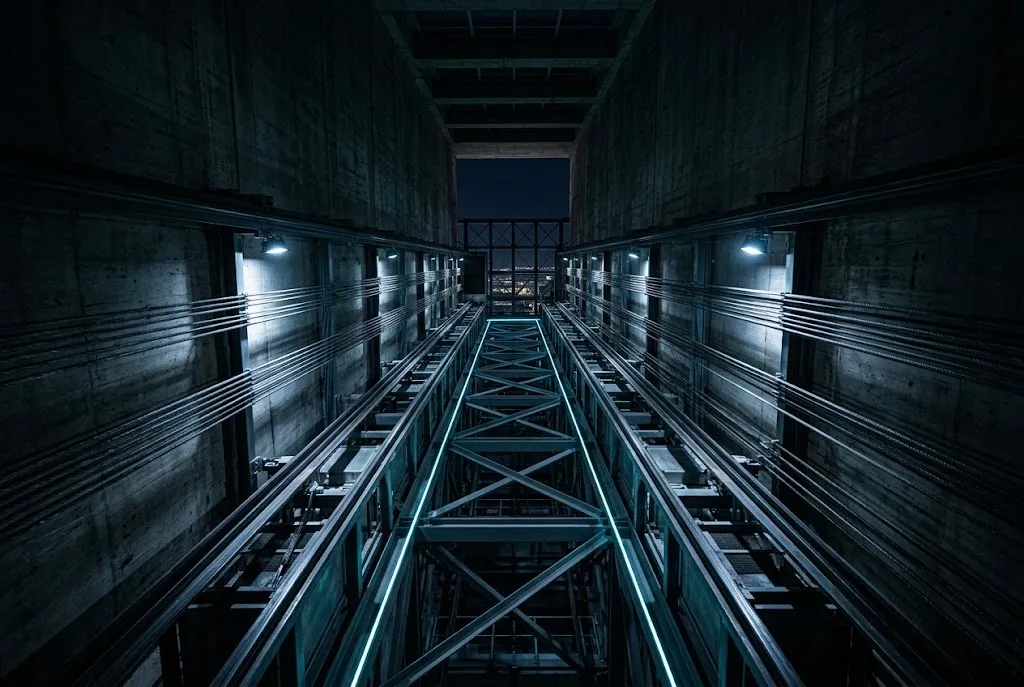
In a modern traction elevator, the cab is not dangling from a single wire. It hangs from between four and eight independent, high-tensile steel cables woven from aircraft-grade alloy. Each individual cable is thick enough to suspend the entire weight of a fully packed elevator cab on its own, maintaining an engineering safety factor of at least ten to one under standard building codes. To trigger a free-fall through cable breakage, all eight steel ropes would have to shear simultaneously at the exact same fraction of a millisecond. That simply does not happen during normal operation.
The Counterweight Secret: Why Elevators Want to Fall Up
There is a second reason a free fall is virtually impossible that almost nobody talks about: elevators rarely want to fall down in the first place.
A passenger cab does not operate like a bucket in a well. It connects across a giant grooved drive sheave at the top of the shaft to a massive steel block called a counterweight. That counterweight is deliberately weighed to equal the exact mass of the empty elevator cab plus roughly 40 to 50 percent of its maximum passenger capacity.
Do the math on that for a second. If you get into an elevator with two other people, the counterweight hanging on the other side of the cable loop is significantly heavier than the cab you are standing in. If the hoist motor suddenly lost all power and the primary motor brake completely disintegrated, the cab would not plummet toward the earth.
It would shoot upward.
The heavier counterweight would plunge downward into the pit, dragging your passenger compartment up toward the roof of the tower. This is why you feel that subtle, sinking stomach drop when an express elevator begins descending: your mass is lagging behind the hoist motor as it works to overcome the counterweight's gravitational pull, not slipping down the shaft.
Building engineers knew decades ago that gravity alone wasn't enough to guarantee safety. What happens if the cables snap, or if a loaded cab carrying three tons of passengers starts accelerating downward out of control? That is where an entirely separate, purely mechanical system takes over.
The 1853 Crystal Palace Stunt That Changed Architecture
Before 1853, people avoided freight elevators like the plague. If a rope frayed and snapped, the wooden platform crashed into the dirt, killing workers and smashing cargo. That terrifying reputation kept cities short. Nobody wanted to build a ten-story building if it meant climbing nine flights of stairs on foot.
An American inventor named Elisha Otis (opens in a new tab) decided to fix that problem with a theatrical demonstration that borders on lunatic confidence.
At the 1853 New York World's Fair inside the Crystal Palace, Otis had himself hoisted three stories into the air on an open platform. He wore a top hat and stood calmly beside boxes and barrels. Once the platform reached peak height above a gasping crowd, he ordered an assistant to step forward with a broadaxe and chop the primary hoisting rope clean in half.
The crowd screamed. The rope parted with a whip-like crack.
The platform dropped by about two inches. Then it snapped to an immediate, dead stop.
Otis had fitted his platform with a tough wagon spring held under tension by the weight of the pulling hoist rope. The second the rope snapped, that tension vanished. The spring instantly bowed outward, driving hardened steel pawls into notched ratchets built directly into the vertical guide rails along the shaft walls. Gravity attempted to pull the cab down, but the cab's own weight forced the teeth deeper into the ratchets.
He tipped his hat to the stunned spectators and delivered one of the most famous taglines in engineering history: "All safe, gentlemen. All safe." Modern skyscrapers were born in that exact second.
How the Overspeed Governor Weaponizes Centrifugal Force
Modern elevators do not use wagon springs and notched ratchets anymore, but they rely on the exact same philosophical principle: passive mechanical autonomy. When total catastrophe occurs, you never depend on microchips, optical sensors, or building electricity. You rely on cold, unyielding physics.
Elevators belong to the same stubborn philosophy of engineering as mechanical fire sprinkler systems: no matter how advanced software gets, the ultimate failsafe must function even if the building has lost all power.
Today, the system begins with an independent device called a centrifugal governor (opens in a new tab), positioned inside the machine room at the top of the shaft.
The governor is connected to its own dedicated steel cable—a rope that does not carry the weight of the cab. Instead, this cable forms a continuous loop anchored to the elevator frame, running around the governor wheel at the ceiling and looping through a heavy tensioning pulley in the pit floor. As the elevator moves up and down, that loop turns the governor wheel at the exact velocity of the cab.
Inside the governor wheel, two weighted metal flyweights spin against calibrated steel springs.
As long as the elevator travels at its rated operating speed, the springs hold the flyweights inward. But if the cab ever exceeds safe speed—typically calibrated to trip at 115% to 125% of maximum rated speed under the ASME A17.1 elevator safety code (opens in a new tab)—centrifugal force overpowers the springs. The flyweights fling outward, catching a mechanical stop.
Instantly, heavy steel clamping jaws inside the governor snap shut, clamping the governor cable with immense force. The wheel stops dead. The cable freezes.
Wedge Safeties: How Gravity Becomes Its Own Brake
Remember: the elevator cab is still moving downward, but the governor cable is now locked in place.
Because the governor cable attaches to a pivoting safety lever on the elevator carriage, the downward momentum of the falling car pulls that lever upward. That single mechanical pull yanks a heavy linkage rod running beneath the floor of the cab, triggering the "safeties"—massive, forged-steel brake shoes mounted inside the carriage frame on either side of the vertical guide rails.
These safeties are ingenious tapered wedges.
As the linkage trips, hardened steel wedges slide upward into angled housings flanking the T-shaped guide rails. Because the channel narrows toward the top, the downward motion of the cab forces the wedges tighter and tighter against the steel rails.
The heavier the cab and the faster it tries to fall, the harder those wedges bite into the solid steel tracks. Much like how anti-lock brakes manage friction to prevent car tires from skidding out of control, modern progressive safeties do not slam you to an instantaneous halt that would snap human necks. Instead, flexible spring-loaded clamps allow a controlled, progressive deceleration, absorbing immense kinetic energy over a distance of a few feet.
It takes zero electricity. No batteries. No human intervention. The very kinetic energy of the runaway cab provides the force required to crush the brake shoes against the structural spine of the building.
There is also a massive steel buffer resting at the very bottom of the shaft pit. In low-rise buildings, these are heavy coil springs; in tall skyscrapers, they are heavy-duty telescoping hydraulic oil pistons designed to cushion any terminal overshoot at survivable deceleration levels.
Why Jumping at the Last Second Is a Physics Delusion
Every few months, someone online revives the old playground myth: "If an elevator ever falls, can you just jump up at the exact second it hits the floor to survive?"
Not a chance.
First, consider the vector math. If an elevator were in true free-fall from the 30th floor, it would hit the ground traveling at around 50 miles per hour (roughly 22 meters per second). The greatest vertical jump an elite human athlete can produce is maybe 7 or 8 miles per hour (around 3 meters per second) relative to the platform they push off of.
Do the subtraction. If you leap upward at 8 miles per hour while the floor under you is dropping at 50 miles per hour, your net velocity toward the concrete foundation is still 42 miles per hour. You are not floating; you are still hitting the floor with lethal force.
Second, in genuine free-fall, there is effectively zero normal force between your shoes and the elevator floor. You have nothing solid to push against. If you bend your knees and shove, you will simply push your head into the ceiling of the cab.
Emergency trauma experts recommend an entirely different, counter-intuitive move if an elevator ever experiences a catastrophic hard stop: lie flat on your back on the floor, ideally in the center of the cab, and protect your head with your arms. Spreading your surface area distributes the sudden deceleration forces across your entire skeletal frame rather than concentrating the blow on your leg bones and spine.
(And honestly, the first time I learned that detail, I spent my next three elevator rides glancing nervously at the floor carpet, calculating how awkward it would be to explain why I was lying down flat to a cab full of strangers).
Real elevator accidents almost never involve falling cabs. The rare injuries that do happen are mundane: tripping over an unlevel threshold as doors open, or maintenance workers caught in machinery during repairs. As far as the car itself is concerned, the system is an impenetrable fortress of mechanical redundancy. Between multi-rope tensile ratings, counterweight balances, centrifugal governors, and self-locking wedge safeties, an elevator remains statistically the safest vehicle in the world.



Conversation0
No comments yet. Be the first to share a thought — the best questions often become new stories.