



The Asphalt Scars: Why Red Lights Aren't Weight Scales
I was idling at an empty suburban crossroads at two in the morning. Not a car in sight. Miles of desolate asphalt stretched in every direction, accompanied only by the faint hum of sodium-vapor streetlights and a stubborn red bulb that refused to switch.
Nothing moved. After three full minutes of staring through the windshield, I did what almost every frustrated driver eventually does: I inched forward three inches. Then another foot. I thought I was trying to land my tires squarely on a pressure plate hidden beneath the pavement.
It did not change. Turns out, I was aiming at the wrong physics entirely.
Millions of drivers assume traffic lights operate on giant underground scales. The logic feels intuitive: cars are heavy, asphalt is rigid, so highway engineers must bury massive mechanical switches that register two tons of rolling steel. But road surfaces flex under temperature swings, freeze-thaw cycles crack concrete, and mechanical scales would break within six months under heavy semi-truck traffic.
Next time you roll up to an intersection, look down at the lane right in front of the white stop bar. You will spot thin, deliberate geometric grooves cut directly into the roadway, sealed over with thick rubbery black tar. They form rectangles, octagons, or elongated diamonds.
Those scars are not expansion joints or sloppy utility patches. They are the physical housing for traffic sensors, and they do not care about your vehicle's weight at all.
Inside the Inductive Loop: How Coils Sense Steel
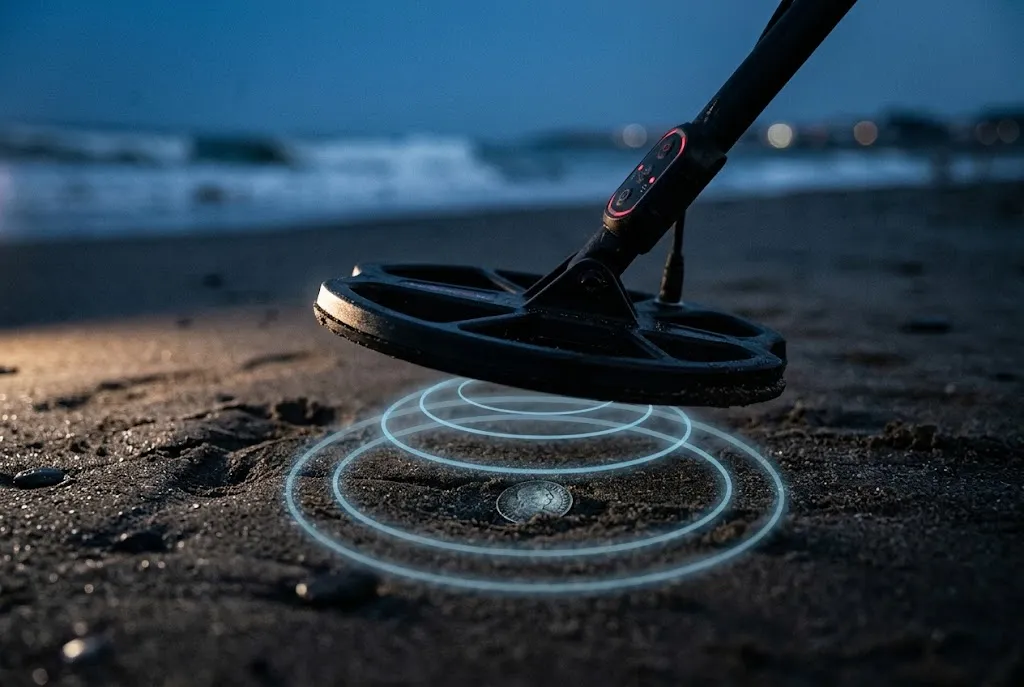
To understand how do traffic lights detect cars, you have to look past mechanical triggers and step into the physics of electromagnetic induction (opens in a new tab). The most common vehicle detection system on the planet is the inductive loop, a deceptively simple device that turns an entire traffic lane into a massive metal detector.
Road crews carve narrow slots roughly two to four inches deep into the asphalt using a diamond-bladed concrete saw. Inside those trenches, technicians wind several continuous turns of insulated copper wire—typically 12 to 14 gauge—into a large perimeter loop. Once the wire is laid, they seal the trench with polyurethane or hot-pour asphalt mastic to shield the wiring from moisture, road salt, and grinding tires.
Those copper lead-in cables run through underground conduits straight to the silver aluminum traffic controller cabinet bolted to the sidewalk nearby. Inside that cabinet sits an electronic amplifier connected to a capacitor, which mates with the buried copper loop to form a tuned electrical circuit known as an LC oscillator.
The roadside cabinet pumps a low-voltage alternating electrical current through the underground coil, oscillating anywhere from 10 to 50 kilohertz. As alternating current cycles through the copper windings, it generates an invisible, pulsating magnetic field that blossoms upward through the asphalt, extending roughly two to three feet into the open air above the driving lane.
By itself, that magnetic field just hums along at a stable, predetermined resonant frequency. But the moment a vehicle enters that field, the balance breaks.
Eddy Currents and Frequency Shifts: The Invisible Physics
Most people assume a car triggers an induction loop (opens in a new tab) because the steel body acts like an iron core in an electromagnet, pulling the magnetic field tighter. While iron does have high magnetic permeability, that is actually the weaker of two competing physical phenomena at play.
The primary mechanism is far more elegant: eddy currents.
When a large conductor—like the sheet metal floor pan, engine block, transmission housing, and steel frame of an automobile—enters an alternating magnetic field, the shifting field lines slice through the metal. According to Faraday's law, this moving magnetic field forces free electrons inside the car's metallic undercarriage to swirl in closed circular paths. These circular electrical loops are eddy currents (opens in a new tab).
Here is where Heinrich Lenz's law enters the equation. Those swirling eddy currents produce an opposing magnetic field of their own. This secondary field pushes back against the coil's primary field, weakening the total magnetic flux density surrounding the underground wire loop.
Because the net magnetic field weakens, the overall electrical inductance of the buried loop suddenly drops. Inductance is simply a coil's ability to store energy in a magnetic field; when eddy currents fight that field, the loop's inductance decreases by anywhere from 0.1% to 3%.
Now remember that tuned LC oscillator sitting in the roadside cabinet. The resonant frequency of that circuit is governed by a strict mathematical relationship:
Where is the loop inductance and is the internal capacitance. When a vehicle's metal underbody forces the inductance () downward, the resonant frequency () instantly spikes upward.
The detector card inside the roadside cabinet monitors this frequency thousands of times per second. When it spots a sudden upward phase shift that exceeds a programmed threshold, it registers a presence call, closing a solid-state relay that alerts the signal phase controller: car waiting in lane two.
This high-frequency magnetic interaction shares fundamental physics with how induction cooktops generate heat, and it relies on magnetic sensing principles closely related to the wheel speed monitors inside anti-lock braking systems.
This is why stopping three feet past the white stop line leaves you stranded until another car pulls up behind you. If your chassis rolls beyond the perimeter of those buried wire turns, the eddy currents collapse, the resonant frequency drops back to baseline, and the computer decides your car simply drove away.
Why Motorcycles Get Trapped (And the Magnet Myth)
If you ride a motorcycle, scooter, or lightweight commuter bicycle, you have almost certainly lived through the nightmare of the immortal red light. You pull up to a deserted junction, wait patiently through three light cycles, and realize the signal simply cannot see you.
Bikers often curse the city for installing a faulty sensor. But the hardware is working exactly as designed.
A motorcycle simply does not present enough contiguous surface area. Because a motorcycle frame is narrow, its wheels are spoked, and its engine sits several inches higher off the ground, the magnetic field lines struggle to intersect enough contiguous metal to induce substantial eddy currents. The resulting frequency shift falls beneath the detector's sensitivity cut-off, leaving the controller blind to your presence.
This frustration birthed a persistent urban myth: the kickstand neodymium magnet. For years, motorcycle forums have advised riders to glue powerful rare-earth magnets to the bottom of their frame or kickstand, claiming the static magnetic field will force the road sensor to trip.
It does not work. (And honestly, the first time a rider showed me their glued-on neodymium puck with absolute confidence, I had to suppress a sympathetic grimace).
Inductive road loops do not measure static magnetic attraction. They do not have magnetic reed switches buried in the tar. They operate strictly on high-frequency alternating current inductance shifts driven by conductive surface area. A tiny, static permanent magnet does virtually nothing to alter the high-frequency inductance of a ten-foot copper loop.
What actually helps? Stopping your motorcycle directly along the cut lines of the perimeter saw cuts rather than in the dead center of the box. The magnetic field strength of an inductive loop is concentrated right above the physical copper turns, meaning your rims and chain will generate the strongest possible eddy current response when aligned directly over the wire.
Overhead Eyes: Radar, Video Cameras, and Thermal Sensors
While inductive loops remain the backbone of global traffic management, cities are increasingly looking up instead of down. Digging trenches into asphalt is expensive, disrupting traffic for hours, and winter snowplows or road resurfacing projects routinely tear buried cables apart.
If you scan the horizontal mast arms holding up traffic signals today, you will often spot small cylindrical cameras or white plastic wedges aimed down at the road. These represent the modern wave of above-ground vehicle detection.
One dominant technology is microwave radar. Mounted ten to twenty feet above the pavement, these radar units sweep the approach lanes with narrow radio beams. By tracking microwave frequency shifts, they measure the presence, distance, and approach speed of vehicles—operating on the exact same Doppler radar physics that power police radar speed guns.
Unlike underground loops, a single overhead radar unit can track multiple lanes simultaneously and adjust detection zones via software without anyone picking up a concrete saw.
Other intersections rely on video image processing. Optical cameras stream real-time footage to a processor inside the cabinet, where computer vision algorithms monitor user-defined bounding boxes on the video feed. When pixels inside a designated lane area change contrast and shape in patterns characteristic of a vehicle silhouette, the software registers a vehicle presence.
Yet optical cameras have an obvious weakness. Heavy blizzards, dense sea fog, blinding headlight glare, and shifting tree shadows can confuse the contrast algorithms. To solve this, transportation departments increasingly deploy thermal cameras that ignore visual lighting entirely, detecting the heat blooms of automobile tires, exhaust manifolds, and warm engines against cool pavement.
Do Flashing High Beams Trigger Red Lights?
Alongside the kickstand magnet myth sits an even more pervasive piece of folklore: flashing your high beams at a red light will force it to turn green immediately.
Generations of drivers swear by this trick. They believe traffic lights are fitted with optical sensors calibrated to detect emergency vehicles, and that flicking your brights rapidly mimics an approaching ambulance.
It is entirely false.
Traffic intersections frequently feature traffic signal preemption (opens in a new tab) hardware, but the system is far more sophisticated than a simple photocell looking for flickering headlights. The most common optical system, known commercially as Opticom, uses an infrared and visible strobe emitter mounted on fire engines, ambulances, and police cruisers.
This transmitter flashes at an exact, crystal-controlled frequency—typically 14.035 pulses per second for high-priority emergency vehicles, and 10 pulses per second for secondary transit vehicles like city buses. Above the intersection, a small receiver equipped with an optical bandpass filter monitors incoming light.
If the receiver does not detect a strobe flashing at that exact coded pulse repetition rate, it discards the light entirely. Flicking your high beams twice with your hand does nothing. You are simply exercising your index finger.
The Changing Intersection
The next time you brake at a deserted crossroads, take a closer look at the street beneath you and the hardware overhead. You are not waiting on a mechanical pressure plate, and no city worker is watching you through an observation lens.
You are sitting inside a resonant electrical circuit. Your car is creating a localized magnetic disturbance in an underground LC oscillator, generating eddy currents that shift electrical oscillations by a few fractions of a percent so a microchip can calculate your arrival. It is a quiet, invisible piece of physics that millions of us participate in every single day without ever realizing it.

Conversation0
No comments yet. Be the first to share a thought — the best questions often become new stories.