


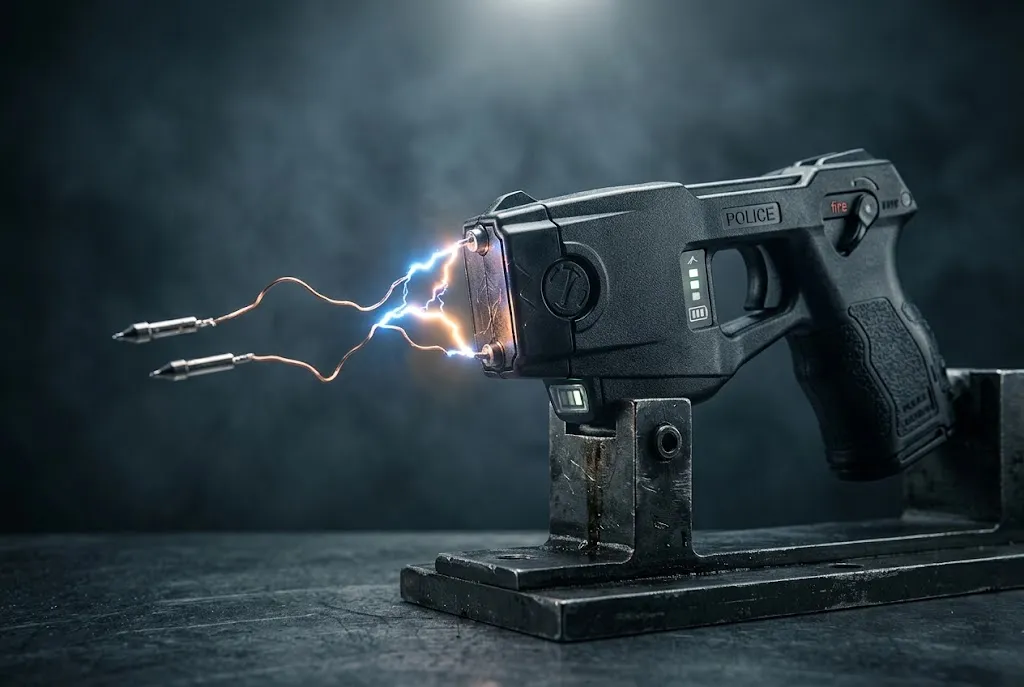
The 50,000-Volt Illusion: Why It Doesn't Fry You
I once watched a police training demonstration where a 240-pound instructor volunteered to take a hit from a Taser (opens in a new tab). He stood braced, chest puffed out, ready to fight through the pain. The trigger clicked. In less than a tenth of a second, his entire body went rigid as an oak plank, and he collapsed face-first onto a foam mat. No struggle. No dramatic stumbling. Just total, unceremonious gravity at work.
Most people look at the spec sheet for a conducted energy weapon and panic at the numbers. Fifty thousand volts. That sounds like an electric chair in a yellow plastic holster.
So why doesn't it kill you?
The short answer is that voltage does not kill people. Current does.
To understand why a target drops instantly yet walks away with little more than two tiny puncture marks, you have to separate electrical pressure from electrical volume. That massive 50,000-volt figure you see on technical brochures is an open-circuit peak. It exists for barely a microsecond, serving one specific mechanical purpose: it ionizes the air between the dart and your skin.
Think of it like static electricity. When you shuffle your wool socks across a living room carpet and touch a metal doorknob, the spark leaping from your fingertip easily carries 20,000 to 30,000 volts. You jump, sure. But your heart does not stop. The voltage is simply the push needed to punch through the insulation of your clothing and create a conductive plasma bridge.
Once those dart probes establish an electrical connection, that 50,000-volt wall drops off a cliff. Inside the human body, the operating voltage plunges to roughly 1,200 to 1,400 volts.
Voltage Is Pressure, but Amperage Does the Damage
Electricity follows the exact physics of plumbing. Voltage is water pressure inside the pipe; amperage is the actual volume of water rushing out of the nozzle.
A fire hose blasting water at 100 pounds per square inch will knock you down because it delivers hundreds of gallons per minute. A pressure washer operating at 3,000 pounds per square inch delivers only a tiny trickle. It stings your skin, but it will not sweep your car down the street.
A typical household wall outlet pushes around 120 volts, but it can dump 15 to 20 amps of current into anything that touches it. If you grab an exposed wire in your basement, that continuous flow of electrical current (opens in a new tab) can easily throw your heart into fatal spasms.
A Taser does the exact opposite. While the initial pulse operates at high voltage to breach thick denim or leather jackets, the actual delivered current is roughly 2 to 3.6 milliamperes. That is 0.002 to 0.0036 amps.
It takes roughly 100 to 200 milliamps crossing the human chest cavity to trigger lethal ventricular fibrillation—a mechanic we explored in detail when looking at how defibrillators reset an arrhythmic heart. By delivering less than a thirtieth of that lethal threshold, the weapon delivers intense neuromuscular shock without cooking tissue or stopping your cardiac cycle.
The Nitrogen Launch: Ballistics of the Trailing Wires
Movies always get the firing mechanism wrong. Hollywood sound designers love adding a loud gunpowder bang or a sci-fi laser hum. In reality, firing a conducted energy weapon sounds like popping the cap off a high-pressure soda bottle.
Behind the twin dart cartridge sits a small capsule of compressed nitrogen gas pressurized to roughly 2,200 psi. Pulling the trigger drives a mechanical firing pin into the puncture disk of the cylinder. The escaping gas expands violently into two parallel launch bores, driving the dart assemblies out of the muzzle at roughly 160 to 180 feet per second.
Each dart trails an ultra-thin, enamel-insulated copper wire that spools out from inside the cartridge casing.
And here is the engineering trick: the two darts do not fly parallel to one another.
If both darts hit an attacker two inches apart, the weapon is practically useless. To incapacitate someone, the electrical circuit needs to cross a large volume of skeletal muscle. So, manufacturers angle the lower barrel downward—typically by 8 degrees on older cartridges, or using specialized multi-angle spreads on modern systems like the TASER 7. For every seven feet the darts travel through the air, the spread between the top and bottom probe widens by about one foot.
Pain Compliance vs. Neuromuscular Incapacitation
There is a massive mechanical distinction between a cheap pocket stun gun and a police-grade conducted energy weapon. People mix them up constantly.
A handheld stun gun relies entirely on pain compliance. You press two fixed metal prongs against an assailant's ribs and hold the button. It burns, it pops loudly, and it causes localized muscle soreness. But an attacker high on PCP, saturated with adrenaline, or determined to hurt you can simply grit their teeth, ignore the agony, and wrestle the device out of your hands.
Conducted energy weapons do not care about pain tolerance. They rely on a biophysical phenomenon called neuromuscular incapacitation (opens in a new tab), or NMI.
| Device Type | Mechanism | Target Effect | Average Delivered Current |
|---|---|---|---|
| Handheld Stun Gun | Localized sensory shock | Pain compliance only | 1 to 4 milliamps |
| TASER / CEW | Remote motor nerve capture | Involuntary tetanic lockup | 2 to 3.6 milliamps |
| Standard AC Wall Outlet | Continuous 60Hz alternating flow | Severe thermal burns & cardiac arrest | 15,000 to 20,000 milliamps |
When the top dart catches you in the shoulder and the bottom dart hits your thigh, the electrical circuit does not just sit in the skin. It routes directly through the deep tissue and peripheral nervous system.
Hijacking the Wiring: How 19 Pulses Per Second Freeze Your Skeleton
Your brain controls your body using microscopic electrical pulses. When you decide to bend your elbow, your motor cortex fires an action potential down the spinal cord, across peripheral motor nerves, and into the biceps. The signal commands the muscle fibers to contract.
A conducted energy weapon works like an aggressive signal jammer.
The onboard microprocessor inside the handle pulses current at roughly 19 to 22 pulses per second (Hz). That specific frequency is not arbitrary. It happens to match the natural operational frequency of human alpha motor neurons.
The incoming electrical wave completely drowns out the brain's voluntary commands. It floods the motor nerve pathways with synthetic signals, ordering every muscle fiber caught in the electrical field to contract at absolute maximum force. The physiological term for this is tetanic contraction.
Every opposing muscle group locks simultaneously. Your quadriceps fight your hamstrings; your bicep pulls violently against your tricep.
This is why an assailant cannot simply 'fight through' a good Taser hit using willpower or anger: the signal completely bypasses conscious decision-making and commands the skeletal muscles to clamp shut at the biological level.
Your legs do not buckle because you are scared or hurt. They buckle because your knees are physically prevented from unbending.
Shaped Pulse Technology: How Modern Cartridges Save Battery and Skin
Early electroshock devices were notoriously inefficient. They threw chaotic spark bursts that drained internal batteries quickly and caused significant superficial burns on target skin.
Modern systems solve this with what engineers call "shaped pulse" technology (and honestly, the first time I saw the electrical breakdown of a shaped pulse cycle, I had to double-check the timing numbers). Instead of outputting a continuous buzz, the weapon breaks each individual pulse into two distinct sub-phases:
- The Arc Phase: A rapid, nanosecond-fast spike at extremely high voltage (~50,000 V) whose sole purpose is to ionize an electrical path through clothing layers.
- The Sustain Phase: The instant the arc establishes a circuit, the system downshifts into a low-voltage, continuous wave (~1,200 V) that pours roughly 100 microcoulombs of electric charge straight into the target's motor pathways.
By splitting the pulse, the device wastes almost zero energy on unnecessary thermal dissipation. The clothing gets bypassed in the blink of an eye, and the muscle tissue receives the exact dosage required to maintain complete lockup without melting cell membranes.
The Cardiac Question: Can It Stop a Human Heart?
If a Taser can seize every skeletal muscle in your back, why doesn't it seize the heart muscle?
The answer lies in cellular biology and geometry.
First, cardiac muscle behaves differently than skeletal muscle. Your heart's contractions are governed by its own internal pacemaker cells—the sinoatrial node—which fire at their own rhythmic threshold. Skeletal motor nerves are far more sensitive to external electrical stimulation than the deep, muscular walls of the human myocardium.
Second, probe distance matters enormously. For the electric field to penetrate the chest wall deeply enough to trigger ventricular capture, the darts must land unusually close to the cardiac silhouette. Much like how modern synthetic fibers absorb kinetic force in ballistic body armor design, human fat, skeletal rib cages, and intercostal muscle layers disperse and dilute electrical current before it reaches deeper internal organs.
Still, the risk is not completely zero. If an upper dart strikes the chest directly over the sternum with the bottom dart below the heart, the risk of inducing an arrhythmia rises slightly. That is precisely why modern tactical training doctrine instructs officers to aim for the lower torso, the back, or the legs rather than center-mass chest targets.
From Tom Swift to Modern Defense
The entire weapon owes its existence to an obsessive reader of early 20th-century juvenile adventure fiction. In the late 1960s, a NASA physicist named Jack Cover (opens in a new tab) began tinkering with non-lethal weapons in response to a string of violent skyjackings and civil disturbances.
Cover wanted a device that could stop an armed suspect on an airplane without puncturing the pressurized aluminum fuselage. He drew inspiration from his favorite childhood book series, Tom Swift and His Electric Rifle, published in 1911.
When Cover patented his prototype in 1974, he named it after the book: Thomas A. Swift's Electric Rifle. The acronym stuck.
It took decades for material science, lithium battery chemistry, and micro-circuitry to catch up with Cover's original vision. Today's devices are miniature computers capable of logging electrical output in real time, firing independently targeted darts, and cycling high-frequency electrical pulses with microsecond precision.
The next time you see someone freeze and collapse from a conducted energy hit, remember what you are watching. It is not raw brute voltage cooking someone from the inside out. It is a precise, calculated hijacking of the human nervous system—using just enough electrical pressure to knock the brain off the steering wheel.



Conversation0
No comments yet. Be the first to share a thought — the best questions often become new stories.