


The Ghost Orbit at the Edge of Darkness
When flight engineers announced that the James Webb Space Telescope would orbit a patch of silent, empty vacuum roughly one million miles away from Earth, I assumed someone had misspoken. Or made a bad joke.
Every orbit we learn about in grade school requires an anchor. The Moon circles Earth because Earth’s gravitational mass bends spacetime around it. Earth circles the Sun for the exact same reason. Take away the central mass, and the orbit dissolves. An object in motion should simply fly off in a straight line.
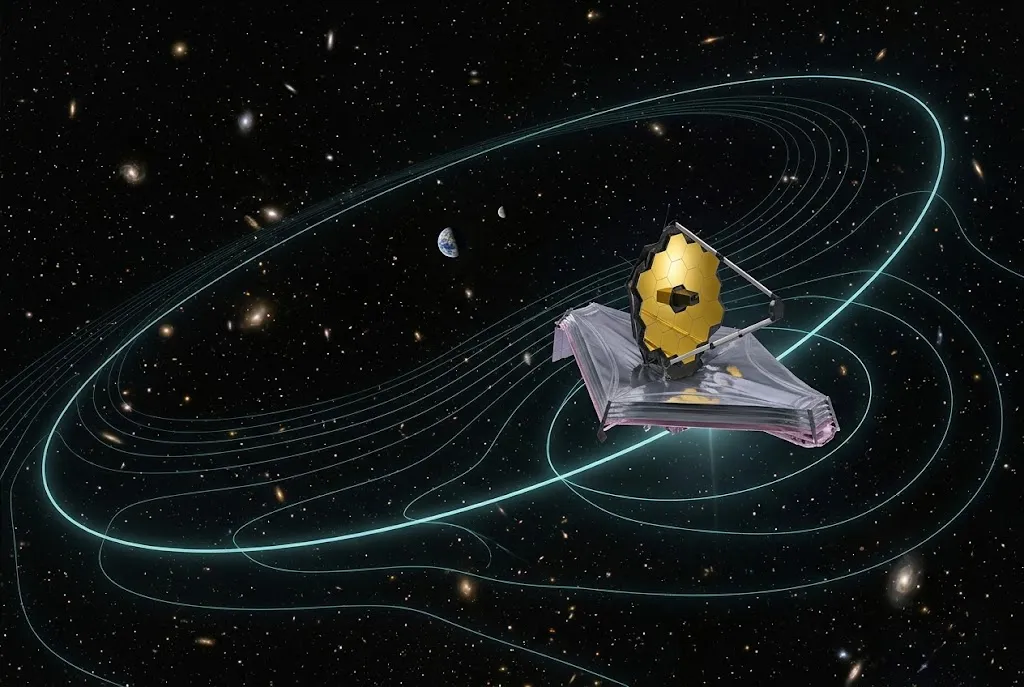
Yet Webb spends its days tracing a vast loop around nothing.
No asteroid sits at the center of that loop. No hidden dwarf planet anchors it. There isn't even a dense clump of dark matter holding it together. If you were floating in a spacesuit at the focal point of Webb's path, you would look around and find nothing but pure, black vacuum.
So what keeps a ten-billion-dollar observatory from drifting away?
The answer lives inside an 18th-century mathematical puzzle known as the three-body problem. In 1772, Italian-French mathematician Joseph-Louis Lagrange published a paper analyzing what happens when a small object enters an orbital arena dominated by two massive bodies. Isaac Newton had already figured out how two celestial bodies pull on one another, but adding a third body broke the clean geometry completely. Lagrange found five specific pockets where the gravitational pull of the two giants combines with the outward centrifugal swing of an orbiting observer to create a stable island of equilibrium.
We call them Lagrange points (or libration points). And they are the closest thing our universe has to cosmic parking spots.
This is why your satellite TV dish points continuously at a single geostationary satellite parked 22,236 miles overhead, while deep-space observatories like Webb burn fuel every three weeks just to hover near an empty patch of vacuum.
To understand why these invisible balance zones exist, we have to throw out the standard two-body model of spaceflight and step inside a rotating frame of reference.
Gravitational Tug-of-War and the Centrifugal Illusion
If you watch the solar system from a stationary vantage point outside the plane of the planets, everything moves constantly. Earth whips around the Sun at 67,000 miles per hour, dragging its gravitational field along with it.
Look at that same system while riding along with Earth, and the perspective changes.
In this co-rotating reference frame, Earth appears motionless. The Sun sits fixed in place across the gulf. Because your reference frame is spinning, an apparent force shows up: centrifugal force, pushing outward away from the center of rotation. In orbital mechanics, if you can balance the inward pull of gravity against that outward centrifugal push, an object can remain stationary relative to both celestial bodies.
Lagrange calculated that five such points exist in any two-body system, labeled L1 through L5.
The Linear Points: L1, L2, and L3
Three of these points sit along the direct line connecting the Sun and Earth. They rely on gravity adding up or subtracting from orbital speed.
- L1 sits directly between the Sun and Earth, roughly 930,000 miles sunward. Normally, an object orbiting closer to the Sun moves faster than Earth because Kepler's laws demand shorter orbital periods at smaller orbital radii. But at L1, Earth's gravity tugs in the opposite direction of the Sun's gravity. That subtle backward tug weakens the Sun’s effective grip. The satellite slows down just enough to match Earth's 365-day year. NASA's Solar System Exploration (opens in a new tab) fleet keeps sun-watching sentinels like SOHO and DSCOVR at L1 for this exact reason: they get an uninterrupted, 24/7 view of solar flares without Earth ever getting in the way.
- L2 sits on the opposite side of Earth, 930,000 miles out into deep space, directly away from the Sun. Out here, a satellite would normally orbit slower than Earth, falling behind over months and years. But at L2, the gravitational pulls of the Sun and Earth point in the exact same direction. Their forces combine. That extra inward pull accelerates the satellite's orbital rate, forcing it to complete a circuit in exactly one Earth year. It keeps pace with us, permanently shielded from the blazing sun by Earth's bulk.
- L3 hides on the far side of the Sun, slightly beyond Earth's orbit. It remains permanently invisible to us, inspiring decades of mid-century science-fiction stories about a hidden "Counter-Earth."
The Triangular Points: L4 and L5
The remaining two points, L4 and L5, form equal-sided triangles with the Sun and Earth. L4 leads Earth by 60 degrees in its orbit; L5 trails 60 degrees behind.
At these angles, the gravitational pulls of the Sun and Earth combine at an angle that points directly toward the center of mass of the entire system. Because the distance to both massive bodies is identical, the forces blend into an exceptionally stable gravitational anchor.
Here is where most people get tripped up. It is tempting to picture these points as cozy gravitational bowls—deep depressions in space where a satellite can rest like a marble at the bottom of a coffee mug.
Turns out, no.
L1, L2, and L3 are not bowls at all. They are gravitational saddles. If you visualize a mountain pass, you have high peaks on your left and right, but steep drop-offs in front of and behind you. That is L2. Move slightly perpendicular to the Sun-Earth line, and gravity pulls you gently back toward center. But drift just a few miles closer to Earth or a few miles further away, and you begin sliding down a steep gravitational cliff.
An object placed dead-center at L2 without guidance will not stay there. It will inevitably tumble off the saddle and drift away forever.
Riding the Invisible Saddle: The Coriolis Trick and Halo Orbits
If L2 is an unstable saddle, how can a fragile space observatory spend two decades orbiting it without crashing or drifting into the void?
The solution came from an orbital mechanics pioneer named Robert Farquhar in the late 1960s. He realized that a spacecraft doesn't need to sit dead-center at the equilibrium point. Instead, it can execute a continuous, three-dimensional loop around the point—a trajectory known as a halo orbit (opens in a new tab).
When a spacecraft begins sliding off the gravitational saddle of L2, its forward motion inside the rotating reference frame triggers the Coriolis force. This pseudo-force deflects the spacecraft sideways relative to its motion.
Instead of plunging downhill toward Earth or escaping into deep space, the trajectory gets continuously bent into an elliptical loop. By balancing its orbital velocity against the shape of the saddle, the spacecraft falls around empty space indefinitely. The physics mimics the way a rolling coin circles the rim of a funnel before dropping through.
(And honestly, the first time you look at a flight simulation of a halo orbit, it looks completely unnatural, like watching a figure skater trace circles around an invisible flagpole).
Why Webb Never Sits at L2 Directly
Sitting in a wide halo orbit around L2 solves two catastrophic engineering problems that would kill a mission like Webb if it parked at the exact center:
- The Solar Power Paradox: If Webb sat directly at L2, Earth would perpetually block out the Sun. A permanent solar eclipse sounds dramatic, but it means zero sunlight on Webb's solar arrays. The observatory would run out of electrical power in hours.
- Thermal Contamination: Webb's primary instruments must stay down near 40 Kelvin (-388°F) to detect faint infrared signatures from the earliest galaxies. We explored this extreme cryogenic packaging when breaking down how the James Webb telescope stays cold. If Webb sat in Earth's partial shadow, Earth would glow as a giant, warm infrared heat source directly overhead.
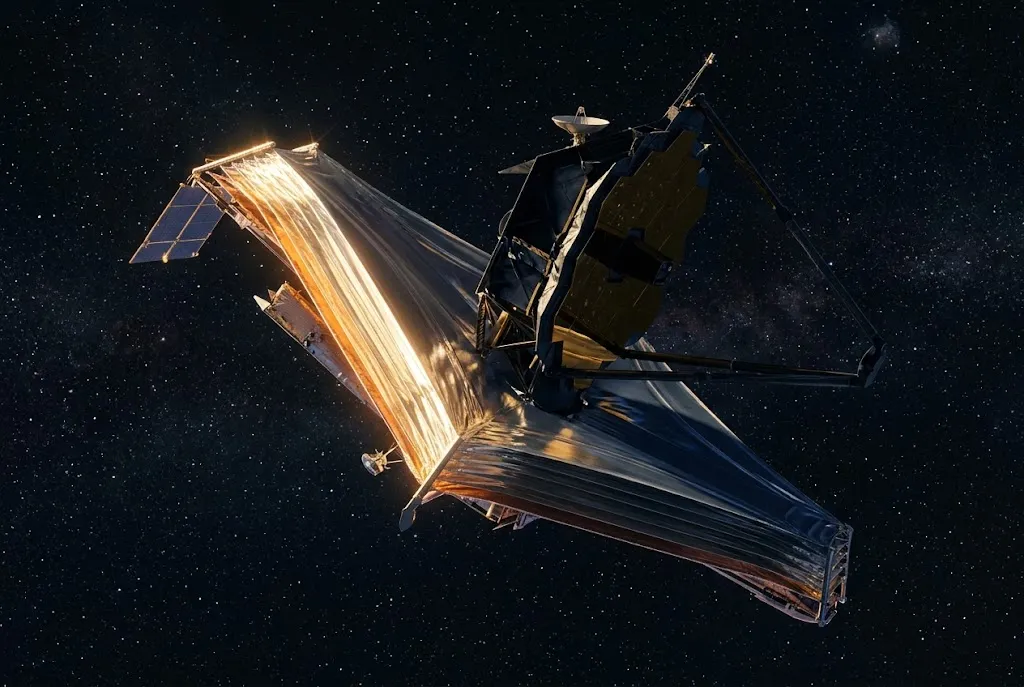
By tracing a halo orbit roughly the size of the Moon's orbit around Earth, Webb stays bathed in continuous sunlight for power while keeping Earth, the Moon, and the Sun grouped tightly together behind its five-layer Kapton sunshield.
The Fuel Clock Is Ticking
Because the saddle at L2 remains inherently unstable, a halo orbit requires constant maintenance. It is not a permanent trajectory.
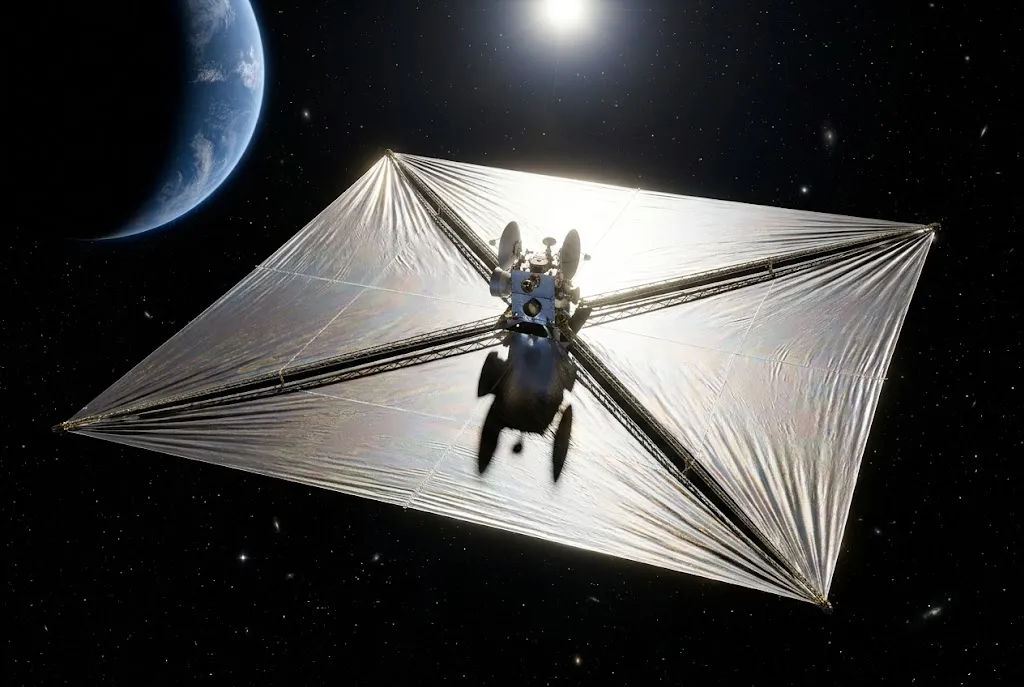
Solar radiation pressure—the physical momentum transfer of sunlight striking the giant sunshield, similar to the mechanics behind how solar sails navigate deep space—constantly pushes Webb off course. Every 21 days, small monopropellant thrusters fire microscopic puffs of hydrazine. These delicate burns, known as station-keeping maneuvers, push the telescope back toward the sweet spot on the saddle.
When Webb's fuel tanks run dry, it will no longer be able to fight the gravitational slope. Within weeks, the spacecraft will slip off the ridge, leaving its ghost orbit behind forever.
| Lagrange Point | Stability Type | Ideal For | Notable Missions |
|---|---|---|---|
| L1 | Unstable (Saddle) | Continuous solar observation | SOHO, DSCOVR, Genesis |
| L2 | Unstable (Saddle) | Deep-space infrared astronomy | JWST, Euclid, Gaia, Roman |
| L3 | Unstable (Saddle) | Hidden solar monitoring | Theoretical / Sci-Fi |
| L4 | Stable (Potential Peak) | Trojan asteroid collection | Lucy mission targets |
| L5 | Stable (Potential Peak) | Space weather monitoring | Planned ESA missions |
The Natural Traps: Trojan Asteroids
While L1, L2, and L3 require active thruster burns to keep artificial spacecraft on balance, L4 and L5 take care of themselves.
At these triangular points, the Coriolis force is strong enough to turn the potential peaks into true gravitational traps. If an asteroid drifts away from L4, the Coriolis deflection bends its path into a stable kidney-bean-shaped loop around the point. It cannot easily escape.
Jupiter's L4 and L5 points hold over 10,000 cataloged "Trojan asteroids"—ancient, frozen remnants of the early solar system trapped in orbital resonance with the gas giant for four billion years. Earth has its own smaller Trojan companions, including asteroid 2020 XL5, locked quietly into our orbital wake.
Much like the momentum transfers that make gravitational slingshots work for outer planet probes, the mechanics of libration points reveal that space is not just flat, open terrain. It has contours, ridges, and invisible islands sculpted entirely by mass and motion.
Lagrange points prove that you do not need a planet or a star to build a cosmic harbor. Sometimes, all it takes is two gravitational giants, a spinning frame of reference, and an equation scribbled down two centuries before humanity ever touched the sky.
Conversation0
No comments yet. Be the first to share a thought — the best questions often become new stories.