


The 10,000-Degree Myth: Why Friction Isn't What Heats Spacecraft
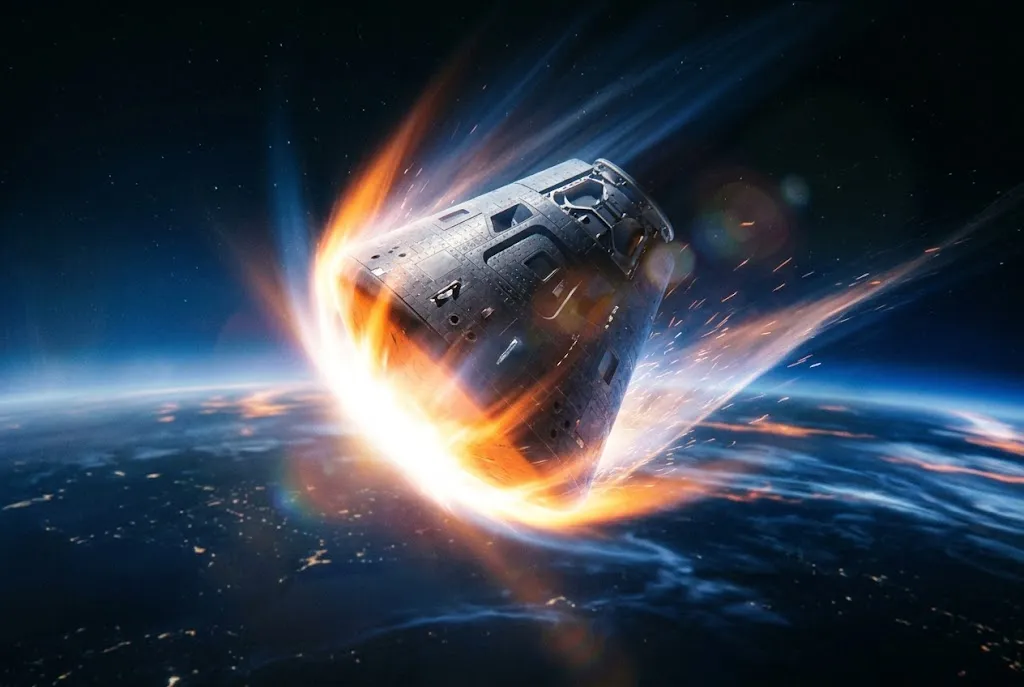
I used to believe the standard movie trope about spacecraft returning to Earth. The capsule hits the upper sky, rubs violently against air molecules, and friction sets the hull ablaze.
It makes intuitive sense. Rub your hands together fast enough and your palms sting with warmth.
Except that isn't what happens. Not even close.
Friction plays almost no role in the white-hot inferno that envelopes an astronaut falling from orbit. When an Apollo capsule, a SpaceX Dragon, or the Orion spacecraft returns from the void, it hits the upper atmosphere at roughly Mach 25. That is approximately 17,500 miles per hour—nearly five miles every single second. Returning from lunar missions, vehicles slam in even faster, exceeding Mach 36.
At those speeds, something far more violent takes over. The air doesn't have time to flow around the spacecraft. Instead, the vehicle physically crushes the atmosphere ahead of it into a microscopic cushion of unimaginable pressure.
What generates that blinding inferno is pure, unadulterated compression.
The Ram-Pressure Shockwave: Compressing Air into Plasma
To understand why a spaceship survives, you first have to understand the monster it fights. The culprit is known in fluid dynamics as ram pressure (opens in a new tab).
When you sprint through a room, the air effortlessly glides around your shoulders. The speed of sound in air is roughly 767 miles per hour at sea level; that speed represents how fast gas molecules can bump into each other and signal incoming objects to make way. But when a spacecraft plunges downward at twenty-five times the speed of sound, it outruns the atmosphere's ability to clear a path.
Air molecules are caught completely off guard. They pile up against each other in an impossibly narrow boundary just inches thick.
This is why the metal valve on a bicycle pump gets surprisingly hot when you rapidly inflate a tire: compressing a gas forces its thermal energy into a smaller volume, spiking its temperature without any friction required.
Now imagine taking that bicycle pump effect and multiplying it by hypersonic velocities. The atmospheric gas in front of the vehicle is compressed so brutally that temperatures instantly spike between 5,000°C and 10,000°C. That is hotter than the visible surface of the Sun. Under that level of thermal violence, nitrogen and oxygen molecules rip apart into raw atomic ions and free electrons. The air ceases to be air; it becomes a glowing envelope of conductive plasma.
If that compressed shock layer touched the raw hull of a spacecraft for even a second, the ship would vaporize like a drop of water on a red-hot skillet. Yet astronauts land safely in the ocean with the cabin interior sitting at a comfortable 22°C.
The secret isn't merely having a tough shield. The secret lies in a bizarre aerodynamic discovery that turned classical rocket design completely on its head.
The Blunt-Body Revolution: Why Pointy Rockets Don't Work
In the early 1950s, aerospace engineers faced a dead end. As intercontinental ballistic missiles climbed higher and fell faster, their pointed nose cones kept incinerating upon atmospheric entry (opens in a new tab). The universal engineering intuition back then was simple: make vehicles sharp, sleek, and needle-like to pierce the atmosphere with minimal resistance.
Every single one of those needle-nosed designs burned up in flight tests.
Then came an aeronautical engineer named H. Julian "Harvey" Allen at the NACA Ames Aeronautical Laboratory. In 1951, Allen proposed an idea that sounded like absolute lunacy to his peers: if you want a spacecraft to survive the plunge, you shouldn't make it sharp at all. You should make it flat, wide, and bluntly rounded.
Allen's breakthrough—formalized in H. Julian Allen's blunt body theory (opens in a new tab)—fundamentally changed spaceflight forever.
Here is the genius of the blunt face: because a wide, rounded surface cannot slide through the air, it pushes a massive, detached bow shockwave out in front of itself. The shockwave doesn't cling to the skin of the craft. Instead, it hovers several inches ahead of the vehicle, held off by a pocket of trapped, stagnant gas.
That cushion acts like an invisible deflector shield. Because the blistering 8,000°C plasma forms inside that detached shockwave rather than against the metal hull, the vast majority of the heat—upwards of 90 percent—never touches the spacecraft at all. The superheated gas flows smoothly around the rounded shoulders and dissipates into the expanding wake behind the vehicle.
(And honestly, the first time I saw the fluid dynamic simulations showing that detached cushion, I stared at the screen until my tea went cold.)
Still, deflecting 90 percent of the heat leaves 10 percent hitting the craft. In hypersonic conditions, that 10 percent is more than enough to liquefy solid steel. To handle the leftover inferno, spacecraft rely on materials that survive by literally destroying themselves on purpose.
How Ablative Heat Shields Sacrifice Themselves to Save Astronauts
Rather than trying to build an indestructible armor plate, capsule designers turn to sacrificial materials called ablative thermal protection systems.
You can spot these on historic Apollo capsules, modern SpaceX Crew Dragon ships, and planetary landers. Many early experiments chasing extreme heat resistance—reminiscent of the wild claims behind legendary heat-resistant compounds like Starlite—aimed to create substances that could take infinite heat without flinching. But the aerospace industry discovered that controlled self-destruction works far better.
Modern capsules use composites like Avcoat (an epoxy novolac resin filled inside a fiberglass honeycomb matrix, used on Apollo and Orion) or PICA, short for phenolic-impregnated carbon ablators (opens in a new tab). PICA takes a porous matrix of carbon fibers and soaks them in phenolic resin. It sounds simple, but under hypersonic speed (opens in a new tab), it pulls off a multi-layered chemical magic trick.
Pyrolysis: Chemistry Under Extreme Thermal Load
When radiant energy from the plasma shock strikes the heat shield, the outer millimeters don't just sit there. They undergo pyrolysis—a thermal decomposition that converts solid resin into gas.
Breaking those complex chemical bonds absorbs a tremendous amount of latent heat. It is an endothermic reaction, sucking energy away from the spacecraft hull like an industrial sponge.
As the resin turns into vapor, that superheated gas expands and forces its way out through microscopic pores in the carbon matrix. This creates what aerodynamicists call the blowing effect, or transpiration cooling. The gas erupting from the shield pushes against the oncoming airstream, literally blowing the hot shock layer even further away from the surface.
What remains behind on the surface is a light, brittle crust of pure porous carbon: char. Carbon char has an astonishingly high sublimation temperature. It sits there, glowing white-hot, reflecting infrared radiation back into space while acting as a rigid thermal insulator for the virgin resin nestled safely beneath it.
Reusable Tiles vs. Sacrificial Resin: Two Different Engineering Philosophies
Not every vehicle uses ablative shields. Ablation is inherently single-use; the shield sheds inches of mass during descent, leaving a charred, pitted ruin that must be stripped and replaced before another flight. That was unacceptable for the Space Shuttle, which was engineered as a reusable spaceplane.
Instead of ablating, the Shuttle used non-ablative, radiational thermal protection. Its belly was covered in more than 20,000 individual tiles made of LI-900: essentially high-purity silica glass fibers composed of 94 percent empty air. These tiles have such astonishingly poor thermal conductivity that technicians could pull a glowing, 1,200°C tile directly out of an oven and pick it up by its edges with bare hands while its core remained molten.
The silica tiles survived by absorbing virtually no heat into their structure, radiating 90 percent of the thermal energy straight back into the night sky as incandescent glow. But they were notoriously fragile—glass-foam crackers glued to an aluminum airframe.
Today, modern spaceflight strikes a pragmatic balance. Vehicles that need simple, bulletproof reliability—like crew capsules returning from the Moon or Mars—stick to ablative shields. Meanwhile, reusable platforms like SpaceX Starship rely on hexagonal ceramic tiles combined with precise aerodynamic maneuvers, contrasting sharply with how the company handles lower-energy descents when landing orbital rocket boosters vertically using pure rocket thrust.
The Radio Blackout: When Compressed Plasma Blinds Mission Control
Every time a spacecraft drops into the atmospheric cauldron, there is a legendary period of dead silence: the communications blackout.
For three to seven agonizing minutes, telemetry flatlines. Voice loops drop. Flight controllers stare at frozen screens. Many people assume the friction noise simply drowns out the microphones.
In reality, the culprit is the exact same plasma sheath that threatens to roast the vehicle.
When ram pressure rips air molecules into ions and free electrons, that dense cloud of charged particles envelopes the spacecraft in an electrically conductive cocoon. In physics, an electromagnetic wave cannot pass through a plasma if the wave's frequency is lower than the plasma's natural oscillation frequency. The free electrons in the shock layer oscillate furiously—often exceeding several gigahertz.
Standard radio transmissions sent from Earth simply bounce off the plasma sheath like tennis balls off a brick wall.
Modern engineers found clever ways around this blackout. During the Space Shuttle era, NASA learned that the plasma sheath thins out dramatically behind the spacecraft's blunt shoulders. By angling antennas backward through the aerodynamic wake, modern capsules can beam signals upward toward Tracking and Data Relay Satellites (TDRS) orbiting high above, maintaining voice and telemetry loops where older missions were flying blind.
What Surviving the Plunge Really Proves
Surviving atmospheric entry is easily one of the most counterintuitive feats in human history.
If you asked an aircraft designer in 1940 how to survive traveling at Mach 25, they would have drawn a razor-sharp dart. They would have optimized for piercing the sky. But the atmosphere isn't something you can slice through at hypersonic velocity; it fights back with the hydraulic fury of a brick wall.
By embracing a blunt, seemingly clumsy shape, Harvey Allen turned the atmosphere's own violence against itself. The craft builds a wall of compressed air that shelters it from its own hypersonic wake. And behind that pocket of trapped gas, sacrificial layers of resin slowly melt and boil away, shedding thermal calories one vapor molecule at a time.
It isn't armor that keeps astronauts alive.
It is the brilliant realization that when nature throws ten thousand degrees at you, the smartest move isn't to fight the blow—it's to let the air push itself out of the way.
Conversation0
No comments yet. Be the first to share a thought — the best questions often become new stories.