


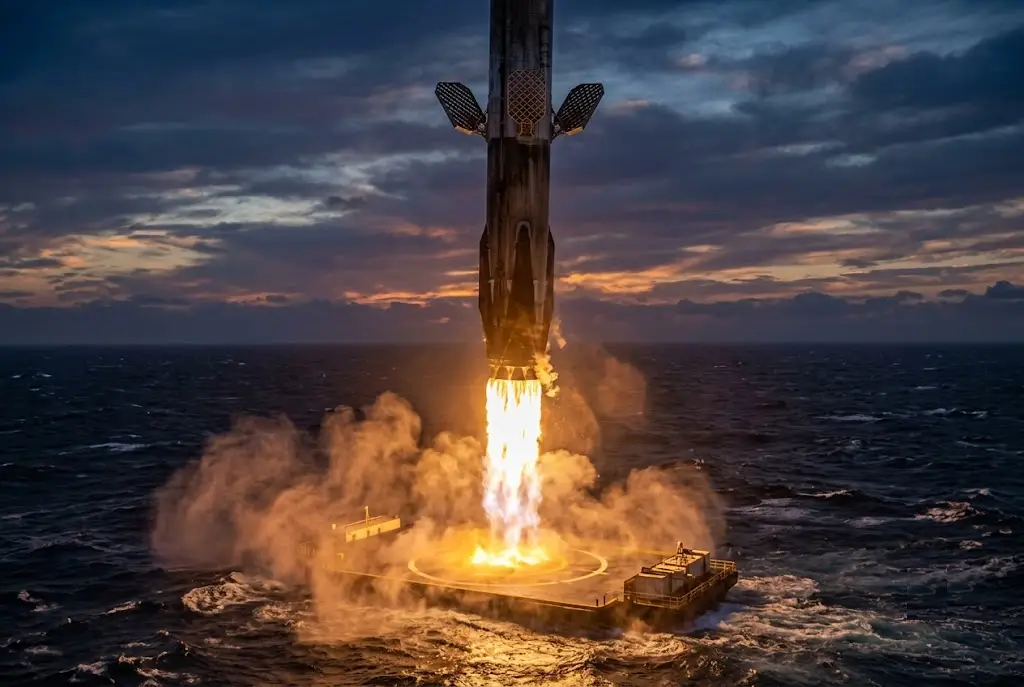
Every time I watch a 15-story orbital rocket booster plummet out of the upper atmosphere at Mach 6 and touch down perfectly on a floating barge in the middle of the ocean, my brain still struggles to process it. For six decades, space flight followed a single, brutally expensive rule: rockets were disposable. You built a $60 million machine, ignited it once, and let it crash into the sea.
When SpaceX first announced they intended to flip a massive missile upside down, ignite its engines against hypersonic winds, and balance it vertically on four carbon-fiber legs, most aerospace veterans called it impossible.
Yet today, propulsive rocket landing is almost routine. But how does a multi-ton aluminum-lithium cylinder actually navigate through extreme atmospheric turbulence, brake from supersonic speeds, and hit a target the size of a bullseye on a swaying ship?
The answer lies in four radical engineering triumphs working in total millisecond synchronization.
1. Grid Fins: Steering a falling skyscraper through hypersonic air
When the first stage booster separates from the upper stage around 80 kilometers above Earth, it isn't just falling—it is moving sideways at thousands of miles per hour.
To guide itself back toward land or a drone ship, the booster deploys four titanium waffle-like structures near its nose called grid fins (opens in a new tab). Unlike smooth, conventional aircraft wings like those found on high-performance stealth fighters, grid fins operate exceptionally well at both supersonic and subsonic speeds.
These grid fins rotate independently to control roll, pitch, and yaw. As the rocket plummets back into denser air:
- Hypersonic airflow passes through the lattice cells, generating massive control torque with minimal mechanical effort.
- Forged titanium construction allows the fins to withstand re-entry temperatures exceeding 1,000°C without melting.
- Hydraulic actuators adjust the fin angles dozens of times per second based on flight computer calculations.
Without these fins, the rocket would tumble uncontrollably in the upper atmosphere and burn up due to uneven friction.
2. Supersonic Retropropulsion: Using fire as a heat shield
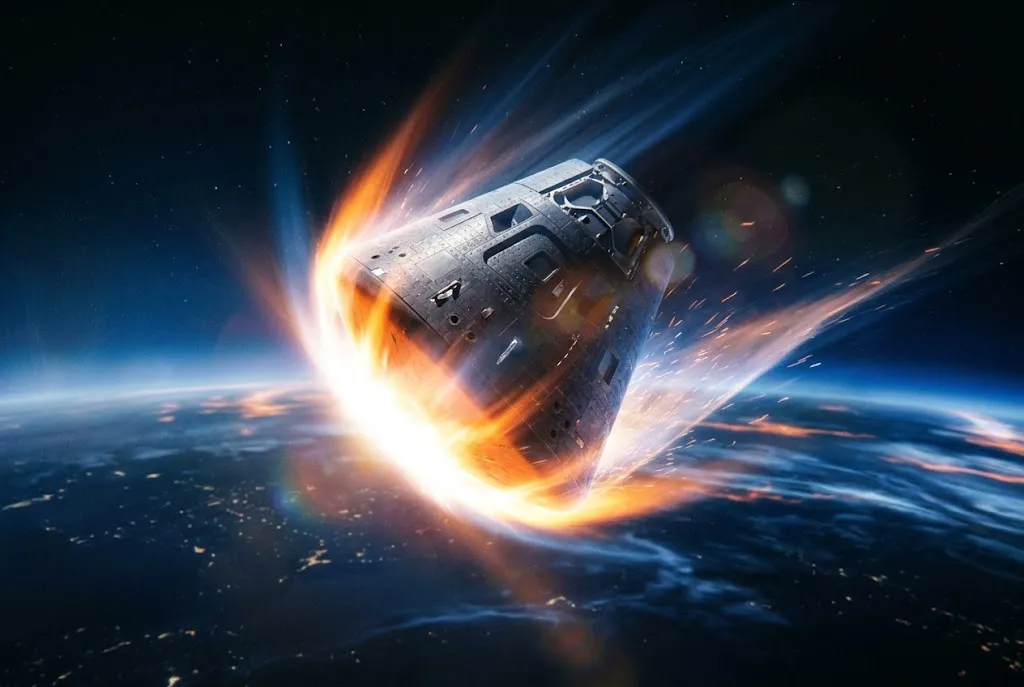
One of the greatest challenges in re-entering Earth's atmosphere is heat and deceleration. Space capsules traditionally rely on blunt heat shields and parachutes. But a multi-ton orbital booster is far too heavy for parachutes to work efficiently.
Instead, SpaceX pioneered supersonic retropropulsion (opens in a new tab).
[Space Separation at ~80 km Altitude]
               │
               ▼
   [Cold-Gas Thruster Flip] ──► Flips booster 180° in vacuum
               │
               ▼
    [Re-Entry Burn @ Mach 3] ──► Engine fire acts as dynamic shield
               │
               ▼
    [Grid Fin Steering] ───────► Aerodynamic gliding through dense air
               │
               ▼
    [Hoverslam Landing Burn] ──► Deceleration from 300 km/h to 0 at touchdown
During the re-entry burn, the booster reignites three of its nine Merlin engines while traveling at three times the speed of sound. The high-pressure exhaust plume ejected forward actually pushes the oncoming atmosphere away from the rocket body. Surprisingly, the rocket uses its own engine fire as a dynamic shield to protect its outer skin from friction damage.
3. Gimbaled Thrust: The art of balancing a broom on your fingertip
Try balancing a long broomstick vertically on the palm of your hand. To keep it from falling, your hand must constantly shift underneath the stick's center of gravity. That is precisely what liquid rocket engines do using thrust vectoring (opens in a new tab).
During the final landing maneuver, the central Merlin engine uses high-pressure hydraulic rams to swivel on two axes—a mechanism known as gimbaled thrust (opens in a new tab).
"Balancing a rocket on its plume of exhaust as it touches down on a floating barge in rough seas is mechanically equivalent to shooting a pencil over the Empire State Building and having it land on a index card in a snowstorm." — Aerospace Engineering Consensus
If gusting ocean winds tilt the rocket 3 degrees to the left, the onboard flight computer instantly swivels the engine nozzle to direct thrust sideways, pushing the bottom of the rocket back under its top.
4. The "Hoverslam": Why the rocket cannot actually hover
Here is a mind-bending physics reality that most people miss: a Falcon 9 rocket booster cannot hover.
Even with only one engine ignited at its absolute lowest throttle setting, the rocket produces more thrust than the weight of the nearly empty fuel tanks. If it tried to hover 10 feet above the ground, it would immediately start accelerating upward into the sky again!
Therefore, the rocket must perform a maneuver called the Hoverslam (or suicide burn):
- The flight computer calculates the exact microsecond to ignite the landing engine.
- The rocket decelerates violently from 300 km/h down to precisely 0 km/h at the exact millisecond its legs contact the landing pad.
- If the engine ignites a fraction of a second too late, the rocket impacts the pad; if it ignites too early, the rocket stops in mid-air and falls.
To achieve this precision, the booster relies on dual-redundant radar altimeters and precision satellite navigation systems similar to those powering modern GPS positioning networks.
How vertical landing lowers costs in your everyday life
Why should you care about rocket recovery physics? Because payload launch costs directly dictate the price of space technology in our daily lives.
| Launch Method | Cost Per Kilogram to LEO | Booster Reusability | Turnaround Time |
|---|---|---|---|
| Legacy Disposable Rockets | 20,000 | None (Destroyed in ocean) | 12 – 18 Months |
| First-Gen Reusable Spacecraft | $50,000 (Space Shuttle) | Partial (Expensive overhaul) | 3 – 5 Months |
| Vertical Retropropulsion | 2,500 | Full First-Stage Reuse | 21 Days |
By landing and reusing rocket boosters over 20 times each, launch costs dropped by nearly 80%. This massive economic shift is what made dense satellite constellations like Starlink financially viable, bringing low-latency satellite internet to remote regions, lowering global maritime tracking costs, and accelerating research into advanced orbital timing clocks.
The Verdict: Autonomous precision at Mach speeds
Landing a rocket vertically isn't just about big engines—it is a victory of rapid computational control. With thousands of sensor inputs evaluated every millisecond, cold-gas nitrogen thrusters fine-tuning orientation in vacuum, and titanium grid fins cutting through supersonic air, retropropulsion converted space travel from a throwaway luxury into reusable infrastructure.
The next time you see a booster ignite its landing burn over the ocean, remember: you aren't just watching a rocket land—you're watching physics, aerodynamics, and code perform a high-speed ballet in real time.
Conversation0
No comments yet. Be the first to share a thought — the best questions often become new stories.