I was recently navigating a new city, effortlessly guided by the little blue dot on my smartphone. It struck me, as it often does, how profoundly we rely on GPS technology. We punch in a destination, and moments later, a satellite hundreds of miles above us helps pinpoint our exact location, calculating the fastest route. It’s so seamless, so commonplace, that we rarely stop to consider the sheer scientific brilliance—and the mind-bending physics—that makes it all possible. What if I told you that every time your GPS guides you, you're not just witnessing technological marvel; you’re experiencing one of the most profound proofs of Einstein's theory of relativity, effectively making us all **daily time travelers**?
## The Unseen Force: Time's Elusive Nature
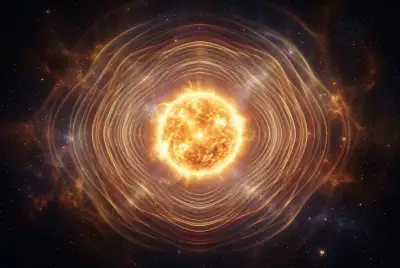
For centuries, time was perceived as an absolute, unyielding constant, flowing uniformly for everyone, everywhere. Sir Isaac Newton famously described it as "absolute, true and mathematical time, of itself, and from its own nature flowing equally without relation to anything external." This intuitive understanding governed our perception of the universe for over two hundred years. However, in the early 20th century, a young patent clerk named Albert Einstein shattered this notion with his revolutionary theories of relativity. He posited that time is not absolute but **relative**, intricately woven with space into a single fabric known as spacetime, and its passage can vary depending on speed and gravity.
### Einstein's Twin Pillars: Special and General Relativity
To truly grasp how GPS proves time’s relative nature, we need to delve into Einstein's two monumental theories:
**1. Special Relativity (1905): The Speed Factor**
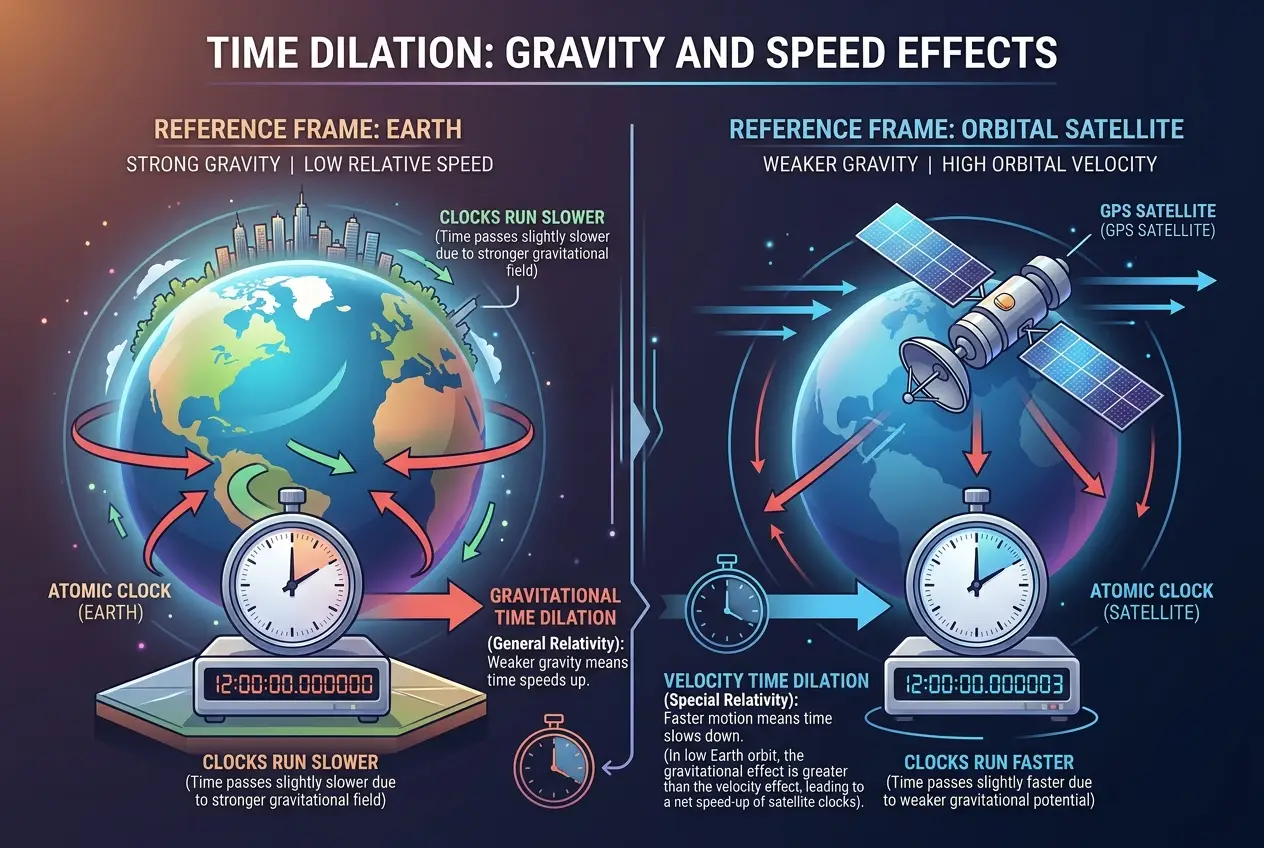
Special Relativity deals with objects moving at constant speeds relative to each other in the absence of gravitational fields. Its most famous tenet is **time dilation**: the faster you move, the slower time passes for you relative to a stationary observer. Imagine a twin astronaut who rockets off at near light speed while their sibling stays on Earth. When the astronaut returns, they would have aged less than their Earth-bound twin. This isn't science fiction; it's a verifiable consequence of the universe's physics. For more on how space travel might bend time, you might find our article on ["Does Dark Energy Warp Our Sense of Time?"](/blogs/does-dark-energy-warp-our-sense-of-time-5047) insightful.
**2. General Relativity (1915): The Gravity Factor**
A decade later, Einstein expanded his theory to include gravity. General Relativity describes gravity not as a force, but as the curvature of spacetime caused by mass and energy. The more massive an object, the greater the curvature, and the slower time passes in its vicinity. This is often called **gravitational time dilation**. So, time runs slower closer to a massive object (like Earth) and faster further away from it.
### The Atomic Clocks: Our Precision Timekeepers
At the heart of GPS technology are **atomic clocks**. These aren't your grandfather's ticking timepieces. Atomic clocks are incredibly precise, using the resonant frequencies of atoms (like cesium or rubidium) to keep time with astounding accuracy, losing or gaining less than a second over millions of years. Each GPS satellite carries several of these atomic clocks.
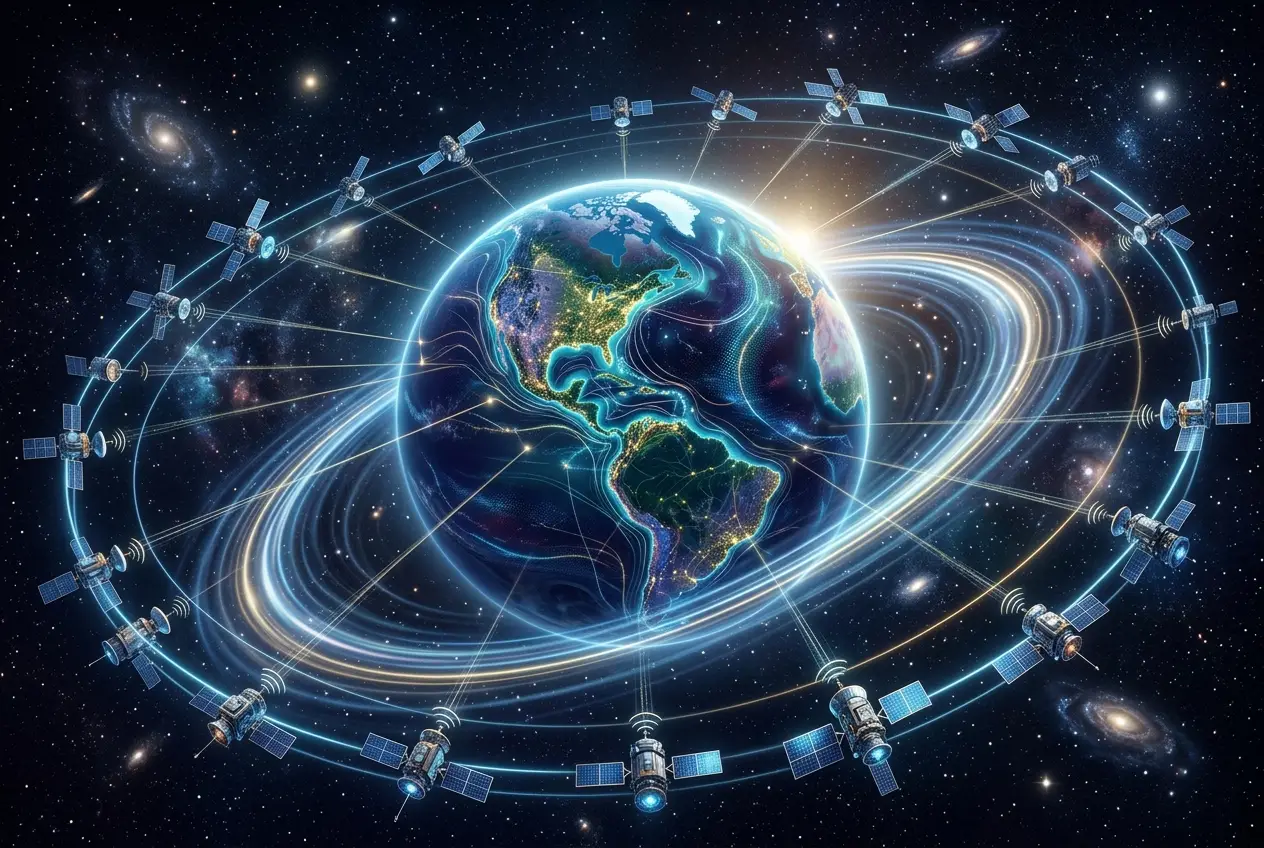
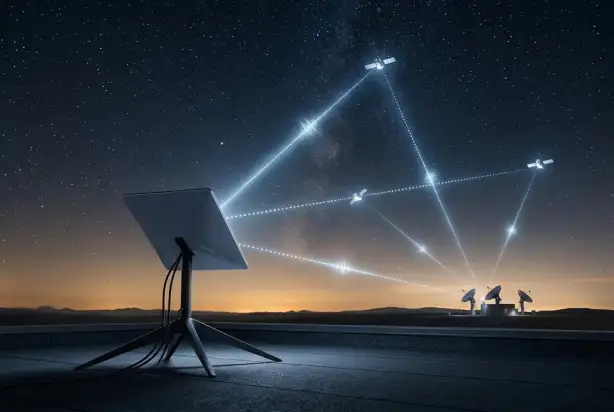
The Global Positioning System (GPS) itself consists of a constellation of satellites orbiting Earth, each transmitting precise timing signals. Your GPS receiver on the ground listens to signals from multiple satellites, calculates the time it took for each signal to arrive, and then triangulates your position based on these time differences. Even a minuscule error in timing translates to a huge error in distance – a nanosecond error can mean a foot of position error. This requires unfathomable precision, a precision that would be completely undermined if we ignored relativity. You can read more about the intricate details of GPS on its [Wikipedia page](https://en.wikipedia.org/wiki/Global_Positioning_System).
## GPS: A Real-World Relativity Experiment
Now, let's connect the dots. The GPS satellites are in orbit, approximately 20,200 kilometers (12,550 miles) above Earth, zipping around at speeds of about 14,000 kilometers per hour (8,700 mph). Relative to us on Earth, these satellites are in two distinct relativistic environments:
### The Special Relativity Effect: Speeding Through Time
Due to their high orbital velocity, the atomic clocks on the GPS satellites experience **time dilation** from Special Relativity. If we didn't account for this, the clocks on the satellites would tick *slower* than identical clocks on Earth. Calculations show that this effect would cause the satellite clocks to lose approximately **7 microseconds (7,000 nanoseconds)** per day compared to Earth-bound clocks.
### The General Relativity Effect: Escaping Gravity's Grip
Conversely, because the satellites are much further away from Earth's massive gravitational pull, they experience **weaker gravity** than clocks on the ground. According to General Relativity, time runs *faster* where gravity is weaker. This effect causes the satellite clocks to gain approximately **45 microseconds (45,000 nanoseconds)** per day compared to Earth-bound clocks.
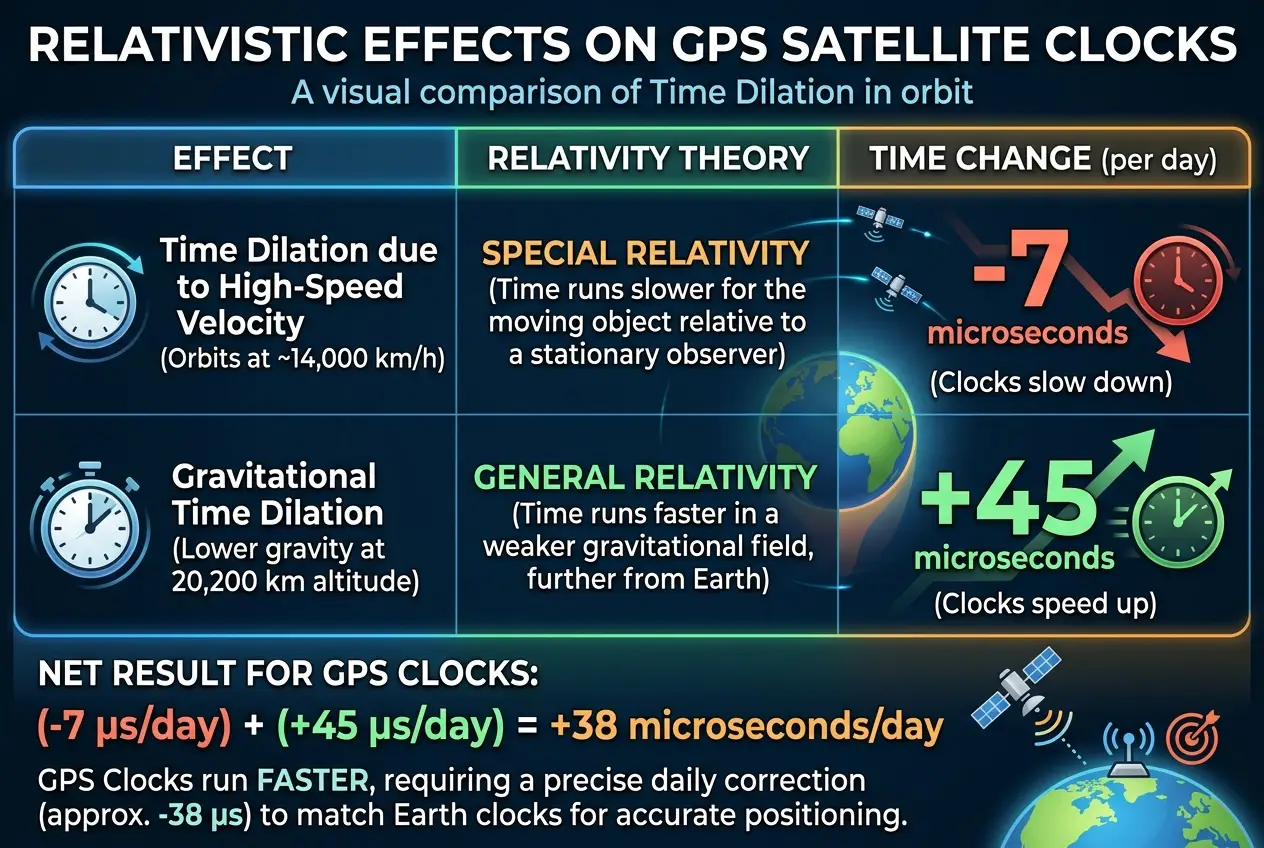
| Effect | Relativity Theory | Time Change (per day) |
| :--------------------------- | :---------------- | :-------------------- |
| Orbital Speed | Special Relativity | -7 microseconds (slower) |
| Weaker Gravity in Orbit | General Relativity | +45 microseconds (faster) |
| **Net Relativistic Effect** | **Combined** | **+38 microseconds (faster)** |
### The Daily Time Warp Calculation
When we combine both relativistic effects, the atomic clocks on GPS satellites are effectively ticking **38 microseconds (38,000 nanoseconds)** faster each day than clocks on Earth.
This might not sound like much, but remember, timing is everything for GPS. A daily error of 38 microseconds would accumulate rapidly. Within just one day, this error would translate to a position error of roughly 10 kilometers (over 6 miles)! Your car would think it's in a different town, rendering GPS completely useless.
## Engineers to the Rescue: Calibrating for Relativity
To prevent this digital chaos, GPS engineers deliberately design the satellite clocks to tick slightly *slower* before launch. They are factory-set to run at a frequency that anticipates and compensates for the 38-microsecond daily gain. This calibration ensures that once in orbit, the satellite clocks appear to tick at the same rate as clocks on Earth. This meticulous adjustment is not an optional tweak; it's a fundamental requirement for the system to function. Without incorporating Einstein's theories, GPS would simply not work. For a deeper understanding of how these clocks operate, you can consult the [Atomic Clock Wikipedia page](https://en.wikipedia.org/wiki/Atomic_clock).
## Beyond Navigation: The Broader Implications
The daily operation of GPS stands as a remarkable, irrefutable empirical proof of Einstein's theories of relativity. It moves these abstract concepts from the realm of theoretical physics into our everyday lives. Every precise location fix, every timely arrival estimate, is a testament to the fact that time is indeed relative.
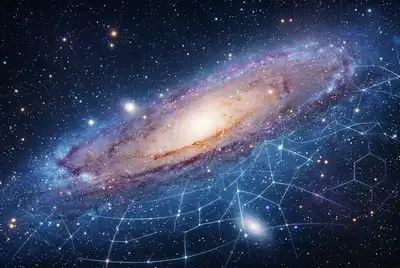
This realization extends far beyond navigation. It reshapes our understanding of the universe, suggesting that perhaps other seemingly immutable constants might also be subject to subtle shifts. For instance, the very fabric of spacetime itself might store quantum data, a concept explored in our blog on ["Could Spacetime Store Quantum Data?"](/blogs/could-spacetime-store-quantum-data-2719). The continuous need to adjust for these relativistic effects means we are, in a very real sense, constantly interacting with a universe where time is a flexible dimension, not a rigid one.
Moreover, technologies beyond GPS, such as global communication networks and deep-space missions, also rely on precise relativistic corrections. As we push the boundaries of technology and explore distant corners of our cosmos, understanding and accounting for these relativistic effects will become even more critical. Could this understanding even unlock new forms of energy? The possibility of harnessing the vacuum's power is discussed in ["Zero-Point Energy: Can the Vacuum Power Our Future?"](/blogs/zero-point-energy-can-the-vacuum-power-our-future-2796).
## The Everyday Miracle
The next time you pull out your phone, open a navigation app, and watch that blue dot move seamlessly across the map, take a moment to appreciate the profound scientific principles at play. You're not just using a convenient tool; you're engaging with a technology that literally proves the bending of time and space – a daily reminder that the universe is far stranger and more fascinating than we often imagine. In a way, we are all **daily time travelers**, experiencing the subtle, yet powerful, dance of relativity right in the palm of our hands.
Frequently Asked Questions
If relativistic effects were not accounted for, GPS positioning errors would accumulate rapidly, leading to errors of several miles within a single day. This would make the system completely non-functional for precise navigation.
Yes, many other advanced technologies rely on relativistic corrections, including high-precision global communication networks, deep-space probes that send data back to Earth, and even some particle accelerators where particles approach relativistic speeds.
While technically possible, experiencing significant time dilation (like the twin paradox scenario) would require traveling at speeds very close to the speed of light or being in extremely strong gravitational fields, far beyond what current human technology allows or what we experience naturally on Earth.
GPS satellites use highly stable atomic clocks, primarily cesium and rubidium atomic clocks, which are among the most accurate timekeeping devices known to humankind. These clocks maintain astonishing precision, losing or gaining only a second over millions of years.
Time literally speeds up and slows down for the satellites relative to Earth-bound observers. This isn't just a calculation; it's a fundamental physical reality of how spacetime behaves according to Einstein's theories of relativity. The clocks on the satellites actually tick at a different rate.
Verified Expert
Alex Rivers
A professional researcher since age twelve, I delve into mysteries and ignite curiosity by presenting an array of compelling possibilities. I will heighten your curiosity, but by the end, you will possess profound knowledge.
Leave a Reply
Comments (0)
No approved comments yet. Be the first to share your thoughts!
 Join Us



 Unknown Author

























Leave a Reply
Comments (0)