


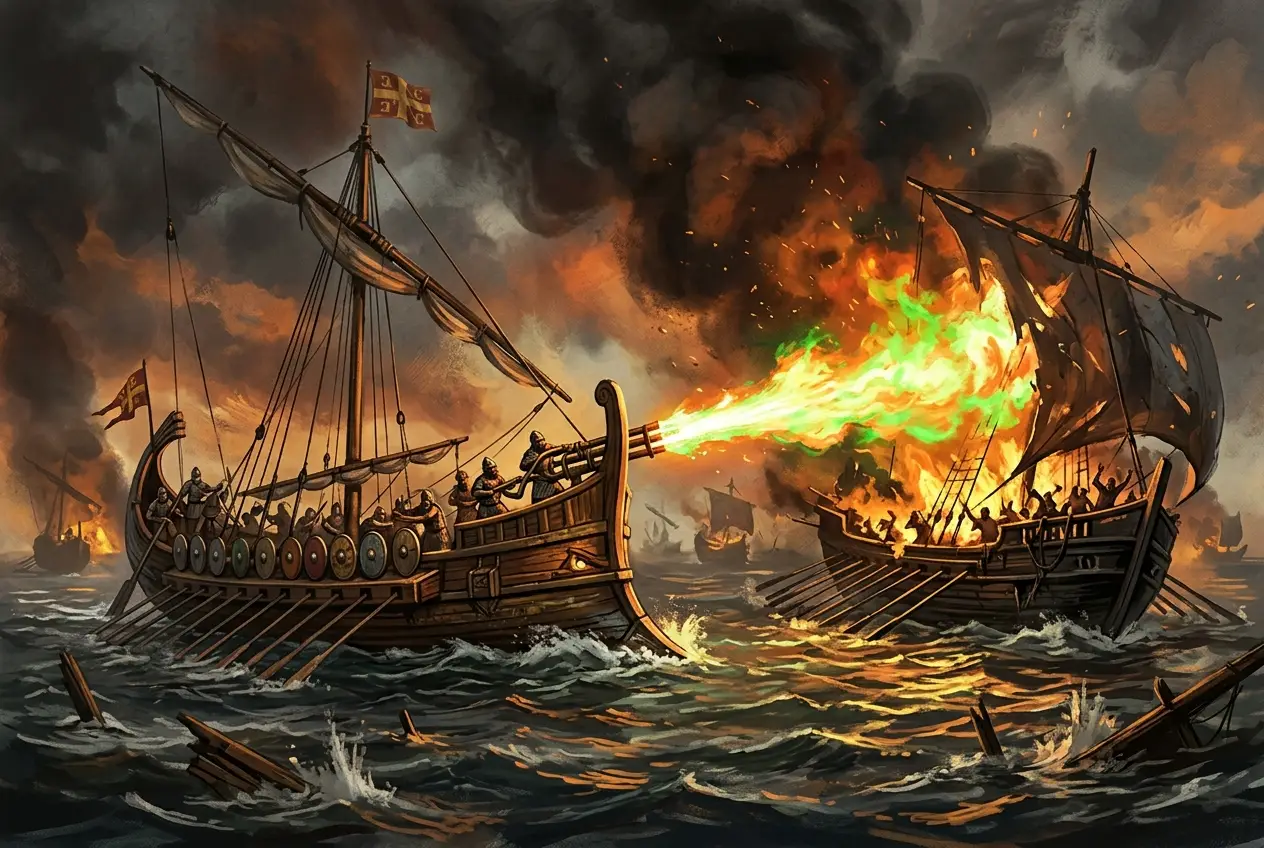
I can only imagine the sheer terror. Picture this: the year is 678 AD, amidst the swirling chaos of a naval siege. Enemy fleets, formidable in their numbers, press against the walls of Constantinople. Then, from the Byzantine ships, a terrifying weapon unleashes its fury. It’s not just fire; it’s a living, unquenchable torrent of flame that ignites on water, clings to hulls, and refuses to be extinguished. Panic ensues. Ships become infernos, their crews engulfed in an agony that defies conventional understanding. This was the legend of Greek Fire, a weapon so devastating and mysterious that it reshaped naval warfare and safeguarded an empire for centuries.
For years, as a history buff and someone fascinated by lost technologies, I've pondered the true nature of Greek Fire. How could an ancient civilization, without modern chemistry or engineering, create such an advanced incendiary? Was it merely a clever mix of crude flammable materials, or did the Byzantines stumble upon something far more sophisticated—perhaps even a rudimentary form of nanotechnology? The idea might seem outlandish, but when you delve into the properties of Greek Fire, the possibility begins to spark a profound curiosity.
The Unquenchable Mystery: What Was Greek Fire?
Greek Fire, or pyr thalassion (sea fire) as it was known, was a liquid incendiary weapon used by the Byzantine Empire, primarily in naval battles, from the 7th to the 14th centuries. Its formula was a closely guarded state secret, known only to a select few, and passed down through generations. This extreme secrecy contributed to its effectiveness and, ultimately, to its disappearance from historical record. When the empire fell, so too did the knowledge of its most fearsome weapon.
What we do know from historical accounts and scholarly analysis is startling:
- Ignited on Water: Unlike ordinary fire, Greek Fire wasn't extinguished by water; in some accounts, water even fueled it, making it terrifyingly effective at sea.
- Adhered to Surfaces: It would stick to enemy ships and personnel, burning intensely.
- Produced Dense Smoke: Accounts describe thick, noxious smoke accompanying the flames.
- Difficult to Extinguish: Sand, vinegar, or even urine were said to be the only effective countermeasures, not water.
The standard theories often suggest a mixture based on naphtha (a petroleum distillate), quicklime (calcium oxide), sulfur, resins, and possibly other ingredients. The quicklime component is particularly intriguing, as its exothermic reaction with water could provide a spontaneous ignition source, explaining the "igniting on water" phenomenon. However, achieving the reported intensity and unquenchable nature with just these ingredients presents significant chemical challenges, leading me to wonder if there was more to it. You can delve into the fascinating history of this weapon on its Wikipedia page (opens in a new tab).
Ancient Craftsmanship and the Nano Hypothesis
When we think of nanotechnology, we usually picture laboratories with electron microscopes and precise molecular manipulation. But ancient civilizations were surprisingly adept at manipulating materials on a microscopic scale, often without fully understanding the underlying science. Think of the intricate patterns in Damascus steel, achieved through a specific forging process that created carbon nanotubes and cementite nanowires, giving it unparalleled strength and sharpness. Or consider Roman concrete, whose enduring strength and self-healing properties are now attributed to rare mineral formations at the nanometer scale. This is a topic we've explored before in our article, Damascus Steel: Was Ancient Tech Stronger Than Modern?, and similarly with Roman Concrete: Did Ancients Master Self-Healing Materials?.
Could the Byzantines have inadvertently stumbled upon "nano-scale" manipulation in their Greek Fire? Here’s where the idea gains traction:
Pyrophoric Materials and Fine Powders
Some theories propose that Greek Fire contained pyrophoric materials – substances that ignite spontaneously in air. While many pyrophoric materials are metals, it's not impossible to imagine organic or composite mixtures that could achieve similar reactivity. The key to pyrophoricity often lies in a large surface-area-to-volume ratio, meaning very finely divided particles.
Ancient cultures were masters of grinding and pulverization. If the Byzantines had a specific process for creating extremely fine powders of certain reactive ingredients, they might have achieved a level of reactivity far beyond what simple mixtures of coarse materials could offer. Imagine a component, perhaps a finely ground mineral or a complex organic compound, that becomes highly reactive when exposed to air or water in its micron or sub-micron particulate form. This level of preparation, while not "nano-engineering" in the modern sense, could very well involve empirical methods to achieve "nano-effects." The Wikipedia article on pyrophoricity (opens in a new tab) explains this fascinating phenomenon in more detail.
Emulsions and Surfactants
The unquenchable nature of Greek Fire, especially its ability to burn on water, hints at a complex mixture. If the fuel component was an emulsion (a mixture of two immiscible liquids, like oil and water, where one is dispersed in the other as tiny droplets), it could create a stable, difficult-to-extinguish substance. Ancient peoples knew how to create emulsions for paints, cosmetics, and medicines using natural surfactants (substances that reduce surface tension). Could a sophisticated, highly stable emulsion, combined with pyrophoric elements or quicklime, have been key?
The Chemical Dance: Recreating the Fury
Numerous attempts have been made to recreate Greek Fire, with varying degrees of success. Historians and chemists have experimented with combinations of naphtha, pitch, sulfur, quicklime, and even saltpeter. While many of these mixtures can produce formidable incendiaries, few fully replicate all the reported properties of Greek Fire, especially its aquatic ignition and extreme persistence.
One of the most compelling theories, first proposed by the Greek scholar Ioannis G. Dedes, suggests that Greek Fire was a combination of petroleum, quicklime, and calcium phosphide. Calcium phosphide reacts with water to produce phosphine gas, which is spontaneously combustible in air (pyrophoric). This would perfectly explain why the fire ignited upon contact with water and was extremely difficult to extinguish. While not "nano-tech" in the modern sense, the precise preparation and mixing of such reactive compounds would require a level of chemical understanding and control that borders on advanced material science for its time.
Consider the possibility that the Byzantines had a deep, empirical understanding of material properties, even if they couldn't articulate it with modern scientific terms. They might have discovered that certain minerals, when processed in a particular way (e.g., through specific heating, grinding, or chemical reactions), yielded substances with extraordinary properties. This isn't far-fetched; many ancient technologies relied on empirical knowledge of material science, often discovering phenomena that modern science only later explained. For more on how ancient cultures might have inadvertently utilized advanced material properties, you might enjoy our post on Ancient Tech: Did Lost Cultures Master Self-Assembly?.
Legacy and Lingering Questions
The mystery of Greek Fire continues to captivate. It stands as a testament to the ingenuity of ancient engineers and chemists, and a stark reminder of how much knowledge can be lost to time. While the "nano-tech" angle remains a hypothesis, it encourages us to look beyond simplistic explanations for ancient marvels. It prompts us to consider that "advanced" isn't solely defined by our current understanding of technology, but by the ability to manipulate nature's laws, however empirically, to achieve extraordinary results.
The true formula for Greek Fire may forever remain lost to the sands of time. However, the questions it raises about ancient scientific understanding, advanced material processing, and the potential for "nano-scale" effects through empirical means, are as relevant as ever. It's a reminder that history often holds secrets that challenge our perceptions of ancient capabilities, pushing us to constantly re-evaluate the boundaries of lost innovation. The Byzantines certainly sparked a revolution, and its embers still glow with wonder.




Conversation0
No comments yet. Be the first to share a thought — the best questions often become new stories.