I recently found myself staring out the window, not at the busy street below, but at the intricate branching of a tree. Each branch seemed to mimic the larger trunk, splitting into smaller versions, which in turn split again. It was a familiar sight, yet this time, something clicked. It wasn't just a pattern; it felt like a silent instruction manual, a hidden code orchestrating the tree’s entire existence. This realization led me down a rabbit hole into the fascinating world of fractals – the self-similar patterns that seem to be nature’s favorite design template.
**Fractals: Nature's Secret Language of Form**
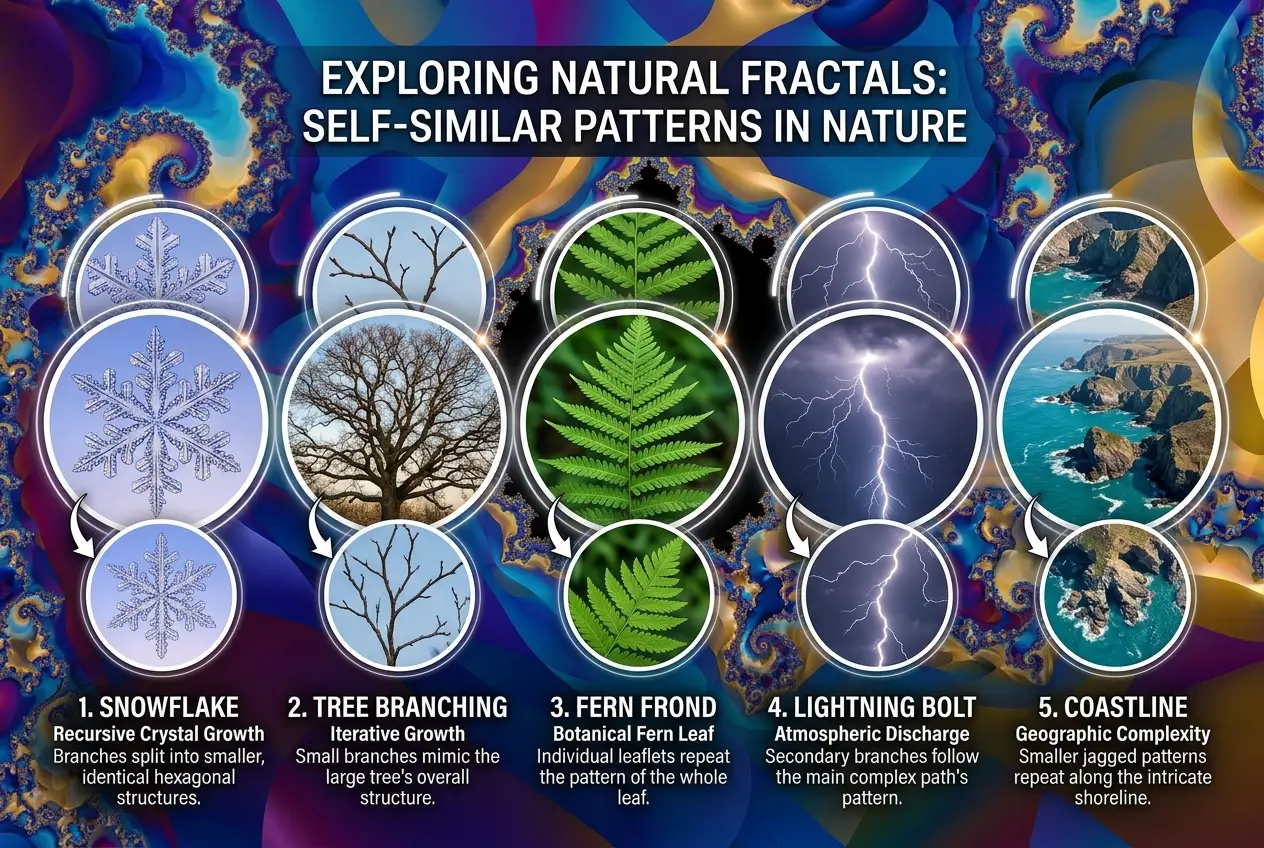
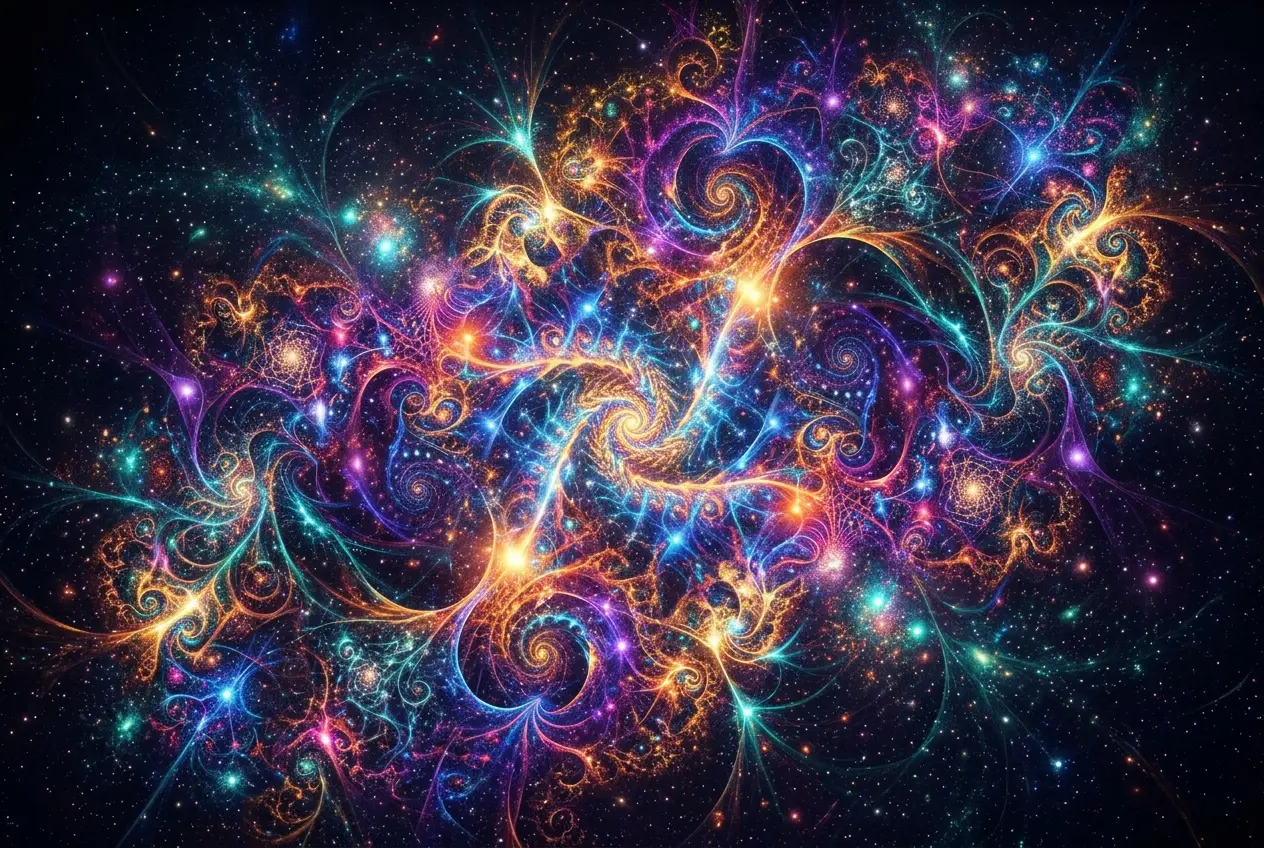
Have you ever considered how a single snowflake can exhibit such mind-boggling complexity, each one unique, yet adhering to a fundamental six-fold symmetry? Or the jagged coastlines that look equally intricate whether you view them from a satellite or a few feet away? These are not random occurrences. These are fractals: geometric shapes that contain self-similar patterns, meaning they look roughly the same at any scale you observe them. Zoom in, and you’ll find smaller versions of the larger pattern repeating infinitely, or at least until the physical limits of the material are reached.
The term "fractal" was coined by mathematician Benoît Mandelbrot in 1975, derived from the Latin "fractus," meaning "broken" or "fragmented." Mandelbrot saw fractals as a way to describe the irregularities and complexities of the natural world, a realm previously deemed too chaotic for classical Euclidean geometry. He famously asked, "How long is the coast of Britain?" The answer, as he showed, depends entirely on the length of your measuring stick, revealing the fractal nature of the coastline. The smaller your unit of measurement, the longer the coastline appears, as you account for every tiny inlet and protrusion.
For a deeper dive into Mandelbrot's work, I recommend checking out the [Wikipedia page on Fractals](https://en.wikipedia.org/wiki/Fractal). It’s an eye-opening journey into how mathematics can describe apparent chaos.
**The Algorithmic Heart of the Universe**
The prevalence of fractals in nature isn’t just a beautiful coincidence; it suggests a deeper principle at play. Could these patterns be the visual manifestation of underlying universal algorithms? An algorithm, in its simplest form, is a set of rules or instructions followed in a specific sequence to achieve a particular outcome. From the growth of a fern frond to the branching of blood vessels in our lungs, nature seems to follow incredibly efficient, recursive algorithms.
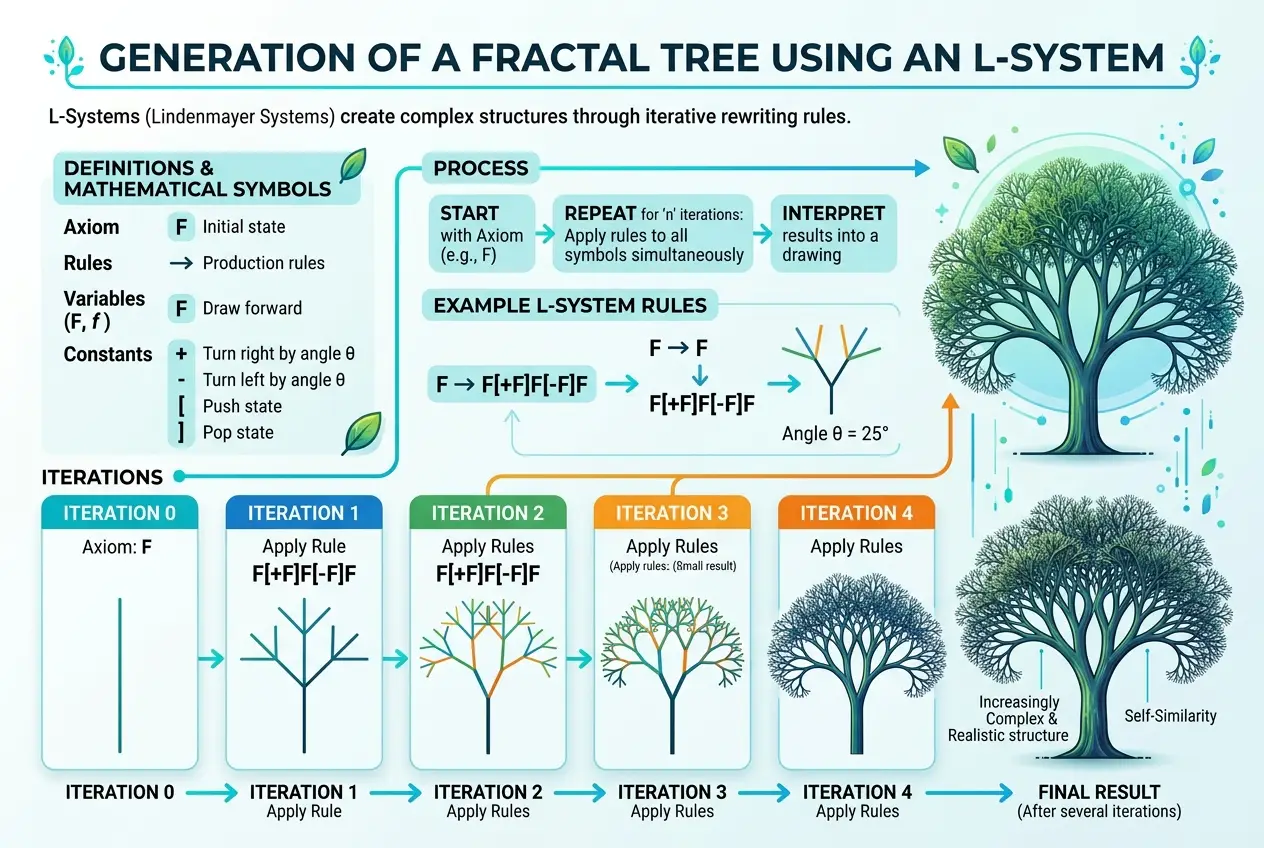
Consider the L-system (Lindenmayer system), a formal grammar developed in 1968 by Aristid Lindenmayer. It's used to model the growth processes of plants and other biological structures. An L-system starts with a simple "axiom" (e.g., a single stem) and applies a set of "production rules" recursively (e.g., "replace a stem with a stem that branches left and right"). By iterating these rules, stunningly realistic fractal plant structures emerge. This demonstrates how complex biological forms can arise from simple, algorithmic instructions. It's like nature has its own low-level programming language, and fractals are the output.
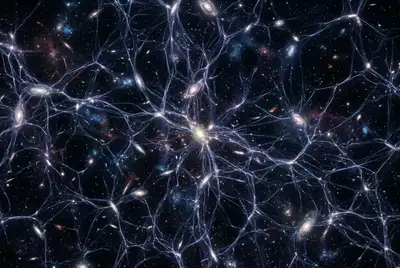
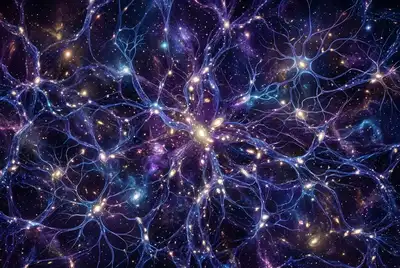
This algorithmic perspective makes me wonder if our own universe might function similarly. We often discuss the universe as a giant computer or a neural network. If so, fractals could be the foundational code – the recurring subroutines that build everything from galaxies to subatomic particles. It's a concept I explored in a previous blog post, "Is the Universe a Giant Neural Network?" which you can read at [Is the Universe a Giant Neural Network?](https://curiositydiaries.com/blogs/is-the-universe-a-giant-neural-network-2907).
**Beyond Aesthetics: Function and Efficiency**
Fractals aren’t just pretty; they are incredibly functional. Their self-similar, space-filling properties offer optimal solutions for various natural processes:
* **Maximizing Surface Area:** The fractal branching of lungs maximizes the surface area for oxygen exchange, while the intricate folds of the small intestine increase nutrient absorption.
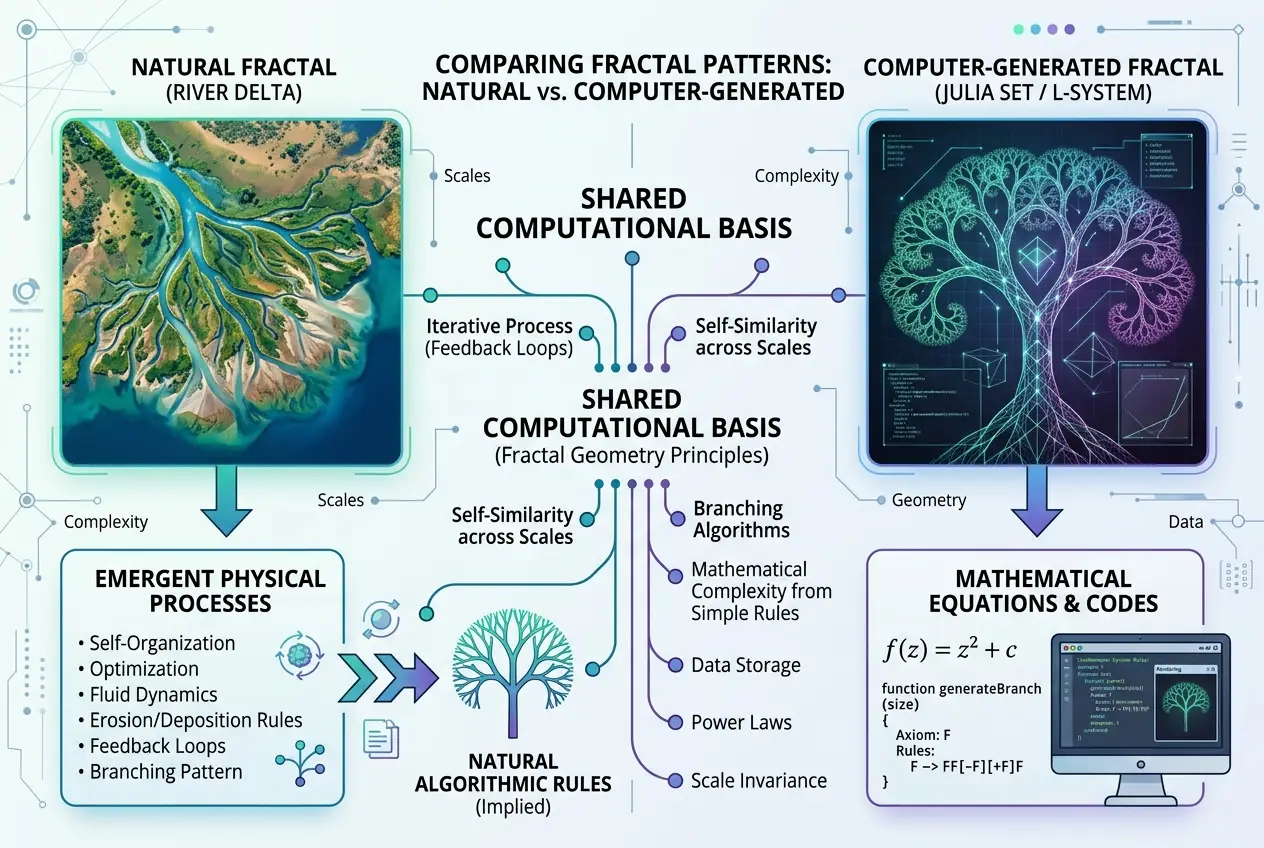
* **Efficient Transport:** Blood vessels, nerve cells, and even river deltas use fractal patterns to efficiently distribute resources or information throughout a given space.
* **Robustness:** A system built on fractal principles can be remarkably resilient. If one part of a fractal network is damaged, the overall structure often retains much of its functionality due to redundancy and self-similarity.
This efficiency hints at an underlying design principle, a universal "best practice" that nature instinctively follows. It’s as if the universe is running a highly optimized operating system, and fractals are a core component of its architecture.
**The Role of Chaos Theory**
While fractals may seem to represent order, they are deeply intertwined with **Chaos Theory**. Chaos theory deals with complex systems whose behavior is highly sensitive to initial conditions – often referred to as the "butterfly effect." Within these chaotic systems, however, fractals often emerge as basins of attraction or strange attractors, revealing underlying order amidst the apparent randomness.
One of the most famous examples is the [Mandelbrot Set](https://en.wikipedia.org/wiki/Mandelbrot_set) itself, a stunning fractal generated by a simple equation iterated repeatedly. Zooming into its complex boundaries reveals an infinite array of miniature Mandelbrot sets and other intricate patterns. This illustrates that deep within what might seem chaotic, there’s a deterministic process generating incredible, structured complexity. It makes me question if what we perceive as cosmic "chaos" might actually be governed by these unseen, fractal algorithms.
**Decoding Nature's "Source Code"**
If fractals are indeed manifestations of universal algorithms, what implications does this have for our understanding of reality, technology, and even biology?
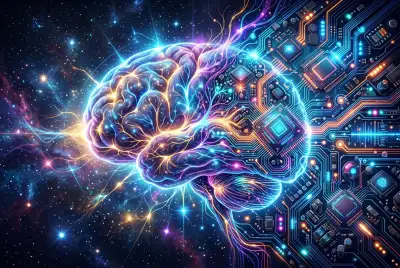
* **Biomimicry and AI:** Engineers and AI designers are increasingly turning to fractal patterns to create more efficient antennas, solar cells, and even neural networks. By mimicking nature’s algorithms, we can build more resilient and optimized technologies.
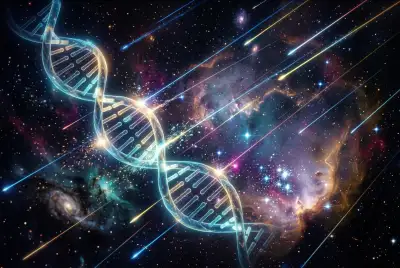
* **Understanding Life:** Could the genetic code itself be a fractal algorithm, with genes expressing themselves in self-similar, recursive ways across different scales of an organism’s development? Some researchers suggest that the way DNA folds and expresses might exhibit fractal characteristics. Our understanding of how living organisms compute might be key to unlocking these secrets, a topic we touched upon in "[Can Living Organisms Compute? The Rise of Biocomputing](https://curiositydiaries.com/blogs/can-living-organisms-compute-the-rise-of-biocomputing-5626)".
* **Cosmic Data Storage:** If universal algorithms govern fractal formation, could these patterns hold information about the universe's history or even its future trajectory? It’s a bold thought, suggesting that the very fabric of reality is encoded with data.
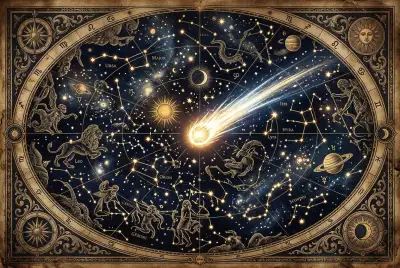
Consider the intriguing possibility that ancient cultures, through their deep observation of nature, might have intuitively grasped these hidden patterns. While they lacked the mathematical framework of Mandelbrot, their art, architecture, and cosmologies often display geometric patterns that resonate with fractal principles. Perhaps they were trying to decode nature's hidden sounds, as discussed in "[Did Ancient Cultures Decode Nature's Hidden Sounds?](https://curiositydiaries.com/blogs/did-ancient-cultures-decode-natures-hidden-sounds-8216)".
**The Search for a Universal Blueprint**
The study of fractals and their algorithmic underpinnings pushes the boundaries of our scientific understanding. It suggests that the universe isn't just a collection of random objects, but a dynamic system governed by elegant, recursive rules that generate immense complexity from simplicity.
Could it be that the grand symphony of the cosmos, from the smallest quantum foam to the largest galactic superclusters, is merely the playing out of a colossal, fractal algorithm? If so, every tree, every cloud, every coastline becomes a tiny, observable piece of the universe's ultimate source code, inviting us to decode its secrets. As we continue to explore the universe, from the quantum realm to the farthest galaxies, the fractal lens offers a powerful new way to perceive the intrinsic order and algorithmic beauty that binds it all together.
Frequently Asked Questions
Fractals are mathematical constructs, but they are also ubiquitous in the real world. Natural phenomena like coastlines, tree branches, snowflakes, lightning, river networks, and even the branching of our own circulatory and respiratory systems exhibit fractal characteristics, displaying self-similarity across different scales.
Fractals are generated through iterative processes following simple rules. This recursive, step-by-step nature is essentially an algorithm. For instance, the growth of a plant can be modeled by an L-system, which is a set of algorithmic instructions that, when repeatedly applied, generate complex fractal structures.
Fractals often emerge from chaotic systems. While chaos theory describes systems highly sensitive to initial conditions (the 'butterfly effect'), fractals provide a geometric representation of the underlying order within these seemingly unpredictable behaviors. Chaotic systems often produce 'strange attractors' that are fractal in nature, showing patterned behavior amidst the unpredictability.
Absolutely! Artists, architects, and engineers utilize fractal geometry in various fields. Fractal designs are used in computer graphics, art, music, and even in engineering to create more efficient antennas (fractal antennas), self-similar solar cells, and complex network designs. The Mandelbrot set is a prime example of a fractal generated by a simple mathematical formula.
Understanding nature's fractal algorithms could lead to revolutionary advancements in technology. This includes designing more efficient and robust communication networks, developing new materials with unique properties, creating more realistic AI simulations, and even potentially unlocking deeper insights into biological computing and the fundamental operating principles of the universe.
Verified Expert
Alex Rivers
A professional researcher since age twelve, I delve into mysteries and ignite curiosity by presenting an array of compelling possibilities. I will heighten your curiosity, but by the end, you will possess profound knowledge.
Leave a Reply
Comments (0)
No approved comments yet. Be the first to share your thoughts!
 Join Us
 Unknown Author



Leave a Reply
Comments (0)