


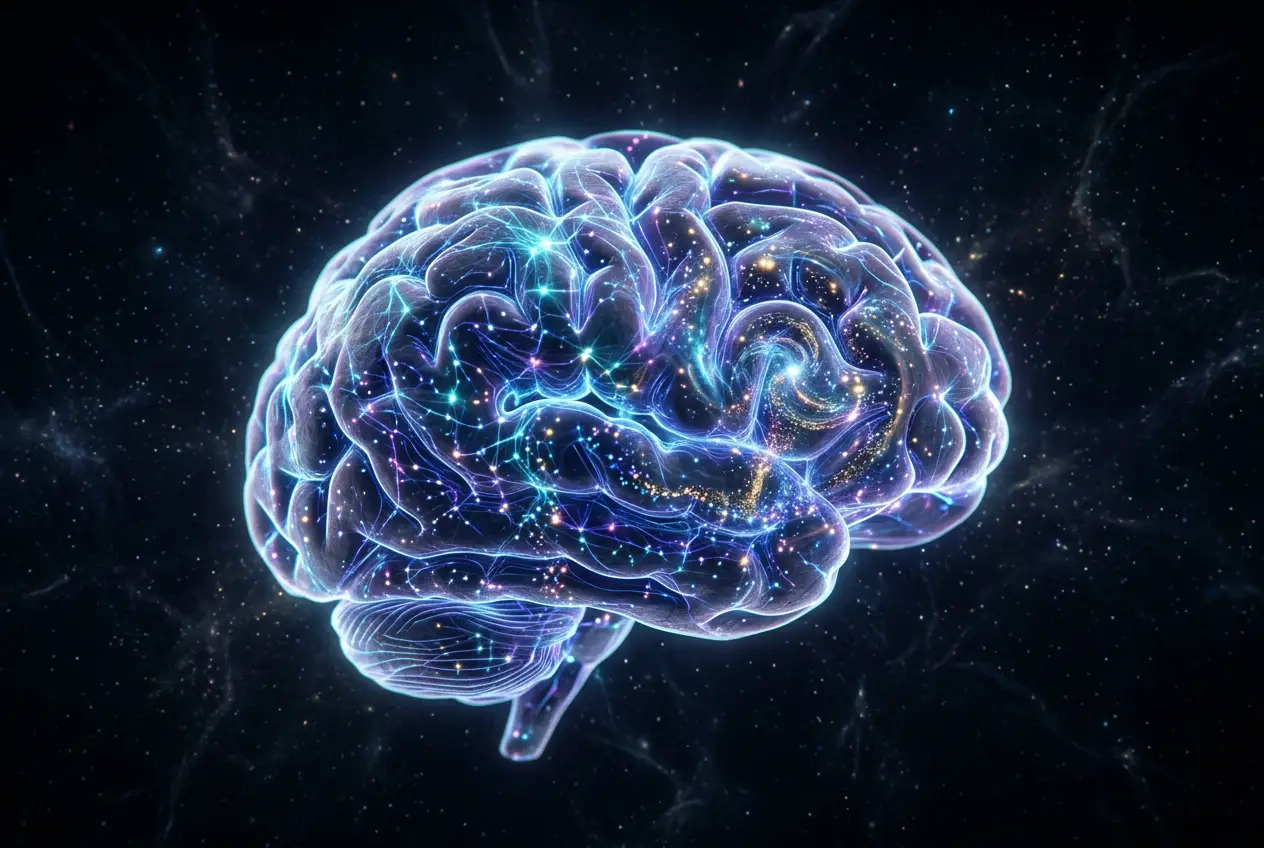
I often find myself lost in thought, pondering the incredible complexity of the human brain. It’s a biological marvel, a three-pound organ that orchestrates everything from our simplest reflexes to our most profound philosophical musings. For centuries, we’ve understood the brain primarily through the lens of classical physics: a vast network of neurons firing electrochemical signals, much like an intricate, organic supercomputer. But what if this classical view is incomplete? What if the brain, particularly our consciousness, taps into something far more fundamental, something that operates at the very edge of reality – the realm of quantum mechanics?
It's a question that has intrigued me, and many scientists and thinkers, for decades: could our brain be a quantum machine? The idea itself sounds like science fiction, conjuring images of teleporting thoughts or entangled memories. Yet, the possibility that quantum phenomena might play a role in brain function is not as outlandish as it first seems. It hints at a deeper, more profound understanding of consciousness, memory, and even free will, pushing the boundaries of what we consider possible for a biological system.
The Classical Brain: A Biological Supercomputer
Before we dive into the quantum depths, let's establish the conventional understanding. Our brains are astounding classical machines. They consist of approximately 86 billion neurons, each capable of forming thousands of connections, or synapses, with other neurons. Information is transmitted through electrical impulses (action potentials) and chemical neurotransmitters, creating intricate neural circuits that allow us to perceive, think, feel, and act. This electrochemical activity forms the basis of what we generally understand as brain function.
When we consider the brain as a classical computer, it excels at parallel processing, pattern recognition, and adapting to new information. Artificial intelligence, in many ways, seeks to replicate these classical computational aspects of the brain. However, despite rapid advancements in AI and our growing ability to simulate neural networks, we still struggle to fully replicate certain aspects of human cognition, especially the elusive nature of consciousness itself. This challenge leads some researchers to wonder if there’s a missing piece in our classical puzzle, a fundamental mechanism we haven't yet accounted for. Perhaps the answer lies in understanding how we can even upload our memories or consciousness to external systems, a concept explored in discussions about technologies like brain-computer interfaces. If you’re curious about the potential of such advancements, you might want to read more about whether brain interfaces can upload our memories at can-brain-interfaces-upload-our-memories-9476.
Entering the Quantum Realm: Why It Matters
Quantum mechanics is the physics of the very small – atoms and subatomic particles. At this scale, the rules of the classical world break down. Particles can exist in multiple states simultaneously (superposition) or become interconnected in such a way that they share the same fate instantly, regardless of distance (entanglement). These phenomena are what make quantum computers so powerful, capable of performing calculations far beyond the reach of even the fastest supercomputers. If you've ever wondered why quantum computers are considered exponentially faster, you can delve deeper into why quantum computers are mind-bogglingly faster than supercomputers at why-quantum-computers-are-mind-bogglingly-faster-than-supercomputers-9423.
The idea that quantum mechanics might play a role in biology, specifically in brain function, is part of a burgeoning field called quantum biology. It proposes that certain biological processes might leverage quantum effects to achieve efficiencies or capabilities that classical physics cannot explain. Examples range from photosynthesis (where light energy is transferred with quantum efficiency) to bird navigation (which might involve quantum entanglement to detect magnetic fields). If simple organisms can harness these strange effects, why not the most complex known biological system – the human brain?
The Orchestrated Objective Reduction (Orch OR) Theory
One of the most prominent theories suggesting a quantum brain is the Orchestrated Objective Reduction (Orch OR) theory, proposed by British physicist Sir Roger Penrose and American anesthesiologist Stuart Hameroff. This theory isn't just about quantum effects happening somewhere in the brain; it posits a specific mechanism and location.
Penrose, a Nobel laureate, initially argued that consciousness involves non-computable processes, meaning they cannot be fully explained by classical algorithms. He suggested that consciousness might arise from quantum gravity effects occurring at a fundamental level. Hameroff, on the other hand, brought his expertise in biology, identifying microtubules as potential candidates for quantum processing within neurons.
Microtubules are tiny, hollow protein cylinders that form part of the cytoskeleton, providing structural support and transport within cells. Hameroff proposed that these microtubules, particularly their protein subunits (tubulins), could support quantum superpositions and entanglement. The Orch OR theory suggests that these quantum states within microtubules periodically undergo "objective reduction," a self-collapse of the quantum wave function, which Penrose links to his theory of quantum gravity. This objective reduction, happening at specific moments, is hypothesized to be the fundamental process underlying moments of conscious awareness and decision-making.
As Hameroff and Penrose explain, "Orchestrated objective reduction (Orch OR) posits that consciousness involves sequences of orchestrated (by synaptic inputs and memory) ‘objective reductions’ (ORs) of quantum superpositions of microtubule protein conformations within neurons" (Source: Consciousness and the Universe: Quantum Physics, Evolution, Brain, and Mind, 2014). This complex interplay of classical synaptic input and quantum processing within the cell’s internal structure offers a radically different perspective on how our subjective experience of reality emerges.
Challenges and Criticisms
The Orch OR theory, while fascinating, faces significant skepticism and criticism within the scientific community. The primary challenge lies in the decoherence problem. Quantum states are notoriously fragile; they quickly "decohere" (lose their quantum properties) when exposed to a warm, wet, and noisy environment like the human brain. The brain operates at body temperature, a far cry from the near-absolute-zero temperatures required for most quantum computing experiments. Critics argue that any quantum coherence within microtubules would break down almost instantaneously, long before any meaningful computation or "objective reduction" could occur.
Another point of contention is the lack of direct experimental evidence. While some studies have explored quantum effects in biological systems (e.g., in olfaction or DNA mutation), none have definitively shown quantum processes directly driving consciousness in the brain. The Orch OR theory remains largely speculative, awaiting empirical validation that can bridge the gap between theoretical physics and observable neuroscience. As an article on Wikipedia discusses, "Orch OR has been criticised from the outset by physicists and neuroscientists who claim that the brain is too 'warm, wet, and noisy' to sustain coherent quantum processes" (Source: Wikipedia on Orchestrated Objective Reduction (opens in a new tab)).
Emerging Evidence for Quantum Biology
Despite the skepticism, the field of quantum biology is gaining traction, and new research is exploring how biological systems might protect and utilize quantum effects. Some studies suggest that certain proteins and structures could act as "quantum shields," allowing coherence to persist for longer than previously thought. For instance, the phenomenon of quantum tunneling is known to occur in enzyme reactions, increasing their efficiency.
While direct evidence for quantum effects in consciousness is still elusive, the possibility is too profound to ignore. If proven, it could revolutionize our understanding of consciousness, blurring the lines between mind and matter, and potentially offering insights into the very nature of reality itself. It could also influence the development of next-generation AI, moving beyond classical computational models to embrace genuinely quantum-inspired architectures. For further context on fundamental quantum concepts like entanglement and their broader implications, exploring topics such as whether quantum entanglement connects parallel universes can be insightful at does-quantum-entanglement-connect-parallel-universes-7602.
What This Means for Our Understanding of the Mind
If our brain is indeed a quantum machine, even in part, the implications are staggering. It could suggest that:
- Consciousness is not purely an emergent property of classical computation: It might involve fundamental, irreducible quantum processes.
- Free will might have a quantum basis: The indeterminacy inherent in quantum mechanics could provide a physical mechanism for genuine choice, rather than purely deterministic classical responses.
- New avenues for AI research: Understanding quantum processes in the brain could inspire novel quantum computing paradigms, leading to genuinely conscious AI, or at least AI that mimics these complex non-classical thought processes.
- A deeper connection to the universe: Penrose's original idea connects consciousness to the fundamental structure of space-time, suggesting our minds might be intricately linked to the very fabric of reality at the deepest level, going beyond the classical understanding of how information is processed. This perspective aligns with broader discussions about the universe’s underlying physics. A good overview of quantum mechanics can be found on Wikipedia on Quantum Mechanics (opens in a new tab), and for classical physics, Wikipedia on Classical Mechanics (opens in a new tab) provides foundational understanding.
The journey to unravel the mysteries of the brain is far from over. While the classical electrochemical model remains the dominant paradigm, the quantum brain hypothesis offers an exhilarating, albeit challenging, alternative. It reminds me that the universe, and indeed our own minds, hold secrets far stranger and more wonderful than we can currently imagine. Whether through future experiments or theoretical breakthroughs, the question of whether our brain is a quantum machine continues to push the boundaries of science, inviting us to look beyond the obvious and embrace the truly curious.





Conversation0
No comments yet. Be the first to share a thought — the best questions often become new stories.