


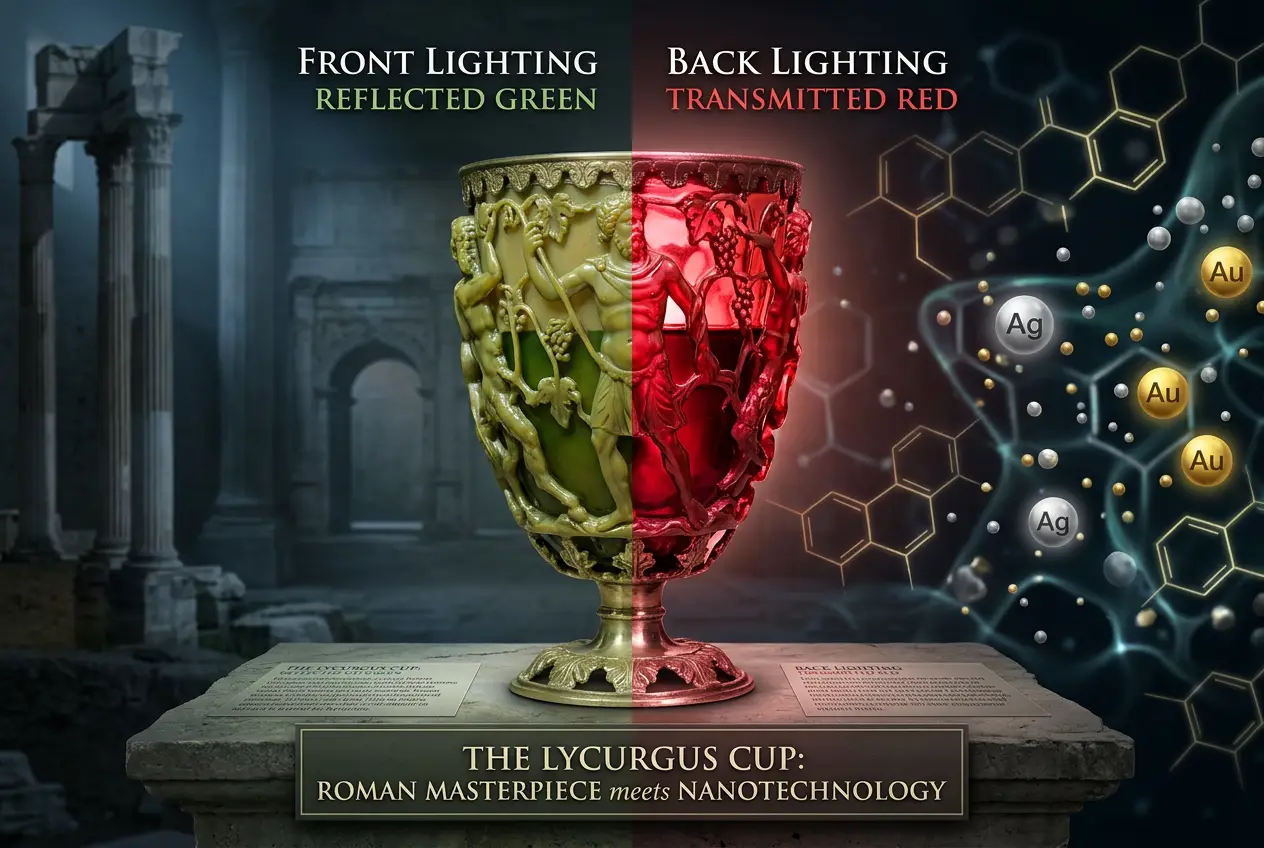
I remember the first time I saw a picture of the Lycurgus Cup. It was simply baffling. Here was an ancient Roman goblet, crafted nearly two millennia ago, that seemed to possess a magical quality: it changes color depending on how light hits it. From the front, it glows a jade green, but illuminate it from behind, and it transforms into a rich, translucent ruby red. For years, this artifact mystified historians and scientists alike, a testament to ancient Roman artistry, but also, as we’ve come to understand, a profound, almost unbelievable example of early nanotechnology.
It makes you wonder, doesn't it? Could the Romans, with their aqueducts, mighty legions, and intricate mosaics, have inadvertently stumbled upon, or perhaps even understood, principles that we only fully grasp with the advent of modern quantum physics and advanced material science? The Lycurgus Cup isn't just a beautiful piece of art; it's a silent, sparkling question mark from the past, challenging our assumptions about ancient capabilities.
The Riddle of the Lycurgus Cup
Discovered in the 19th century, the Lycurgus Cup is a cage cup (or diatretum) crafted from dichroic glass, depicting the mythical King Lycurgus ensnared by Dionysus and his followers. Its intricate design alone is a marvel, showing incredible skill in glasswork. But it was the cup's peculiar optical properties that truly set it apart. For centuries, nobody could fully explain how this color change occurred. It wasn't merely a trick of pigment or layering; the entire glass matrix seemed to shift its light absorption and reflection properties.
Imagine holding this cup in your hands in a dimly lit Roman villa. One moment, it’s a regal green, perhaps reflecting the verdant gardens outside. The next, as a torch is moved behind it, it blazes an intense red, almost as if it holds a tiny, captive sun. This isn’t simple refraction or a stained-glass effect; it’s something far more sophisticated, a property known as dichroism. You can delve deeper into the fascinating world of such optical phenomena on Wikipedia's page about Dichroism (opens in a new tab).
Unveiling the Nanoparticle Secret
The true secret of the Lycurgus Cup wasn't revealed until the 1990s, when researchers at the British Museum meticulously analyzed fragments of the cup using electron microscopy. What they found was astonishing: embedded within the glass were nanoparticles of gold and silver. These weren't just specks; they were precisely sized and distributed, ranging from about 50 to 100 nanometers in diameter. For context, a human hair is about 80,000 to 100,000 nanometers thick. This means the Roman artisans were working with materials at a scale far beyond anything we typically associate with ancient technology.
The presence of these metallic nanoparticles is what gives the cup its remarkable dichroic properties. When light strikes the cup from the front, the silver and gold nanoparticles scatter the green light wavelengths and absorb others, making the cup appear green. However, when light shines through the cup from behind, the nanoparticles allow the red light wavelengths to pass through, resulting in the ruby-red glow.
This phenomenon is known as Surface Plasmon Resonance (SPR), or more broadly, plasmonics. It’s a quantum mechanical effect where the free electrons in the metallic nanoparticles oscillate in resonance with the incident light. The size, shape, and spacing of these nanoparticles determine which wavelengths of light are scattered, absorbed, or transmitted. Modern science harnesses these principles in advanced fields like biosensing, medical diagnostics, and even next-generation displays. If you're curious about the intricate science, the Wikipedia article on Surface Plasmon Resonance (opens in a new tab) offers a detailed explanation.
Ancient Artisans or Accidental Nanotechnologists?
The million-dollar question then becomes: Did the Romans know what they were doing? Did they possess an understanding of material science so advanced that it borders on what we consider "quantum tech" today? Or was it an incredibly fortunate accident, a mastery achieved through generations of empirical trial and error?
I believe the truth likely lies somewhere in between. It's improbable that Roman artisans had a theoretical understanding of quantum mechanics or even the concept of a nanometer. They wouldn't have known about electron oscillations or plasmon resonance. However, their practical expertise in glassmaking was extraordinary. Roman glassmakers were true masters of their craft, constantly experimenting with different metal salts and compounds to achieve specific colors and effects.
Consider the incredible skill required to embed such tiny, precise particles into a glass matrix. This wasn't a simple recipe; it involved careful control of temperature, cooling rates, and the composition of the raw materials. It's possible they developed empirical methods, passed down through generations, that allowed them to consistently produce glass with these properties, even if they didn't understand the underlying atomic-level physics. They knew what worked, even if they didn't know why. This kind of practical knowledge without full theoretical understanding wasn't uncommon in ancient civilizations, as we've seen with other complex technologies like those discussed in our blog about the possibility of [/blogs/did-ancient-metals-have-self-healing-powers-4250](Did Ancient Metals Have Self-Healing Powers?).
The Lycurgus Cup isn't an isolated anomaly in ancient glassmaking. Roman glass was incredibly versatile, ranging from translucent everyday ware to intricate mosaic pieces. We've even explored other aspects of their material science prowess, such as the mysterious properties of [/blogs/flexible-glass-did-romans-master-lost-material-science-8230](Flexible Glass: Did Romans Master Lost Material Science?). The precision required for the Lycurgus Cup suggests a highly sophisticated understanding of material manipulation.
Quantum Dots Before Quantum Mechanics
Today, we use similar principles in quantum dots – semiconductor nanocrystals that emit light of specific wavelengths when excited, depending on their size. These are revolutionizing displays, solar cells, and biological imaging. The Lycurgus Cup's use of metallic nanoparticles to control light interaction is an analogous application, placing Roman artisans centuries ahead of their time in a practical sense.
| Feature | Lycurgus Cup (Roman) | Modern Nanotechnology (e.g., Quantum Dots) |
|---|---|---|
| Primary Material | Gold and silver nanoparticles in glass | Semiconductor nanocrystals (e.g., CdSe) |
| Size Scale | 50-100 nanometers | 2-10 nanometers |
| Optical Effect | Dichroism (color changes based on light direction due to SPR) | Emits specific colors based on size (quantum confinement) |
| Understanding | Empirical, trial-and-error, practical mastery | Theoretical (quantum mechanics), precise engineering |
| Intent/Application | Artistic, decorative, possibly ritualistic | Displays, solar cells, biosensors, medicine |
| Technological Leap | Accidental or intuitive plasmonics | Deliberate engineering of quantum effects |
This table highlights the incredible parallel. The Romans, without the language of physics, achieved a functional outcome that echoes modern discoveries. It's a testament to human ingenuity across millennia. This intersection of ancient craft and cutting-edge science continues to be a rich area of study, often revealing surprising connections, as we saw in our discussion on [/blogs/nano-glass-did-romans-master-ancient-color-shifting-tech-6816](Nano-Glass: Did Romans Master Ancient Color-Shifting Tech?).
The Legacy of Ancient Innovation
The Lycurgus Cup stands as a powerful reminder that "advanced" is a relative term. What we consider groundbreaking today might have ancient roots, albeit developed through different methodologies. It forces us to reconsider the sophistication of ancient civilizations and their capacity for material science. While they may not have wielded scanning electron microscopes, their empirical knowledge and artisanal skill led them to create objects that still baffle and inspire us.
In a world increasingly driven by nanotechnology – the manipulation of matter on an atomic and molecular scale – the Lycurgus Cup serves as a historical benchmark. It shows that the human quest to understand and control materials for specific properties isn't new. It’s an ancient impulse, expressed with remarkable success by the Romans. Learning more about this ancient art and science can profoundly shift our perspective on the history of technology and innovation, reminding us that breakthroughs often come from unexpected places and times. You can explore the broader history and applications of Nanotechnology (opens in a new tab) on Wikipedia.
The Lycurgus Cup truly is an "impossible artifact" in many ways, a piece of ancient Roman brilliance that feels strangely futuristic. It reminds us that history is not a linear progression of discovery but a winding path filled with forgotten knowledge and unexpected leaps of ingenuity. What other secrets are still hidden within the artifacts of our past, waiting for modern science to unlock their true stories?




Conversation0
No comments yet. Be the first to share a thought — the best questions often become new stories.