


Imagine a world where electricity flows without resistance, where powerful magnets levitate objects effortlessly, and energy is transmitted with near-perfect efficiency. This isn't a scene from a distant future; it's the reality promised by superconductors, materials that conduct electricity with zero resistance below a certain critical temperature. The implications for modern technology – from maglev trains and lossless power grids to advanced quantum computing – are revolutionary. But what if this seemingly futuristic technology isn't so new after all? What if ancient civilizations, through empirical knowledge or accidental discovery, stumbled upon the secrets of superconductivity, forging materials with properties we are only now beginning to fully grasp?
The very idea sounds like something out of a historical fiction novel, yet the more I delve into the fascinating world of ancient metallurgy and unexplained artifacts, the more I ponder the hidden depths of their knowledge. We often underestimate the ingenuity of our ancestors, quick to dismiss their achievements as primitive when, in many cases, their understanding of materials and processes was astonishingly sophisticated.
Unearthing Ancient Ingenuity: Beyond the Obvious
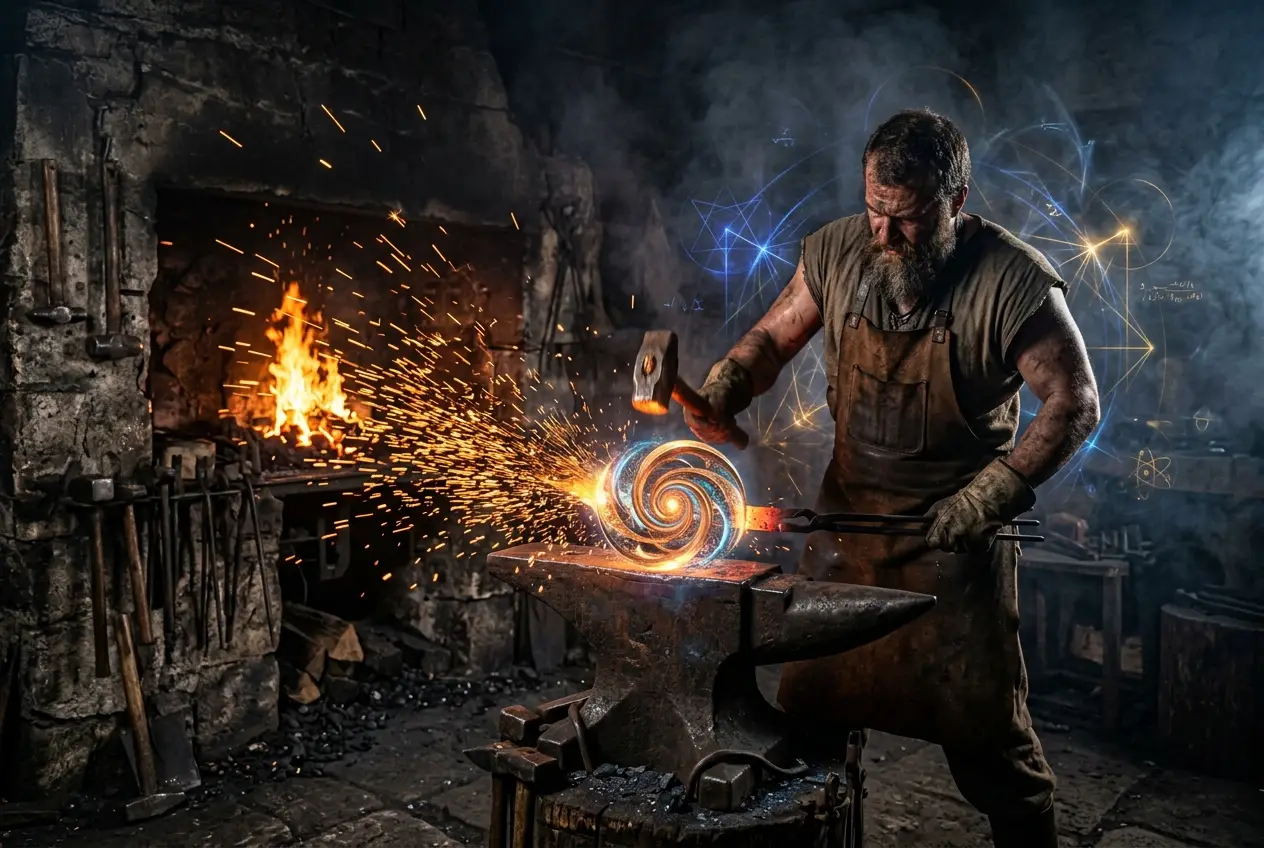
For centuries, the narrative of technological progress has been a linear one, with each era building incrementally on the last. However, archaeological discoveries frequently challenge this view, revealing pockets of advanced knowledge that seem to defy their historical context. Consider the incredible strength and flexibility of Damascus steel, whose legendary qualities were once attributed to magical properties but are now understood to be the result of a complex, nanostructured internal composition achieved through precise heating and cooling cycles. For more on this fascinating material, you might enjoy exploring this article: Damascus Steel: Did Ancient Smiths Use Nanotech?
Similarly, Roman concrete, used in structures like the Pantheon, has proven to be remarkably durable, even self-healing, thanks to specific volcanic ash mixtures that continue to react over millennia. This level of material science, achieved without modern microscopes or chemical analysis, speaks volumes about their empirical mastery. Learn more about this marvel of ancient engineering here: Roman Concrete: Did Ancients Engineer Self-Healing Tech? These examples compel me to ask: if such complex material properties were discovered and utilized, could something as profound as superconductivity also have been within their grasp, perhaps inadvertently?
The Spark of Superconductivity: A Modern Marvel
Before we explore the ancient possibilities, let's briefly touch on what superconductivity entails. At its core, a superconductor is a material that, when cooled below a specific critical temperature (Tc), exhibits two remarkable properties:
- Zero Electrical Resistance: Electricity flows through it without any energy loss. This is unlike conventional conductors where electrons encounter resistance, generating heat.
- Meissner Effect: Superconductors expel magnetic fields. If you place a magnet above a superconductor cooled below its Tc, the magnet will levitate due to the expulsion of its magnetic field. This perfect diamagnetism is a hallmark of the superconducting state.
The discovery of superconductivity in 1911 by Heike Kamerlingh Onnes, observing mercury's resistance drop to zero at 4.2 Kelvin (-269 °C), was a monumental achievement of modern physics. Since then, scientists have been on a relentless quest to find materials that superconduct at higher temperatures, ideally room temperature, which remains the "holy grail" of material science. You can delve deeper into this quest by reading: Is Room-Temp Superconductivity Real? Tech's Holy Grail.
Whispers from the Past: Clues in Ancient Alloys?
The challenge with proposing ancient superconductors is the extreme conditions usually required – super-cold temperatures. Ancient civilizations certainly didn't have liquid nitrogen. However, some materials exhibit "high-temperature" superconductivity (relative to other superconductors, still very cold by human standards, but higher than liquid helium). Could certain alloys or impurities in ancient metals have created micro-regions with anomalous electrical or magnetic properties?
Consider the following indirect "clues" or areas of inquiry:
- Unusual Durability and Conductivity: Some ancient alloys, particularly those used in ceremonial or sacred objects, exhibit extraordinary resistance to corrosion or an unexpected electrical conductivity for their time. While not direct evidence of superconductivity, it points to a deep, perhaps empirically derived, understanding of how to manipulate material properties.
- "Orichalcum" and Lost Metals: Ancient texts, most notably Plato's description of Atlantis, mention a mysterious metal called Orichalcum, said to possess unique properties, including a reddish glow. While highly speculative, the idea of "lost metals" with unusual characteristics persists in metallurgical history. Could some of these properties have been linked to an early understanding of materials with unexpected electrical or magnetic behaviors? For a deeper look into such legends, check out: Orichalcum: Did Ancients Forge a Lost Supermetal?
- Symbolic Use of Metals with Unique Luster/Color: The aesthetic properties of metals, such as specific lusters or colors, were often imbued with symbolic or divine significance. Could certain alchemical-like processes, aimed at achieving these visual traits, have inadvertently created materials with anomalous electrical or magnetic properties at certain temperatures, even if those temperatures were only achievable in specific, limited environments (e.g., cold mountain streams, deep mines)?
It's important to differentiate between actual superconductivity and simply highly conductive metals. Copper and silver are excellent conductors, but they are not superconductors. The key lies in zero resistance and the Meissner effect. Finding evidence of the latter in ancient artifacts would be a true game-changer.
The Science of Discovery: How Could We Know?
Without a time machine, proving that ancient artisans created superconductors is incredibly difficult. However, modern analytical techniques offer tantalizing possibilities:
Non-Destructive Analysis
- Scanning Electron Microscopy (SEM) & Transmission Electron Microscopy (TEM): These tools can reveal the microstructure of ancient alloys at an atomic level, identifying unusual crystal structures, nanometer-scale inclusions, or unique grain boundaries that might be conducive to exotic electronic properties.
- X-ray Diffraction (XRD) & X-ray Fluorescence (XRF): These methods can precisely determine the elemental composition and crystalline phases of ancient metals, helping to identify unusual combinations or unexpected purity levels that might hint at advanced processes.
- Magnetic Susceptibility Measurements: Modern magnetometers could detect weak diamagnetic responses in ancient metal artifacts when cooled, which would be a powerful indicator of the Meissner effect, even if the material is not a "perfect" superconductor at higher temperatures.
Hypothetical Conditions & Accidental Discoveries
The most plausible scenario for ancient "superconductors" would likely involve accidental discovery through empirical trial-and-error, coupled with unique local environmental conditions.
- High Purity and Specific Impurities: Certain ancient smelting processes might have inadvertently produced extremely pure metals or introduced specific trace impurities (e.g., lead, mercury compounds, specific rare earths) that, when combined with a base metal, could create a superconducting alloy. Many superconductors today rely on precise mixtures of elements.
- Pressure Forging: Extreme pressure forging techniques, known to be employed by some ancient cultures to densify metals, could alter crystal structures in ways that might favor superconductivity in some alloys.
- Natural Cold Environments: While liquid nitrogen wasn't available, specific geographical locations (e.g., high-altitude mountain regions, deep caves, or regions with permafrost) might have provided pockets of sufficiently low temperatures for brief periods, allowing early artisans to observe anomalous magnetic or electrical behavior in certain metals. Imagine a unique alloy accidentally dropped into a glacial stream or buried in permafrost, exhibiting strange levitational properties when retrieved.
It’s not just about the final composition, but the entire process. Just as in modern material science, the thermal history, cooling rates, and mechanical working of a metal can drastically alter its final properties.
The Broader Implications
If compelling evidence for ancient superconductors were ever found, it would rewrite significant chapters of human history and material science.
- Re-evaluating Ancient Knowledge: It would force us to profoundly re-evaluate the scientific and technological capabilities of ancient civilizations, suggesting a far more sophisticated understanding of the material world than currently acknowledged. It might imply a deeper connection between empirical observation and material properties than we give credit for.
- Lost Technologies: It would open the door to the possibility of other lost technologies, perhaps inspiring new avenues for research into historical artifacts and texts, including the nature of exotic materials (opens in a new tab) and their potential applications.
- Inspiration for Modern Science: Such a discovery could even provide new leads for modern researchers in their quest for room-temperature superconductors. Perhaps the answers lie not in complex quantum theories alone, but also in forgotten empirical methods of material manipulation. Even ancient dyes, as some researchers suggest, might have possessed unexpected quantum properties.
Conclusion: A Continuous Quest for Lost Wisdom
The notion of ancient superconductors is, for now, firmly in the realm of speculation and curiosity. However, it's a speculation grounded in the demonstrable fact that ancient artisans often achieved metallurgical feats that astonish us even today. The human capacity for observation, experimentation, and empirical discovery is timeless. As our analytical tools become more sophisticated, perhaps one day we will uncover an artifact that whispers tales not just of an ancient civilization, but of a forgotten age of material mastery, where lost alloys defied the known laws of physics for their time. The quest for knowledge about our past, like the pursuit of superconductors, is a continuous journey into the unknown, promising unexpected revelations.




Conversation0
No comments yet. Be the first to share a thought — the best questions often become new stories.