The world of computing has always been a race against the clock, pushing the boundaries of what’s possible with silicon and electrons. For decades, we've relied on the steady march of Moore's Law, shrinking transistors and cramming more processing power into ever-smaller spaces. But what if the very medium we use for computation could be reimagined? What if, instead of electrons in silicon, we could harness something as ethereal and swift as light, but make it behave like a liquid? It sounds like science fiction, a concept pulled from a visionary's fever dream, yet the phenomenon known as "liquid light" is a very real, captivating area of research that could fundamentally redefine our digital future.
Imagine a stream of light that, when it interacts with matter in a specific way, forms a hybrid particle, half-light and half-matter. These peculiar entities, called **exciton-polaritons**, don't just exist; under the right conditions, they can condense into a super-fluid state, moving without friction, literally flowing like a quantum liquid. I find this concept truly mind-boggling—light, typically seen as a beam of individual photons, transforming into something that mimics a fluid, complete with vortices and ripples. This isn't just a fascinating laboratory curiosity; it holds immense promise for next-generation computing, offering pathways to ultra-fast, energy-efficient devices that could leave our current silicon chips in the dust.
### The Curious Case of Exciton-Polaritons
At the heart of "liquid light" are exciton-polaritons. To understand them, we first need to briefly touch on their constituents: excitons and photons.
* **Photons:** These are the elementary particles of light, traveling at the speed of light, carrying electromagnetic energy. They are bosons and typically don't interact with each other in a significant way under normal circumstances.
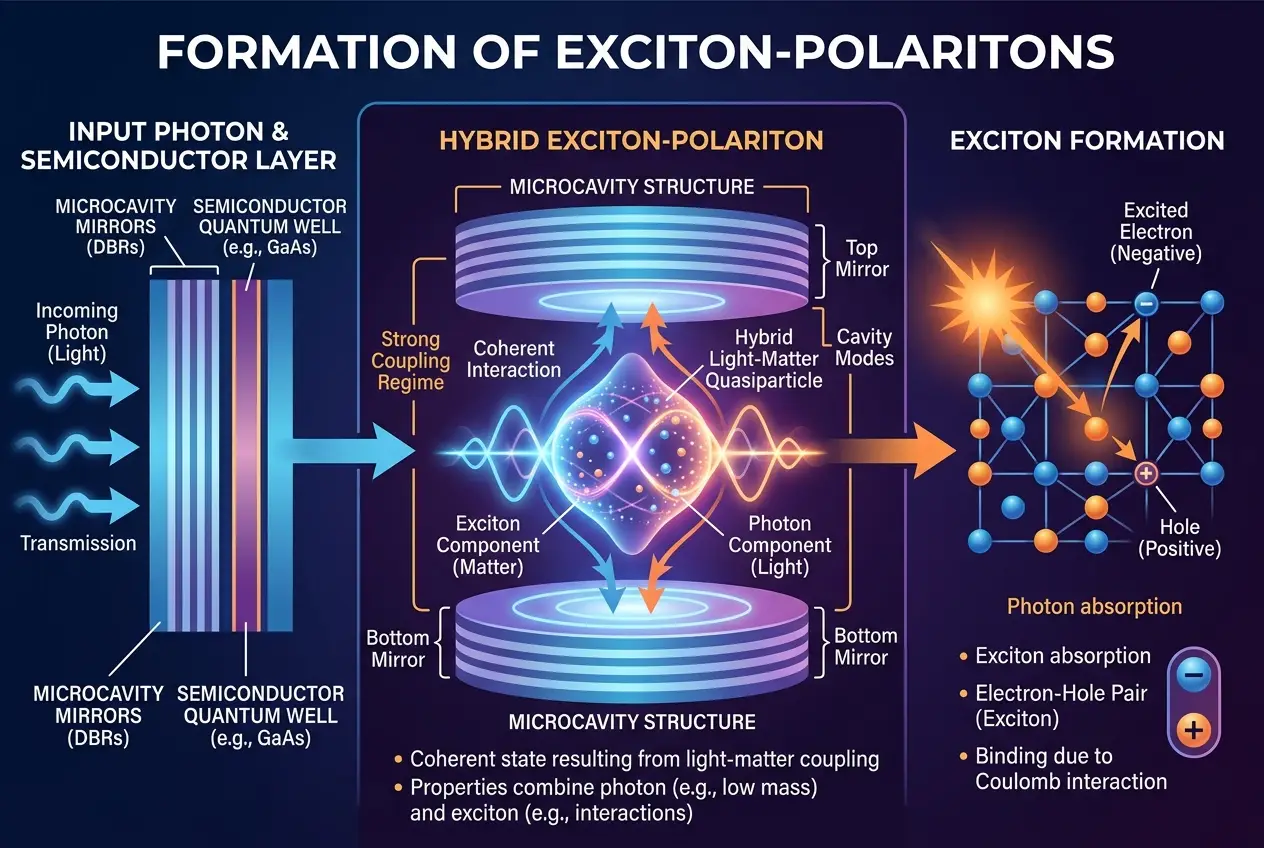
* **Excitons:** When a material absorbs a photon, an electron can be excited to a higher energy level, leaving behind a "hole" (a missing electron). This electron-hole pair, bound together by electrostatic forces, is called an exciton. They are quasiparticles, meaning they behave like particles within the material.
Now, imagine these two meeting in a confined space, specifically a **microcavity** – a tiny optical resonator designed to trap light. If the interaction between the photons bouncing within this cavity and the excitons forming in the embedded material (often a semiconductor like gallium arsenide or a monolayer of transition metal dichalcogenides) is strong enough, they don't just interact; they merge. They form a new, hybrid quasi-particle: the exciton-polariton. These polaritons have properties of both light and matter. They are very light, inheriting the photon's low effective mass, allowing them to move incredibly fast. Yet, they also interact strongly with each other, a trait usually associated with matter, due to their exciton component. This strong interaction is key to their potential for computing.
### Why Liquid Light Matters: Bose-Einstein Condensates
The real magic happens when these polaritons are cooled down to extremely low temperatures, or even sometimes at room temperature in advanced materials. Because polaritons are bosons (like photons), many of them can occupy the same quantum state. When enough polaritons are created and confined, they can undergo a phase transition, collapsing into a single, macroscopic quantum state known as a **Bose-Einstein Condensate (BEC)**. This is the "liquid light" state.
In a BEC, all the particles behave as one giant super-particle. They lose their individual identities and move coherently, almost like a wave. Crucially, this condensate can flow without any viscosity or friction, a phenomenon called **superfluidity**. For light, this means it can travel through the material with virtually no energy loss. This is a monumental advantage for computing, where heat dissipation is a major bottleneck for performance and energy consumption. Imagine circuits where information flows effortlessly, without resistance.
"When you cool a cloud of atoms to temperatures close to absolute zero, they become one giant quantum object, a Bose-Einstein condensate. Now imagine doing that with light." — *Zlatko Kherani, Professor of Electrical and Computer Engineering at the University of Toronto, on the concept of light BECs.* (Source: [Wikipedia on Bose-Einstein Condensate](https://en.wikipedia.org/wiki/Bose%E2%80%93Einstein_condensate))
While achieving BECs for ordinary atoms requires incredibly low temperatures (nanokelvin range), exciton-polariton BECs have been observed at much higher temperatures, even up to room temperature in some organic semiconductor systems. This makes them far more practical for real-world applications than traditional atomic BECs.
### The Computing Revolution: Photonics vs. Liquid Light
The idea of using light for computing isn't new. **Optical computing**, where photons replace electrons for information processing, has been a long-standing goal. Photons are inherently faster than electrons and don't suffer from electrical resistance, which causes heat. However, a major hurdle for traditional optical computing has been the lack of strong photon-photon interaction. To perform logic operations, signals need to interact; if photons just pass through each other, computation is impossible. This is where "liquid light" comes in.
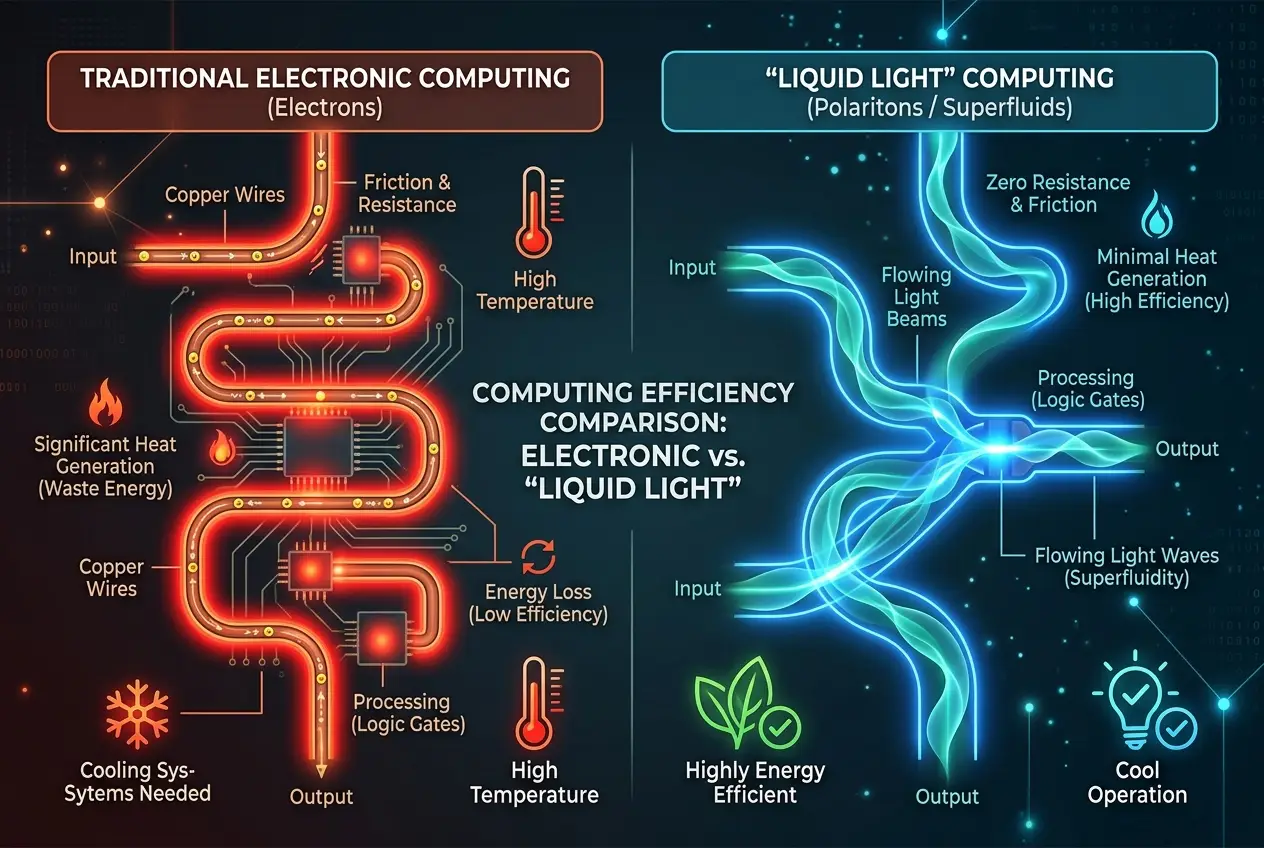
Exciton-polaritons, with their matter component, interact strongly. This interaction allows them to influence each other, enabling the creation of logic gates – the fundamental building blocks of any computer. When two streams of liquid light interact, their interference patterns can be used to represent binary 0s and 1s, leading to computations. This bypasses the need for large, energy-intensive optical switches required in conventional photonics.
Consider the potential:
* **Ultra-Fast Processing:** Information encoded in "liquid light" could travel much faster than electrons, leading to significantly quicker processing speeds.
* **Energy Efficiency:** The superfluid nature of polariton condensates means minimal energy loss as heat, leading to vastly more energy-efficient computers. This is critical for everything from mobile devices to massive data centers, and a welcome development in an era concerned with the environmental impact of technology.
* **New Computing Architectures:** The unique properties of "liquid light" might enable entirely new ways of designing computers, potentially moving beyond the traditional Von Neumann architecture. This could involve **topological computing**, where information is stored in the "knots" or "vortices" of the liquid light, offering robustness against errors. This is similar to how quantum computers aim for error correction, and could even lead to novel forms of quantum computation. If you're curious about how quantum computing works, you might find our blog on [Can Quantum Computers Break Every Encryption?](/blogs/can-quantum-computers-break-every-encryption-1438) enlightening.
### Beyond Logic Gates: Analog Computing and Simulators
The applications extend beyond digital logic gates. "Liquid light" systems can also act as powerful **analog simulators**. Complex physical phenomena, like the behavior of black holes or the properties of new materials, can be mapped onto the dynamics of polariton condensates. By observing how the liquid light behaves, scientists can gain insights into these complex systems without having to build costly and time-consuming physical models.
Furthermore, the ability of polaritons to form complex patterns and vortices makes them excellent candidates for **neuromorphic computing**, which aims to mimic the human brain's structure and function. Polariton networks could process information in a massively parallel and energy-efficient way, potentially paving the path for more advanced artificial intelligence. This takes me back to my earlier reflections on how powerful AI can become, something I explored in [Can Graphene Chips Unleash AI Superpowers?](/blogs/can-graphene-chips-unleash-ai-superpowers-8640).
### Challenges on the Horizon
While the promise is immense, bringing "liquid light" computing from the lab to commercial products faces significant challenges.
1. **Material Science:** Developing materials that can sustain polariton condensates reliably at room temperature and integrate them into scalable chip architectures is a major hurdle. Organic semiconductors are promising, but their stability and longevity need improvement.
2. **Control and Manipulation:** Precisely controlling and manipulating these quantum fluids to perform complex calculations requires sophisticated engineering. Creating stable, reconfigurable "channels" and "gates" for liquid light to flow and interact is non-trivial.
3. **Integration:** Integrating these novel components with existing electronic infrastructure remains a complex task. How do you feed information from a conventional computer into a "liquid light" processor and get readable output?
Despite these challenges, researchers worldwide are making steady progress. Breakthroughs in materials like perovskites and transition metal dichalcogenides are pushing the boundaries of room-temperature polariton systems. The field is vibrant, with continuous innovations.
### Conclusion: A Luminous Future?
"Liquid light" isn't just a fascinating scientific phenomenon; it represents a bold new frontier in computing. By leveraging the quantum properties of light and matter, we could unlock processing speeds and energy efficiencies that are currently unimaginable. The journey from theoretical concept to practical application is long and arduous, but the potential rewards—computers that are not only faster and more powerful but also fundamentally more sustainable—are well worth the effort.
I believe that as we push past the limits of conventional silicon, we'll see more and more radical ideas like "liquid light" emerge from the realm of quantum physics and materials science. The future of computing, it seems, might be less about brute force and more about elegant quantum fluidity. It makes me wonder, could a similar shift be happening in the realm of optical computing, where light itself begins to "think"? You can learn more about this in our article [Can Light Think? The Dawn of Optical Computing](/blogs/can-light-think-the-dawn-of-optical-computing-3860). This luminous future promises not just faster machines, but a deeper understanding of the universe itself, perhaps even paving the way for technologies we haven't even dreamt of yet.
Frequently Asked Questions
'Liquid light' refers to exciton-polariton condensates, a state where light (photons) and matter (excitons, which are electron-hole pairs) merge to form hybrid quasiparticles. These quasiparticles then condense into a superfluid state, allowing light to flow without resistance, much like a quantum liquid.
Regular light consists of individual photons that generally don't interact with each other. Liquid light, composed of exciton-polaritons, behaves like a fluid, allowing the quasiparticles to interact strongly with each other due to their matter component. This interaction is crucial for performing logic operations in computing, something normal photons struggle with.
Key challenges include developing stable materials that can sustain polariton condensates at room temperature, precisely controlling and manipulating these quantum fluids into integrated circuits, and effectively integrating these novel components with existing electronic systems. Material science and engineering precision are critical hurdles.
Liquid light computing is currently a cutting-edge research field. While significant progress is being made, especially with room-temperature polariton systems, commercial implementation is likely several decades away. It requires overcoming substantial material science, engineering, and integration challenges before it can move beyond the laboratory.
While liquid light technology holds immense promise for ultra-fast and energy-efficient computing, it is more likely to complement, rather than completely replace, silicon-based computers. Its unique properties might be best suited for specific applications, such as high-performance computing, specialized AI processors, or quantum simulators, while silicon continues to excel in general-purpose computing.
Verified Expert
Alex Rivers
A professional researcher since age twelve, I delve into mysteries and ignite curiosity by presenting an array of compelling possibilities. I will heighten your curiosity, but by the end, you will possess profound knowledge.
Leave a Reply
Comments (0)
No approved comments yet. Be the first to share your thoughts!
 Join Us



 Unknown Author


































Leave a Reply
Comments (0)