


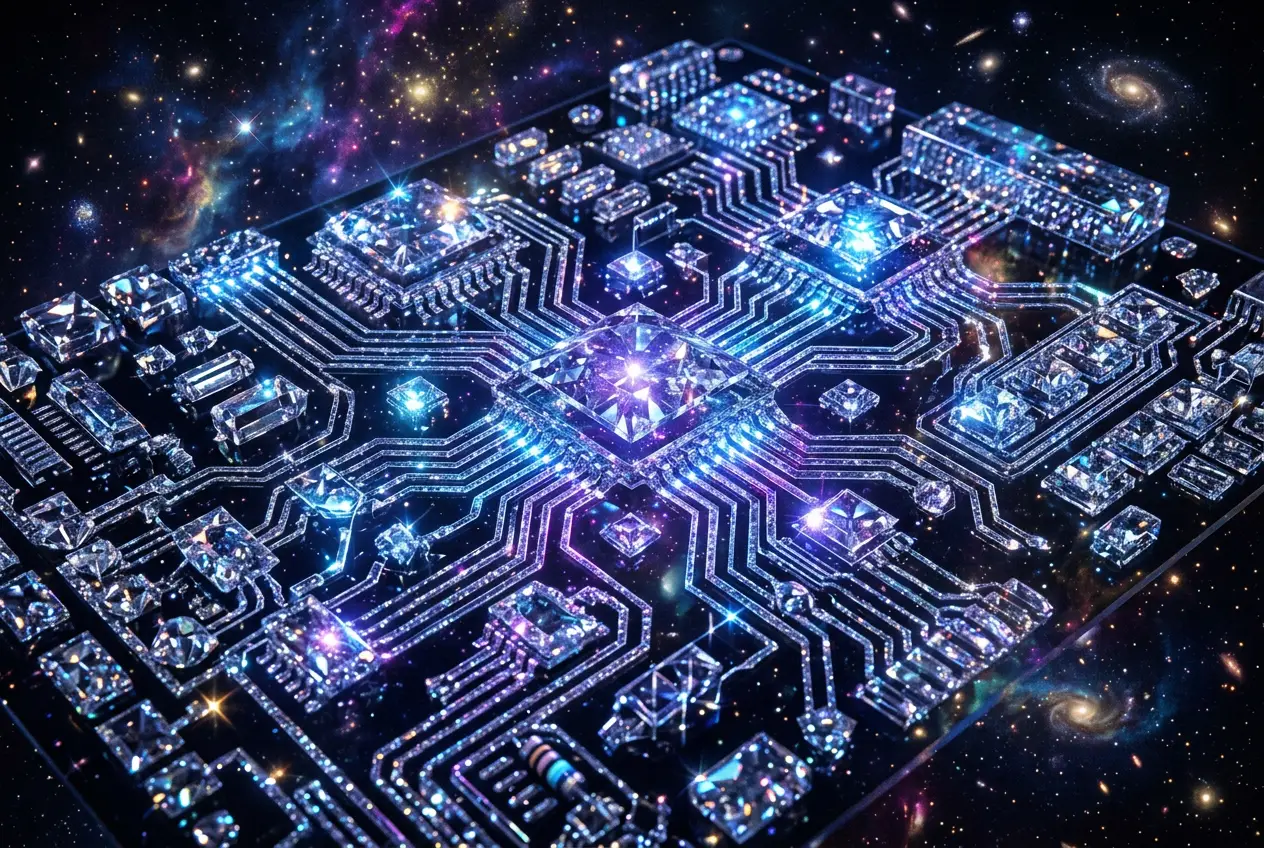
I remember a time, not so long ago, when the idea of a personal computer in every home seemed like science fiction. Now, the devices we carry in our pockets are more powerful than the supercomputers of yesteryear, all thanks to a humble element: silicon. For decades, silicon has been the bedrock of our digital world, the silent engine driving everything from our smartphones to the colossal data centers humming with information. But as the demands of the digital age escalate, and our thirst for processing power becomes insatiable, I’ve started to wonder: what happens when silicon reaches its absolute limit?
We're approaching a fascinating crossroads in computing. Moore's Law, the famous observation that the number of transistors on a microchip doubles approximately every two years, has guided the tech industry for over half a century. But physics, with its unyielding laws, is starting to push back. As transistors shrink to atomic scales, silicon's inherent properties, like its bandgap and thermal conductivity, begin to betray its stellar performance. This has led many brilliant minds, including myself, to ask: what comes next? Could a material renowned for its brilliance and hardness also hold the key to our computing future? The answer might just be diamonds.
The Reign of Silicon: A Digital Empire Built on Sand
To understand the potential of diamonds, we first need to appreciate the marvel that is silicon. Silicon is a semiconductor, meaning it can control the flow of electricity, making it perfect for switches (transistors) that form the basis of all digital logic. It's abundant, relatively inexpensive to process, and has a well-understood chemistry, allowing for precise manufacturing at microscopic levels.
For generations, engineers have pushed silicon to its limits, squeezing ever more transistors onto smaller chips. This relentless miniaturization has given us astonishing leaps in performance, enabling AI, high-resolution graphics, and vast network connectivity. However, shrinking transistors means electrons have less space to move, leading to increased heat, quantum tunneling effects (where electrons jump barriers they shouldn't), and ultimately, performance plateaus. The energy required to cool these tiny, densely packed chips is becoming a significant challenge. As one insightful article on Wikipedia notes, the physical limits of silicon are becoming increasingly apparent, driving the search for alternatives.
The Challenges Silicon Faces:
- Heat Dissipation: Denser chips generate more heat, which can degrade performance and reliability.
- Quantum Tunneling: At atomic scales, electrons can "tunnel" through thin insulating layers, leading to leakage and energy loss.
- Fabrication Costs: Manufacturing smaller silicon features becomes exponentially more expensive.
- Bandgap Limitations: Silicon's bandgap limits its efficiency in high-power and high-frequency applications.
It's clear that while silicon has been an incredible workhorse, its journey as the sole king of computing materials is nearing a turning point. We need a successor, or at least a powerful complement, that can meet the demands of future technologies, from advanced AI to quantum computing.
Why Diamonds? Beyond Bling, A Technological Marvel
When most people think of diamonds, they picture glittering jewelry or industrial drills. But for material scientists and electrical engineers, diamonds represent something far more profound: a material with extraordinary electronic and thermal properties that could revolutionize computing.
What makes diamonds so promising?
- Exceptional Thermal Conductivity: Diamonds are the best known thermal conductors at room temperature, meaning they can dissipate heat incredibly efficiently. This is a game-changer for high-power chips, potentially allowing for much denser packing of components without overheating. Imagine a CPU that runs cool even under extreme load – that’s the diamond advantage.
- Wide Bandgap: Silicon has a bandgap of about 1.12 electron volts (eV). Diamond, on the other hand, boasts a bandgap of approximately 5.5 eV. This wider bandgap means diamond-based devices can operate at much higher voltages, frequencies, and temperatures without breaking down. This is crucial for power electronics, high-frequency communication, and extreme environment computing.
- Radiation Hardness: Diamonds are incredibly resilient to radiation, making them ideal for applications in space, nuclear facilities, or medical implants where conventional silicon chips would quickly fail.
- High Electron Mobility: While not as high as some other exotic semiconductors, diamond still offers good electron mobility, allowing for fast switching speeds crucial for processors.
- Quantum Potential (Nitrogen-Vacancy Centers): This is where diamonds truly shine in the realm of future computing. Imperfections within diamond crystals, particularly nitrogen-vacancy (NV) centers, can act as isolated quantum bits, or "qubits." These NV centers have unique spin properties that can be controlled and read using microwaves and lasers, making them prime candidates for quantum computing and sensing applications. You might find it interesting to see how even living crystals are being explored as computing frontiers.
Leading research institutions, like those at the National Institute of Advanced Industrial Science and Technology (AIST) in Japan, are actively developing diamond-based semiconductors and quantum technologies. Their work underscores the serious scientific interest in this material.
Diamond in Action: From Power Grids to Quantum Leaps
The applications of diamond computing extend far beyond just faster processors for your laptop.
- High-Power Electronics: Imagine power converters, electric vehicle chargers, or even components in the electrical grid that are vastly more efficient and smaller. Diamond power devices could handle extreme loads with minimal energy loss, leading to a more efficient energy infrastructure.
- Extreme Environment Computing: For missions to Venus, probes near the sun, or even critical infrastructure in harsh industrial settings, diamond chips could provide unparalleled reliability where silicon would simply melt or fail.
- Quantum Computing: The NV centers in diamonds are a hotbed of research for quantum computing. Their stability at room temperature and long coherence times (the period during which a qubit can maintain its quantum state) make them highly attractive for building robust quantum processors. This could lead to breakthroughs far beyond what even the fastest quantum computers can currently achieve.
- High-Frequency Communications: Diamond-based transistors could operate at terahertz frequencies, opening doors for ultra-fast wireless communication and imaging systems.
- Advanced Sensing: Diamond quantum sensors can detect incredibly subtle magnetic fields, electric fields, and even temperature changes at the nanoscale, with implications for medical diagnostics, materials science, and fundamental physics research.
The potential is truly mind-boggling. "Diamonds are not just for rings anymore," says Dr. Robert Nemanich, a leading expert in diamond electronics at Arizona State University. "They are poised to be a fundamental material for the next generation of electronics, especially where extreme performance is needed."
The Road Ahead: Challenges and Synthetic Solutions
Of course, replacing silicon with diamond isn't as simple as swapping out one material for another. There are significant challenges:
- Cost: Natural diamonds are rare and expensive. However, advances in Chemical Vapor Deposition (CVD) have made it possible to grow high-quality synthetic diamonds in laboratories at a much lower cost and with greater control over purity and defects. This process involves introducing carbon-containing gases into a vacuum chamber, where they break down and deposit carbon atoms onto a substrate, forming a diamond layer. This technological leap is critical for industrial adoption. More on CVD can be found here on Wikipedia's CVD page (opens in a new tab).
- Doping: Introducing impurities (doping) into a semiconductor like silicon allows us to control its electrical properties. Doping diamond to create n-type and p-type semiconductors (essential for transistors) is much more challenging due to its tightly bound atomic structure. Researchers are making strides, primarily using boron for p-type and phosphorus or nitrogen for n-type doping, but it remains an active area of research.
- Fabrication Complexity: Working with diamond requires specialized techniques and equipment, which adds to the manufacturing complexity compared to silicon.
Despite these hurdles, the progress in synthetic diamond technology is astonishing. Researchers are not only growing large, high-purity single-crystal diamonds but also fabricating intricate microstructures and even doping them with specific elements to tailor their electronic properties.
Beyond the Horizon: The Diamond Age of Computing
As I reflect on the incredible journey of computing, from vacuum tubes to silicon wafers, I can't help but feel a thrill of anticipation for what lies ahead. The idea that diamonds, symbols of enduring strength and beauty, could also be the building blocks of our most advanced technologies, feels almost poetic.
We are entering an era where the demand for raw processing power, efficient energy use, and robust performance in challenging environments will only grow. While silicon will undoubtedly remain relevant for many applications, the limitations it presents are forcing us to look for new horizons. Whether it's enabling powerful AI, facilitating intergalactic communication, or even helping us understand the fundamental nature of reality—perhaps even influencing discussions like could our reality be a simulation—diamond computing offers a glittering promise.
The "Diamond Age" of computing isn't here yet, but the foundations are being meticulously laid, atom by atom, in labs around the world. The shift won't be sudden, but rather a gradual integration of diamond technology into specialized niches first, then potentially expanding as costs decrease and fabrication techniques mature. We are witnessing the dawn of a new material revolution, one where the hardest known material might just unlock the softest secrets of the universe through computation.
Conclusion
The pursuit of faster, more efficient, and more resilient computing is a perpetual human endeavor. Silicon has served us remarkably well, but the quest for what comes next is leading us down fascinating new paths. Diamond, with its unparalleled thermal, electronic, and quantum properties, stands as a formidable contender for the future of high-performance and quantum computing. While significant challenges remain, the scientific community's unwavering dedication to innovation suggests that a future powered by diamond chips is not just a glittering dream, but a tangible possibility on the horizon.






Conversation0
No comments yet. Be the first to share a thought — the best questions often become new stories.