


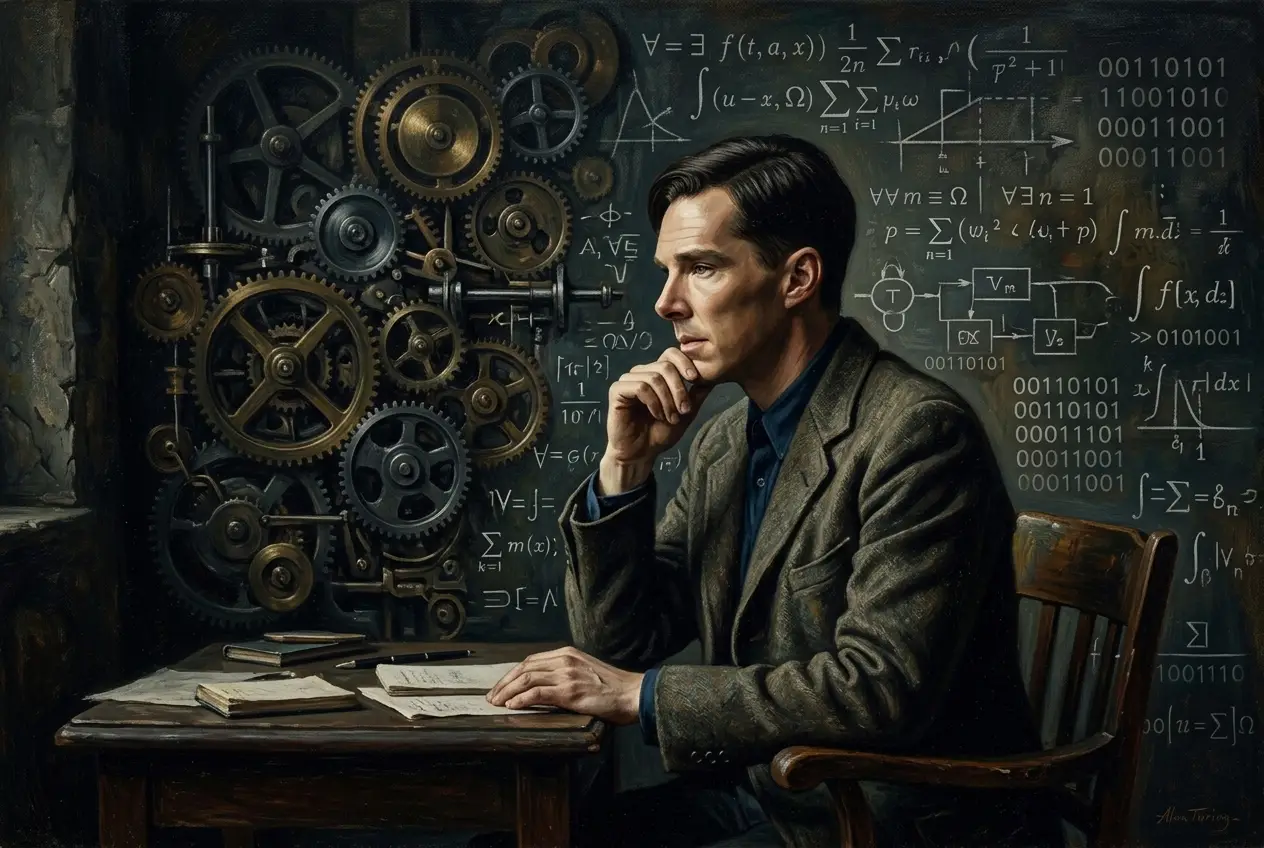
I remember first encountering the name Alan Turing in a dusty history book, a fleeting mention of a mathematician who helped win a war. It wasn't until much later, diving deeper into the origins of artificial intelligence and modern computing, that I truly grasped the monumental impact of this singular mind. His story isn't just about groundbreaking algorithms or powerful machines; it’s a poignant narrative of genius, secrecy, and profound injustice that continues to resonate today. This is going to be a very long blog, delving deeply into the life, work, and legacy of a man whose ideas underpin the very digital world we inhabit.
The Architect of Modernity: Who Was Alan Turing?
Alan Mathison Turing, born in London in 1912, was far more than a brilliant mathematician. He was a visionary who conceived of the theoretical foundations of modern computers before they even existed, a wartime hero whose intellect saved countless lives, and a philosopher who dared to ask, "Can machines think?" His life was a whirlwind of innovation, intellectual pursuit, and ultimately, tragedy, leaving behind a legacy that has only recently received the recognition it so richly deserves. I find it astonishing how one individual could touch upon so many critical aspects of 20th-century progress, from abstract logic to practical engineering and even theoretical biology.
Early Life and Prodigious Beginnings (1912-1926)
Turing’s childhood hinted at the genius to come, though it was often misunderstood by those around him. Born into a relatively privileged family, his father was a member of the Indian Civil Service, meaning Turing and his elder brother, John, spent much of their early years shuttling between England and India. This itinerant lifestyle often left the young Alan feeling somewhat displaced, but it also fostered a deep independence and a burgeoning curiosity about the world around him.
A Child's Unconventional Intellect: From a very young age, Turing displayed signs of an exceptional mind. He was fascinated by puzzles, chemicals, and anything that could be analyzed logically. While other children played, he was often found conducting rudimentary experiments or engrossed in complex mathematical problems far beyond his years. I imagine him as a quiet, observant child, absorbing the world’s intricacies and trying to decipher its underlying rules. This intellectual hunger, however, didn't always translate into academic success in the traditional sense.
Sherborne School: A Crucible of Genius (1926-1931)
Turing's time at Sherborne School, a prestigious public school, was initially challenging. He struggled with the rigid curriculum, often showing little interest in subjects he deemed uninteresting, while excelling in mathematics and science. His unconventional methods and independent thinking clashed with the school's emphasis on classical education and rote learning. It was a period where his brilliance simmered, often unrecognized by his teachers, who sometimes admonished him for his untidy work or disregard for conventional methods.
The Profound Friendship with Christopher Morcom: The turning point at Sherborne came with his friendship with Christopher Morcom. Morcom was a fellow student with a keen intellect and a shared passion for science, particularly astronomy. For the first time, Turing found a kindred spirit, someone with whom he could freely discuss complex ideas and explore the depths of his intellectual curiosity. Their bond was profound, a blend of deep affection and intense intellectual stimulation. Christopher became Turing's first love, and his presence truly ignited Alan’s academic fire.
Tragedy Strikes: The Loss of Christopher: This deeply meaningful friendship was tragically cut short in 1930 when Morcom died suddenly from bovine tuberculosis. The loss devastated Turing. It was a formative trauma that arguably intensified his drive, pushing him to explore the very nature of consciousness, mind, and the possibility of life beyond the physical, perhaps even finding a way to communicate with a lost friend through the realm of logic and computation. I can only imagine the grief and intellectual searching that followed such a profound personal loss, shaping the trajectory of his future work.
King's College, Cambridge: Logic and Foundations (1931-1938)
Following Sherborne, Turing secured a place at King's College, Cambridge, in 1931, where he truly blossomed intellectually. Cambridge provided a vibrant environment where his unconventional genius was not just tolerated but celebrated. He immersed himself in mathematics, logic, and the philosophical underpinnings of these fields. Here, he encountered some of the brightest minds of his generation and began to grapple with fundamental questions about the limits of computation and the nature of proof.
Exploring the Limits of Logic: At Cambridge, Turing’s focus narrowed to mathematical logic, particularly the work of Kurt Gödel and David Hilbert. Hilbert, a prominent German mathematician, had posed a famous challenge known as the Entscheidungsproblem (decision problem), asking if there existed a general algorithm that could determine whether any given mathematical statement was true or false. This seemingly abstract problem would become the catalyst for one of Turing's most significant contributions.
The Turing Machine: A Blueprint for the Digital Age (1936)
In 1936, while still a postgraduate student at King’s College, Turing published his seminal paper, "On Computable Numbers, with an Application to the Entscheidungsproblem." In this groundbreaking work, he introduced a theoretical construct that would forever change the course of human history: the Universal Turing Machine.
Conceptualizing the "Machine": The Turing Machine wasn't a physical device, but a conceptual model of computation. It consisted of an infinitely long tape divided into squares, a "head" that could read and write symbols on the tape, and a finite set of states (internal instructions) that dictated its behavior. Based on the symbol read and its current state, the machine would perform an action (write a new symbol, move left or right) and transition to a new state. This simple, elegant model proved capable of performing any computation that could be described as an algorithm.
Impact on Computer Science: The Foundation of Everything: The implications were profound. Turing demonstrated that a single machine, a Universal Turing Machine, could simulate the operations of any other Turing Machine. This meant a single device, given the right instructions (software), could perform any conceivable computational task. This concept laid the absolute theoretical groundwork for modern general-purpose computers, predicting their very essence decades before they were physically realized. I often pause to think how truly visionary this was – to imagine something so complex and universal from first principles, without any practical precedent. His work, alongside that of Alonzo Church, proved that the Entscheidungsproblem was unsolvable, a significant result in mathematical logic.
Princeton University: Furthering the Theory (1936-1938)
Impressed by his paper, the American mathematician Alonzo Church invited Turing to Princeton University, where he spent two years pursuing his PhD. During this period, he worked under Church, who had independently developed his own equivalent model of computation using lambda calculus. This collaboration deepened Turing's understanding and solidified his theoretical contributions to computability theory. He also explored cryptography, a skill that would soon become invaluable. Upon returning to Cambridge, he completed his PhD in 1938, supervised by Church.
Bletchley Park: The War Effort and Codebreaking (1939-1945)
With the outbreak of World War II, Turing's brilliant mind was urgently recruited. He joined the Government Code and Cypher School (GC&CS) at Bletchley Park, a top-secret facility tasked with breaking the encrypted communications of the Axis powers. This was a place where abstract mathematical theory met the desperate reality of war, and Turing’s contributions here were nothing short of heroic.
The Enigma Machine: Germany's Secret Weapon: The Germans relied heavily on the Enigma machine for encrypting their military communications. Enigma was an electromechanical rotor machine that produced incredibly complex codes, making it seemingly unbreakable. Each day, the settings of the Enigma machines would change, presenting a new, gargantuan cryptographic challenge. Breaking Enigma was critical to the Allied war effort, particularly in the Battle of the Atlantic, where German U-boats were sinking supply convoys at an alarming rate.
The Bombe Machine: A Revolutionary Tool: Turing’s most significant contribution at Bletchley Park was his crucial role in designing the Bombe machine. Building upon earlier Polish work, Turing, along with Gordon Welchman, developed an electromechanical device designed to rapidly test possible Enigma settings. The Bombe exploited "cribs"—probable plaintext segments that codebreakers suspected were present in encrypted messages (e.g., "Heil Hitler" or weather reports). By automating the search for inconsistencies across these cribs, the Bombe dramatically reduced the number of possible Enigma key settings that needed to be manually checked.
Breaking Naval Enigma: Turning the Tide: Turing’s genius was particularly vital in breaking the Naval Enigma, which was even more complex than its army counterpart due to additional rotors. His insights, including statistical methods like Banburismus, allowed the Allies to read crucial German naval messages. This intelligence, known as "Ultra," provided real-time insights into U-boat movements, convoy positions, and operational plans. I honestly believe that without his work, the war would have lasted years longer, costing millions more lives. The historical impact is almost immeasurable. For a broader context on historical decryption efforts, one might find it interesting to read about ancient cultures decoding cosmic algorithms for the future, though the methods were vastly different.
A Table of Turing's Key Contributions at Bletchley Park:
| Contribution | Description | Impact |
|---|---|---|
| Bombe Machine | Electromechanical device co-designed by Turing and Gordon Welchman. Used "cribs" (probable plaintext) to quickly test potential Enigma machine settings, significantly narrowing down the search space for the daily keys. | Dramatically sped up the process of breaking daily Enigma codes, providing vital intelligence ("Ultra"). |
| Banburismus | A sequential probability method developed by Turing to help identify the daily settings of the Naval Enigma, especially when cribs were scarce. It analyzed patterns in character repetitions. | Crucial for breaking the more complex Naval Enigma, which was essential for winning the Battle of the Atlantic. |
| Statistical Methods | Applied advanced statistical analysis to cryptology, moving beyond purely mechanical approaches. | Improved efficiency and reliability of codebreaking, particularly for the Naval Enigma, which had additional complexities like a reflector that could be rewired. |
| Delilah Speech Scrambler | Post-Bletchley, Turing designed an electronic speech scrambler, though it was not deployed during the war. It demonstrated his continued interest in secure communication. | Though not wartime operational, it showcased his innovative thinking in secure communications and his ability to move from theoretical concepts to practical, albeit highly complex, electronic devices. |
| Contribution to ACE | His vision for the Automatic Computing Engine (ACE) while still at Bletchley Park, based on his Universal Turing Machine concept, became a blueprint for post-war electronic stored-program computers. | Directly influenced the architecture of early general-purpose computers, transitioning from codebreaking machines to programmable digital machines. |
The Secrecy Oath: A Lifelong Burden: Turing's work at Bletchley Park was shrouded in absolute secrecy, an oath he upheld meticulously for the rest of his life. Even after the war, he could not openly discuss his vital contributions, which were not declassified until decades after his death. This meant he never received public acclaim during his lifetime for his immense wartime service, living under the shadow of a secret that defined him.
Post-War Computing: Manchester and ACE (1945-1948)
After the war, Turing’s focus shifted from codebreaking to the practical realization of his theoretical computing ideas. He joined the National Physical Laboratory (NPL) in London in 1945, where he began work on designing the Automatic Computing Engine (ACE).
The ACE Report: A Blueprint for a Digital Future: In 1946, Turing produced a remarkably detailed design document for ACE, which was arguably the most comprehensive design for a stored-program electronic computer at that time. It incorporated principles like subroutines, high-speed memory, and conditional branching, all concepts fundamental to modern computing. He envisioned a computer that could not only perform calculations but also store its own programs in memory, a revolutionary idea.
Frustrations and a Move to Manchester: However, progress at NPL was slow, hampered by bureaucracy and a lack of urgency. Turing, ever the visionary, became frustrated with the delays. In 1948, he moved to the University of Manchester, which was quickly becoming a hub for pioneering computer research. This move proved pivotal for the practical development of electronic computing.
The Manchester Baby and the First Stored-Program Computers (1948-1950)
At Manchester, Turing joined a team that included engineers Tom Kilburn and Frederic Williams, who were building the Manchester Small-Scale Experimental Machine (SSEM), affectionately known as "The Baby."
The World's First Stored-Program Computer: In June 1948, The Baby successfully ran its first program, marking a monumental milestone: it was the world's first stored-program electronic digital computer. While primitive by today's standards, its ability to store and execute programs from memory validated Turing's theoretical work and opened the door to the digital age. I can only imagine the excitement of witnessing that first program run, a tangible manifestation of pure thought transforming into action.
Turing's Role in Manchester: While not the primary designer of the hardware, Turing played a critical role in programming The Baby and developing software for its successor, the Manchester Mark 1. His work ensured that these machines could perform complex operations and move beyond mere calculation. He contributed to the fundamental principles of programming and demonstrated the practical utility of his abstract theories. This period firmly cemented his legacy as a practical computer scientist, not just a theoretician. His explorations into computation also resonate with modern discussions about whether the universe is a giant neural network, highlighting the enduring nature of his foundational inquiries.
Artificial Intelligence and the Turing Test (1950)
Perhaps one of Turing's most enduring and widely known contributions came in 1950 with his groundbreaking paper, "Computing Machinery and Intelligence." In this work, he tackled the profound question: "Can machines think?"
The Imitation Game: Defining Intelligence: Recognizing the ambiguity of "thinking," Turing proposed a practical test, which he called the "Imitation Game," now famously known as the Turing Test. In this test, a human interrogator interacts with two hidden entities: one human and one machine. If the interrogator cannot reliably distinguish the machine from the human based solely on their textual responses, then the machine is said to have passed the Turing Test, demonstrating a form of intelligence indistinguishable from a human’s.
Legacy and Criticisms of the Turing Test: The Turing Test has become a cornerstone of artificial intelligence research, sparking endless debate and inspiring generations of AI developers. While often criticized for its limitations (it tests linguistic mimicry, not necessarily genuine understanding or consciousness), its conceptual simplicity and directness have ensured its lasting influence. It forces us to confront what we truly mean by "intelligence" and whether it can ever be replicated, or even surpassed, by non-biological entities. I believe it remains a crucial philosophical and practical benchmark. For more on the cutting edge of AI, one might explore discussions about AI's neural networks becoming self-aware.
Mathematical Biology and Morphogenesis (1951-1954)
In the early 1950s, Turing embarked on yet another astonishing intellectual journey, shifting his focus to mathematical biology. This seemingly radical departure from computing demonstrated the breadth of his curiosity and his ability to apply mathematical rigor to entirely new domains.
The Chemical Basis of Morphogenesis: In 1952, he published "The Chemical Basis of Morphogenesis," a paper that explored how patterns and forms develop in biological organisms. He proposed a model involving two interacting chemical substances—an "activator" and an "inhibitor"—that diffuse and react at different rates within a system. This reaction-diffusion system could explain the emergence of complex patterns from an initially uniform state.
Explaining Nature's Patterns: Turing’s model provided a theoretical framework for understanding the formation of seemingly disparate biological patterns: the spots on a leopard, the stripes on a zebra, the whorls of a pinecone, or the branching patterns of leaves. He showed how simple chemical interactions could give rise to such intricate and diverse forms. This work was decades ahead of its time, pioneering the field of mathematical biology and demonstrating his unparalleled interdisciplinary thinking.
Persecution and Tragic End (1952-1954)
Despite his immense contributions to science and the war effort, Alan Turing’s life took a tragic turn in 1952. Homosexuality was illegal in the United Kingdom, and he was arrested and charged with "gross indecency" after reporting a burglary to the police, inadvertently revealing his relationship with another man.
A Cruel Choice: Prison or Chemical Castration: Faced with a stark choice between imprisonment and chemical castration (hormone treatment designed to reduce libido), Turing chose the latter to avoid jail and continue his work. The treatment had devastating physical and psychological effects, impacting his health and state of mind.
Loss of Security Clearance and Public Humiliation: As a result of his conviction, Turing lost his security clearance, meaning he could no longer work for GCHQ (the successor to Bletchley Park) and was barred from sensitive government work. This was a cruel irony for a man whose intellect had been so vital to national security. The public humiliation and legal persecution deeply affected him.
The Cyanide Apple: A Mystery and a Legacy: On June 8, 1954, Alan Turing was found dead in his bed from cyanide poisoning. An apple, partially eaten, was found near his body. The inquest ruled his death a suicide. While some speculate about accidental poisoning or even foul play, the prevailing view is that the cumulative toll of the persecution, the chemical castration, and the ongoing public shaming led him to take his own life. The image of the poisoned apple has become a powerful, tragic symbol, sometimes even suggested as an inspiration for the Apple Inc. logo, though this has been widely debunked. I find it difficult to reconcile the brilliance of his mind with the profound cruelty he endured from the society he helped to save.
A Slow Reckoning: Posthumous Recognition
For decades after his death, Turing's contributions remained largely unacknowledged, primarily due to the intense secrecy surrounding Bletchley Park. His wartime achievements were classified for over 50 years, meaning his unparalleled role in cracking the Enigma code was unknown to the public during his lifetime and for many years thereafter.
Growing Appreciation and the Turing Award: As computing evolved and the Bletchley Park story slowly emerged, the true extent of his genius began to surface. In 1966, the Association for Computing Machinery (ACM) established the Turing Award, widely considered the "Nobel Prize of Computing," a testament to his foundational impact on the field. This award helped to solidify his place in the pantheon of scientific greats.
Official Apologies and Pardons: A Quest for Justice: The injustice he suffered at the hands of the British legal system began to gain wider public attention in the 21st century. In 2009, then-Prime Minister Gordon Brown issued a public apology for the "appalling" treatment of Alan Turing. Four years later, in 2013, Queen Elizabeth II granted him a posthumous royal pardon, effectively overturning his conviction. This was a crucial step, acknowledging the moral failings of the state.
The Alan Turing Law: The advocacy didn't stop there. In 2017, "Alan Turing's Law" was enacted, which retroactively pardoned thousands of men who had been convicted of historical homosexual offenses in the UK. This broader pardon symbolized a collective societal acknowledgment of past wrongs, extending Turing’s personal tragedy into a broader act of restorative justice.
Turing's Enduring Legacy: A Digital Universe Built on His Ideas
Today, it is impossible to imagine our world without Alan Turing’s influence. Every smartphone, every computer, every piece of software, and every AI algorithm owes a debt to his groundbreaking work.
Foundation of Computer Science: His theoretical model of computation—the Turing Machine—remains the bedrock of computer science. It provides the mathematical framework for understanding what algorithms can and cannot do, defining the very limits of computation.
Impact on World War II: His codebreaking efforts at Bletchley Park were absolutely critical to Allied victory. Historians widely agree that his work shortened the war by at least two years, saving countless lives. His strategic intelligence was invaluable.
Philosophical Implications: Beyond the practical, Turing forced humanity to confront profound philosophical questions about intelligence, consciousness, and what it means to be human. His Turing Test continues to be a benchmark in the ongoing quest to understand and create artificial intelligence. These are deeply intertwined with complex ideas, much like how some inquire if quantum entanglement can connect minds, pushing the boundaries of what we understand about consciousness and information.
A Symbol of Persecution and Resilience: Turing’s life story has become a powerful symbol for human rights, demonstrating the devastating consequences of prejudice and discrimination. His posthumous recognition serves as a reminder of the importance of tolerance and the ongoing fight for equality.
Beyond the Code: The Human Behind the Machine
Turing was, by all accounts, a complex and eccentric man. He was known for his shyness, his distinctive speaking style, and his unusual habits (like chaining his mug to a radiator to prevent it from being stolen). He was a passionate long-distance runner, a keen chess player, and someone who found immense joy in the simple beauty of nature. He was not always understood, and his unconventional brilliance often set him apart. Yet, beneath the veneer of the aloof genius was a deeply sensitive individual who experienced profound joy, devastating loss, and ultimately, unimaginable suffering.
Conclusion: The Echoes of a Brilliant Mind
Alan Turing's life was a testament to the power of human intellect and the tragic fragility of human existence in the face of societal prejudice. He gave us the blueprint for the digital age, helped secure victory in a world war, and dared us to imagine a future where machines could think. His questions about intelligence and consciousness continue to fuel our technological advancements, making him perhaps the most significant figure you’ve never truly known. As we navigate an increasingly AI-driven world, I think it's crucial to remember the man who started it all, not just for his innovations but for the profound lessons his life offers about justice, empathy, and the enduring human spirit.
For further reading on Alan Turing's life and work, I recommend these sources:


Conversation0
No comments yet. Be the first to share a thought — the best questions often become new stories.