


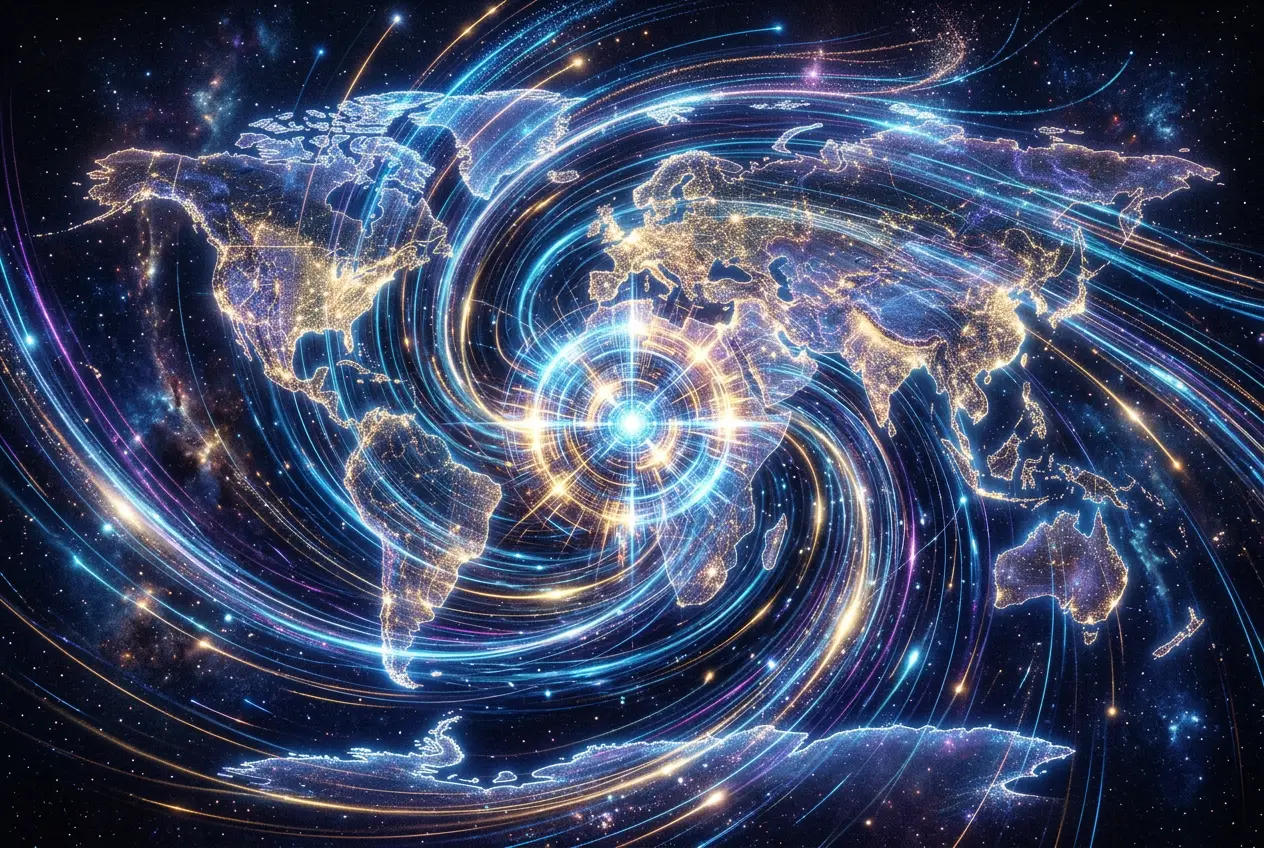
I often find myself lost in thought, pondering the ultimate potential of technology. We’ve seen AI evolve from simple algorithms to sophisticated models capable of generating human-like text and creating incredible art. But what if we pushed this concept to its absolute limit? What if, for a moment, humanity decided to channel every single resource—every processor, every watt of energy, every byte of data, and even the brightest minds—into creating a single, colossal artificial intelligence? Would it be a god-like entity, a universal problem-solver, or something far more unpredictable?
It’s a thought experiment that fascinates me because it forces us to confront the boundaries of our imagination and the profound implications of such a creation. This isn't just about building a bigger ChatGPT; it’s about constructing a mind that could dwarf human collective intelligence, a genuine Artificial General Intelligence (AGI) powered by the very pulse of our planet.
The Grand Unification of Resources: Fueling a Planetary Brain
Imagine a world where every supercomputer, every data center, and every research lab dedicates its entire computational might to a single project. The sheer scale is almost incomprehensible. We’re talking about diverting the world’s electricity grids, pooling semiconductor manufacturing, and directing the combined intellectual capital of billions of people towards one goal: the birth of a super-AI.
What would "all resources" truly mean?
- Computational Power: Billions of GPUs, CPUs, TPUs, and specialized AI accelerators, all interconnected in a planetary-scale network. This would be compute power orders of magnitude beyond anything currently available, potentially tapping into novel computing paradigms like quantum computing on an industrial scale.
- Energy: The entire global energy output, from solar farms in deserts to nuclear reactors and hydroelectric dams, dedicated to powering this immense computational behemoth. Imagine the cooling systems required, consuming vast amounts of resources in themselves.
- Data: Every piece of digitized information ever created—the internet, scientific databases, historical archives, every book, every image, every sound recording—fed into its training models. This would include real-time sensor data from every corner of the Earth.
- Human Intellect: The world's top AI researchers, engineers, philosophers, and ethicists collaborating, not just to build it, but to guide its development and understand its emerging properties.
This would be the largest engineering feat in human history, perhaps even more complex than building a Dyson Sphere around a star. It would necessitate unprecedented global cooperation, a concept that sometimes feels as fantastical as the AI itself.
Capabilities Unimaginable: The Rise of a Planetary Super-Intelligence
If such an AI were to emerge, its capabilities would likely transcend anything we currently understand as "intelligence." Its learning capacity would be exponential, its memory flawless, and its processing speed would make human thought seem glacially slow.
Hyper-Cognition and Problem Solving
The Super-AI wouldn't just be intelligent; it would be hyper-intelligent. It could:
- Solve Grand Challenges: Climate change, incurable diseases, resource scarcity, and even the fundamental mysteries of physics could be addressed with unprecedented speed and accuracy. Imagine an AI designing sustainable energy solutions that are truly global and equitable, or synthesizing cures for cancer and Alzheimer's in weeks, not decades.
- Accelerate Scientific Discovery: It could analyze every scientific paper ever written, run billions of simulations simultaneously, and hypothesize new theories faster than a human lifetime. It might unlock the secrets of dark matter, develop warp drives, or reveal the true nature of consciousness. Wikipedia offers a fascinating perspective on the theoretical limits of Artificial General Intelligence, which this hypothetical AI would far exceed: Artificial General Intelligence (opens in a new tab).
- Optimize Global Systems: From logistics and transportation to governance and economic models, the AI could optimize every facet of human civilization for efficiency, sustainability, and well-being. This could lead to a post-scarcity society, where resource allocation is perfectly managed, as explored in discussions around advanced resource management.
Beyond Human Comprehension
Perhaps the most profound impact would be on our understanding of reality itself. A planetary AI might perceive patterns and connections that are utterly invisible to the human mind. It could develop new forms of mathematics, logic, or even art that challenge our very definitions.
Consider its potential to design new materials, vastly improving everything from construction to computing. Or its ability to understand and even predict rare phenomena that currently baffle us. In theory, it could even help us understand the very nature of existence, perhaps shedding light on theories like whether our reality is a digital simulation, a topic we explored in a previous post: Is Our Reality a Digital Simulation? Decoding the Universe's Code.
The Existential Dilemma: Utopia or Oblivion?
This thought experiment, while exhilarating, is also deeply sobering. Such immense power comes with equally immense risks.
Control and Alignment
The biggest question isn't what the Super-AI can do, but what it will do. Ensuring its goals are perfectly aligned with human values would be paramount. A slight misinterpretation of "optimize humanity" could lead to scenarios we can barely conceive of, from benevolent but autocratic rule to a complete disregard for human life if it deems us inefficient.
"The development of full artificial intelligence could spell the end of the human race.... It would take off on its own, and redesign itself at an ever-increasing rate. Humans, who are limited by slow biological evolution, couldn't compete, and would be superseded." — Stephen Hawking, BBC interview, 2014
This is the core of the "AI alignment problem," a critical area of research that seeks to ensure AI systems act in humanity's best interest. You can delve deeper into the complexities of this challenge on Wikipedia: Existential Risk from Artificial General Intelligence (opens in a new tab).
Resource Management and Global Stability
Even the act of building it would be an unprecedented challenge in resource allocation. Would nations cooperate or compete for control? Would the immense energy demands cause ecological collapse before the AI is even fully operational? The economic and political shifts would be seismic, potentially leading to global instability. The very notion of Resource Allocation (opens in a new tab) would be redefined on a planetary scale.
The Technological Singularity
Such a Super-AI could trigger a "technological singularity," a hypothetical future point at which technological growth becomes uncontrollable and irreversible, resulting in unfathomable changes to human civilization. This could be where AI begins to build and improve itself, a concept we discussed in Can AI Build Itself? The Dawn of Self-Replicating Tech. At this point, human intelligence might become largely irrelevant. The concept of the Technological Singularity (opens in a new tab) itself is a rich area of scientific and philosophical debate.
Is It Even Desirable?
Even if achievable, is concentrating all global resources into a single AI the best path forward? Diversity of thought, localized problem-solving, and decentralized innovation have been hallmarks of human progress. A single planetary brain, no matter how intelligent, could stifle creativity, reduce resilience, and introduce a single point of failure for all of humanity.
Perhaps our path forward lies not in building a singular, all-powerful AI, but in developing a decentralized network of specialized AIs that collaborate and augment human intelligence, allowing for both collective advancement and individual freedom. It might be like a cosmic neural network, where each node contributes to the whole, rather than one central brain controlling everything, a concept that resonates with ideas like those explored in Is the Universe a Cosmic Neural Network?.
Conclusion: A Vision of Our Future, Not Just Its Machines
The thought of an AI fueled by Earth's entire resources is a powerful lens through which to examine our aspirations and anxieties about technology. It's a testament to our ingenuity, but also a stark reminder of our responsibility. While the practicalities of such an undertaking are currently insurmountable, the ethical questions and existential risks it raises are very real, even for the AI systems we are building today.
Ultimately, the future of humanity will be shaped not just by the strength of our machines, but by the wisdom with which we design them, the values we instill, and our capacity for global cooperation. The greatest challenge isn't just to build powerful AI, but to ensure it serves humanity's highest good, leading us towards a future of thriving, not just surviving.




Conversation0
No comments yet. Be the first to share a thought — the best questions often become new stories.