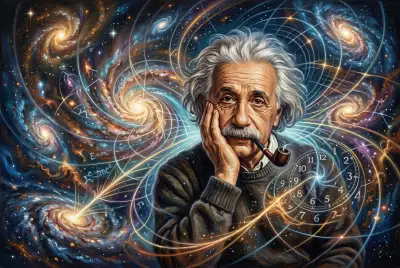
Have you ever looked up at the stars, felt the inexplicable pull of the Earth, and wondered if there's more to gravity than meets the eye? I certainly have. For centuries, gravity has been the silent architect of the cosmos, dictating the dance of planets and the birth of galaxies. We’ve come to understand it as a fundamental force, a curvature of spacetime as Einstein famously described. But what if gravity isn't just a force or a geometry? What if, at its very core, gravity is a vast, intricate algorithm, a cosmic computer program running our universe? This isn't just a philosophical musing; it’s a radical idea gaining traction in the fringes of theoretical physics, suggesting our reality might be a computation, and gravity its underlying code.
For a long time, the quest in physics has been to unify everything – to find a single, elegant theory that explains all forces, from the quantum realm to the cosmic scale. General Relativity beautifully explains gravity on large scales, but it struggles when we try to peer into black holes or the very early universe, where quantum effects should dominate. This clash has led physicists down many fascinating paths, and one of the most intriguing is the idea that gravity itself might emerge from something more fundamental: information.
### The Universe as a Hologram: A Data-Driven Reality?
To understand gravity as an algorithm, we first need to grapple with the **Holographic Principle**. This mind-bending concept, born from the study of black holes, suggests that the information content of a volume of space can be entirely encoded on its boundary. Think of a hologram: a 3D image encoded on a 2D surface. Similarly, our entire 3D universe, with all its stars, galaxies, and living beings, might just be a holographic projection of information residing on a distant, 2D cosmic boundary. If this is true, then our perceived reality, including gravity, would be an emergent phenomenon, much like a complex image emerges from data on a screen.
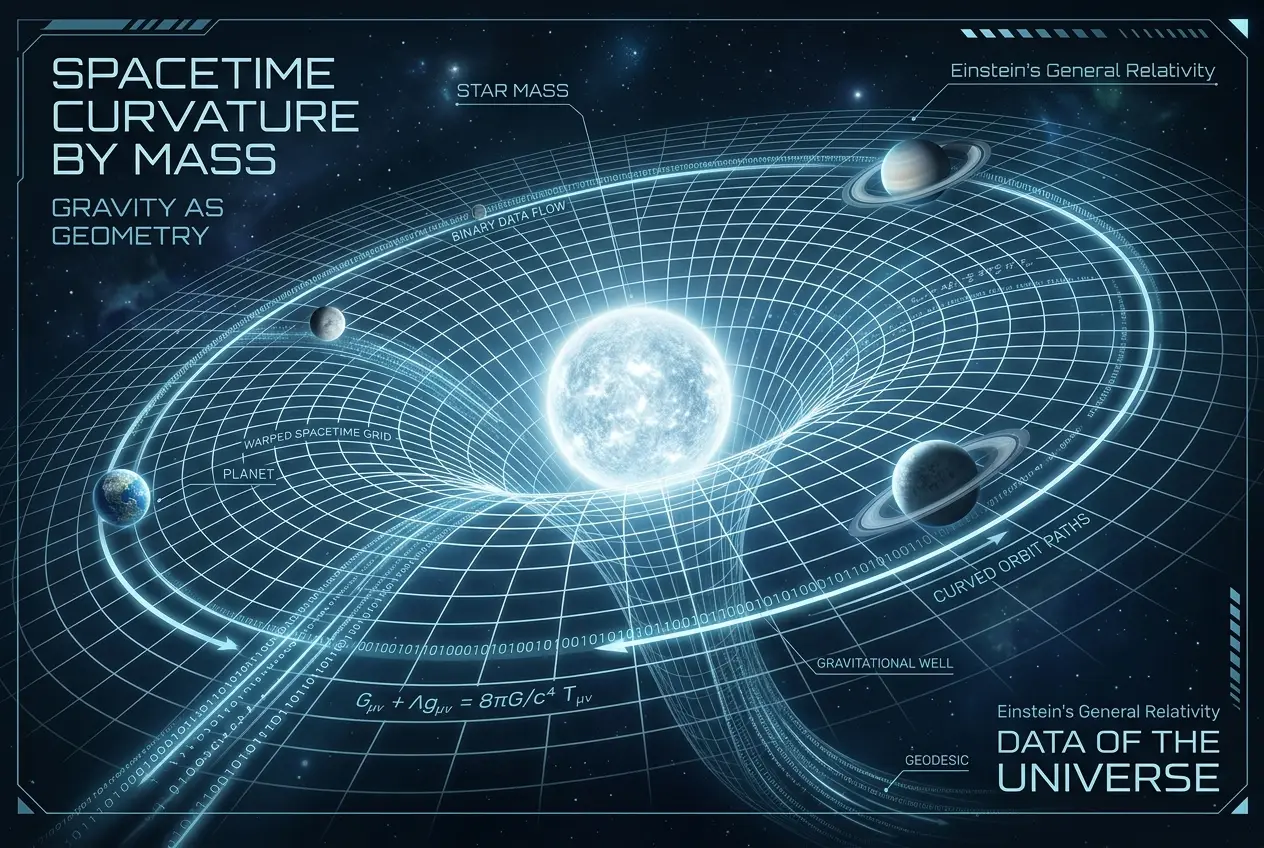
In this holographic model, gravity wouldn't be a fundamental force in the traditional sense. Instead, it would be a manifestation of the underlying informational structure. Imagine a simulation running on a supercomputer. The visual effects you see – the characters, the landscapes, the physics engines – are not fundamental entities; they are computations derived from lines of code and data. In a similar vein, gravity could be the "physics engine" of our cosmic simulation, a consequence of the way information is processed and projected from a deeper, informational reality.
"The holographic principle states that the description of a volume of space can be thought of as encoded on a lower-dimensional boundary to the region," notes the Wikipedia article on the topic, highlighting its radical implications for understanding reality. For more details, you can explore the [Holographic Principle on Wikipedia](https://en.wikipedia.org/wiki/Holographic_principle).
### Emergent Gravity: From Bits to Black Holes
Building on the holographic principle, some theories propose **emergent gravity**. This perspective posits that gravity isn't a fundamental force existing independently, but rather *emerges* from the collective behavior of microscopic degrees of freedom, much like temperature emerges from the motion of countless atoms. Erik Verlinde, a prominent physicist, has spearheaded this idea, suggesting that gravity arises from changes in information associated with the positions of matter.
Consider a hot gas. You can describe its temperature, pressure, and volume without needing to track every single molecule. These macroscopic properties are emergent. Verlinde proposes that gravity is similar: it's a thermodynamic force, a statistical consequence of information changes. When an object moves, it changes the information distribution in the universe, and this change manifests as the force we call gravity. This shift from "force" to "information processing" is where the "cosmic algorithm" idea truly takes hold.
If gravity is emergent, then the rules governing its behavior — like Newton's law or Einstein's field equations — could be thought of as algorithms. These aren't algorithms written by a conscious programmer, but rather fundamental computational rules embedded in the fabric of reality itself. They dictate how information is processed, exchanged, and manifested as the gravitational interactions we observe.
### Quantum Gravity and the Quest for the Cosmic Code
The ultimate goal of theoretical physics is a theory of **quantum gravity** that seamlessly merges General Relativity with quantum mechanics. Many approaches to quantum gravity, such as string theory and loop quantum gravity, hint at a universe built from fundamental "bits" or quanta. If spacetime itself is quantized, then it’s not a smooth, continuous fabric, but rather a discrete structure, a lattice of information points.
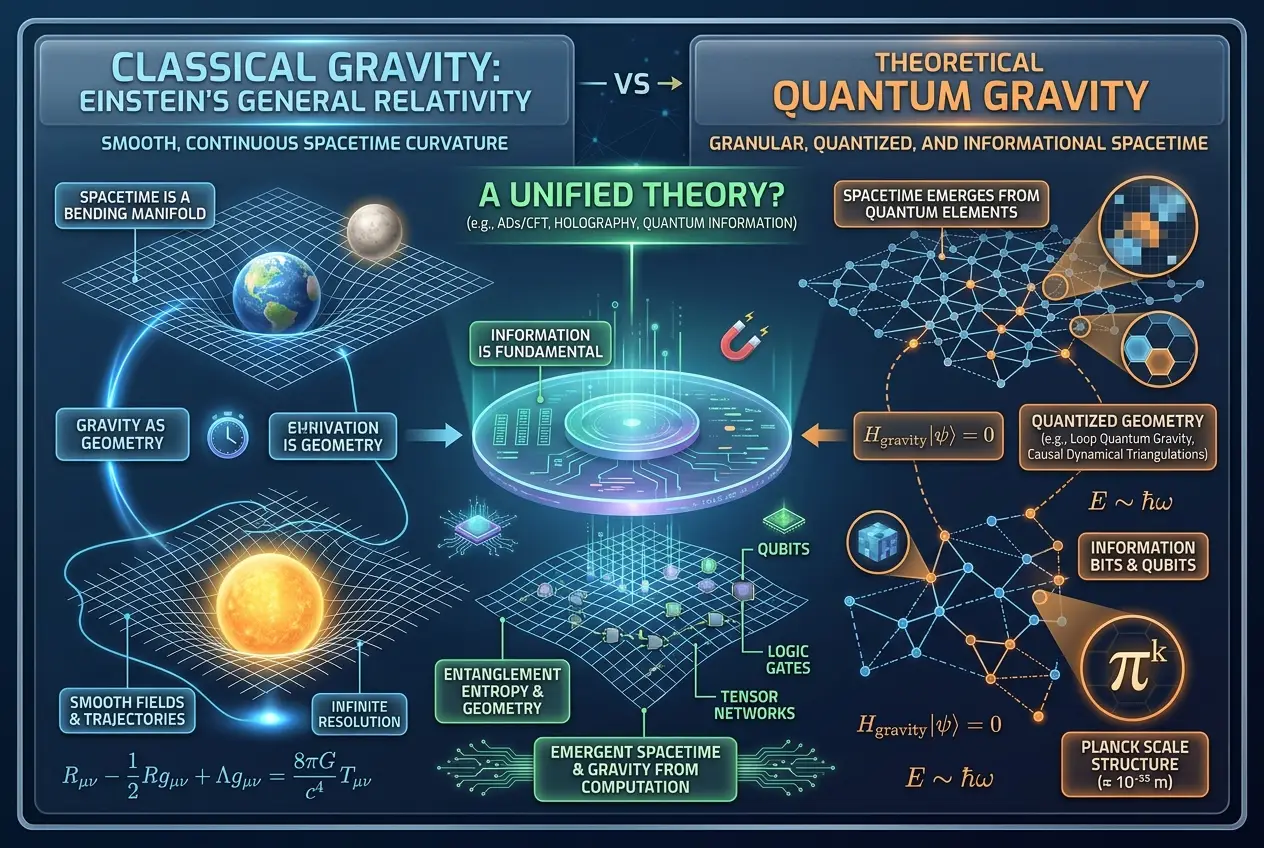
In this scenario, the universe would be performing computations at its most fundamental level. The interaction of these quantum bits would give rise to the macroscopic phenomena we observe, including gravity. Imagine a complex cellular automaton, where simple rules applied to individual cells produce intricate patterns. Perhaps our universe is a grand cellular automaton, and gravity is one of the emergent, intricate patterns.
The idea that the universe could be a giant computer is not new. Pioneers like John Archibald Wheeler explored "It from Bit," suggesting that every physical entity, every "it," derives its existence from elementary yes/no questions, i.e., "bits" of information. If everything is information, and gravity emerges from information, then gravity is intrinsically algorithmic.
This conceptual shift is profound. It means that the universe isn't just *governed* by laws; it *is* those laws in action, a self-executing algorithm continually calculating its next state. The bending of spacetime, the trajectories of falling apples, the orbits of galaxies – all could be the output of an unimaginably vast, cosmic computation. Dive deeper into the concept of quantum gravity by visiting its [Wikipedia page](https://en.wikipedia.org/wiki/Quantum_gravity).
### Searching for Clues: Where Does the Algorithm Run?
If gravity is an algorithm, where is this cosmic computer located? The most radical answer is: *everywhere*. The universe itself is the computer, and spacetime is its operating system. There's no external processor; the processing power is inherent in the very fabric of reality.
We might even find subtle clues in cosmological phenomena. Some theories, for instance, propose that cosmic rays or other high-energy particles could be considered "errors" or "glitches" in this cosmic computation. Or, perhaps, the strange behaviors of phenomena like dark matter and dark energy – which we still struggle to fully understand – could be interpreted as parameters or variables within this grand algorithm that we haven't yet deciphered.
Our understanding of the universe has already evolved dramatically. From a geocentric view to a vast, expanding cosmos, we’ve repeatedly reshaped our perception of reality. The idea of gravity as an algorithm or an emergent phenomenon is another such paradigm shift, challenging us to look beyond the surface of what we observe. For instance, the quest to understand the properties of the cosmos beyond what we currently know sometimes involves examining /blogs/do-cosmic-rays-silently-corrupt-our-digital-memories-4310 or even exploring /blogs/could-empty-space-hold-the-universes-lost-data-7037. These seemingly unrelated phenomena might eventually connect to the fundamental computational nature of reality.
### The Implications of a Computational Cosmos
If gravity is truly a cosmic algorithm, the implications are staggering.
* **A Deeper Reality:** It would suggest that our physical reality is a derivative, a projection of something more fundamental, an informational substratum.
* **New Physics:** This could open entirely new avenues for developing a unified theory, moving beyond particles and fields to focus on bits and information processing.
* **The Nature of Reality:** It blurs the line between physics and computation, suggesting that the universe might be inherently computational, a "digital universe" in a profound sense.
Consider the notion of /blogs/is-the-universe-a-giant-neural-network-2907, which also hints at a computational aspect of cosmic structure. Or perhaps, the fundamental bits of information could be stored in unexpected places, such as explored in /blogs/do-black-holes-store-universes-lost-data-5797. These concepts, while distinct, share a common thread: the universe might be fundamentally information-based.
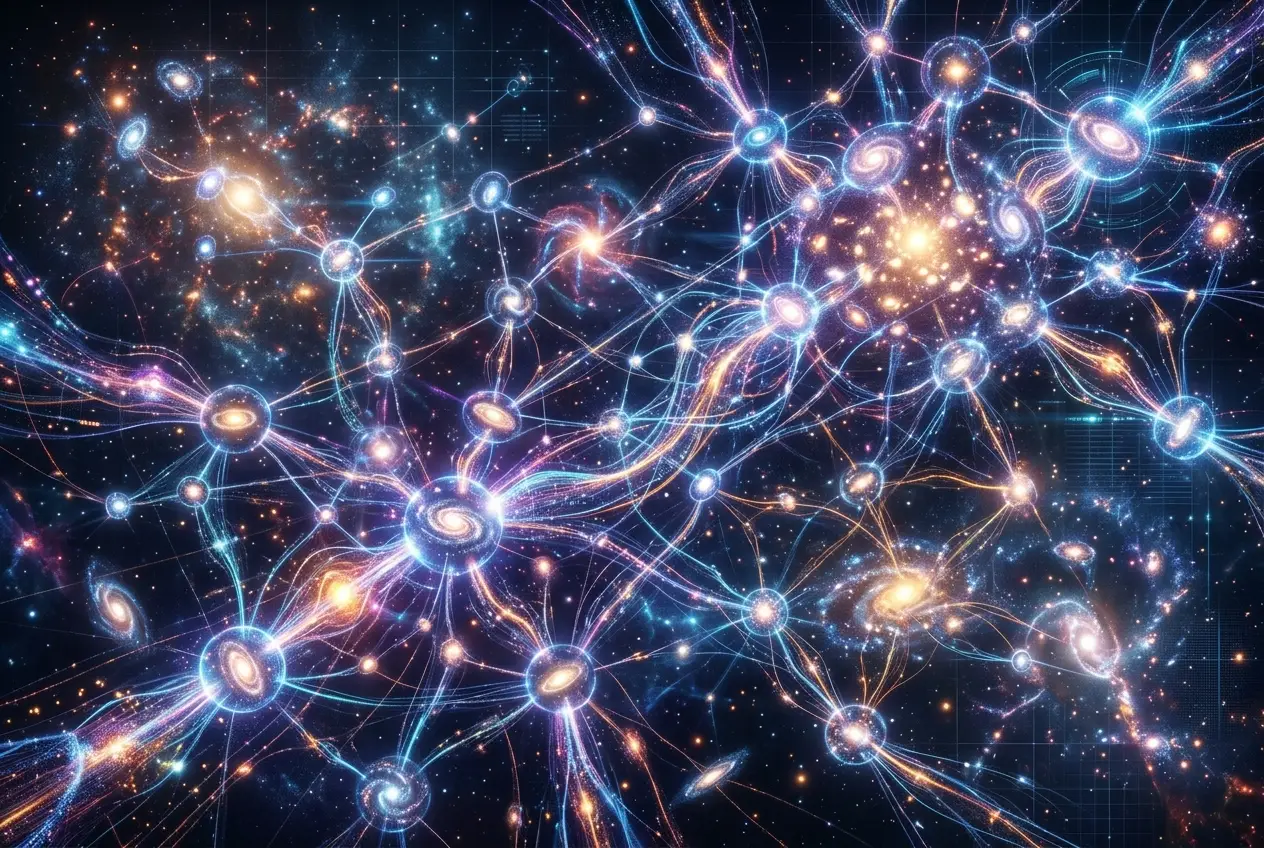
Of course, this remains theoretical, a frontier of exploration. There are immense challenges in testing such hypotheses experimentally. However, the elegance and explanatory power of emergent gravity and the holographic principle are compelling. They offer a fresh lens through which to view one of the oldest and most profound mysteries of the universe.
So, the next time you feel the Earth’s gravitational embrace, pause for a moment. Are you simply feeling a force, or are you experiencing the output of an unimaginably ancient and complex cosmic algorithm, a fundamental computation that defines the very fabric of our existence? The universe, it seems, might just be running the most sophisticated software ever conceived. You can read more about various theories of cosmic computation on [Wikipedia's article about the simulated reality hypothesis](https://en.wikipedia.org/wiki/Simulated_reality).
Frequently Asked Questions
The Holographic Principle suggests that all the information in a 3D volume of space can be encoded on a 2D surface at its boundary. In the context of gravity, this means gravity might not be a fundamental force but an emergent phenomenon arising from this underlying informational structure, much like a 3D image from a 2D hologram.
Emergent gravity is a theoretical concept proposing that gravity isn't a fundamental force but rather emerges from more basic, microscopic degrees of freedom or from changes in information. It's akin to how macroscopic properties like temperature emerge from the collective behavior of countless particles.
The idea of a 'computational cosmos' suggests that the universe, at its most fundamental level, operates like a giant computer, processing information. If spacetime is discrete (made of tiny 'bits' of information), then the interactions of these bits could be seen as computations, giving rise to phenomena like gravity.
While the concept of gravity as an algorithm or emergent information shares some philosophical overlap with the 'simulated reality' hypothesis, it's not strictly the same. It proposes that reality is fundamentally informational and computational, rather than necessarily being run on an external, artificial computer. It's about the inherent nature of physical laws themselves.
The main challenges lie in experimental verification. These theories often operate at scales far beyond our current technological reach (e.g., the Planck scale where quantum gravity effects are dominant). Developing experiments that can directly test the informational or computational nature of gravity is a monumental task for future physics.
Verified Expert
Alex Rivers
A professional researcher since age twelve, I delve into mysteries and ignite curiosity by presenting an array of compelling possibilities. I will heighten your curiosity, but by the end, you will possess profound knowledge.
Leave a Reply
Comments (0)
No approved comments yet. Be the first to share your thoughts!
 Join Us



 Unknown Author









Leave a Reply
Comments (0)