I was recently watching a sci-fi documentary, the kind that makes you question everything you thought you knew about physics. It showed cities with cars zipping through the air, buildings defying the pull of the Earth, and people moving objects with what seemed like sheer will. It struck me: for all our technological advancements, gravity remains one of the universe's most unyielding forces. We've sent rockets to the moon, built supercolliders, and even started peering into the quantum realm, yet the dream of truly *manipulating* gravity—of levitation and defying Earth's constant embrace—feels as distant as ever. Or does it?
The concept of gravity manipulation isn't just the stuff of science fiction. It’s a tantalizing frontier that has fascinated scientists, engineers, and dreamers for centuries. From the mythical tales of flying carpets to the sleek anti-gravity vehicles in futuristic films, the idea of freeing ourselves from the relentless tug of gravity is deeply ingrained in our collective imagination. But beyond the fantastical, what does cutting-edge science say about the possibility? Are we inching closer to understanding, and perhaps even controlling, this fundamental force? I believe we might be.
### The Unseen Hand: Understanding Gravity
Before we can even think about manipulating gravity, we need to truly understand it. Sir Isaac Newton famously described gravity as a force that pulls objects towards each other, proportional to their mass and inversely proportional to the square of the distance between them. This classical view, outlined in his *Philosophiæ Naturalis Principia Mathematica*, explained everything from falling apples to the orbits of planets with remarkable accuracy for centuries. For a deeper dive into Newton's foundational work, you can explore the
Wikipedia page on Principia Mathematica.
Then came Albert Einstein, who revolutionized our understanding with his theory of **General Relativity**. Einstein didn't see gravity as a force, but as a manifestation of the curvature of spacetime itself. Imagine a bowling ball placed on a stretched rubber sheet; it creates a depression. If you then roll a marble near it, the marble will curve inwards, not because the bowling ball is "pulling" it, but because the sheet itself is distorted. Massive objects, like Earth or the Sun, warp the fabric of spacetime around them, and what we perceive as gravity is simply objects following the shortest path through this curved spacetime.
This relativistic view is incredibly powerful and has been confirmed by numerous experiments, from the bending of starlight around the Sun to the precise predictions of GPS satellite orbits. However, General Relativity, for all its success, doesn't play well with **quantum mechanics**, the theory that governs the universe at its smallest scales. This disconnect—the lack of a unified theory of quantum gravity—is one of the biggest challenges in modern physics, and perhaps the key to unlocking gravity's deepest secrets. It's a mystery that still baffles even the brightest minds, much like the strange hum that still baffles scientists globally, as discussed in our blog,
"Why Does the Hum Baffle Scientists Globally?"
### Current Approaches to "Levitation"
While true gravity manipulation in the sci-fi sense remains elusive, scientists are exploring several intriguing avenues that offer glimpses into what might be possible.
#### 1. Magnetic Levitation (Maglev)
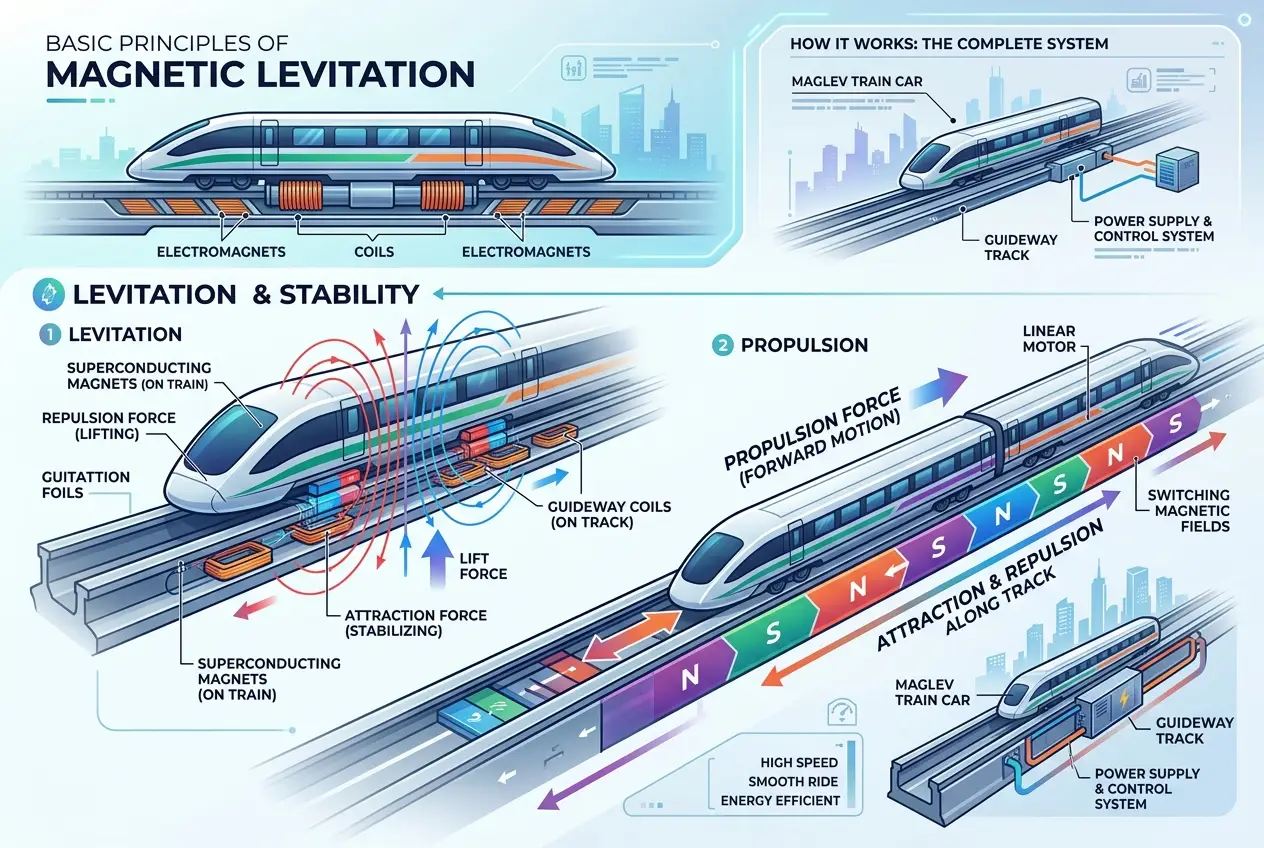
Perhaps the most well-known form of practical "levitation" is **magnetic levitation**, or **maglev**. This technology uses powerful electromagnets to suspend and propel objects, typically trains, above a track. The repulsion between like magnetic poles or the attraction to an induced magnetic field counters the force of gravity. Maglev trains, like those in Shanghai or Japan, can reach incredible speeds because they eliminate friction with the ground. While impressive, this isn't gravity manipulation; it's simply using one fundamental force (electromagnetism) to counteract another.
#### 2. Acoustic Levitation
Imagine sound waves powerful enough to hold an object in mid-air. That's the principle behind **acoustic levitation**. By precisely controlling high-frequency sound waves (often ultrasound, which is inaudible to humans), scientists can create standing waves that generate pressure nodes—points where the sound waves interfere in such a way that they create a stable pocket of high pressure. Small, light objects, like water droplets or tiny particles, can then be trapped and suspended within these nodes. This is extremely useful in laboratories for handling delicate materials without contamination, but it's limited to very small masses and specific environments. For more on the intriguing interaction of sound and light, you might enjoy our post on
"Sonoluminescence: Does Sound Truly Emit Light?"
#### 3. Aerodynamic Levitation
This is the most common form of "flight" we experience daily: airplanes. **Aerodynamic levitation** relies on the principles of fluid dynamics. Wings are designed to create a pressure differential, generating lift that opposes gravity. While incredibly effective for moving through Earth's atmosphere, it requires constant energy input to overcome air resistance and is distinct from true gravity manipulation.
### Beyond Conventional Levitation: The Search for Antigravity
The real quest for gravity manipulation goes beyond merely countering gravity with other forces. It seeks to lessen, negate, or even reverse gravity itself. This is where science gets truly speculative, venturing into the realms of theoretical physics and exotic matter.
#### 1. Exotic Matter and Negative Mass
Einstein's General Relativity suggests that gravity is always attractive. However, some theoretical models propose the existence of **exotic matter** or **negative mass**. If such matter existed, it might generate a repulsive gravitational field. Imagine a "negative mass" object; it wouldn't be pulled by gravity but pushed away. While mathematically intriguing, there's no observational evidence for negative mass, and its existence would have profound implications, potentially violating fundamental laws of physics like the conservation of energy. It remains firmly in the realm of hypothesis.
#### 2. Warp Drives and Spacetime Engineering
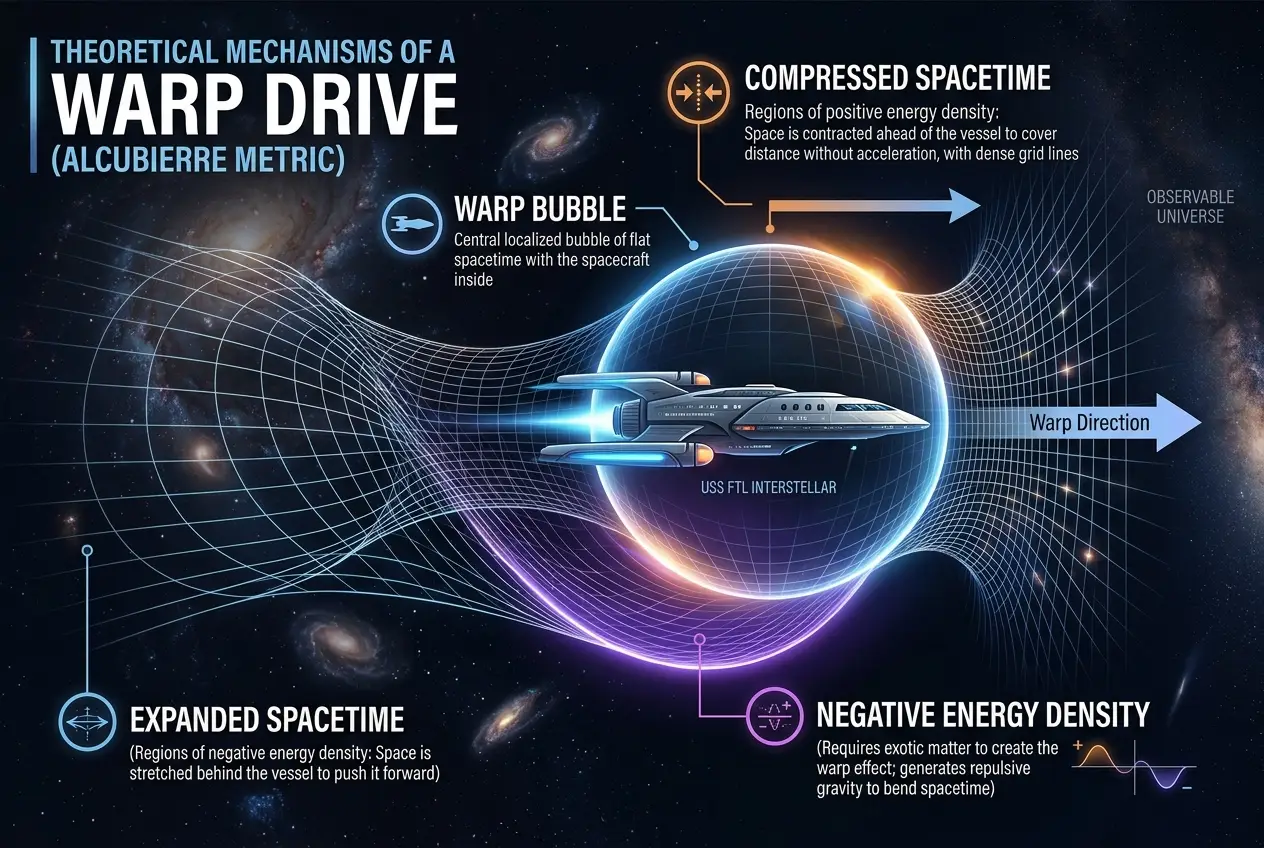
The concept of a **warp drive**, popularized by Star Trek, is a form of gravity manipulation. It doesn't involve moving faster than light through space, but rather distorting spacetime itself. The theoretical **Alcubierre drive**, for instance, proposes compressing spacetime in front of a spacecraft and expanding it behind, effectively creating a "warp bubble" within which the spacecraft could travel at superluminal *effective* speeds without violating local light speed limits. This would require immense amounts of negative energy density, a concept closely related to exotic matter. While mathematically plausible within General Relativity, the energy requirements are astronomical, potentially exceeding the mass-energy of entire planets or stars. Understanding the fabric of spacetime is crucial here, a topic also explored in our article
"How Does Quantum Entanglement Defy Space-Time?"
#### 3. Gravitational Waves and Quantum Gravity
The detection of **gravitational waves** by LIGO in 2015 was a monumental triumph, confirming another key prediction of General Relativity. These ripples in spacetime, caused by accelerating massive objects like colliding black holes, show that spacetime is dynamic and can be influenced. Could we generate targeted gravitational waves to create localized regions of reduced gravity? This is far beyond our current technological capabilities, but it hints at the active nature of spacetime.
The ultimate key, many physicists believe, lies in a unified theory of **quantum gravity**. If we could reconcile General Relativity with quantum mechanics, we might unlock a deeper understanding of gravity's fundamental nature, perhaps revealing a way to manipulate it at its most basic level. Theories like String Theory or Loop Quantum Gravity are attempts to achieve this grand unification, positing that gravity might be carried by hypothetical particles called **gravitons** or emerge from the very quantum structure of spacetime. Discovering these underlying mechanisms could be the breakthrough we need. You can learn more about gravitational waves and their detection on
Wikipedia's Gravitational Wave page.
### The Challenges and the Horizon
The road to gravity manipulation is fraught with immense challenges. The gravitational force, while pervasive, is incredibly weak compared to electromagnetism or the nuclear forces. It takes the entire mass of Earth to keep us grounded, whereas a small magnet can lift a paperclip against that colossal pull. Any technology attempting to manipulate gravity would need to generate forces on an unprecedented scale or tap into entirely new physics.
| Method of "Levitation" | Principle Used | Gravity Manipulation? | Current Status |
| :--------------------- | :-------------- | :-------------------- | :------------- |
| **Magnetic Levitation** | Electromagnetism | No (counters gravity) | Practical, commercial |
| **Acoustic Levitation** | Sound Waves | No (counters gravity) | Laboratory, micro-scale |
| **Aerodynamic Lift** | Fluid Dynamics | No (counters gravity) | Common, macro-scale |
| **Exotic Matter (Negative Mass)** | Theoretical Gravity | Yes (reverses/negates) | Hypothetical, no evidence |
| **Warp Drive (Alcubierre)** | Spacetime Distortion | Yes (distorts gravity) | Theoretical, immense energy barrier |
| **Quantum Gravity Manipulation** | Unified Theory | Potentially Yes (fundamental) | Theoretical, unknown mechanisms |
Despite these hurdles, the pursuit of gravity manipulation continues to inspire groundbreaking research. Advances in materials science could lead to incredibly light and strong structures. Our understanding of spacetime and quantum mechanics continues to evolve. While we may not have flying cars tomorrow, the journey itself is pushing the boundaries of human knowledge and technological innovation.
I find myself continually amazed by the sheer audacity of human curiosity. We look at the stars and imagine not just reaching them, but redesigning the very laws that govern our universe. The possibility of manipulating gravity, even if generations away, promises a future where energy is harnessed differently, travel is redefined, and our place in the cosmos takes on an entirely new dimension. It’s a bold vision, one that reminds me that the most profound discoveries often lie just beyond the edge of our current understanding.
Perhaps one day, we will look back at our current limitations with the same wonder we now hold for ancient civilizations, and marvel at how far we've come. The dream of floating free, whether through subtle shifts in quantum fields or grand distortions of spacetime, continues to pull us forward. To explore more mind-bending possibilities of physics, check out our article on
"Is Our Universe a Hologram? Decoding Cosmic Data." Join Us



 Unknown Author




























Leave a Reply
Comments (0)