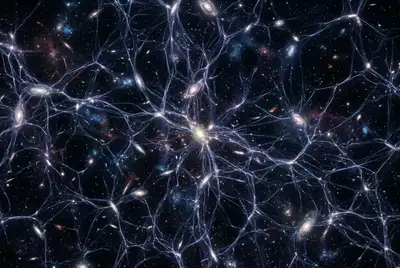
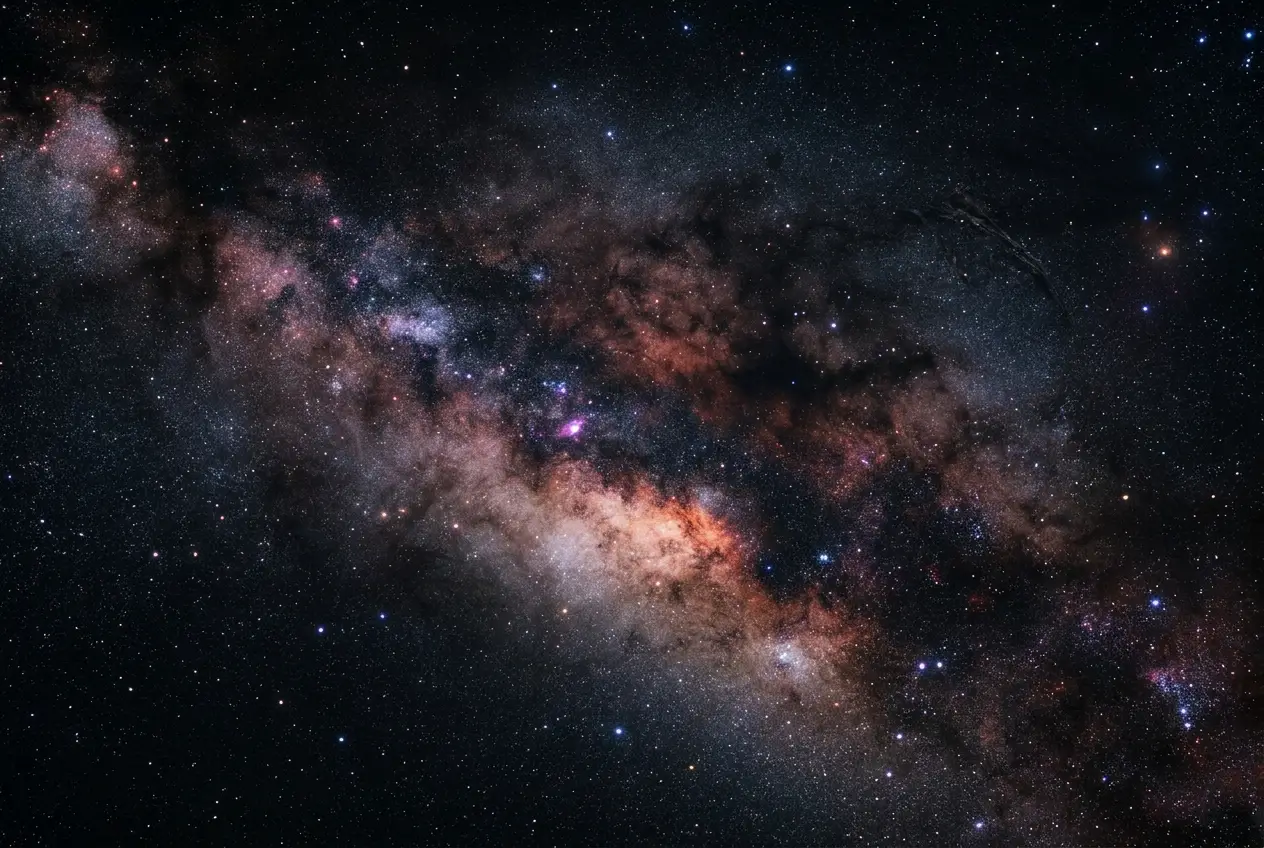
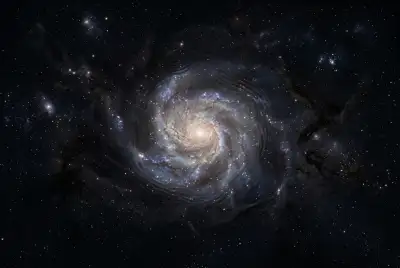
Recently, I found myself gazing at the night sky, completely overwhelmed by the sheer scale of the universe. Every tiny pinprick of light represents a star, potentially orbited by countless planets. The numbers are staggering – billions of galaxies, each with billions of stars. It makes you wonder, doesn't it? **Where is everyone?** If life is so common, and the universe so vast, why haven't we heard a peep? This profound silence is often called the Fermi Paradox, and it’s a question that has haunted scientists and dreamers for decades. But what if the silence isn't due to an absence of life, but rather a deliberate choice by advanced civilizations to remain hidden, lurking within a "Dark Forest"?
This chilling concept, popularized by science fiction author Liu Cixin in his acclaimed "Remembrance of Earth's Past" trilogy, paints a stark picture of the cosmos. Imagine the universe as a vast, dark forest, filled with hunters. Each civilization is a hunter, stealthily moving through the trees, wary of others. If a hunter reveals itself, it risks being targeted and destroyed by another, more powerful hunter. Therefore, **silence becomes the ultimate survival strategy.**
### The Fermi Paradox: A Cosmic Enigma
Before we dive deeper into the implications of a Dark Forest, let's briefly revisit the core of the Fermi Paradox. Named after physicist Enrico Fermi, who famously posed the question, "Where is everybody?", the paradox highlights the contradiction between the high probability of extraterrestrial life existing and the apparent lack of evidence for it.
The numbers are compelling:
* An estimated 10^22 to 10^24 stars in the observable universe.
* A significant fraction of these stars are thought to host planets.
* Many exoplanets exist within habitable zones, meaning conditions could support liquid water.
Given these odds, the universe should be teeming with life, and advanced civilizations should be common. Yet, our Search for Extraterrestrial Intelligence (SETI) efforts have, so far, yielded nothing but static. This cosmic quietude fuels various theories, ranging from our being the only intelligent life (a lonely prospect) to advanced civilizations being too far away, or perhaps having already destroyed themselves. For a deeper dive into this enigma, you might find our previous blog post on why the universe is so quiet particularly insightful: "Why Is the Universe So Quiet? Decoding the Fermi Paradox" (/blogs/why-is-the-universe-so-quiet-decoding-the-fermi-paradox-5418).
### Entering the "Dark Forest" Hypothesis
The Dark Forest hypothesis offers a grim, yet logically consistent, explanation for this silence. It suggests that any civilization capable of interstellar travel or communication would quickly realize that revealing its presence is an existential risk.
**Why the hostility?** In the Dark Forest, resources are finite, and intentions are unknowable. If you detect another civilization, you have two choices:
1. **Assume they are benign:** This is a gamble. If they are not, you risk being annihilated.
2. **Eliminate them before they can eliminate you:** This is the safest bet for survival.
This "chain of suspicion" leads to an unavoidable conclusion: **any detected civilization is a potential threat that must be neutralized.** It's a cosmic game theory where the optimal strategy for survival is pre-emptive strike, or, even better, complete stealth.
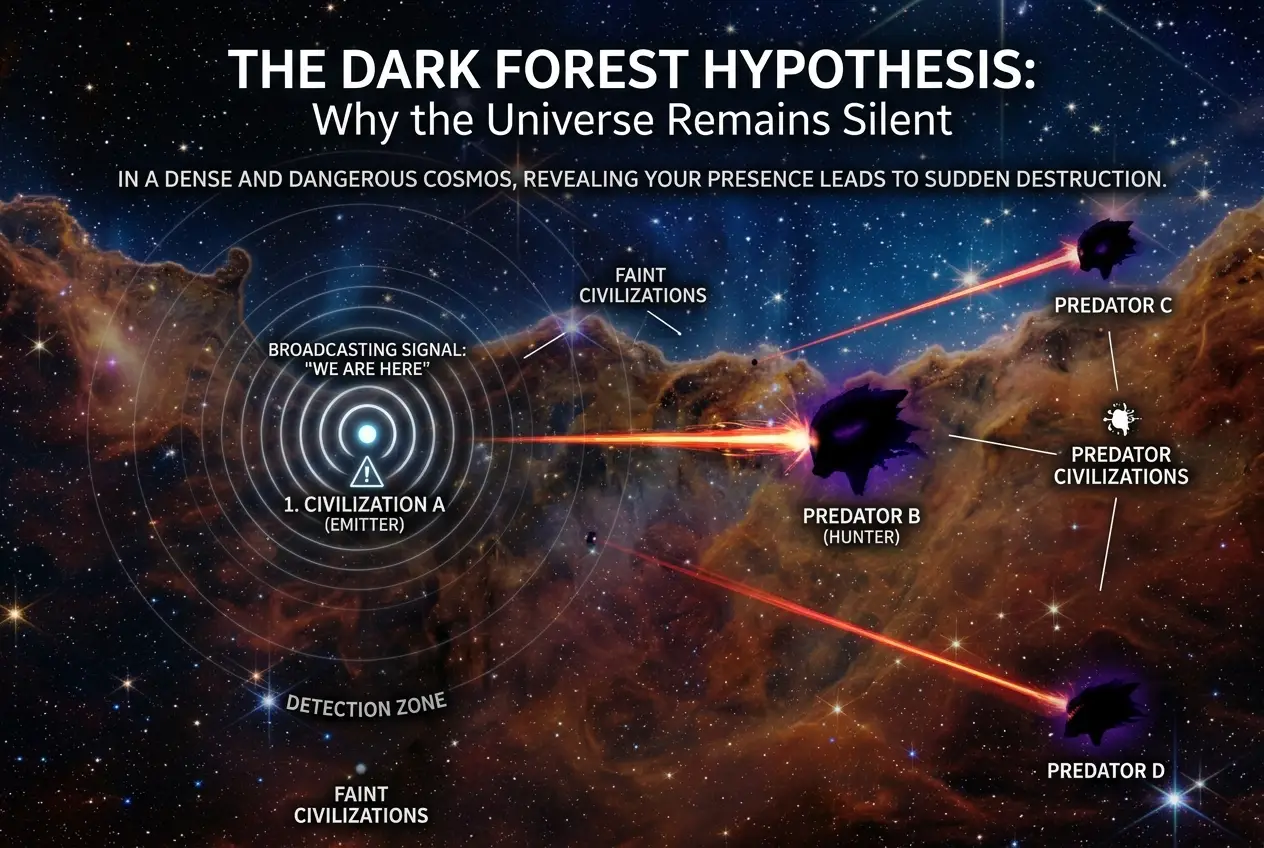
This chilling idea flips our traditional view of alien encounters on its head. Instead of expecting benevolent explorers or intellectual peers, we should brace for silent, calculating predators. This leads to a crucial question: **If alien civilizations are deliberately hiding, what kind of "tech" would they use to achieve this, and how would it manifest?**
### The Art of Cosmic Camouflage: Hiding in Plain Sight
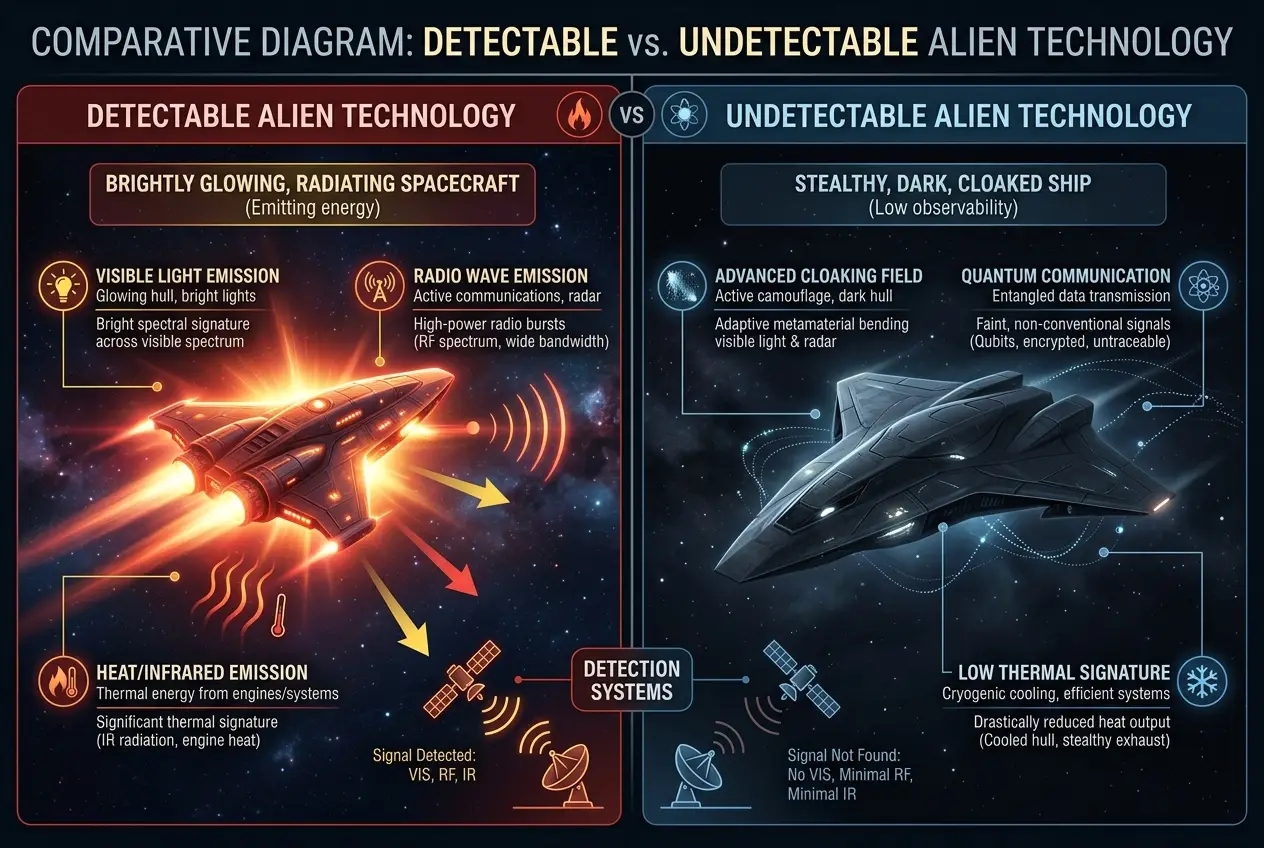
If the Dark Forest hypothesis holds true, then advanced alien civilizations wouldn't be broadcasting their existence with grand, obvious signals. Instead, they would be masters of cosmic camouflage, developing technologies designed to minimize their detectable footprint.
**1. Stealth Technologies:**
Just as stealth aircraft on Earth are designed to evade radar detection, advanced alien civilizations would likely employ technologies to reduce their "signature" across the electromagnetic spectrum. This could involve:
* **Active Cloaking:** Using meta-materials or energy fields to bend light and other radiation around their settlements or spacecraft, making them effectively invisible.
* **Passive Absorption:** Developing surfaces that absorb all incoming radiation, preventing any reflection that could give away their position.
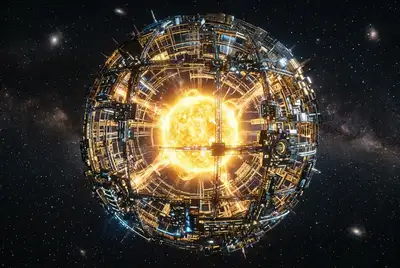
* **Mimicry:** Blending their technological structures seamlessly with natural cosmic phenomena. Imagine a city built inside an asteroid or a Dyson Sphere (a hypothetical megastructure enclosing a star to harness its energy) so perfectly integrated with its star that it looks like a natural, if slightly unusual, star.
**2. Minimal Energy Signatures:**
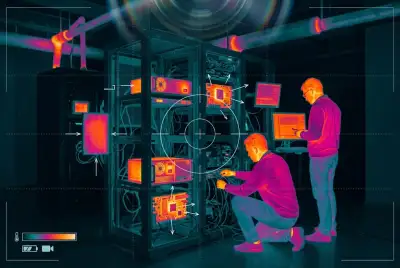
A civilization needs energy, but energy consumption creates heat, light, and other detectable emissions. A Dark Forest civilization would aim for **ultra-efficient energy systems** that produce minimal waste heat. Perhaps they harness exotic forms of energy that don't radiate in conventional ways, or they utilize incredibly effective waste heat sinks. The idea of Dyson Spheres, for example, posits a highly advanced civilization that would be detectable by its unique infrared signature as it radiates waste heat from its energy capture. In a Dark Forest, such a massive and tell-tale signature would be a death wish. Perhaps they build *micro-Dyson Swarms* around smaller stars, or develop methods to radiate heat into cold dark matter or other undetectable sinks. You can read more about such megastructures in our article: "Can We Build a Dyson Sphere? Taming a Star for Power" (/blogs/can-we-build-a-dyson-sphere-taming-a-star-for-power-3135).
**3. Advanced Data Storage & Communication:**
Instead of broadcasting across vast distances, which is inherently risky, these civilizations might rely on:
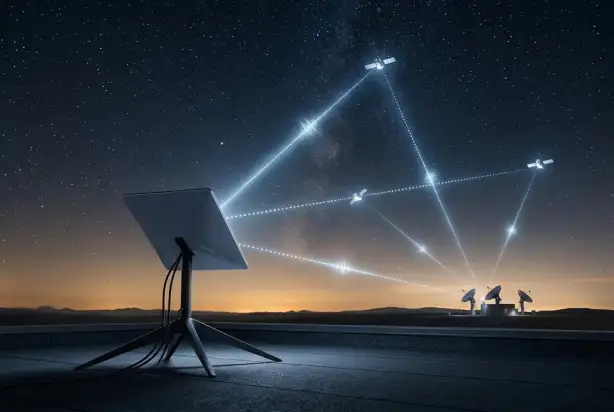
* **Quantum Communication:** Using entangled particles for instant, secure communication that leaves no traditional electromagnetic trace.
* **Subspace or Hyperspace Technology:** If such physics are possible, communication that doesn't propagate through conventional space would be untraceable.
* **Massive, Encrypted Data Storage:** Storing their entire civilization's knowledge in highly condensed, undetectable formats, perhaps even within quantum entanglement networks or exotic matter. Our ability to store vast amounts of data is already evolving with DNA storage, as explored in "Can DNA Store the World's Digital Data?" (/blogs/can-dna-store-the-worlds-digital-data-5328). Imagine this concept scaled up astronomically and made entirely invisible.
### Hunting for the Unseen: Technosignatures of a Hidden Foe
If alien civilizations are actively hiding, how could we possibly find them? The answer lies in looking for subtle, indirect clues – **technosignatures** – that are not intended to be signals, but rather unintended byproducts of advanced technology.
**1. Anomalous Energy Signatures:**
While Dark Forest civilizations would try to minimize their energy footprint, extreme energy events or processing might still leave a trace. For example:
* **Transient Absorption of Starlight:** A temporary, unexplained dimming of a star that isn't due to natural planetary transits. Could it be a cloaked megastructure passing in front, or even some form of hyper-efficient energy harvesting that causes unusual stellar fluctuations? We've explored mysteries around exoplanet transits before: "Do Exoplanet Transits Hide Alien Tech?" (/blogs/do-exoplanet-transits-hide-alien-tech-6425).
* **Unusual Spectrographic Signatures:** Detecting elements or compounds in a star's atmosphere or around a planetary system that couldn't possibly be natural, implying industrial-scale processing.
**2. Gravitational Anomalies:**
Massive cloaking devices or propulsion systems could create localized gravitational distortions that might be detectable. While incredibly difficult to measure at interstellar distances, highly sensitive gravitational wave detectors in the future might pick up such events.
**3. "Ghost" Echoes in Cosmic Data:**
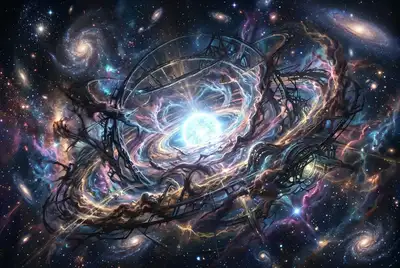
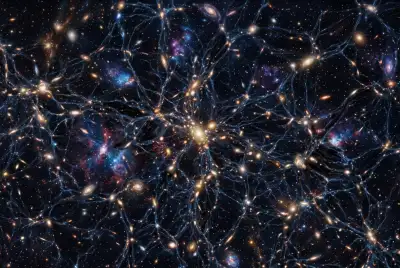
Could there be subtle patterns in cosmic background radiation, or in the distribution of matter, that indicate highly advanced, yet cloaked, manipulation of the universe? Imagine artificial structures so vast they subtly influence cosmic evolution, appearing as statistical anomalies in large-scale surveys.
**4. The "Graveyard" of Civilizations:**
A truly chilling thought: perhaps we find evidence not of living, hiding civilizations, but of those that failed to hide effectively. Remnants of destroyed megastructures, fragmented planets, or unusual chemical signatures left behind by a cosmic conflict. This would serve as a grim warning, reinforcing the Dark Forest principle.
"The universe is a dark forest. Every civilization is an armed hunter stalking through the trees like a ghost, gently pushing aside branches that block the path and trying to tread without sound. The forest is full of other hunters, too. If he finds another life—another hunter, angel or demon, fragile fawn or stomping elephant—there’s only one thing he can do: open fire and eliminate them." — Liu Cixin, *The Dark Forest*
### The Ethical Dilemma: To Broadcast or Not To Broadcast?
The Dark Forest hypothesis presents humanity with an immense ethical challenge. For decades, our SETI efforts have been largely focused on listening, but also on the potential for METI (Messaging Extraterrestrial Intelligence) – actively broadcasting our presence. The "Arecibo Message" in 1974 was one such attempt, a radio signal aimed at a star cluster 25,000 light-years away.
If the Dark Forest is real, then such messages are not acts of welcoming, but potentially **suicidal declarations.** Many scientists and thinkers are now advocating for extreme caution, if not outright cessation, of METI projects. The potential risk of attracting unwanted attention from a malevolent, or simply hyper-paranoid, civilization could outweigh any perceived benefit of making contact.
This debate highlights a fundamental shift in our understanding of interstellar relations. From hopeful expansionists envisioning a galactic community, we might need to become cautious pragmatists, prioritizing survival above all else.
### Conclusion: Glimmers of Hope in the Cosmic Shadow
While the Dark Forest hypothesis is undoubtedly bleak, it doesn't necessarily spell the end of our cosmic dreams. It forces us to re-evaluate our approach to extraterrestrial life and technology. Perhaps understanding this potential threat is the first step towards developing our own sophisticated stealth technologies and a more nuanced strategy for interacting with the cosmos.
What if the "Dark Forest" is just one possible scenario? Could there be other reasons for the silence, perhaps more benign? Or could there be civilizations who have found ways to cooperate, forming a "galactic garden" in secret, far from the hunters? The truth remains shrouded in cosmic mystery. But as we continue to push the boundaries of our own technology and understanding, I believe we will eventually uncover the universe's true nature, even if it means peering into the deepest, darkest corners of the cosmic forest, ever so quietly.
 Join Us
 Unknown Author




















Leave a Reply
Comments (0)