


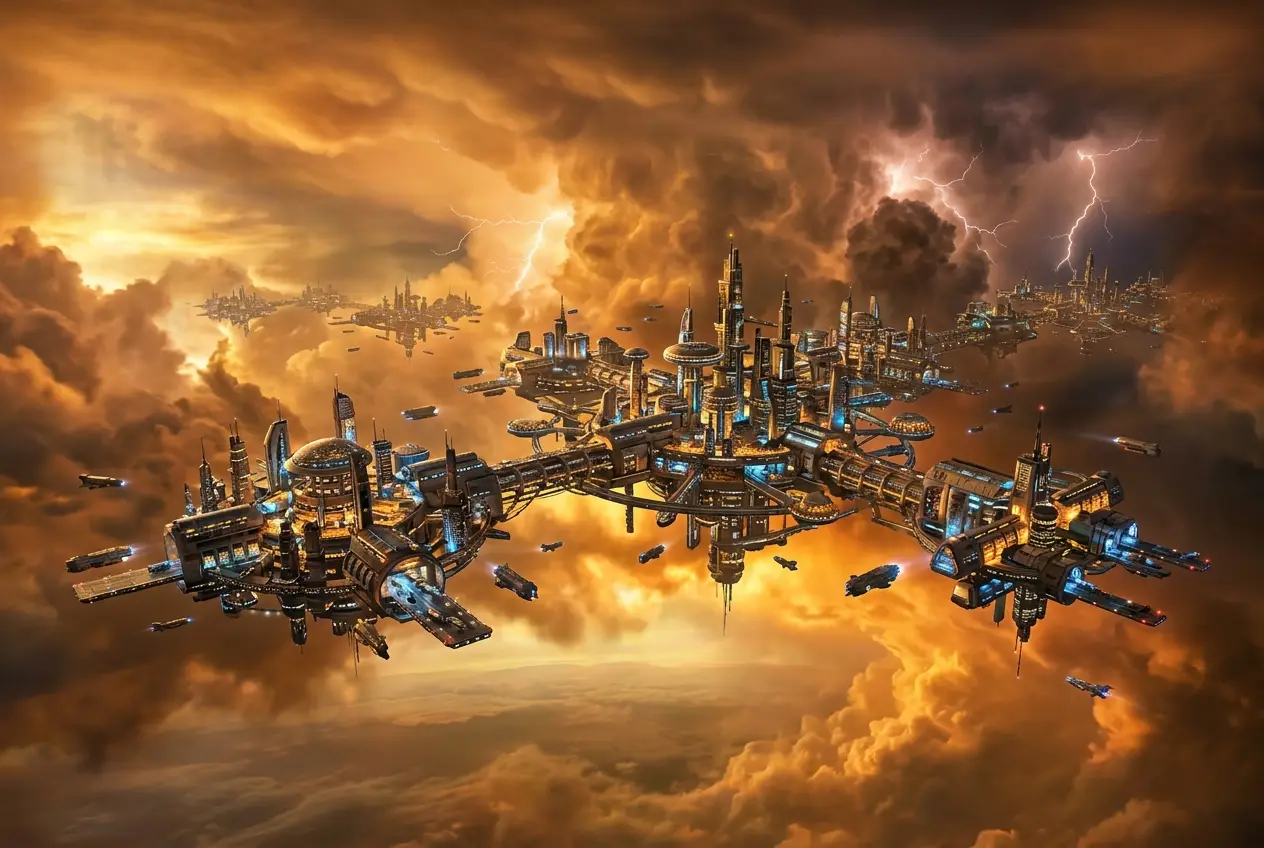
Every time I think about humanity's future in space, my mind inevitably drifts to Mars. It’s the obvious candidate, right? Red, rocky, a touch cold, but undeniably a potential future home. Yet, I recently stumbled upon a concept that completely shifted my perspective, one that dares to look past the red planet to our shrouded, sulfuric neighbor: Venus. I used to dismiss Venus as an inferno, a planet utterly hostile to life, a cautionary tale of runaway greenhouse effects. But what if I told you that in its notoriously dense atmosphere, there’s a sweet spot, a habitable zone, where humans could not just survive, but thrive in floating cities?
This isn't science fiction; it’s an audacious vision backed by serious scientific inquiry and advanced engineering concepts. While the surface of Venus is indeed hellish—hot enough to melt lead, with atmospheric pressure ninety times that of Earth's—its upper atmosphere, specifically around 50-60 kilometers above the surface, offers surprisingly benign conditions. This altitude presents a remarkable paradox: temperatures are around 20-30°C (68-86°F), atmospheric pressure is similar to Earth's sea level, and even the radiation levels are comparable to those found in Canada. It's a goldilocks zone, but instead of on a planetary surface, it's suspended within a perpetual chemical storm.
Why Venus Over Mars? An Unconventional Argument
The idea of colonizing Venus might sound counterintuitive when Mars gets all the headlines. I mean, who wouldn't prefer a rocky planet you can stand on? But let’s dive into the core arguments for Venus. Mars has its challenges: extremely thin atmosphere requiring robust pressure suits, frigid temperatures, high radiation, and a low gravity that could pose long-term health risks. Venus, at its 50 km altitude sweet spot, actually offers several surprising advantages:
- Earth-like Pressure and Temperature: As mentioned, 50 km up, the atmospheric pressure is almost identical to Earth's sea level, meaning simple shirtsleeve environments are possible within habitats. The temperature is also comfortably warm.
- Gravity: Venus has roughly 90% of Earth’s gravity, significantly higher than Mars's 38%. This is crucial for long-term human health, minimizing bone density loss and muscle atrophy.
- Radiation Shielding: The dense Venusian atmosphere provides excellent protection from solar and cosmic radiation, a major concern for Mars missions and settlements.
- Solar Power: Venus is closer to the Sun than Earth, meaning it receives significantly more solar energy. Even through its thick clouds, enough sunlight penetrates to make solar power a viable energy source for atmospheric habitats.
- Atmospheric Resources: The dense atmosphere, though toxic, is rich in carbon dioxide and nitrogen. These can be processed to yield useful materials, including breathable oxygen and structural components, as discussed in various proposals for Venusian airships and habitats. You can learn more about the challenges and opportunities of Venus exploration on its Wikipedia page (opens in a new tab).
The Vision: Aerostat Cities and Atmospheric Habitats
So, how do you build a city in the sky? The primary concept revolves around aerostat cities—massive, buoyant structures akin to super-blimps or airships that float within the Venusian atmosphere. These aren't your grandfather's dirigibles; these would be colossal, self-sustaining habitats.
The principle is simple: the Venusian atmosphere is primarily carbon dioxide (CO2). If you fill a balloon or airship envelope with a lifting gas, such as a breathable mixture of oxygen and nitrogen (like Earth's air), it would naturally float. Why? Because Earth's air is less dense than the Venusian CO2 at the proposed altitude. It's the reverse of how a helium balloon floats on Earth; here, our own air becomes the lifting gas.
Imagine vast, multi-decked cities encased in strong, lightweight materials like Kevlar or advanced composites. These structures would be designed to withstand the harsh sulfuric acid clouds, which exist mainly at higher altitudes but still pose an engineering challenge. Each habitat module would be pressurized with Earth-like air, creating comfortable living and working spaces. These modules could then be linked together, forming sprawling aerial metropolises.
Engineering Challenges and Innovative Solutions
Building these cosmic cloud cities is no small feat. I’ve often wondered about the practicalities beyond the initial concept. Here are some of the major hurdles and proposed solutions:
- Acidic Atmosphere: The clouds of Venus are primarily sulfuric acid. Any exterior materials would need to be highly resistant to corrosion. Advanced ceramics, specialized polymers, and self-healing composites are being explored.
- Energy Generation: While Venus receives abundant sunlight, capturing it effectively through the dense cloud cover requires efficient solar panels. Some concepts suggest using large, deployable arrays or even capturing thermal energy gradients within the atmosphere. If we can generate enormous amounts of energy, perhaps we could even power radical projects like a Dyson Sphere (opens in a new tab) in the far future, as discussed in our blog on Can We Build a Dyson Sphere? Taming a Star for Power.
- Resource Extraction: The atmosphere is full of CO2, but how do we get oxygen, water, and other necessities? Chemical processing plants integrated into the aerostats would convert CO2 into oxygen, and possibly extract water from the small amounts of water vapor present, or potentially import it from asteroids, linking to ideas like Asteroid Mining: Fueling Our Space Future.
- Stability and Maneuverability: Keeping these cities stable in Venus’s dynamic winds would require sophisticated propulsion and attitude control systems. Concepts include variable buoyancy systems, electric thrusters, and even anchoring to lower, stable atmospheric layers.
- Thermal Management: Despite the relatively mild temperatures at 50 km, managing heat generated by habitation and internal systems is crucial. Passive radiative cooling and active refrigeration cycles would be essential.
The European Space Agency (ESA) and NASA have both explored concepts for Venus atmospheric missions, including aerostat designs. NASA's High Altitude Venus Operational Concept (HAVOC) is a prime example, outlining a multi-phase plan starting with robotic exploration and leading to human habitats. As Dr. Dale Arney and Chris Jones from NASA Langley Research Center once noted regarding HAVOC, "Even a small human presence in the Venusian atmosphere would allow for a level of scientific observation and exploration that would be difficult or impossible with robotic missions alone." (Source: NASA HAVOC concept documentation, publicly available).
Life in a Cloud City: A Glimpse into the Future
What would daily life be like in a Venusian cloud city? I imagine waking up to panoramic views of swirling, multi-hued clouds outside my window, a vibrant canvas constantly shifting. Instead of concrete streets, we would have interconnected walkways and perhaps internal transport systems between habitat modules. Greenhouses would be vital, not just for food but for psychological well-being, providing a touch of terrestrial nature in the sky.
Entertainment might involve zero-gravity sports within specially designed domes, or perhaps virtual reality experiences that simulate Earth's landscapes, given the unique challenges of observing external reality on Venus. Education and research would flourish, focused on understanding Venus's mysteries—its geology, meteorology, and potential for extremophile life.
It's a future where humanity lives in a true bio-dome, a self-contained ecosystem floating majestically above a hostile world. The engineering feats required would push our technological boundaries, fostering innovations in materials science, environmental control, and closed-loop life support systems. The lessons learned could even inform how we build cities on other planets, similar to discussions around AI constructing cities on the Moon.
Beyond Floating Cities: The Ultimate Goal?
While floating cities offer an immediate pathway to Venusian habitation, some futurists dream even bigger: terraforming Venus. This would involve radically altering the planet's atmosphere to make it Earth-like. This is a monumental task, involving concepts like injecting sunshades into orbit to block sunlight, cooling the planet, and then somehow removing vast quantities of CO2 from the atmosphere to establish a breathable one. This could be achieved through biological means, like introducing genetically engineered microbes that consume CO2 and produce oxygen, or through massive geo-engineering projects.
However, terraforming Venus is centuries, if not millennia, away and presents ethical and logistical challenges on an unprecedented scale. Building aerostat cities offers a more achievable, near-term solution for expanding humanity’s footprint beyond Earth. It leverages existing atmospheric conditions rather than attempting to fundamentally change an entire planet.
Conclusion: A Sky Full of Dreams
The idea of floating cities in the clouds of Venus might seem fantastical, a whimsical dream spun from the pages of a sci-fi novel. Yet, as I delve deeper into the scientific proposals and engineering concepts, I find myself increasingly convinced that this could be humanity's next great adventure. It challenges our assumptions about what constitutes a "habitable zone" and pushes the boundaries of our innovation.
It’s a testament to human ingenuity that we can look at a planet as seemingly inhospitable as Venus and envision a future where we live amongst its clouds. As we continue to explore the cosmos and seek new homes, perhaps the most surprising and hospitable environments are not on solid ground, but suspended in the endless blue (or in Venus's case, yellow-orange) skies. The sky isn’t the limit; it's just the beginning for humanity’s expansion into the solar system. For more insights into celestial mechanics and planetary environments, you might find our discussion on Do Gravity Waves Warp Time? Unpacking Cosmic Ripples intriguing.
Conversation0
No comments yet. Be the first to share a thought — the best questions often become new stories.