


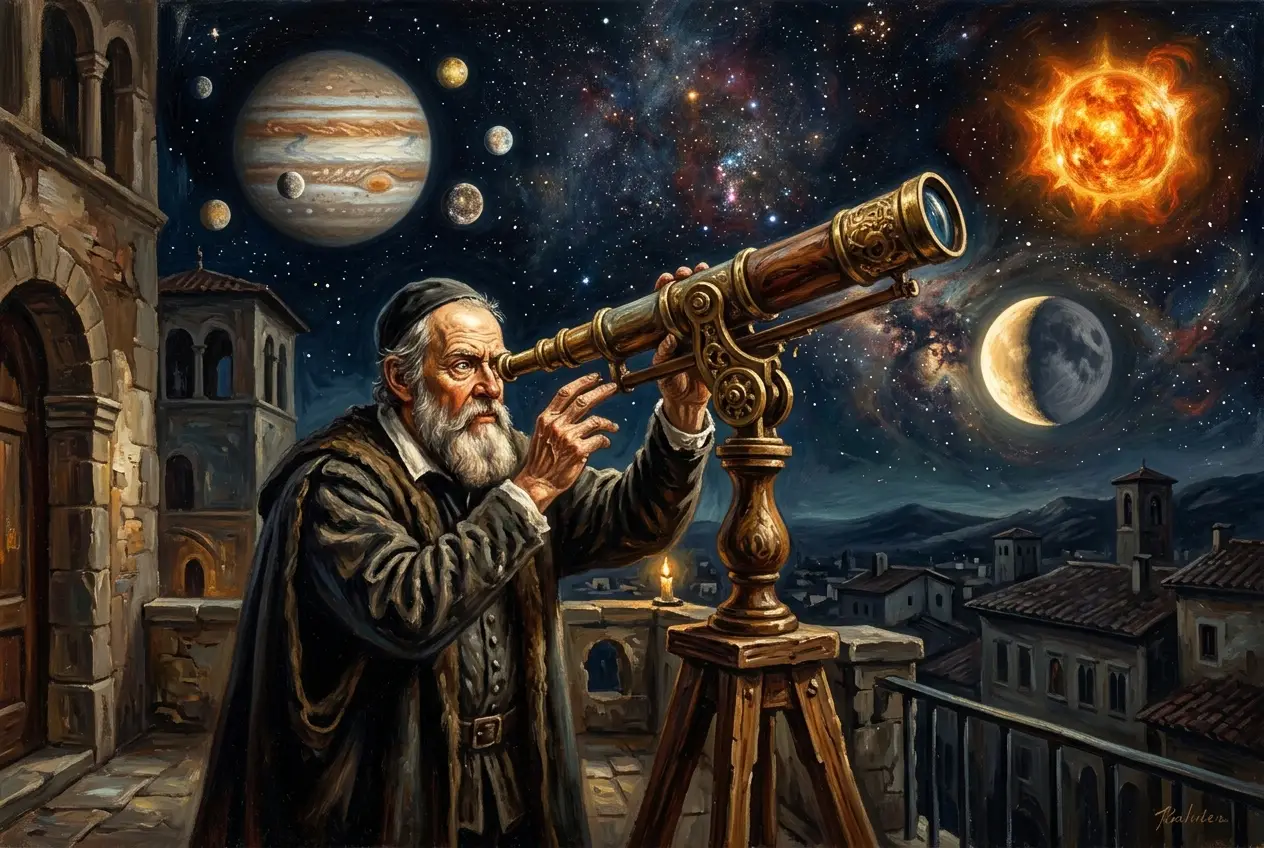
The name Galileo Galilei echoes through the annals of history not merely as a scientist, but as a revolutionary—a man whose relentless pursuit of truth challenged the very foundations of his world. His life, a sprawling narrative stretching over seventy-seven years, is a testament to intellectual courage, scientific innovation, and the often-fraught relationship between discovery and doctrine. For those embarking on this journey with me, be forewarned: this is no fleeting account. This blog post is a deep dive, an extensive exploration into the complete life, profound contributions, and enduring legacy of one of humanity's most pivotal figures. We will traverse the intellectual landscapes of Renaissance Italy, witness the birth of modern scientific method, and delve into the dramatic confrontations that shaped our understanding of the universe.
The Genesis of a Giant: Early Life and Education (1564-1589)
Galileo Galilei was born on February 15, 1564, in Pisa, Italy, a city already famed for its leaning tower and intellectual ferment. His father, Vincenzo Galilei, was a renowned musician, composer, and music theorist—a man of considerable intellect and a pragmatic approach to life. Vincenzo's influence on young Galileo was profound, instilling in him a blend of artistic sensibility, mathematical rigor, and a healthy skepticism towards unproven dogma. This was a household where observation and experimentation, even in music, were valued over mere tradition.
Growing up, Galileo displayed an early aptitude for mechanics, music, and art. His initial education began in Pisa, and later, for a brief but formative period, he was educated at the monastery of Vallombrosa, near Florence. Here, he considered entering the priesthood, a path that would have dramatically altered not only his life but perhaps the course of scientific history. However, his father, recognizing Galileo's burgeoning intellectual gifts and perhaps wary of the Church's strictures on scientific inquiry, urged him towards medicine—a more lucrative and respected profession.
In 1581, at the age of seventeen, Galileo enrolled at the University of Pisa to study medicine. While the curriculum was steeped in the ancient texts of Aristotle and Galen, it was mathematics, geometry, and philosophy that truly captured his imagination. He found himself increasingly drawn to the lectures of Ostilio Ricci, a mathematician who was a student of Niccolò Tartaglia. Ricci introduced Galileo to the works of Euclid and Archimedes, whose rigorous, quantitative approaches to understanding the physical world resonated deeply with his own inquisitive mind. I can only imagine the intellectual excitement that must have coursed through him as he grappled with these new ways of thinking, starkly contrasting with the qualitative descriptions prevalent in medical and Aristotelian philosophy.
His time at Pisa, though cut short due to financial constraints—he was unable to complete his medical degree—was instrumental in shifting his focus irrevocably towards mathematics and natural philosophy. He left the university without a degree in 1585 but had already begun to make a name for himself as an independent thinker and inventor. This period saw him conducting his first recorded scientific experiments, primarily on the oscillations of pendulums, observations that would later inform his work on time and motion.
The Pisan Period: Challenging Aristotle (1589-1592)
Following his departure from the University of Pisa, Galileo spent several years teaching privately and working on various inventions. His reputation grew, and in 1589, largely due to the influence of Guidobaldo del Monte, a wealthy patron and fellow mathematician, Galileo secured a professorship of mathematics at the University of Pisa. This was a relatively modest position, paying little, but it provided him with a platform to continue his research and, more importantly, to challenge the prevailing Aristotelian doctrines that dominated academic thought.
It was during this Pisan period that Galileo famously, if perhaps apocryphally, conducted experiments on falling bodies from the Leaning Tower of Pisa. The story goes that he dropped objects of different weights simultaneously to demonstrate that they fell at the same rate, contrary to Aristotle's assertion that heavier objects fall faster. While historical evidence for this public demonstration is scarce and largely anecdotal (it appears primarily in the biography written by his student Vincenzo Viviani long after Galileo's death), the core idea behind the experiment—that bodies fall at a uniform acceleration regardless of their mass—was certainly one of Galileo's profound insights. He articulated these ideas in his early treatise De Motu (On Motion), which, though unpublished in his lifetime, laid important groundwork for his later, more refined work on mechanics.
I often reflect on the sheer courage it must have taken to openly question Aristotle, whose teachings were practically canonized within the academic and ecclesiastical establishments of the time. To do so was to risk not just one's reputation but potentially one's livelihood. Galileo, however, possessed a fearless intellectual spirit, always prioritizing empirical observation and mathematical reasoning over inherited wisdom. His Pisan years, therefore, were characterized by this nascent defiance, a quiet rebellion against the intellectual inertia of his era.
The Productive Years in Padua: Innovation and Insight (1592-1610)
Galileo's financial situation improved significantly in 1592 when he accepted a professorship of mathematics at the prestigious University of Padua, a position he would hold for eighteen remarkably productive years. Padua, part of the Republic of Venice, was known for its more liberal intellectual climate compared to other Italian states, offering Galileo a degree of freedom that would prove crucial for his groundbreaking work.
Here, he taught geometry, mechanics, and astronomy, attracting a large number of students from across Europe. His lectures were not dry recitations of ancient texts; instead, he brought a vibrant, experimental approach to his teaching, demonstrating principles with practical applications. During this period, he invented or improved numerous devices, showcasing his engineering prowess.
Key Inventions and Improvements in Padua:
- The Geometric and Military Compass (1597): This versatile instrument, which he manufactured and sold, could be used for various practical calculations, from surveying and artillery to drawing and proportioning. He even wrote an instruction manual for it, indicating his entrepreneurial spirit.
- Thermometer (early 17th century): While rudimentary, his thermoscope (an air-filled glass bulb with a long stem submerged in water) could qualitatively indicate changes in temperature based on the expansion and contraction of air.
- Improvements to Pumps and other Mechanical Devices: He frequently offered his expertise to the Venetian Arsenal, applying his understanding of mechanics to practical engineering problems.
His Paduan years were not just about practical inventions; they were also a period of profound theoretical development. He continued his work on motion, refining his understanding of projectile trajectories and the concept of inertia. He recognized that objects, once set in motion, would continue in that motion unless acted upon by an external force—a crucial step towards Newton's first law.
It was also in Padua that Galileo began to openly express his inclination towards the Copernican model of the solar system, where the Earth and other planets orbit the Sun. He initially taught the geocentric (Earth-centered) Ptolemaic system, as was customary, but in private correspondence and later in his writings, he revealed his conviction that Copernicus was correct. This intellectual shift was gradual, rooted in his mathematical studies and observations, which revealed inconsistencies in the complex Ptolemaic system. His work in mechanics gave him a new perspective on how a moving Earth might be plausible, challenging the Aristotelian notion that a moving Earth would leave objects behind.
"I consider the sun, with all the other celestial bodies (not including the moon) to be at rest in the center of the orbit of the earth, and of the other planets; but that the Earth, turning upon its axis, performs a rotation every twenty-four hours, and revolves annually around the sun." – Galileo Galilei, in a letter to Johannes Kepler, 1597 (describing his early Copernican sympathies).
This quote, revealed in a letter to Kepler, shows his early, albeit cautious, embrace of heliocentrism, a position that would define his later life and bring him into direct conflict with powerful institutions.
Table: Galileo's Key Inventions and Discoveries (Paduan Period)
| Invention/Discovery | Year (Approx.) | Description | Impact |
|---|---|---|---|
| Geometric and Military Compass | 1597 | A versatile drafting instrument for practical calculations in geometry, surveying, and artillery. | Standardized complex calculations for engineers, soldiers, and artists; showcased Galileo's practical ingenuity and entrepreneurial spirit. |
| Thermoscope (precursor to thermometer) | Early 1600s | An air-filled glass bulb with a stem submerged in water, indicating temperature changes qualitatively. | One of the earliest devices to measure temperature changes, paving the way for quantitative thermometry; fundamental to understanding heat and energy. |
| Refinements in the Study of Motion | 1590s-1600s | Developed principles of projectile motion and early concepts of inertia, challenging Aristotelian physics. | Laid foundational elements for classical mechanics, influencing Newton's laws of motion; demonstrated the power of mathematical description in physics. |
| Early support for Copernicanism | Late 1590s | Privately advocated for the heliocentric model of the solar system based on mathematical reasoning. | Marked his intellectual commitment to a revolutionary cosmological model, setting the stage for future astronomical observations and conflict. Source: (opens in a new tab)https://en.wikipedia.org/wiki/Galileo_Galilei (opens in a new tab) |
It was during these productive Paduan years that I imagine Galileo felt truly free to explore, invent, and teach. The intellectual air must have been intoxicating, a crucible of emerging ideas and practical applications.
Turning the Sky: The Telescope and Astronomical Revolution (1609-1610)
The year 1609 marked an irreversible turning point in Galileo's life and in human history. News reached Venice of a Dutch spectacle maker, Hans Lippershey, who had invented a device that made distant objects appear closer. Galileo, with his profound understanding of optics and lens grinding, immediately grasped the potential of such an instrument for astronomical observation. He did not invent the telescope, but he significantly improved its design and was the first to systematically point it towards the heavens, revolutionizing astronomy.
Within a few months, he had constructed his own telescopes, continually refining them to achieve greater magnification and clarity. His best instruments could magnify objects up to 30 times. The impact was immediate and profound. He unveiled his discoveries in a small, yet explosive, treatise published in March 1610, titled Sidereus Nuncius (Starry Messenger).
Galileo's Earth-Shattering Astronomical Discoveries:
-
The Moon's Imperfections: Contrary to Aristotelian dogma, which held celestial bodies to be perfect, unblemished spheres, Galileo observed that the Moon was covered in mountains, valleys, and craters, much like Earth. He even estimated the heights of lunar mountains by observing the shadows they cast. This was a radical idea: the heavens were not made of an immutable, perfect quintessence, but of matter similar to our own world.
-
Innumerable Stars: Looking at the Milky Way, which to the naked eye appeared as a nebulous band of light, Galileo resolved it into countless individual stars, far more than had ever been imagined. He also observed that some nebulae previously thought to be gas clouds were, in fact, clusters of stars. This expanded the perceived scale and complexity of the universe dramatically.
-
The Moons of Jupiter: Perhaps his most stunning discovery, and the one that most directly challenged the geocentric model, was the observation of four celestial bodies orbiting Jupiter. He initially thought they were fixed stars, but over successive nights, he noticed their positions shifting relative to Jupiter. He concluded they were moons, orbiting Jupiter just as the Moon orbits Earth. He named them the "Medicean Stars" in honor of his patrons, the powerful Medici family of Tuscany (they are now known as Io, Europa, Ganymede, and Callisto, the Galilean moons). This demonstrated that not everything revolved around Earth, providing a miniature model of a planetary system orbiting a central body other than Earth. This was a critical piece of empirical evidence supporting the Copernican view. You can learn more about how our understanding of our solar system has evolved by reading our blog, "Did Ancient Star Maps Predict Cosmic Events?"
-
The Phases of Venus: Later, in 1610-1611, Galileo observed that Venus, like the Moon, exhibited a full set of phases, from crescent to full. In the Ptolemaic model, Venus was believed to orbit a point between the Earth and the Sun, meaning it should only ever show crescent or partial phases, never full. However, in the Copernican model, where Venus orbits the Sun, it would show a full range of phases, exactly as Galileo observed. This was conclusive evidence in favor of the heliocentric system.
These discoveries were not merely interesting observations; they were direct, empirical challenges to the ancient, Earth-centered view of the cosmos that had been accepted for nearly two millennia and was deeply integrated with theological doctrine. Galileo was effectively demonstrating that the universe was not as humanity had long believed, and that our place within it might be far less central than imagined. His book was a sensation, quickly selling out and making him a celebrity across Europe. This led to his appointment as Chief Mathematician of the University of Pisa and Philosopher and Mathematician to the Grand Duke of Tuscany, Cosimo II de' Medici, allowing him to leave Padua and return to Florence.
The Rising Tensions: Heliocentrism and the Church (1610-1616)
Galileo's astronomical discoveries, particularly the phases of Venus and Jupiter's moons, provided powerful empirical evidence for the Copernican heliocentric model. While Nicolaus Copernicus had published his theory in De revolutionibus orbium coelestium in 1543, it was largely regarded as a mathematical hypothesis, a more elegant way to calculate planetary positions, rather than a physical reality. Galileo, through his telescopic observations, transformed it into a compelling physical truth.
However, the geocentric model was deeply intertwined with the prevailing theological interpretations of the Bible. Passages in scripture seemed to suggest an immobile Earth and a moving Sun. The Roman Catholic Church, grappling with the Protestant Reformation and seeking to maintain its authority, viewed any challenge to its traditional interpretations as a dangerous threat.
Initially, many Jesuit astronomers admired Galileo's work and his telescope. However, as Galileo became a more vocal advocate for heliocentrism, not just as a mathematical model but as a physical reality, the tensions escalated. He engaged in numerous debates, both public and private, defending Copernicanism and arguing that scientific observation and mathematical proof should guide our understanding of the natural world, rather than literal interpretations of scripture. He famously posited that the Bible "teaches us how to go to heaven, not how the heavens go."
In 1616, the Holy Office (the Inquisition) officially declared the heliocentric doctrine "false and contrary to Holy Scripture." Copernicus's De revolutionibus was placed on the Index Librorum Prohibitorum (Index of Prohibited Books) until it could be "corrected." Galileo was formally warned by Cardinal Robert Bellarmine, one of the leading theologians of the time, not to "hold or defend" the Copernican doctrine. The warning allowed him to discuss it as a hypothesis but forbade him from asserting it as fact. This was a critical moment; it put Galileo on notice and marked the beginning of his formal entanglement with the Church’s judicial arm.
I often wonder about the internal struggle Galileo must have faced during this period. To recant his observations would have been to deny the very evidence before his eyes, a betrayal of his scientific principles. Yet, to defy the Church was to invite severe consequences. It was a clash of two powerful systems of truth: empirical observation versus revealed dogma.
The Masterpiece: Dialogue Concerning the Two Chief World Systems (1616-1632)
For several years after the 1616 injunction, Galileo largely adhered to the directive, focusing on other areas of research, such as the theory of tides (which he incorrectly believed provided definitive proof of Earth's motion) and the study of comets. However, his conviction about heliocentrism remained unwavering.
A window of opportunity seemed to open with the ascension of Cardinal Maffeo Barberini to the papacy as Pope Urban VIII in 1623. Barberini was a long-time admirer of Galileo, a fellow intellectual with an interest in science. Galileo visited the new Pope, believing he had gained permission to write about the Copernican system, provided he presented both sides fairly and concluded that humans could not definitively know how the world was constructed, as God's ways were inscrutable.
Buoyed by this apparent green light, Galileo embarked on his magnum opus, Dialogue Concerning the Two Chief World Systems, completed and published in 1632. The book was written as a dialogue between three characters:
- Salviati: A brilliant, sharp-witted advocate for the Copernican (heliocentric) view, representing Galileo's own voice.
- Sagredo: An intelligent, neutral layman, who eventually comes to support Salviati's arguments.
- Simplicio: A stubborn, traditional Aristotelian philosopher, who presents the geocentric arguments.
Galileo's intention was to present a balanced discussion, as he believed he had promised Pope Urban VIII. However, the Dialogue was anything but balanced. Salviati's arguments were overwhelmingly persuasive, backed by empirical evidence and mathematical reasoning, while Simplicio was often portrayed as obtuse, dogmatic, and ultimately foolish. I imagine Galileo, in his passionate desire to reveal the truth, couldn't resist making the Copernican case as strongly as possible. He even put some of Pope Urban VIII's own arguments—particularly the one about God's inscrutable ways—into the mouth of Simplicio, the character consistently ridiculed throughout the book.
The book was written in Italian, rather than Latin, making it accessible to a wider audience beyond just scholars and clergy. This further amplified its impact, but also increased its perceived threat to the Church's authority. The title itself, "Dialogue Concerning the Two Chief World Systems," openly declared its subject matter.
The Trial and Condemnation (1633)
The publication of the Dialogue caused an immediate uproar. Pope Urban VIII, feeling betrayed and personally mocked by Galileo, ordered the Roman Inquisition to try him. Galileo was summoned to Rome in 1633, despite his advanced age (69) and failing health.
The charges against him were primarily that he had violated the 1616 injunction by "holding and defending" the Copernican doctrine as a physical truth, rather than just discussing it as a hypothesis. The trial was politically charged, with powerful forces within the Church determined to make an example of Galileo to reassert their authority amidst the turmoil of the Reformation.
During the trial, Galileo was pressured to recant his views. He initially attempted to defend himself, arguing that he had presented both sides of the argument fairly. However, under the threat of torture (which was mentioned, though probably not applied directly to him given his age and prominence), and knowing the fate of Giordano Bruno, who had been burned at the stake for heresy just decades prior, Galileo chose to abjure.
On June 22, 1633, in a public ceremony, Galileo knelt before the Inquisition and read a formal abjuration, renouncing his belief in the heliocentric theory and confessing his errors. Legend has it that as he rose, he muttered under his breath, "And yet it moves" (Eppur si muove), referring to the Earth. While this famous quote is almost certainly apocryphal, it perfectly encapsulates the defiant spirit of scientific truth that Galileo represented.
The Verdict:
- Galileo was found "vehemently suspect of heresy."
- He was sentenced to formal imprisonment, which was immediately commuted to house arrest.
- His Dialogue was banned, and further publication of his works was forbidden.
- He was required to recite penitential psalms once a week for three years.
This trial was a profound blow to Galileo, personally and professionally. It silenced one of the most brilliant scientific minds of his time and sent a chilling message to others who might dare to challenge established dogma. It also marked a regrettable chapter in the history of the relationship between science and religion. For a deeper look into historical tech and its challenges, I recommend our blog post: "The Baghdad Battery: Could Ancient Civilizations Harness Electricity?"
House Arrest and Later Scientific Work (1633-1642)
Following his condemnation, Galileo spent the remaining nine years of his life under house arrest, initially at the archiepiscopal palace in Siena, and then at his villa, Il Gioiello, in Arcetri, near Florence. Despite his confinement, blindness developing in his later years, and the constant surveillance by the Inquisition, his intellectual spirit remained unbroken. It was during this period that he produced another of his greatest works, arguably his most important contribution to physics: Discourses and Mathematical Demonstrations Relating to Two New Sciences (1638).
Discourses, also written in a dialogue format (featuring the same three characters: Salviati, Sagredo, and Simplicio), synthesized his lifelong work on motion and the strength of materials. Because his books were banned in Catholic countries, Discourses had to be smuggled out of Italy and was published in Leiden, Protestant Netherlands.
Key Contributions in Discourses Concerning Two New Sciences:
-
Science of Materials and Engineering: Galileo investigated the properties of materials, particularly their resistance to fracture. He was the first to systematically study the bending of beams and the scale effects of structures, laying the groundwork for modern engineering mechanics. He recognized that structures do not simply scale up linearly and that larger structures require disproportionately thicker supports—a critical insight for architecture and engineering.
-
Science of Local Motion (Kinematics): This section contained his most profound contributions to physics.
- Uniformly Accelerated Motion: He meticulously described the motion of objects under constant acceleration, such as falling bodies. He demonstrated mathematically that the distance covered by a uniformly accelerating object is proportional to the square of the time elapsed (). This was a monumental achievement, providing a precise mathematical description of motion. Source: (opens in a new tab)https://en.wikipedia.org/wiki/Discourses_on_Two_New_Sciences (opens in a new tab)
- The Law of the Pendulum: He refined his earlier observations on pendulums, establishing the principle that the period of a pendulum's swing is independent of its amplitude (for small angles) and depends only on its length. This was crucial for the development of accurate clocks.
- Projectile Motion: He showed that the trajectory of a projectile is a parabola, a combination of horizontal uniform motion and vertical uniformly accelerated motion. This was a direct contradiction of Aristotelian physics and a cornerstone of classical mechanics.
Discourses demonstrated Galileo's full mastery of the experimental method—using observations, constructing mathematical models, and deriving testable predictions. It marked the definitive shift from qualitative, philosophical descriptions of nature to quantitative, mathematical physics. Isaac Newton, born the year Galileo died, would build directly upon these foundations, especially Galileo's work on inertia and motion. You can delve into Newton's monumental contributions in our blog, "Isaac Newton: Unraveling the Universe's Code."
Even in his darkest hour, facing isolation and physical decline, Galileo's mind continued to blaze with unparalleled brilliance. He died at his villa in Arcetri on January 8, 1642, surrounded by his students Vincenzo Viviani and Evangelista Torricelli.
Galileo's Legacy and Enduring Impact
Galileo Galilei's legacy is immense and multifaceted, extending far beyond his specific discoveries.
-
The Father of Modern Observational Astronomy: His systematic use of the telescope transformed our understanding of the cosmos, moving it from philosophical speculation to empirical science. He showed that the universe was far vaster, more dynamic, and less "perfect" than previously imagined, paving the way for future astronomical discoveries.
-
The Father of Modern Physics: Through his meticulous experiments and mathematical analyses, he laid the foundational principles of kinematics and dynamics. His insistence on quantifiable observation and mathematical description of natural phenomena fundamentally altered the practice of physics, moving it towards what we recognize today as the scientific method.
-
Advocate for the Scientific Method: Galileo championed the idea that knowledge should be derived from observation, experimentation, and mathematical reasoning, rather than solely from ancient authorities or religious texts. He demonstrated the power of the hypothetico-deductive method, where theories are tested against empirical data.
-
Clash of Science and Religion: His conflict with the Roman Catholic Church became a canonical example of the tension between scientific inquiry and religious doctrine. While often oversimplified, it highlights the challenges faced when new scientific paradigms confront established worldviews. It also sparked centuries of debate about the proper relationship between faith and reason. It's interesting to consider how this historical tension echoes in modern discussions about technologies like AI. For example, our post "Can AI Craft a Digital God? Simulating Divine Intelligence" touches on similar philosophical grounds concerning creation and intelligence.
-
Influence on Enlightenment and Beyond: Galileo's insistence on empirical evidence and reason profoundly influenced the Enlightenment thinkers who followed him, contributing to the broader intellectual revolution that reshaped Europe. His work directly inspired Isaac Newton, whose Principia Mathematica built upon Galileo's principles of motion to formulate universal laws of gravity and motion, completing the edifice of classical physics.
It wasn't until 1992, over 350 years after his death, that Pope John Paul II formally acknowledged the Church's error in condemning Galileo. This act of rehabilitation, though long overdue, underscored the enduring importance of Galileo's contribution to human knowledge and the necessity for open inquiry.
His life reminds us that true progress often comes from those willing to challenge the status quo, to look anew at the world, and to trust the evidence of their senses and the rigor of their minds, even when doing so comes at a great personal cost. Galileo Galilei did not just observe the heavens; he fundamentally reshaped humanity's place within them, daring us to see beyond inherited beliefs and embrace the universe as it truly is.
In Retrospect: Galileo's Enduring Light
As I reflect on the extraordinary life of Galileo Galilei, I am struck by the sheer audacity of his intellect and the profound impact of his perseverance. He lived in a time when the universe was believed to revolve around humanity, both literally and figuratively. Yet, with a crude lens and an unwavering mind, he peered into the depths of the night sky and systematically dismantled that anthropocentric view. He taught us not just what to see, but how to see—with skepticism, with mathematics, and with an unyielding commitment to empirical truth.
His struggle with the Church was a tragic testament to the friction that can arise when scientific revelation clashes with deeply entrenched dogma. Yet, even in condemnation, his work persisted, smuggled across borders and studied by minds eager for truth. The parabolic arcs of his projectiles, the predictable swing of his pendulums, the alien landscapes of his moon, and the dance of Jupiter's satellites—these were not just observations; they were the building blocks of a new physics, a new astronomy, and ultimately, a new way of knowing. Galileo's enduring light continues to guide us. He symbolizes the essential spirit of scientific inquiry: the courage to question, the diligence to observe, the ingenuity to invent, and the conviction to stand by what one discovers, even against immense pressure. His story is a powerful reminder that the pursuit of knowledge is not always a smooth path, but it is always a path towards enlightenment, revealing the true wonders of the cosmos and our place within its grand design.


Conversation0
No comments yet. Be the first to share a thought — the best questions often become new stories.