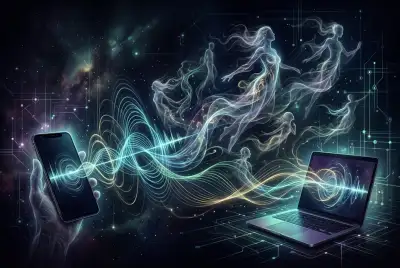
Ever found yourself staring at a tiny USB drive, marveling at how gigabytes of information—your memories, your work, entire digital worlds—can be compressed into something so small? I often do. It makes me wonder about the ultimate limits of information storage. We’ve come a long way from punch cards, but our current technologies, phenomenal as they are, still rely on physical bits – tiny magnets, charges, or optical states. But what if the ultimate storage medium isn't a disc or a chip, but the very fabric of reality itself? What if spacetime, the invisible stage upon which the cosmic drama unfolds, could be engineered to hold quantum data?
It sounds like something straight out of a science fiction novel, doesn't it? Yet, for some of the most brilliant minds in physics, the universe isn't just a container for information; it *is* information, woven into its deepest layers. And if that's true, it opens up a mind-boggling possibility: can we tap into spacetime itself to store an unthinkable amount of quantum data?
***
## The Universe: An Information Processor?
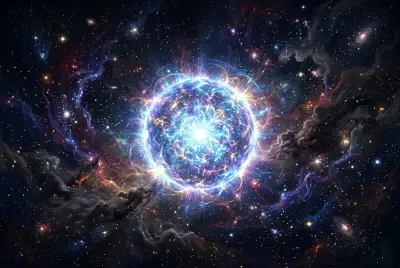
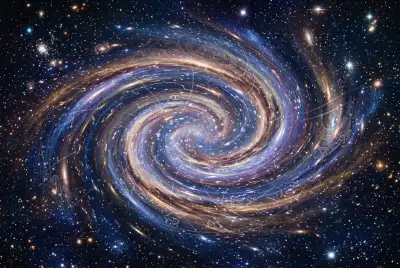
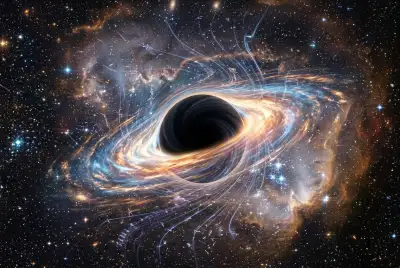
The concept of the universe as a vast information processor or a kind of cosmic computer isn't entirely new. For decades, physicists have wrestled with the idea that information might be as fundamental as energy and matter. Think about it: every particle, every interaction, every black hole spin, it all encodes some form of information. When you observe a quantum particle, its state collapses, revealing information. When a black hole swallows matter, there's a profound question about what happens to the information that fell in, leading to the infamous black hole information paradox. (You can dive deeper into that mystery in our blog:
Black Holes: Are They Nature's Ultimate Quantum Computers?).
This perspective hints at a universe where information isn't just a byproduct of physical processes but a foundational element. This isn’t about metaphysical speculation; it’s about the mathematical frameworks that describe reality. **Quantum information theory**, for instance, treats information as a physical quantity, subject to the laws of quantum mechanics. Unlike classical bits (0s or 1s), quantum bits or qubits can exist in a superposition of states, allowing for exponentially more information to be stored and processed.
## Spacetime: More Than Just a Stage
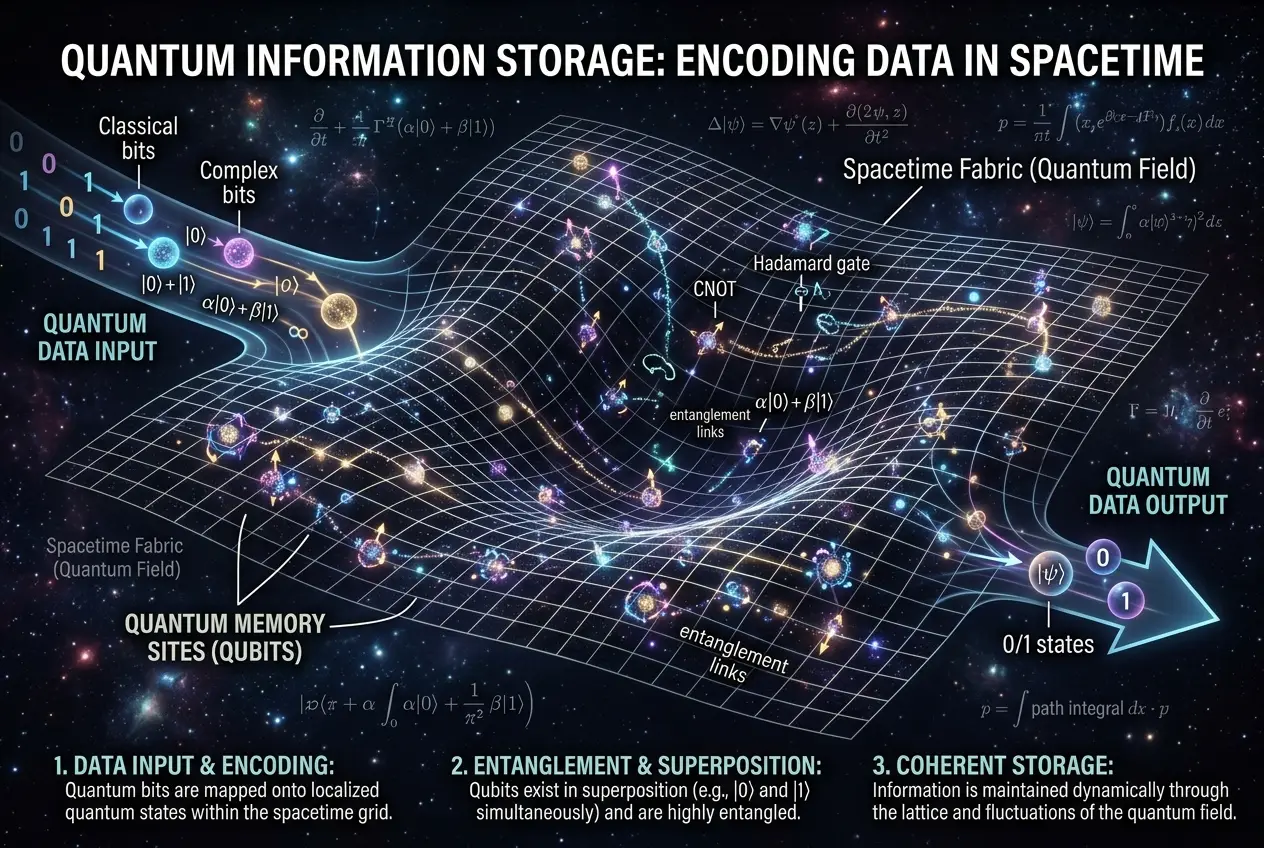
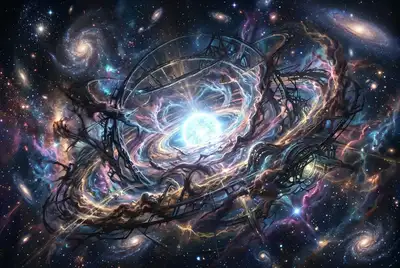
Let's break down what spacetime actually is. Albert Einstein revolutionized our understanding by showing that space and time aren't separate, fixed entities, but are interwoven into a flexible, dynamic continuum. Massive objects warp this fabric, creating gravity. But beyond its gravitational properties, could spacetime also possess intrinsic qualities that make it a candidate for data storage?
Consider the **Holographic Principle**, a radical idea born from studying black holes. It suggests that the information content of a volume of space can be entirely described by data on its boundary – much like a 3D hologram is encoded on a 2D surface. This principle, primarily explored in the context of string theory and quantum gravity, implies that our 3D universe might be a projection of information stored on a distant, 2D surface. If the universe itself is a kind of cosmic hologram, then information is not just *in* spacetime, it *is* spacetime in some fundamental sense. You can explore this fascinating concept further in our piece:
Is Our Universe a Hologram?.
This isn't just theoretical musing. The very definition of spacetime comes from a deeper, underlying quantum field theory where fields permeate everything. These quantum fields, vibrating and interacting, define the particles and forces we experience. Each point in spacetime, at a fundamental level, isn't empty; it's a bustling arena of quantum fluctuations. Could these microscopic quantum fluctuations, these inherent uncertainties in the very fabric of reality, be manipulated to encode information?
***
## The Challenge: Manipulating the Cosmic Canvas
The idea of storing quantum data in spacetime itself presents monumental challenges. How would we even begin to "write" information onto something as intangible and vast as the universe's fabric?
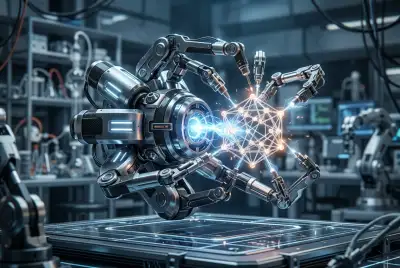
Current quantum computers manipulate quantum states in specific particles – electrons, photons, ions – by isolating them and controlling their interactions. To store data in spacetime would mean manipulating its quantum properties at a microscopic level, perhaps by altering gravitational fields or exploiting exotic quantum effects we don't yet fully understand.
One speculative avenue involves harnessing **quantum entanglement** across vast cosmic distances. If we could entangle particles whose states are inextricably linked to the underlying spacetime geometry, perhaps we could encode information not in the particles themselves, but in the entanglement structure that spans the cosmos. This could unlock unheard-of possibilities for communication too, as explored in
Can Quantum Entanglement Fuel Interstellar Comm?.
Another thought experiment involves engineering **micro-singularities or exotic forms of matter** that could locally warp spacetime in precise, controllable ways, creating a sort of "gravitational qubit." Imagine tiny, controlled gravitational fields that could represent a 0 or a 1, or a superposition of both. This is far beyond our current technological capabilities, requiring a mastery of quantum gravity that remains elusive.
"The amount of information in a region of space is bounded by the area of its boundary, not its volume."
— **Leonard Susskind**, on the Holographic Principle (via Wikipedia)
### The Information Density of Spacetime
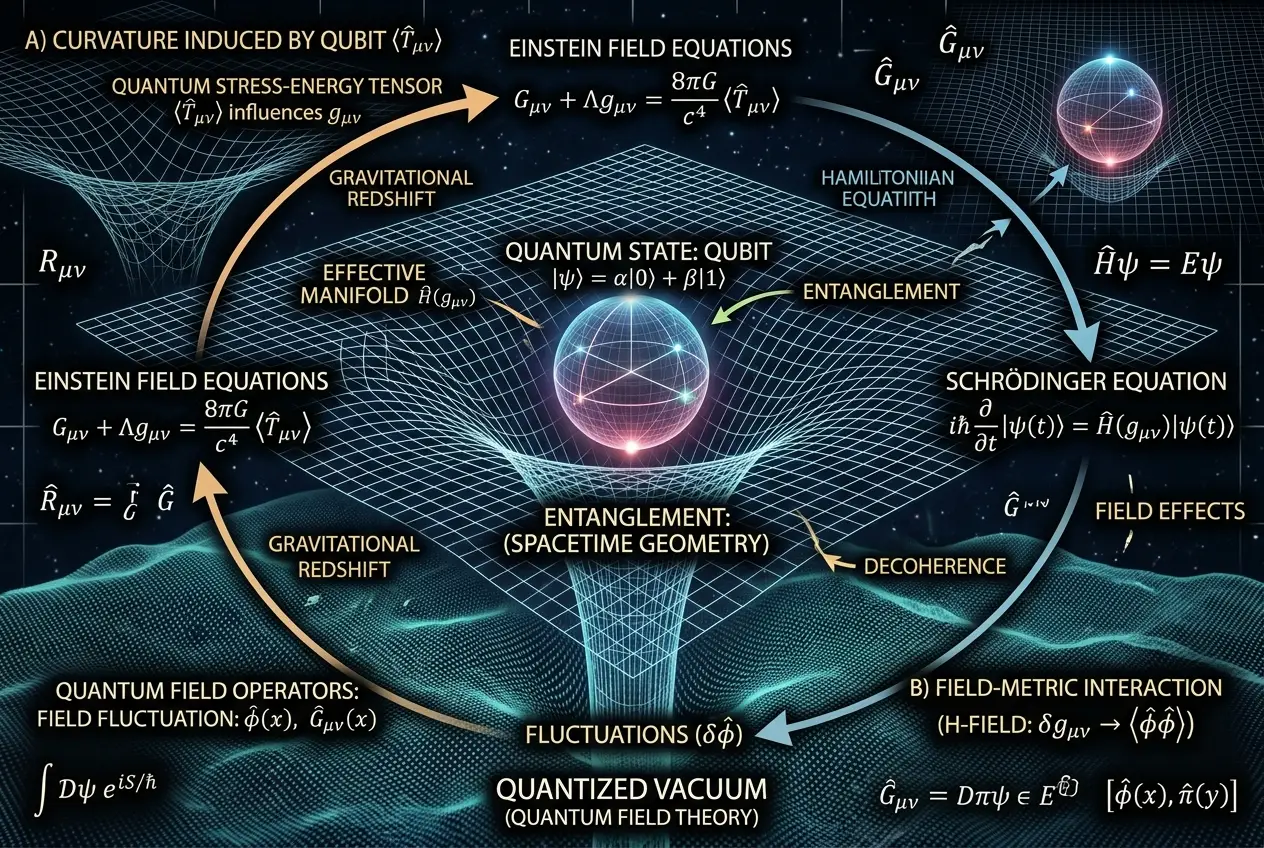
If spacetime *could* store quantum data, the implications for storage density would be mind-boggling. The Bekenstein-Hawking entropy formula, which describes the maximum entropy (and thus information) a black hole can contain, suggests an incredibly dense storage capacity for any given region of space. This theoretical limit, often called the **Bekenstein bound**, states that the maximum amount of information that can be contained within a finite region of space is proportional to the area of the boundary of that region, not its volume.
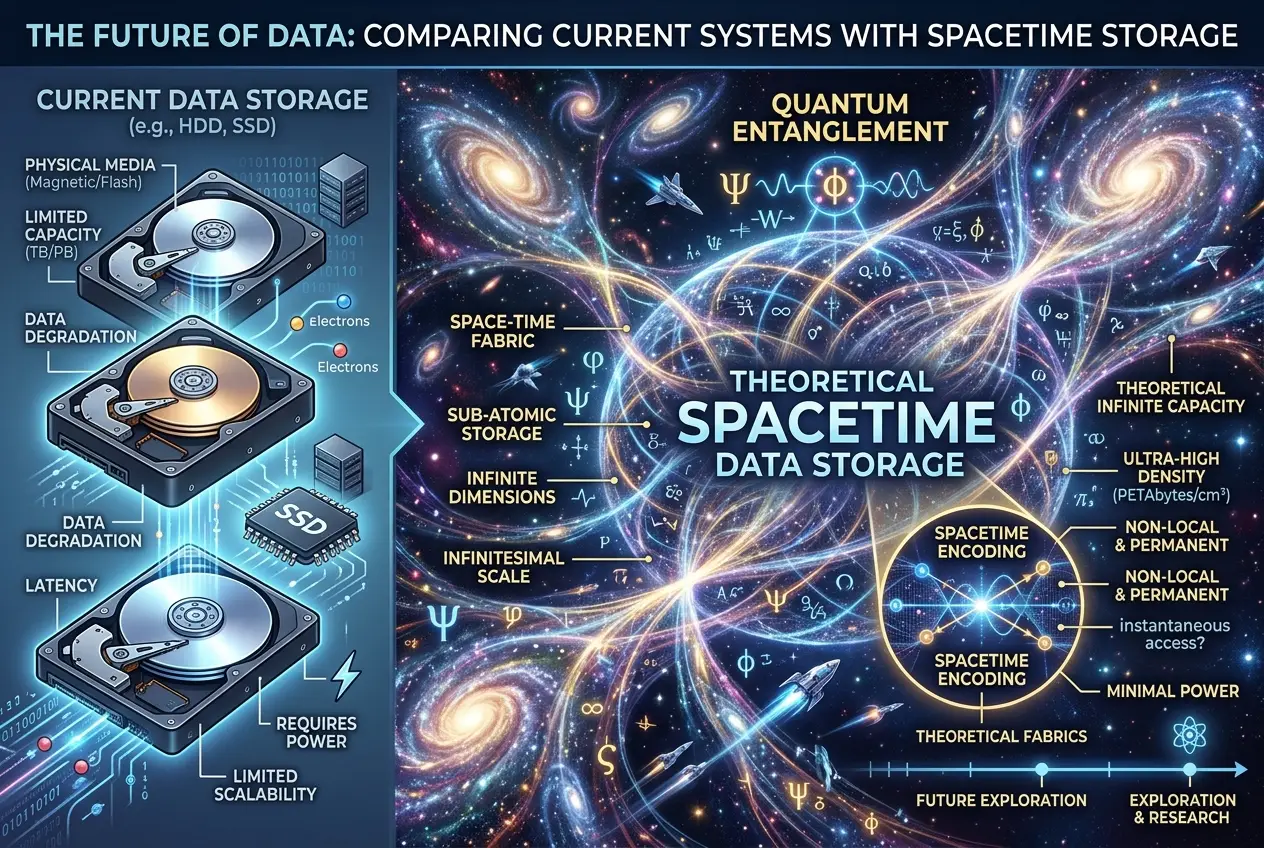
This means that even a cubic millimeter of spacetime, if harnessed to its theoretical maximum, could potentially hold an amount of information far exceeding anything we can imagine with current technologies. It hints at a universe where information is compressed to its absolute limits, woven into the very fabric of existence.
## The Road Ahead: From Theory to Reality
Our current understanding of quantum mechanics and general relativity, while incredibly successful, are incomplete when it comes to merging them into a unified theory of quantum gravity. Such a theory would be essential for truly understanding how information might be embedded in and extracted from spacetime.
Scientists are actively exploring several theoretical frameworks, including **String Theory** and **Loop Quantum Gravity**, that attempt to unify these pillars of modern physics. These theories might eventually reveal the fundamental "pixels" or "quanta" of spacetime itself, which could then potentially be manipulated.
The journey to using spacetime as a quantum hard drive would likely involve:
* **A complete theory of Quantum Gravity:** Understanding the quantum nature of space and time.
* **Techniques for manipulating quantum fields:** Precise control over the vacuum energy and quantum fluctuations.
* **Methods for creating stable, entangled spacetime regions:** Maintaining coherence for long periods.
* **New forms of energy and matter:** To locally modify spacetime geometry.
While the prospect of turning the cosmos into our ultimate data archive is still firmly in the realm of theoretical physics, the continued exploration of quantum information, spacetime, and the fundamental nature of reality might one day reveal secrets that make this futuristic vision a tangible possibility.
For now, I'll continue to be amazed by my tiny USB drive, but also by the audacious possibility that the biggest "hard drive" of all might be all around us, waiting to be understood.
***
## Conclusion
The notion of spacetime storing quantum data challenges our conventional understanding of both information and reality. It pushes the boundaries of physics, hinting at a universe that is far more interconnected and information-rich than we currently grasp. While the practical realization of such a cosmic hard drive is likely millennia away, the theoretical groundwork laid by quantum information theory and the holographic principle keeps this fascinating concept alive. It reminds us that the universe is full of mysteries, and perhaps the greatest technology isn't something we build, but something we finally learn to harness.
 Join Us



 Unknown Author














Leave a Reply
Comments (0)