


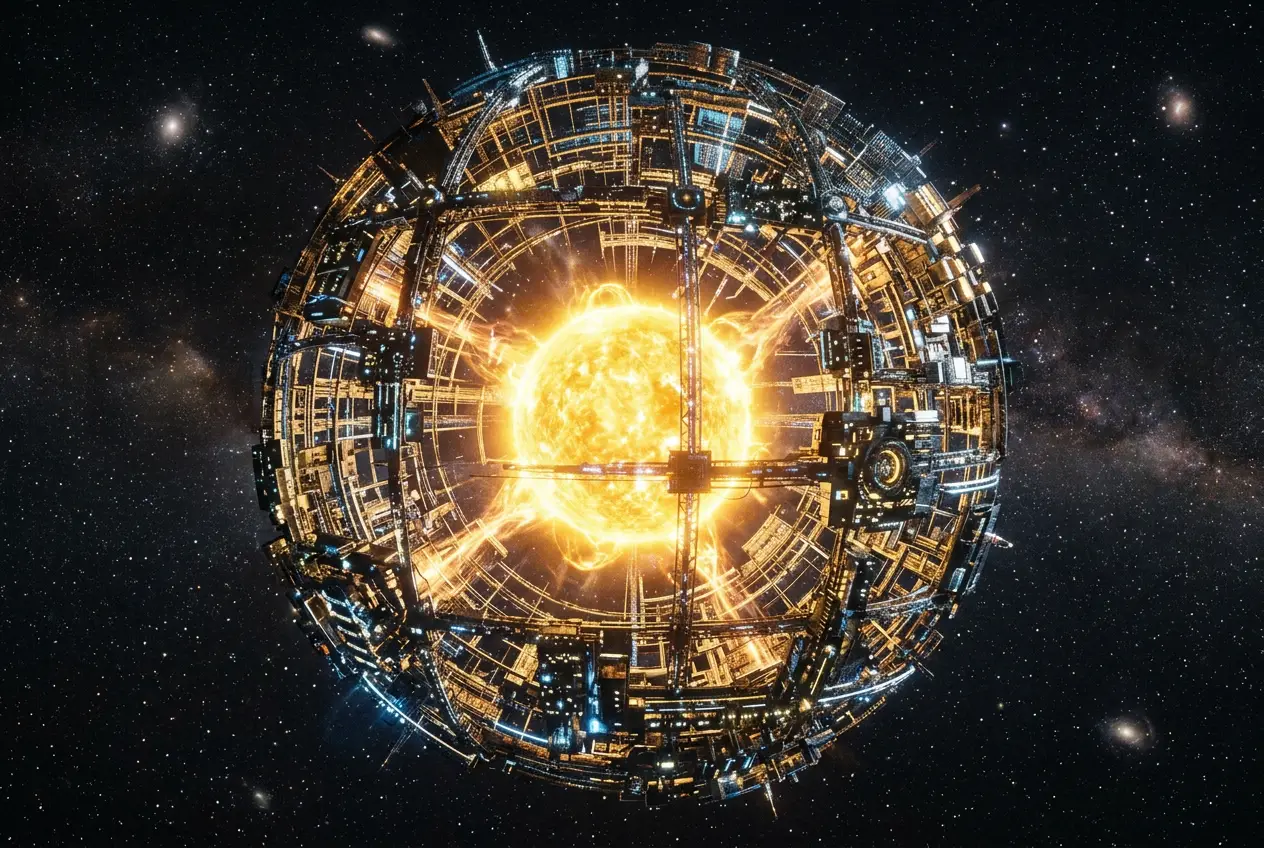
I recently found myself lost in thought, staring up at the night sky. The sheer scale of the cosmos is mind-boggling, isn't it? Billions of stars, each a powerhouse of energy, constantly fusing hydrogen into helium, radiating light and heat across unimaginable distances. It made me wonder: what if humanity could harness just a fraction of that power? What if we could capture all of it from our own Sun? This isn't just a sci-fi fantasy; it's the core concept behind one of the most ambitious engineering feats ever conceived: the Dyson Sphere.
The idea of the Dyson Sphere first captivated me years ago, but delving deeper, I realized it's more than just a theoretical concept for advanced alien civilizations. It's a tantalizing benchmark for our own species' future, a grand vision of what could be possible if we master interstellar engineering and overcome our insatiable energy demands.
The Vision of Freeman Dyson: From Swarms to Shells
The concept isn't about a literal solid sphere encompassing a star, which would be gravitationally unstable and impractical. It originated with physicist Freeman Dyson in a 1960 paper titled "Search for Artificial Stellar Sources of Infrared Radiation." Dyson proposed that an advanced civilization, driven by ever-increasing energy needs, would eventually require far more power than could be generated on a single planet. Their ultimate solution? Enveloping their parent star with structures designed to capture nearly all of its radiant energy.
Dyson's original idea leaned towards a Dyson Swarm – billions of independent solar collectors, orbital habitats, and industrial platforms orbiting a star in a dense cloud. Each component would capture energy and transmit it to recipient planets or stations. This modular approach offers distinct advantages: it can be built incrementally, it's more resilient to damage, and it doesn't require overcoming the immense structural integrity challenges of a single, solid shell.
The more dramatic, solid Dyson Shell is what often comes to mind – a single, rigid sphere encasing the star. While visually striking in fiction, its feasibility is highly questionable. The engineering challenges are astronomical, requiring materials with impossible tensile strength to withstand the star's gravity, and even then, gravitational instabilities would be a nightmare to manage. A slightly more practical (but still extremely theoretical) variant is the Dyson Bubble, which involves a static arrangement of satellites held in place by light pressure, essentially forming a transparent, non-contact sphere.
Why Build a Dyson Sphere? The Ultimate Energy Crisis Solution
Imagine a civilization that has fully colonized its solar system. Its population has grown, its technology has advanced exponentially, and its energy consumption has reached staggering levels. Our current energy sources – fossil fuels, nuclear fission, even Earth-bound solar panels – would be woefully inadequate.
This is where the Kardashev Scale comes into play. Developed by Soviet astronomer Nikolai Kardashev, this scale classifies civilizations based on the amount of energy they can harness:
- Type I Civilization: Can harness all the energy available on its home planet. Humanity isn't quite there yet; we're often estimated to be around 0.73 on the scale.
- Type II Civilization: Can harness the entire energy output of its home star. This is precisely what a Dyson Sphere would allow.
- Type III Civilization: Can harness the entire energy output of its home galaxy.
Achieving Type II status would grant a civilization unimaginable power – enough to power vast interstellar fleets, terraform entire planets, run hyper-efficient computational networks, or even manipulate spacetime. The energy captured from a single star like our Sun is roughly 4 x 10^26 watts. To put that in perspective, humanity's current total energy consumption is around 1.8 x 10^13 watts. A Dyson Sphere around the Sun would provide over 20 quadrillion times our current energy needs! It truly represents the ultimate solution to any energy crisis.
The Astronomical Engineering Challenge
So, if the energy rewards are so immense, why haven't we built one yet? The challenges are, predictably, colossal.
-
Materials: Building a Dyson Swarm, let alone a solid shell, would require an unfathomable amount of raw materials. We'd need to deconstruct entire planets, moons, or asteroids within our solar system. Mercury, for instance, could provide enough material for a substantial swarm, but mining it and transporting those materials would require technologies far beyond our current capabilities. The mass of a Dyson Swarm is estimated to be equivalent to about 10^20 to 10^26 kg – comparable to Jupiter or several inner planets.
-
Construction: This wouldn't be a project for a single generation. It would span millennia, requiring self-replicating automated factories, sophisticated robotics, and an incredibly stable societal structure focused on this singular, monumental goal. Imagine the orbital mechanics required to maintain billions of independent structures in a stable configuration around a star. The sheer logistical nightmare is staggering.
-
Heat Management: A Dyson Sphere captures nearly all the star's energy. What happens to that energy? It has to go somewhere. The sphere itself would absorb the energy and re-radiate it as waste heat, primarily in the infrared spectrum. This means the interior surface facing the star would be incredibly hot, and the outer surface, while cooler, would still radiate a significant thermal signature. This waste heat is actually one of the primary ways astronomers look for potential Dyson Spheres around other stars.
-
Gravitational and Structural Stability: As mentioned, a solid Dyson Shell is unstable. Any perturbation would cause it to drift and eventually collide with the star. Even a Dyson Swarm would need sophisticated station-keeping mechanisms and careful orbital planning to prevent collisions and maintain an optimal energy-capturing configuration. The structural integrity for a solid shell would require materials that literally do not exist.
Could We Spot an Alien Dyson Sphere?
The concept of a Dyson Sphere isn't just about humanity's future; it's also a crucial element in the Search for Extraterrestrial Intelligence (SETI). If advanced alien civilizations exist, some might have already built such megastructures. How would we detect them?
As Freeman Dyson himself pointed out, a Dyson Sphere would re-radiate its captured stellar energy as waste heat. This means a star encased in such a structure would appear unusually dim in visible light but would emit an excess of infrared radiation, much more than a typical star.
Astronomers have already used this principle to search for these alien megastructures. One of the most famous candidates was Tabby's Star (KIC 8462852), which exhibited unusual and dramatic dimming events that couldn't be easily explained by conventional astrophysical phenomena. While natural explanations like dust clouds or cometary fragments are currently favored, the initial suggestion that it could be a partial Dyson Swarm sparked immense public interest. You can read more about this intriguing celestial object in our previous article, "Galactic Anomaly: What Explains Tabby's Star?".
Other SETI efforts also focus on detecting anomalous radio signals, another potential sign of advanced technology, as discussed in "The Wow! Signal: Was It An Alien Radio Beacon?". The implications of finding a Dyson Sphere would be profound, confirming the existence of extraterrestrial intelligence and giving us a glimpse into the distant future of technology.
The Road Ahead: From Theory to Reality
While building a Dyson Sphere seems like an impossible dream today, I believe it's a testament to human ingenuity to even conceive of such a thing. The path towards even a partial Dyson Swarm would involve incremental advancements:
- Asteroid Mining: Developing the technology to efficiently extract resources from asteroids is a crucial first step. Companies are already exploring this, laying the groundwork for future space industrialization.
- Space-Based Manufacturing: Building large structures in space, perhaps using self-replicating 3D printers and autonomous assembly bots, will be essential.
- Advanced Solar Energy Capture: Improving the efficiency and durability of solar collectors, possibly incorporating technologies like "Atomic Batteries: Powering a Future Without Recharging" for internal power, would be necessary.
- Energy Transmission: Efficiently transmitting vast amounts of energy over interplanetary distances, perhaps using focused laser beams or microwave arrays, would be required to power distant colonies or Earth itself.
- Artificial Intelligence: The logistical and computational demands of managing such a project would necessitate advanced AI systems capable of coordinating billions of components and optimizing energy flow.
The Dyson Sphere is more than just an engineering challenge; it's a profound thought experiment about our species' destiny. Will we remain confined to our single planet, or will we expand into the cosmos, reaching for the stars and truly harnessing their power? The concept pushes the boundaries of what we consider possible, encouraging us to dream bigger and plan for a future that transcends our current limitations.
For now, the Dyson Sphere remains firmly in the realm of science fiction, a grand vision of a Type II civilization. But as history has shown us, yesterday's impossible dreams often become tomorrow's scientific endeavors. Perhaps one day, a future generation will look up at their star, not as a distant light, but as the pulsating heart of their galactic civilization. Could humanity achieve such a feat? Only time, and our relentless curiosity, will tell.


Conversation0
No comments yet. Be the first to share a thought — the best questions often become new stories.