I’ve often wondered about the ultimate frontier in digital security. We live in an age where data breaches are daily news, and even the most sophisticated encryption eventually falls to determined attackers or advancing technology. Passwords can be stolen, fingerprints copied, and facial scans bypassed. It makes me question: will we ever truly achieve unhackable security? The answer, I believe, lies not in stronger algorithms alone, but in an entirely new paradigm – one rooted in the strange and counter-intuitive world of quantum mechanics. This isn't just about faster computers; it's about fundamentally rethinking how we prove who we are.
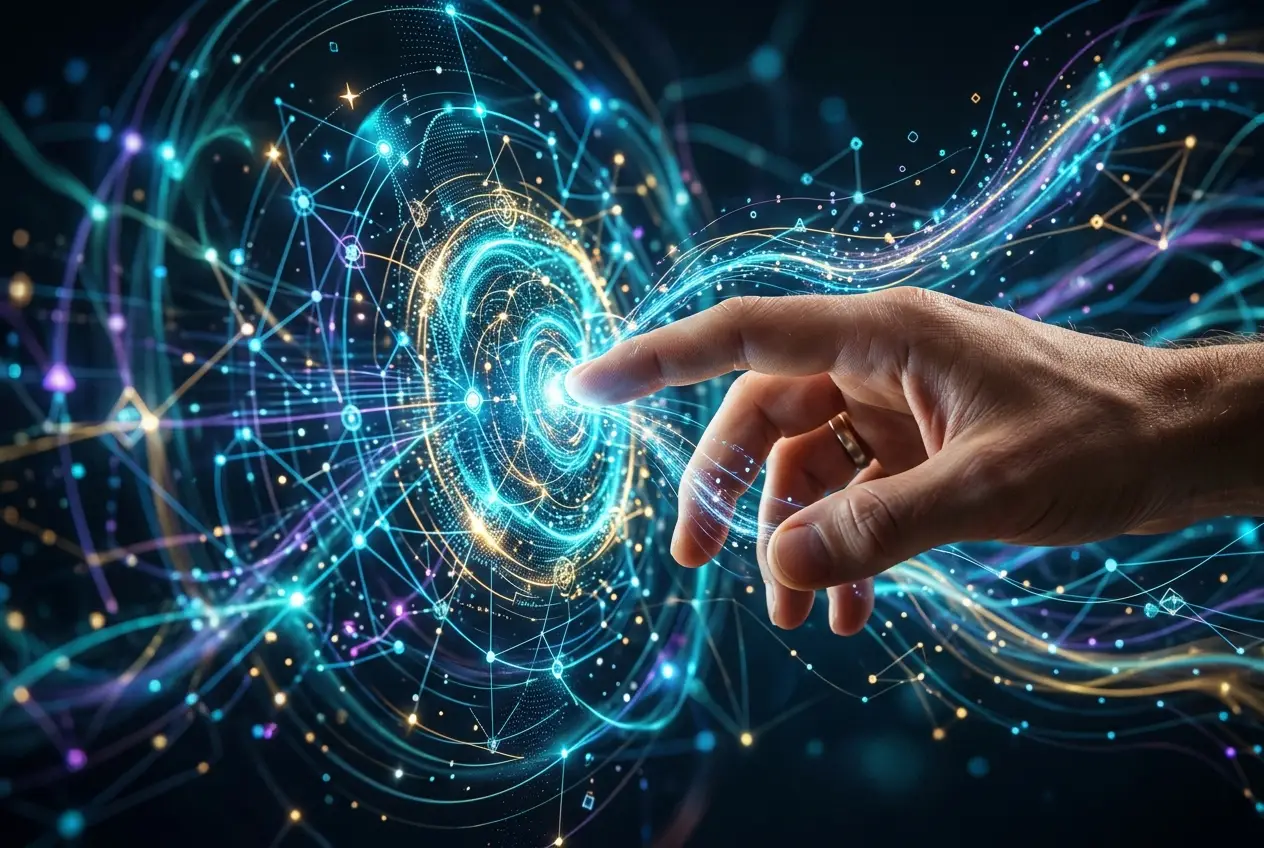
Imagine a world where your digital identity is as unique and impenetrable as the quantum state of a subatomic particle. This is the promise of **quantum biometrics**, a nascent field that seeks to combine the inherent uniqueness of biological identifiers with the unbreakable laws of quantum physics. It’s a bold vision, one that could redefine privacy, trust, and security in our increasingly interconnected lives.
The Current State of Biometrics: A Familiar Battleground
Before we delve into the quantum realm, let’s briefly consider our current biometric landscape. From fingerprint scanners on our smartphones to facial recognition at airports, biometrics have become commonplace. They offer convenience, replacing tedious passwords with a quick touch or glance.
**Common Biometric Modalities:**
* **Fingerprints:** Unique ridge patterns.
* **Facial Recognition:** Analysis of facial features and contours.
* **Iris/Retinal Scans:** Unique patterns in the eye.
* **Voice Recognition:** Distinct vocal characteristics.
* **Behavioral Biometrics:** Gait, typing rhythm, mouse movements.
While these methods are far more secure than a simple password, they are not without their vulnerabilities. High-resolution images can fool facial recognition, sophisticated molds can replicate fingerprints, and even deepfake technology poses a threat to voice authentication. The data itself, when stored, can be compromised. If a database holding biometric templates is breached, that unique identifier is potentially lost forever, unlike a password that can simply be changed.
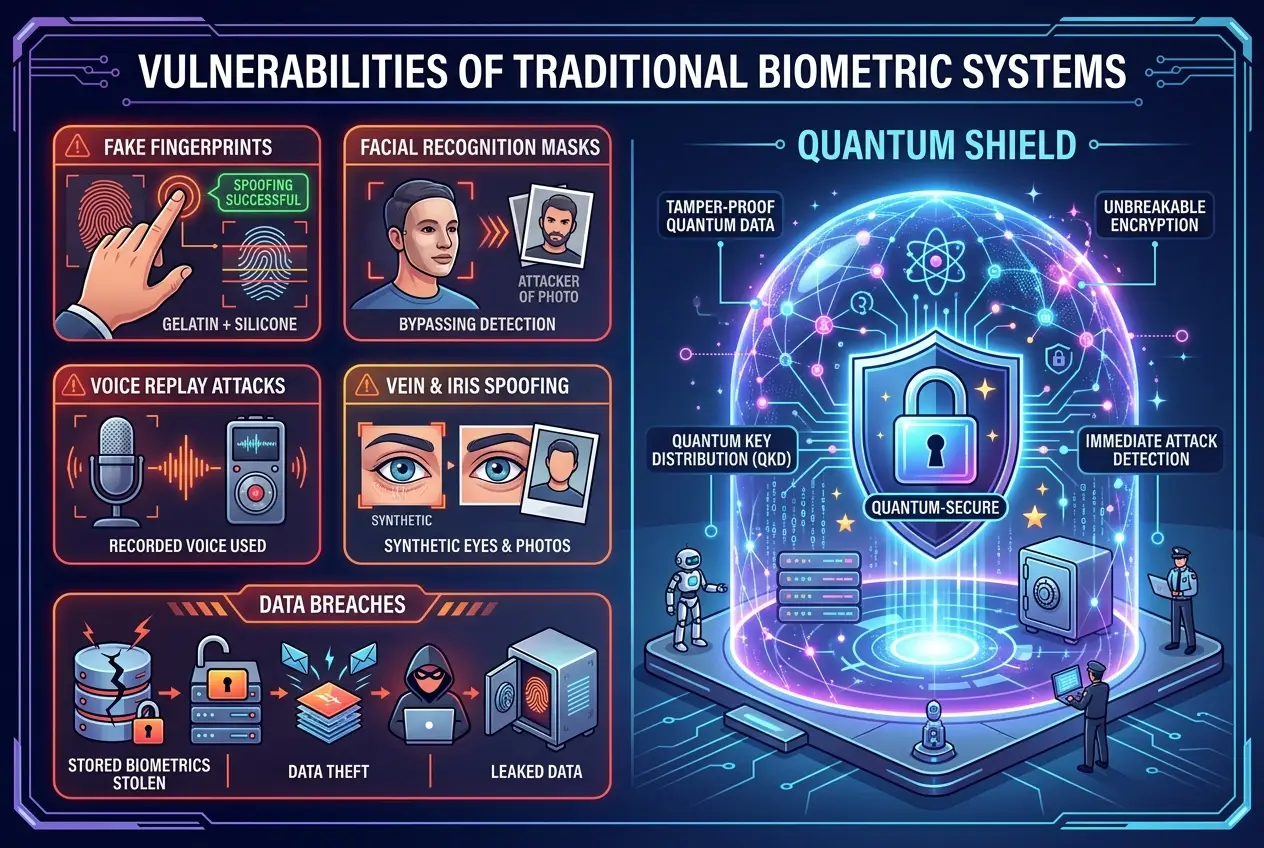
The fundamental problem with classical biometrics is that they often rely on static measurements that can, theoretically, be copied or reproduced. Once a biometric template is captured and stored, even if encrypted, it becomes a target. To truly achieve "unhackable" security, we need a system where the very act of measurement inherently protects the data, and any attempt to intercept or duplicate it would be instantly detectable. This is where quantum mechanics steps onto the stage.
Entering the Quantum Realm: The Principles of Unhackability
Quantum mechanics, the physics of the very small, operates on principles that defy our everyday intuition. Concepts like superposition, entanglement, and the observer effect are not just theoretical curiosities; they offer practical pathways to unprecedented security.
Superposition and Quantum States
At the heart of quantum mechanics is the idea that a quantum particle can exist in multiple states simultaneously (superposition) until it is measured. Once measured, it "collapses" into a single, definite state. For security, this means that any attempt to observe or intercept quantum information will inevitably alter its state, making the intrusion immediately obvious. It's like trying to listen to a conversation on a quantum phone line – the very act of eavesdropping would scramble the message, alerting both sender and receiver.
Quantum Entanglement: Spooky Action at a Distance
Perhaps the most mind-bending quantum phenomenon is **entanglement**, where two or more particles become intrinsically linked, regardless of the distance separating them. The measurement of one entangled particle instantly influences the state of the other, as if they are communicating faster than light. This "spooky action at a distance," as Albert Einstein called it, forms the basis for quantum key distribution (QKD), an encryption method considered theoretically unhackable. You can learn more about entanglement on its Wikipedia page:
Quantum Entanglement - Wikipedia.
In QKD, a secret key is transmitted using the quantum states of photons. If an eavesdropper attempts to measure these photons, their quantum state collapses, introducing detectable errors into the key. This immediately alerts the communicating parties that their key has been compromised, allowing them to discard it and generate a new one. This is a game-changer because it's not about making a key harder to crack; it's about guaranteeing the integrity of the key generation process itself.
The Dawn of Quantum Biometrics: How it Could Work
So, how do we marry the unique patterns of our biology with these quantum principles? The concept of quantum biometrics is still largely theoretical and in its early research stages, but several promising avenues are being explored.
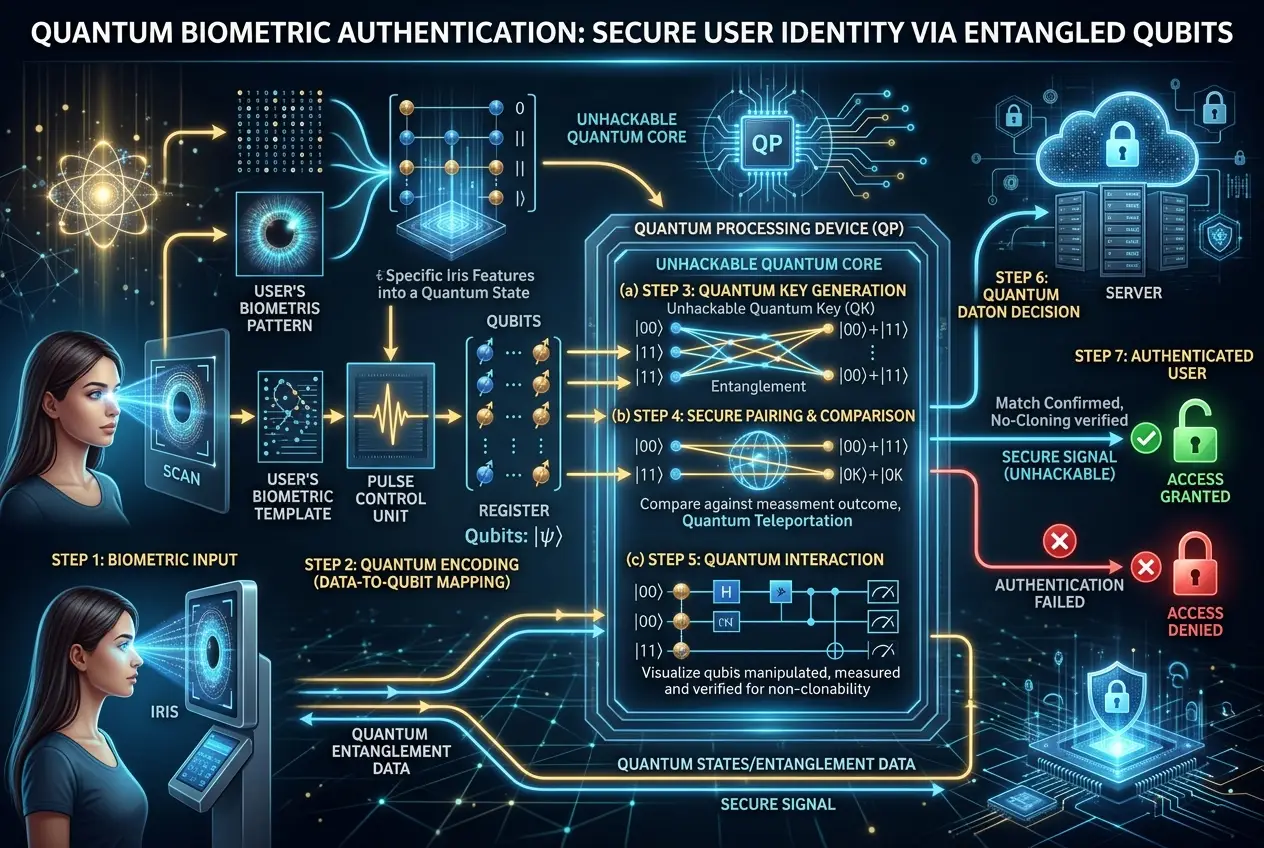
One approach involves **quantum-enhanced biometric templates**. Instead of storing a classical digital image of a fingerprint or iris, which could be copied, a quantum state representing the biometric data would be generated. This could involve encoding aspects of the biometric into the spin or polarization of individual photons.
When a user attempts to authenticate, their live biometric data would be used to interact with these quantum states. Any attempt to "read" the template without authorization would collapse its quantum state, effectively destroying the information or making the tampering evident. It creates a "use-it-or-lose-it" or "measure-it-and-lose-it" scenario, drastically increasing security.
Quantum Bio-Signatures
Another fascinating idea is to use an individual's unique biological quantum properties directly. Our bodies are complex systems where quantum effects may play a role in processes like photosynthesis and even consciousness. Could we detect unique quantum "signatures" within a person's biological processes? While highly speculative, researchers are exploring quantum biology, investigating how biological systems might leverage quantum phenomena. This could lead to genuinely new forms of biometric identification that are inherently quantum.
For deeper insights into quantum biology, you might find this Wikipedia article interesting:
Quantum Biology - Wikipedia.
Quantum Cryptography and Biometric Key Management
While pure quantum biometrics are futuristic, an immediate application involves using quantum cryptography to protect existing biometric data. Instead of transmitting or storing biometric templates classically, these templates could be secured using QKD. When a user enrolls, their biometric data is used to generate a unique quantum key, or it's encrypted with a key distributed via quantum means.
When authenticating, the live biometric scan would be used to unlock or verify against this quantum-secured key. Even if an attacker gains access to the encrypted biometric data, without the corresponding quantum key, it remains meaningless. Furthermore, the inherent detectability of eavesdropping in QKD ensures that any attempt to compromise the key during distribution is immediately flagged. This creates a secure "chain of trust" from biometric capture to verification.
We've discussed how quantum computing could potentially break classical encryption in articles like
Can Quantum Computers Break Every Encryption?, highlighting the urgent need for quantum-resistant solutions. Quantum biometrics, combined with quantum cryptography, offers a path forward.
Challenges on the Quantum Path
Despite its immense promise, quantum biometrics faces significant hurdles:
1. **Technological Maturity:** The hardware required to manipulate and measure quantum states (e.g., single-photon detectors, quantum memory) is still in its infancy and far from practical, widespread deployment.
2. **Environmental Sensitivity:** Quantum states are incredibly fragile and easily disrupted by environmental noise (temperature, vibrations). Maintaining coherence in a real-world biometric scanner environment is a monumental challenge.
3. **Scalability:** Developing quantum biometric systems that can process data quickly and at scale for millions or billions of users is a long-term goal.
4. **Cost:** Current quantum technologies are extremely expensive, limiting their immediate adoption.
5. **Ethical and Privacy Concerns:** Even with unhackable security, the implications of such powerful identification methods raise questions about surveillance, individual rights, and data ownership. We've explored broader ethical questions related to advanced tech, such as in
Can Our Brains Directly Merge with AI?, which touches on similar concerns about identity and technology.
The Future is Quantum: A Vision of Unbreakable Identity
Despite the challenges, the potential rewards of quantum biometrics are too significant to ignore. Imagine a world where:
* **Financial transactions are impervious to fraud:** Your identity is unequivocally verified with every payment.
* **National security systems are truly impenetrable:** Sensitive data is protected by the very laws of physics.
* **Personal privacy is restored:** You have absolute control over your digital identity, knowing it cannot be stolen or replicated.
This might sound like science fiction, but the fundamental principles are sound. The journey from theoretical possibility to widespread reality will be long and arduous, requiring breakthroughs in quantum engineering, material science, and computational algorithms. However, the relentless march of technological innovation suggests that what seems impossible today often becomes the norm tomorrow.
The quest for unhackable security is fundamentally a race against ever-evolving threats. Quantum biometrics represents a potential endgame, a leap beyond the arms race of classical encryption into a realm where the laws of nature themselves become our ultimate guardians. While we may not have quantum biometric scanners on our phones next year, the seeds of this revolutionary technology are being sown today, promising a future where our digital selves are truly, finally, secure.
For more information on the broader field of biometrics, consider visiting the
Biometrics - Wikipedia page.
 Join Us

 Unknown Author











Leave a Reply
Comments (0)