I recently found myself staring at a simple light switch, flicking it on and off, and a bizarre question popped into my head: **What if light could do more than just illuminate? What if it could *compute*?** For decades, our digital world has been built on electrons zipping through silicon circuits. Every click, every swipe, every intricate calculation happens because tiny electrical charges are manipulated. But as the demands on our computational power skyrocket, and the physical limits of silicon loom, a quiet revolution is brewing – one that harnesses the very essence of light itself.
Imagine a computer where information travels at the speed of light, literally. Where heat, the nemesis of electronic processors, becomes a negligible concern. Where incredibly complex problems, once thought intractable, could be solved almost instantaneously. This isn't science fiction anymore; it’s the burgeoning field of **optical computing**, and it promises to reshape our technological landscape in ways we're only just beginning to comprehend.
### **The Electron's Glass Ceiling: Why We Need a Change**
For over half a century, Moore's Law has been our guiding star, dictating that the number of transistors on a microchip would double approximately every two years. This relentless march of progress has given us smartphones more powerful than supercomputers of yesteryear, and AI algorithms that are changing industries. However, the law of diminishing returns is catching up. As transistors shrink to atomic scales, we face fundamental challenges:
1. **Heat Generation:** Packing more electrons into smaller spaces creates immense heat, requiring sophisticated and energy-intensive cooling systems. This is a major bottleneck for performance and efficiency.
2. **Energy Consumption:** Powering billions of transistors, even tiny ones, consumes enormous amounts of energy. Data centers globally are massive energy guzzlers, and this problem will only worsen.
3. **Signal Delays:** Even though electrons move fast, they still encounter resistance and interference within wires, leading to delays. Light, in a vacuum, travels unimpeded and at the ultimate speed limit.
This is where **photonics**, the science of harnessing light, steps in as a potential successor to electronics. Instead of electrons, optical computers use **photons** – the fundamental particles of light – to carry and process information.
### **The Fundamental Shift: From Electrons to Photons**
At its core, optical computing replaces electrical signals with light signals. Think about it: a fiber optic cable already transmits data as pulses of light over vast distances. The challenge, however, is not just transmitting data, but *processing* it using light.
**How does light "compute"?**
Unlike electrons, which carry an electrical charge and interact with magnetic fields, photons don't have mass or charge. This means they are largely unaffected by each other and can pass through one another without interference. This property is a double-edged sword: great for speed, but tricky for interaction. For computing, we need signals to interact, combine, and switch.
Scientists are exploring several ways to make light compute:
* **Interference:** When two light waves meet, they can constructively or destructively interfere, effectively adding or subtracting signals. This can be used for arithmetic operations.
* **Non-linear Optics:** Certain materials change their properties when strong light passes through them. This allows light to control other light, forming the basis of optical transistors or switches.
* **Modulation:** Information can be encoded onto light by changing its intensity, phase, or polarization.
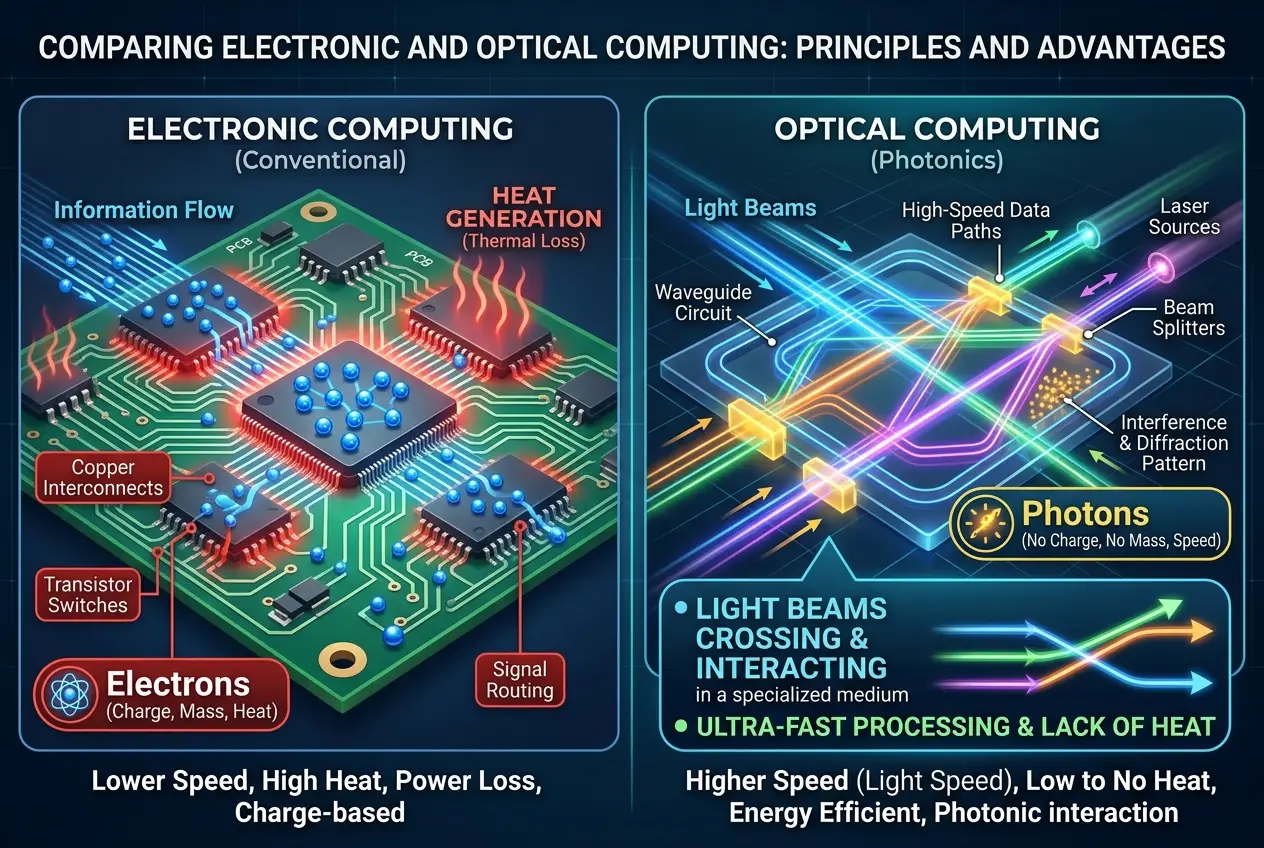
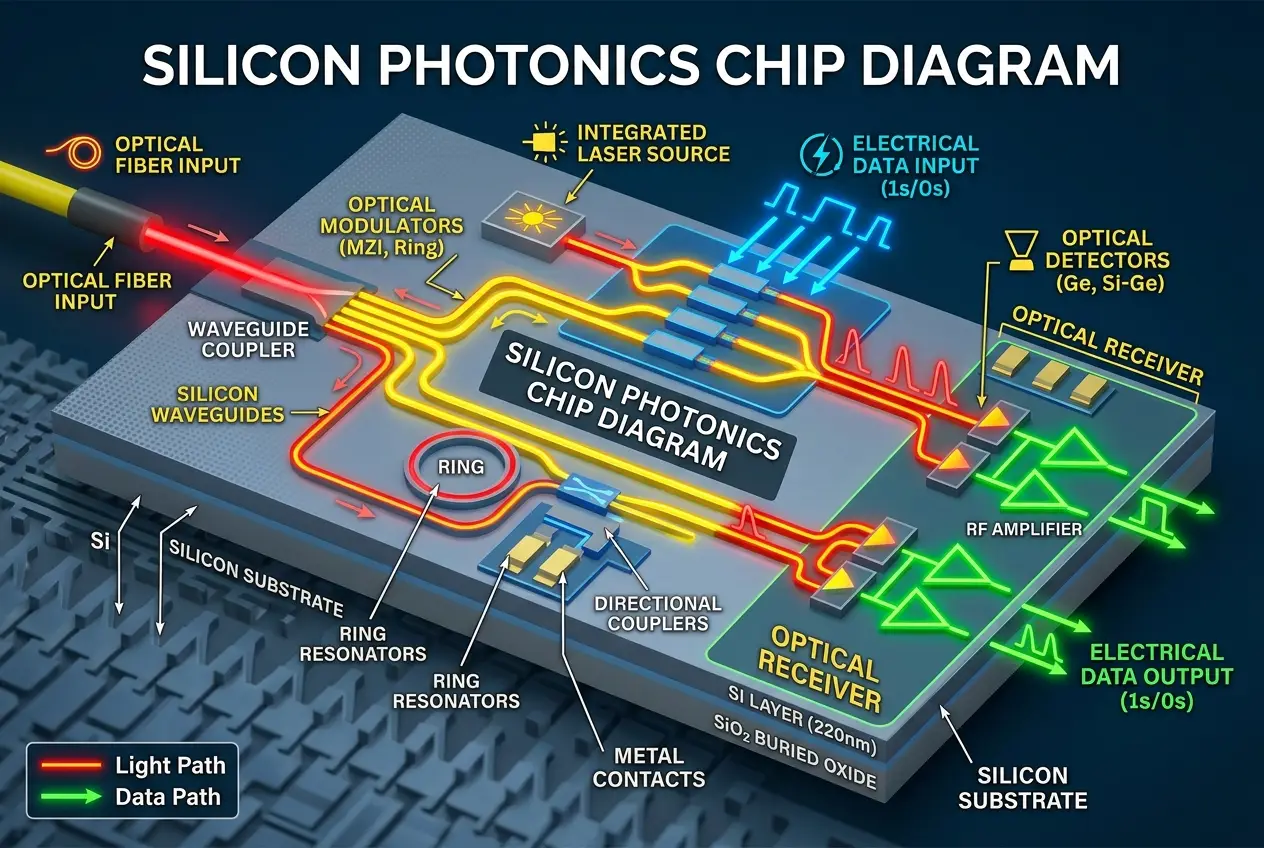
One of the most promising avenues is **silicon photonics**, which integrates optical components onto standard silicon chips. This allows us to leverage existing semiconductor manufacturing techniques while introducing the power of light. Companies and research institutions are developing chips that use light to communicate between different parts of a processor, greatly reducing energy consumption and latency compared to traditional electrical interconnects.
As Gordon Moore himself noted, "If you want to go faster, you’ve got to use photons." This observation underpins the entire drive towards optical systems. You can read more about the historical significance and impact of Moore's Law on computing at [Wikipedia: Moore's Law](https://en.wikipedia.org/wiki/Moore%27s_law).
### **Unlocking New Potentials: The Advantages of Light**
The benefits of optical computing extend far beyond just faster processing.
**1. Blazing Speed:** Light travels approximately 300,000 kilometers per second. While electrons move quickly in wires, they often bounce off atoms, reducing their effective speed. Photons move unimpeded through optical waveguides, leading to incredibly fast signal propagation. This could be a game-changer for applications requiring ultra-low latency.
**2. Extreme Energy Efficiency:** A significant portion of the energy consumed by electronic chips is lost as heat. Photons, having no charge, generate minimal heat when moving. This could drastically reduce the power consumption of future data centers and computing devices, aligning with our global need for sustainable technology.
**3. Parallel Processing Prowess:** A single beam of light can carry multiple streams of data using different wavelengths (colors) or polarization states. This intrinsic parallelism allows optical computers to process vast amounts of information simultaneously, a critical advantage for AI, machine learning, and complex scientific simulations. For instance, imagine how this could revolutionize how AI processes data, potentially making artificial intelligence even more advanced, as discussed in /blogs/can-brain-like-chips-create-true-ai-6876.
**4. Quantum Potential:** Optical computing also has natural synergies with **quantum computing**. Photons are excellent carriers of quantum information (qubits) and can be used to build quantum processors. While distinct, advancements in photonics often inform and accelerate quantum technologies, which themselves promise to break encryption codes and solve problems currently impossible, as explored in /blogs/can-quantum-computers-break-every-encryption-1438. The field of photonics, as a whole, is a fascinating area to delve into; a good starting point is [Wikipedia: Photonics](https://en.wikipedia.org/wiki/Photonics).
### **Challenges on the Horizon**
Despite its dazzling potential, optical computing faces significant hurdles:
* **Miniaturization:** Creating optical components that are as small and densely packed as electronic transistors is a monumental engineering challenge. Light, due to its wavelength, has physical limits on how tightly it can be confined and manipulated.
* **Integration:** Seamlessly integrating optical components with existing electronic systems, especially memory and input/output, requires new architectures and manufacturing processes.
* **Processing Power:** While optical interconnects are becoming common, building a fully optical central processing unit (CPU) that can perform general-purpose computations as flexibly as a silicon chip is still largely in the research phase. The complexity of creating optical logic gates that are robust and scalable remains a key area of focus.
* **Cost:** Developing and manufacturing entirely new optical computing paradigms could initially be very expensive, limiting widespread adoption until economies of scale are achieved.
### **The Future is Bright: Applications and Impact**
I believe the dawn of optical computing isn't just a distant dream; it's a gradual evolution. We're already seeing optical interconnects in high-performance computing and data centers. The next steps will likely involve dedicated optical accelerators for specific tasks, similar to how GPUs accelerate graphics and AI.
Potential applications include:
* **Artificial Intelligence & Machine Learning:** Optical processors could accelerate neural network training and inference, allowing for more complex AI models and real-time processing of massive datasets.
* **High-Frequency Trading:** The ultra-low latency of optical systems would provide an unparalleled advantage in financial markets where milliseconds count.
* **Big Data Analytics:** Processing and analyzing vast quantities of data from scientific research, environmental monitoring, or social networks would become significantly faster.
* **Telecommunications:** Enhanced optical networking could handle the ever-increasing global demand for bandwidth, paving the way for technologies we can only dream of today.
The transition won't be overnight. Instead, we’ll likely see hybrid systems, where light and electrons work in tandem, each playing to their strengths. Light will handle the high-speed data transfer and parallel processing, while electrons will manage control logic and memory. This synergy could lead to unprecedented computational power and efficiency.
The journey to building truly "thinking" machines is a long one, encompassing various approaches from neuromorphic chips to living cells as computers, as discussed in /blogs/can-living-cells-build-our-next-supercomputers-6472. Optical computing is a critical path in this exciting future.
### **Conclusion: A Luminous Leap Forward**
The idea that light, something so fundamental to our perception of reality, could also be the engine of future computation is profoundly captivating. Optical computing holds the key to overcoming the inherent limitations of electronic circuits, promising a future of faster, more efficient, and perhaps even more intelligent machines. While significant engineering and scientific challenges remain, the progress being made is undeniable. The era where light doesn't just illuminate our world, but actively thinks and processes within it, might be closer than we imagine. I'm certainly excited to see how this radiant future unfolds.
Frequently Asked Questions
The primary advantage is speed, as information travels at the speed of light, and greatly reduced heat generation, leading to higher energy efficiency and performance without the need for extensive cooling.
Fully optical general-purpose computers are still largely in the research and development phase. However, optical components like fiber optics for communication and optical interconnects in high-performance data centers are already widely used to enhance electronic systems.
Optical computing can significantly accelerate the training and inference stages of AI models due to its ability to perform highly parallel computations at high speeds. This allows for processing larger datasets and more complex algorithms much faster than traditional electronic systems.
Key challenges include miniaturizing optical components to match the density of electronic transistors, integrating optical systems seamlessly with existing electronic infrastructure, developing robust optical logic gates, and reducing manufacturing costs for widespread adoption.
No, optical computing and quantum computing are distinct fields with different goals. Optical computing aims to improve classical computation speed and efficiency using light. Quantum computing uses quantum mechanical phenomena to solve problems intractable for even the fastest classical computers. In some cases, photons can be used as qubits in quantum computers, indicating potential synergy rather than replacement.
Verified Expert
Alex Rivers
A professional researcher since age twelve, I delve into mysteries and ignite curiosity by presenting an array of compelling possibilities. I will heighten your curiosity, but by the end, you will possess profound knowledge.
Leave a Reply
Comments (0)
No approved comments yet. Be the first to share your thoughts!
 Join Us




 Unknown Author


































Leave a Reply
Comments (0)