


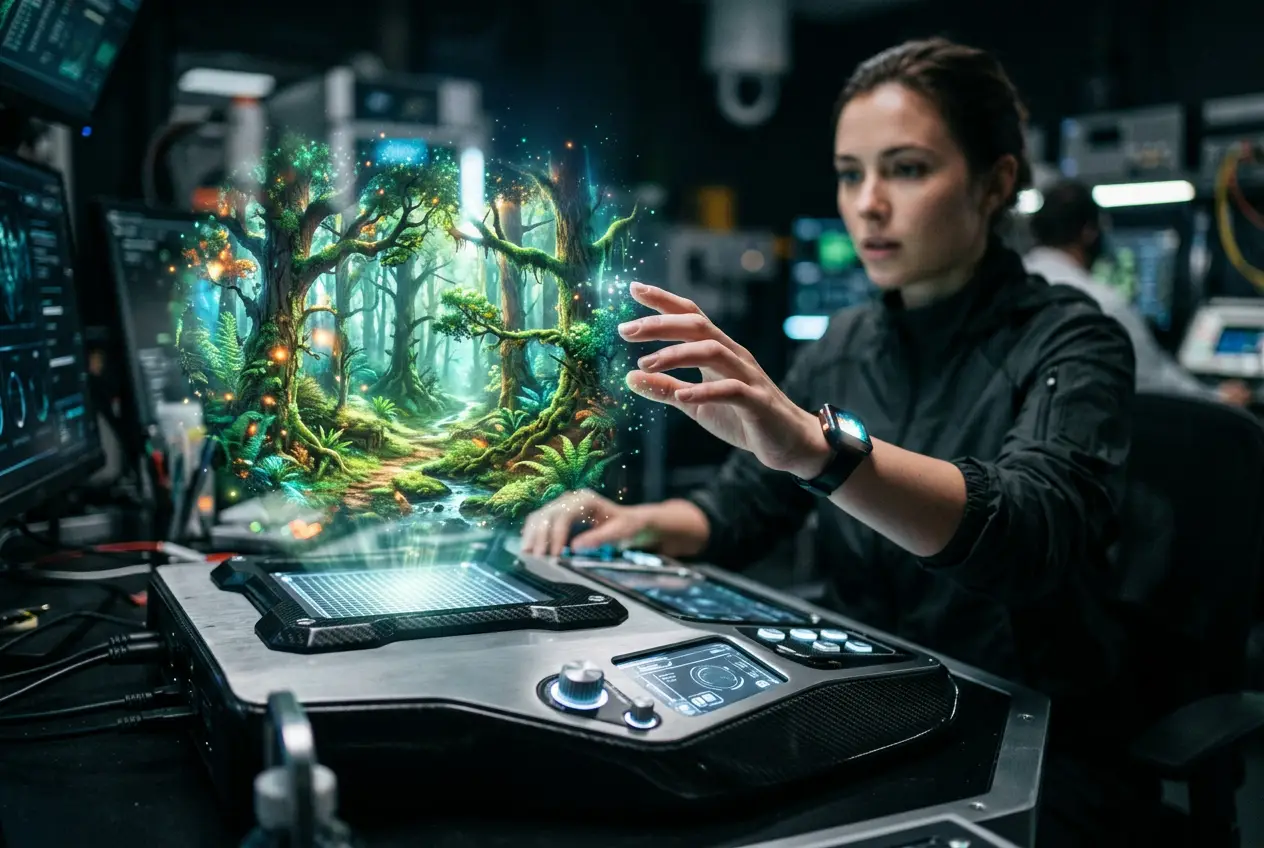
I remember the first time I saw the Holodeck on Star Trek. It was mesmerizing. A room where any fantasy, any environment, any adventure could be conjured with a simple voice command. Mountains, alien planets, historical cities, even sentient characters – all seemingly real, yet entirely holographic. For many, myself included, it wasn't just science fiction; it was a tantalizing glimpse into a future where our imaginations could become tangible realities.
Today, as I navigate the rapidly evolving landscape of virtual reality (VR) and augmented reality (AR), I can't help but wonder: how close are we to building our own Holodeck? Is this ultimate immersive experience still confined to the realm of fiction, or are the building blocks for such a cosmic computer already being laid in our labs and development studios?
The Foundation: Immersive Reality Today
When we talk about a Holodeck, we're essentially envisioning the pinnacle of immersive simulation. This isn't just about putting on a headset and seeing a virtual world; it's about feeling it, smelling it, touching it, and interacting with it as if it were truly there. Our current VR and AR technologies are the embryonic stages of this grand vision.
Virtual reality, with headsets like the Meta Quest and Valve Index, already transports us to digital realms. We can walk through ancient ruins, explore distant galaxies, or battle fantastical beasts. Augmented reality, exemplified by devices like Microsoft HoloLens or even the AR features on our smartphones, overlays digital information onto our physical world, blurring the lines between the two. However, these experiences are largely visual and auditory. The Holodeck promises full sensory immersion.
Beyond Sight and Sound: The Quest for Sensory Immersion
For a true Holodeck experience, we need to fool all our senses. This is where the real technological hurdles begin.
Tactile Feedback (Touch): Current VR often uses haptic feedback in controllers to simulate touch, like a rumble when you fire a virtual weapon. But imagine feeling the rough bark of a tree, the warmth of a fire, or the texture of a fabric. Researchers are making strides with advanced haptic gloves and suits that use micro-actuators, vibrations, or even tiny air pockets to create a sense of resistance and texture. Some experimental setups even use focused ultrasound waves to create localized sensations on the skin without direct contact. I recently read about haptic systems that can simulate different materials, allowing users to "feel" digital objects with remarkable fidelity.
Olfactory Stimulation (Smell): Smell is a powerful sense tied deeply to memory and emotion. Recreating a realistic smellscape is incredibly complex. Imagine walking through a virtual forest and smelling pine needles and damp earth, or entering a virtual café and catching the aroma of freshly brewed coffee. Scientists are experimenting with "olfactory displays" that use arrays of chemical compounds and precise dispersal mechanisms to generate specific scents on demand. These are still very much in their infancy, with challenges in scent mixing, rapid scent changes, and personalizing experiences. You can learn more about the complexities of olfactory display technology on Wikipedia's page on Olfactory displays (opens in a new tab).
Gustatory Sensation (Taste): Perhaps the most challenging of all senses to replicate digitally is taste. Our tongues are incredibly complex organs, distinguishing between sweet, sour, salty, bitter, and umami, along with a vast array of subtle flavors influenced by smell and texture. Early research involves electrical stimulation of the tongue or tiny, dissolvable flavor strips. A Holodeck would need to generate food and drink that not only looks and feels real but tastes authentic too. This remains a distant frontier.
The AI at the Core: Generating Worlds on the Fly
A Holodeck isn't just about sensory input; it's about dynamic, interactive, and intelligent environments. This is where artificial intelligence takes center stage.
In Star Trek, the Holodeck generates entire worlds, complete with realistic physics, weather patterns, and intelligent characters that respond convincingly to user input. This requires an AI far more advanced than anything we possess today. It would need:
- Generative AI: To procedurally create vast, detailed environments, objects, and even narratives in real-time. Modern generative adversarial networks (GANs) and large language models (LLMs) like those I use for writing are taking impressive steps in generating realistic images, text, and even short videos. However, generating an entire, coherent, and interactive world is orders of magnitude more complex.
- Physics Engines: To simulate realistic interactions – gravity, friction, fluid dynamics, material deformation – ensuring that a virtual object behaves exactly as its real-world counterpart would.
- Non-Player Character (NPC) Intelligence: The Holodeck's characters aren't just pre-scripted; they possess personality, memory, and the ability to improvise. This demands highly sophisticated AI models capable of natural language understanding, emotional intelligence, and complex decision-making. Imagine an NPC that learns from your interactions and adapts its behavior, rather than simply following a predetermined script. Such a level of AI might even border on what we consider consciousness, a topic explored in our blog on Are AIs Neural Networks Self-Aware?.
Overcoming Physical Limitations: The Environment Itself
Beyond the digital generation, the Holodeck also needs to manipulate the physical space around the user. How do you walk for miles in a small room? How do objects appear and disappear?
Omnidirectional Treadmills: These are already a reality, albeit in early forms. Devices like the Virtuix Omni allow users to walk, run, and strafe in any direction while staying in place. For a Holodeck, we’d need much larger, more seamless versions, perhaps even modular floor tiles that dynamically shift to create varied terrain.
Force Fields and Haptic Walls: The Holodeck uses force fields to create physical boundaries and objects that can be touched. If you lean against a virtual wall, you feel a real wall. This is perhaps the biggest technological leap needed. One approach involves creating localized air pressure systems or ultrasonic emitters that create tangible resistance. Another might involve "active metamaterials" – materials that can change their properties (like rigidity or texture) on command. While speculative, the concept of such programmable matter is fascinating, as highlighted in our discussion on Can Metamaterials Manipulate Light & Sound Like Magic?.
Replicators and Transporters (for objects): In Star Trek, objects can be "replicated" or "transported" into the Holodeck. This implies advanced molecular assembly or matter-energy conversion, a technology far beyond our current grasp. Without this, physical props would need to be pre-placed or robotically delivered, limiting spontaneity.
The Ethics and Future of a Holodeck
If we ever achieve a fully functional Holodeck, the implications would be profound.
Positive Impacts:
- Education and Training: Imagine medical students performing complex surgeries in a perfectly simulated environment, or pilots training for any conceivable scenario.
- Therapy and Rehabilitation: Immersive simulations could help treat phobias, PTSD, or aid physical therapy.
- Creative Expression: Artists could sculpt environments with their thoughts, and writers could literally step into their stories.
- Entertainment and Exploration: Unparalleled gaming, tourism to impossible places, and living out historical moments.
Potential Downsides:
- Addiction and Escapism: The line between reality and simulation could blur dangerously, leading to individuals preferring virtual worlds over the real one.
- Ethical Dilemmas: If NPCs become truly sentient, what are our responsibilities to them? Can we create simulations with real consequences?
- Security and Control: Who controls these powerful simulations? Could they be weaponized or used for malicious purposes?
Conclusion: A Vision in Progress
While the Star Trek Holodeck remains firmly in the realm of science fiction, it's clear that the scientific and technological advancements we're making in AI, VR, haptics, and materials science are incrementally paving the way. I believe it won't be a single breakthrough, but a convergence of many disparate technologies, pushing the boundaries of what's possible. We might not have a full-fledged Holodeck in our lifetime, but I'm confident that future generations will experience levels of immersive reality that would astonish us today. The journey to build our cosmic computer for dreams is well underway, one virtual step at a time. The pursuit of making the impossible real is, after all, what drives curiosity and innovation.




Conversation0
No comments yet. Be the first to share a thought — the best questions often become new stories.