


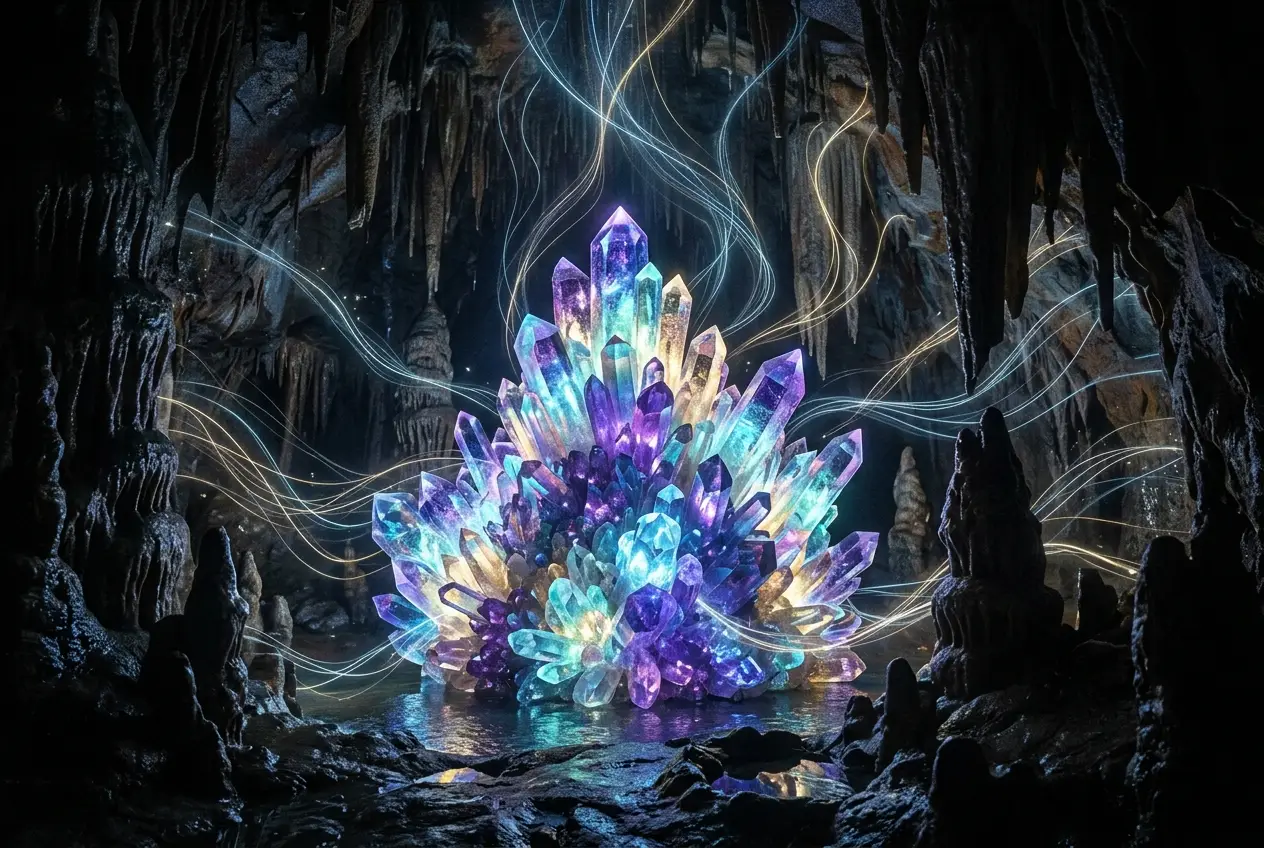
The notion that ancient civilizations possessed knowledge or technology far beyond what historical records suggest is a recurring whisper in the halls of archaeology. We marvel at megalithic structures, precision celestial alignments, and intricate artifacts, often attributing them to sheer ingenuity or spiritual insight. But what if some of these "insights" were, in fact, forms of data, stored not in scrolls or tablets, but within the very fabric of the Earth itself? What if humble crystals, abundant and seemingly inert, held the forgotten histories of our planet, encoded by forces or minds we barely comprehend?
I find this idea profoundly captivating. Imagine stumbling upon an ancient artifact, not just a tool or adornment, but a geological hard drive, pulsating with eons of lost information. It makes you wonder about the very nature of memory and how information can persist beyond our conventional storage methods. For centuries, crystals have been revered across cultures, from divination tools to healing talismans, often associated with memory, energy, and wisdom. Could these ancient beliefs hint at a deeper, more scientific understanding, one that we are only now beginning to grasp with our own advanced technology?
The Enduring Mystery of Crystal Memory
Crystals are more than just beautiful formations; they are ordered structures of atoms, repeating in precise, predictable patterns. This atomic regularity gives them unique properties, including the ability to vibrate at specific frequencies, refract light in peculiar ways, and even generate electrical charges under pressure (piezoelectricity). These characteristics have made them indispensable in modern technology, from quartz watches to computer chips. But what if this inherent ability to maintain an ordered structure, to resonate with specific energies, also allowed them to record and retain information?
The concept of "crystal memory" isn't entirely new in scientific circles. Scientists are actively exploring crystals for high-density, long-term data storage solutions. For example, 5D optical data storage, often using tiny fused quartz crystals, promises to store vast amounts of data (terabytes per disc) for billions of years. This technology works by engraving information in three dimensions plus two dimensions related to the polarization of light, essentially creating microscopic, stable data points within the crystal's structure. If we, with our cutting-edge lasers and nanotechnology, can encode information into crystals, it begs the question: could nature, or even advanced ancient civilizations, have found a way to do something similar?
The Science Behind the Speculation: How Crystals Could Store Data
To understand how crystals might store information, we need to look at their fundamental properties:
1. Atomic Lattice & Imperfections: Crystals are defined by their highly ordered atomic lattices. However, these lattices are rarely perfect. Imperfections, or "defects," in the crystal structure can occur naturally. These defects can trap electrons or create localized energy states. In modern data storage, manipulating these defects or creating precise structural changes is key to encoding binary information (0s and 1s). It's conceivable that powerful natural events—like lightning strikes, seismic activity, or even cosmic radiation—could have induced specific, stable defects within ancient crystals, akin to writing data.
2. Piezoelectricity & Electromagnetism: Many crystals, such as quartz, exhibit piezoelectricity, meaning they generate an electrical charge when subjected to mechanical stress, and vice-versa. They also interact with electromagnetic fields. Imagine a geological environment rich in tectonic activity or electromagnetic fluctuations. These forces could have created subtle, persistent changes in the crystal's internal charge distribution, effectively "imprinting" patterns that represent data. For more on how our planet's forces might influence materials, check out this article on whether ancient structures resonated with Earth's frequencies.
3. Resonance & Vibrational Frequencies: Each crystal has a unique resonant frequency determined by its atomic structure. Just as sound waves can create patterns in sand (Chladni plates), energetic vibrations (sound, light, electromagnetic waves) could theoretically induce lasting structural or energetic changes within a crystal lattice. Could specific cosmic events or powerful ancient rituals—often involving chanting or specific sound frequencies—have left a lasting "vibrational signature" within certain crystals? This idea finds resonance in how we use sound to measure material properties today.
4. Light Interaction & Luminescence: Some crystals exhibit thermoluminescence or optically stimulated luminescence, where stored energy is released as light after exposure to heat or another light source. This phenomenon is used in archaeological dating to determine when a crystal was last exposed to heat or sunlight. This implies that crystals can absorb and store energy from their environment over vast timescales. Could this stored energy contain information about the events they witnessed?
A Tale of Ancient Connections and Modern Parallels
One area where ancient beliefs and modern science seem to converge is the idea of quartz as a universal data medium. Quartz, a piezoelectric crystal, is one of the most abundant minerals on Earth. It’s also the primary component in many silicon-based technologies, including microprocessors and memory chips.
The Mayans, for instance, had an intricate understanding of celestial cycles and time. Their complex calendar system, often carved in stone, suggests an advanced mathematical and astronomical grasp. While not explicitly crystal-based, their focus on precise cycles and monumental stonework leads one to ponder if their knowledge extended to how natural materials could embody or reflect these cosmic rhythms. Could they have understood that certain geological formations, rich in quartz, acted as silent witnesses or even passive recorders of these astronomical events? We've explored aspects of their astronomical prowess in /blogs/did-ancient-maya-predict-solar-flares-8673.
The fascinating part, as I see it, is how our modern advancements in quantum computing and material science increasingly reveal the potential for matter to store and process information in ways once thought impossible. The idea of information being intrinsically linked to the physical world, not just a human construct, feels increasingly plausible. As Dr. Seth Lloyd, a quantum computing pioneer, once said, "The universe is a quantum computer." If the universe is a computer, then perhaps its components—like crystals—are its natural memory banks.
Decoding the Geological Archive
If crystals do hold ancient data, how would we access it? This is where the challenge lies and where science fiction meets scientific aspiration.
- Vibrational Spectroscopy: Techniques like Raman spectroscopy or infrared spectroscopy analyze how light interacts with a material's molecular vibrations. Anomalies in these vibrational patterns could potentially indicate stored information or unusual structural arrangements.
- Electron Microscopy: High-resolution electron microscopes could reveal ultra-fine, stable defects or structural changes within the crystal lattice that are too small to see with conventional methods.
- Quantum Resonance Imaging: A hypothetical future technology might be able to map the quantum states of atoms within a crystal, potentially reading patterns encoded at that fundamental level.
- Biomimicry: Perhaps nature itself holds the key. Some organisms detect subtle electromagnetic shifts. Could ancient civilizations have developed biological or proto-technological "readers" inspired by these natural phenomena?
The quest to unlock these potential geological archives is not just about finding lost history; it’s about expanding our understanding of information itself. If crystals can store data for millennia, it offers profound implications for ultra-long-term data archiving, crucial for preserving human knowledge in a world of rapidly evolving technology. Imagine archiving critical scientific discoveries or cultural heritage in a format that could survive geological epochs.
The Unseen Storytellers of Earth
The thought that crystals might be the Earth's silent storytellers, holding narratives of cosmic impacts, ancient ecosystems, or even forgotten human sagas, is truly inspiring. It transforms every ordinary stone into a potential relic of unimaginable value, a latent library waiting for its decoder. While this remains largely in the realm of hypothesis, the convergence of ancient wisdom and emerging science suggests that we might yet find remarkable secrets hidden within the very rocks beneath our feet.
It encourages us to look at the world around us with new eyes—to consider that history isn't just written in books or etched in stone monuments, but possibly embedded in the fundamental structures of our planet. And perhaps, one day, we will learn to read it.
External Resources:
- Piezoelectricity: Learn more about how crystals generate electricity under pressure: https://en.wikipedia.org/wiki/Piezoelectricity (opens in a new tab)
- 5D Optical Data Storage: Explore this advanced crystal-based data storage technology: https://en.wikipedia.org/wiki/5D_optical_data_storage (opens in a new tab)
- Thermoluminescence Dating: Understand how crystals can store and release energy over time for dating purposes: https://en.wikipedia.org/wiki/Thermoluminescence_dating (opens in a new tab)
- Quartz: A deeper dive into the properties and uses of one of Earth's most common and fascinating crystals: https://en.wikipedia.org/wiki/Quartz (opens in a new tab)




Conversation0
No comments yet. Be the first to share a thought — the best questions often become new stories.