


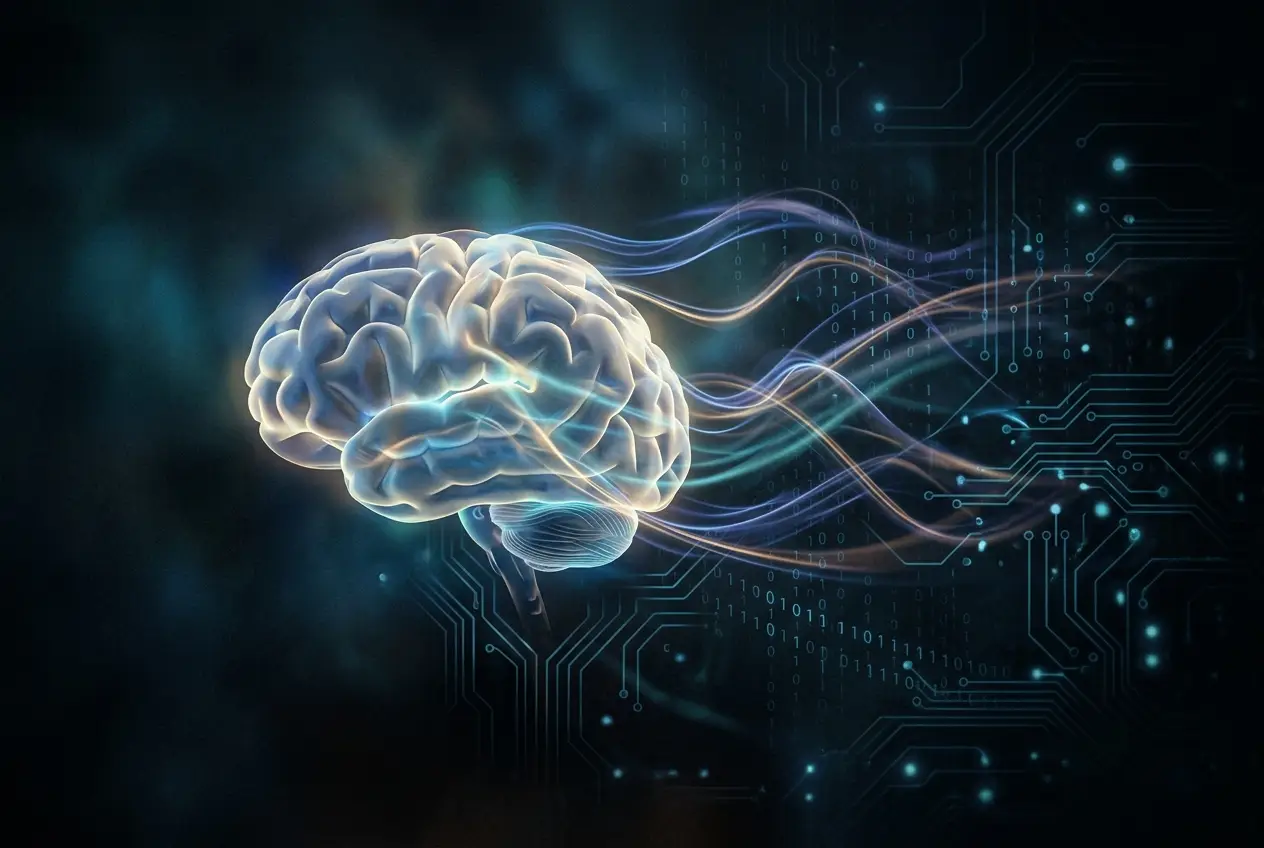
I was recently working late, completely absorbed in a complex coding problem, when something truly odd happened. My screen flickered, not in the way a loose cable might, but with a momentary scramble of pixels that felt… personal. Just as I was intensely thinking, "This code is driving me crazy," the computer seemed to briefly mirror my frustration. Of course, I dismissed it as a coincidence, a mere technical hiccup. But it made me wonder: could our thoughts, our very consciousness, somehow interfere with or even "glitch" the technology around us?
It sounds like something out of a science fiction movie, doesn't it? The idea of psychokinesis, or mind over matter, has long been a staple of speculative fiction. Yet, as our understanding of both the human brain and complex digital systems deepens, the lines between what’s plausible and what’s purely fantastical begin to blur. This isn't about moving objects with your mind, but about the subtle, often imperceptible, interactions that might occur between the human bio-electric field and sensitive electronics.
The Brain: A Bio-Electric Powerhouse
Let's start with what we know for sure: our brains are incredibly complex electrical organs. Every thought, every feeling, every movement is orchestrated by a symphony of electrochemical signals firing across billions of neurons. This activity generates measurable electromagnetic fields. When I wear an EEG cap, I can literally see my brainwaves — alpha, beta, theta, delta — displayed as oscillating patterns. These are not just abstract concepts; they are real, physical phenomena.
These brainwaves, while weak, extend beyond the confines of our skulls. Think of it like a tiny, living radio transmitter. While the direct energy output is minimal, the question isn't about raw power, but about resonant frequencies and subtle interactions. Could these fields, under specific circumstances, influence sensitive electronic components?
The Quantum Connection: A Bridge Between Mind and Matter?
Some scientists and theorists propose that the link might lie in the strange world of quantum mechanics. Quantum phenomena, like superposition and entanglement, suggest a reality far more interconnected and less deterministic than classical physics. Could consciousness itself be a quantum phenomenon, as some theoretical physicists, like Roger Penrose and Stuart Hameroff, have explored with their Orchestrated Objective Reduction (Orch OR) theory? (For more, see the Wikipedia article on the Orch-OR theory: https://en.wikipedia.org/wiki/Orchestrated_objective_reduction (opens in a new tab))
If consciousness has a quantum basis, its interaction with the quantum states within our electronic devices becomes a fascinating, albeit highly speculative, possibility. Modern electronics, especially at the nanoscale, are increasingly operating at a level where quantum effects become significant. Transistors in microprocessors, for instance, are so tiny that electrons effectively "tunnel" through barriers—a purely quantum phenomenon. Could a focused thought, a surge of emotion, or even subconscious brain activity, nudge these delicate quantum states in a way that manifests as a glitch?
This isn't to say we're telekinetically altering quantum states, but rather exploring if the brain's inherent quantum processes could lead to minute, localized disturbances in highly sensitive electronic systems. It's a leap, certainly, but one that continues to fuel research and debate in fringe science circles.
Electromagnetic Interference (EMI) – A Known Culprit
Beyond quantum speculation, there's a more grounded explanation: Electromagnetic Interference (EMI). We know that electromagnetic fields can disrupt electronics. Power lines, radio transmitters, even other electronic devices, all emit EMI that can cause anything from static on your radio to complete system crashes. This is why hospitals have strict rules about mobile phone use near sensitive medical equipment.
While the brain's electromagnetic field is far weaker than a cell phone signal, it's not non-existent. Our bodies are essentially bags of saline solution, excellent conductors for electricity. A sudden strong emotion, intense focus, or even certain physiological states can subtly alter our body's electrical properties. Could these subtle shifts generate a brief, localized EMI strong enough to cause a tiny anomaly in an extremely sensitive device?
For instance, early lie detector tests, despite their scientific limitations, operated on the principle that emotional stress causes physiological changes, including changes in skin conductivity and heart rate, which are measurable electrical signals. What if these stress-induced physiological electrical surges were just enough to throw off a fragile circuit? It’s a slim chance, but not impossible.
The Observer Effect and Digital Anomalies
One area where mind and technology undeniably intersect is through our perception. The observer effect in quantum mechanics postulates that the act of observation can influence the outcome of an experiment. While this is typically applied at the subatomic level, some philosophical extensions ponder its macroscopic implications.
Consider the common experience: you’re trying to fix a stubborn piece of tech, and it refuses to work. Then, just as you're about to give up, or perhaps when you're explaining the problem to someone else, it suddenly springs to life. Coincidence? Or is there something about our focused attention, our expectation, that subtly changes the conditions? While likely confirmation bias, these anecdotes are persistent.
I’ve often noticed how my focus on an error can sometimes make it appear more frequently, or even seem to trigger it. While this is probably my brain being hyper-aware of the specific error, rather than causing it, it highlights the complex interplay between our minds and the technology we interact with. This human element, the human-computer interaction, is often overlooked when we talk about glitches. Our own stress, impatience, or even a sudden thought can affect how we perceive or interact with the technology, sometimes leading us to believe we’ve caused a glitch.
Case Studies and Anecdotal Evidence
While concrete scientific proof remains elusive, there are numerous anecdotal accounts and studies that lean into this idea of mind-tech interaction.
- PK (Psychokinesis) Research: Labs like the Princeton Engineering Anomalies Research (PEAR) program, though controversial and now closed, conducted decades of experiments exploring mind-matter interaction. They used Random Event Generators (REGs), which produce truly random sequences of bits, and had participants try to influence these sequences with their minds. While the effects were small, they claimed statistically significant deviations from chance. While largely dismissed by mainstream science, such experiments raise questions about subtle influences we don't yet understand. You can learn more about the PEAR lab on Wikipedia: https://en.wikipedia.org/wiki/Princeton_Engineering_Anomalies_Research_Lab (opens in a new tab)
- The "Computer Glitch" Phenomenon: Many people report that their computers, phones, or even smart home devices seem to act up more when they are stressed, angry, or intensely focused. Is it a reflection of their own state, or purely coincidence? The psychological impact of technology on us, and our potential subtle impact on it, is a two-way street worth considering.
- Biofeedback and Brain-Computer Interfaces (BCIs): This is where the intersection becomes undeniably real, though controlled. BCIs allow individuals to control computers, prosthetics, and other devices purely with their thoughts. This isn't psychokinesis; it's the meticulous detection and interpretation of brain signals (EEG, ECoG, etc.) by advanced algorithms. Yet, it proves that our thoughts, once properly amplified and decoded, can absolutely "glitch" or, more accurately, control computers. For a deeper dive into BCIs, check out: https://en.wikipedia.org/wiki/Brain%E2%80%93computer_interface (opens in a new tab). We've explored BCIs before on Curiosity Diaries, you might find "Can Brainwaves Control Tech From Afar?" (/blogs/can-brainwaves-control-tech-from-afar-9230) and "Can Neuro-Dust Upload Our Minds?" (/blogs/can-neuro-dust-upload-our-minds-digital-immortality-3545) fascinating reads.
The Future of Mind-Tech Integration
As technology becomes more ubiquitous and integrated into our lives, and as our understanding of consciousness evolves, these subtle interactions might become more apparent, or even deliberately engineered. Imagine devices designed to be less susceptible to human emotional EMI, or perhaps even subtly responsive to it.
The very notion of "glitching" could transform from an annoying error into a feedback mechanism. What if future smart homes could detect your stress levels through subtle bio-electrical cues and adjust ambient lighting or music to calm you? Or if your car could sense your distraction and gently nudge you back to focus? This isn't far-fetched; these are extensions of existing biofeedback and BCI technologies.
The boundary between mind and machine is constantly being redrawn. While the idea of our raw thoughts directly causing malfunctions in our gadgets still resides firmly in the realm of anomaly and hypothesis, the underlying scientific principles—electromagnetism, quantum mechanics, and brain-computer interaction—suggest that our connection to technology is far more intricate than just pushing buttons.
Perhaps the "glitch" I experienced that night wasn't just a coincidence, but a whisper from a deeper connection between my highly agitated mind and the delicate circuitry I was trying to master. It serves as a reminder that the human element, complex and often mysterious, will always be an unpredictable variable in our technological future. What do you think? Have you ever felt like your thoughts or emotions were "glitching" your tech?
Conclusion: More Than Meets The Eye?
The question of whether our thoughts can glitch computers is a fascinating journey through science, philosophy, and curious phenomena. While direct, measurable evidence for psychokinetic influence on consumer electronics is lacking, the scientific understanding of our brain's electrical nature, the quantum realm, and electromagnetic interference suggests that subtle interactions are not entirely outside the bounds of possibility. As technology becomes more sensitive and our integration with it deeper, the subtle dance between our inner world and the outer digital one will only become more intriguing. So next time your computer acts up, pause and consider: was it just a bug, or did your brain send out a cosmic sigh?






Conversation0
No comments yet. Be the first to share a thought — the best questions often become new stories.