I’ve always been captivated by the sheer ingenuity of ancient civilizations. It's one thing to look up at the night sky, point out the constellations, and marvel at the moon's phases. It's quite another to meticulously chart those movements, encode them, and — perhaps — even predict future cosmic events with astonishing accuracy. For centuries, we’ve admired ancient star maps as beautiful records of observation. But what if they were more than just exquisite art or simple calendars? What if these intricate carvings and diagrams were, in fact, sophisticated predictive models, a form of ancient "cosmic computer" hidden in plain sight?
The idea feels almost fantastical, like something out of a science fiction novel. Yet, recent archaeological and astronomical investigations continually push the boundaries of what we thought ancient peoples were capable of. I find myself wondering if we’ve underestimated their understanding of celestial mechanics, seeing only the surface while missing the profound calculations embedded within their star charts.
### Unpacking the Purpose of Ancient Star Maps
From the intricate cave paintings of Lascaux showing star clusters to the sophisticated star catalogues of Babylonian astronomers, humanity's fascination with the cosmos is ancient and enduring. Early civilizations relied on the sky not just for spiritual guidance, but for practical purposes: agriculture, navigation, and timekeeping. These needs drove the development of detailed astronomical observation.
For a long time, the prevailing view was that ancient star maps were primarily observational tools. They helped identify constellations, track the seasons, and mark important dates. Think of the Nebra Sky Disc, a Bronze Age artifact found in Germany, which is widely considered one of the oldest known depictions of cosmic phenomena. It clearly shows the sun or full moon, a lunar crescent, and stars, including the Pleiades. Its design suggests a sophisticated understanding of how to align celestial bodies for calendar purposes, particularly for coordinating agricultural cycles. It's an incredible piece of early astronomy, a testament to careful observation. You can learn more about its significance on Wikipedia: [Nebra Sky Disk](https://en.wikipedia.org/wiki/Nebra_sky_disk).
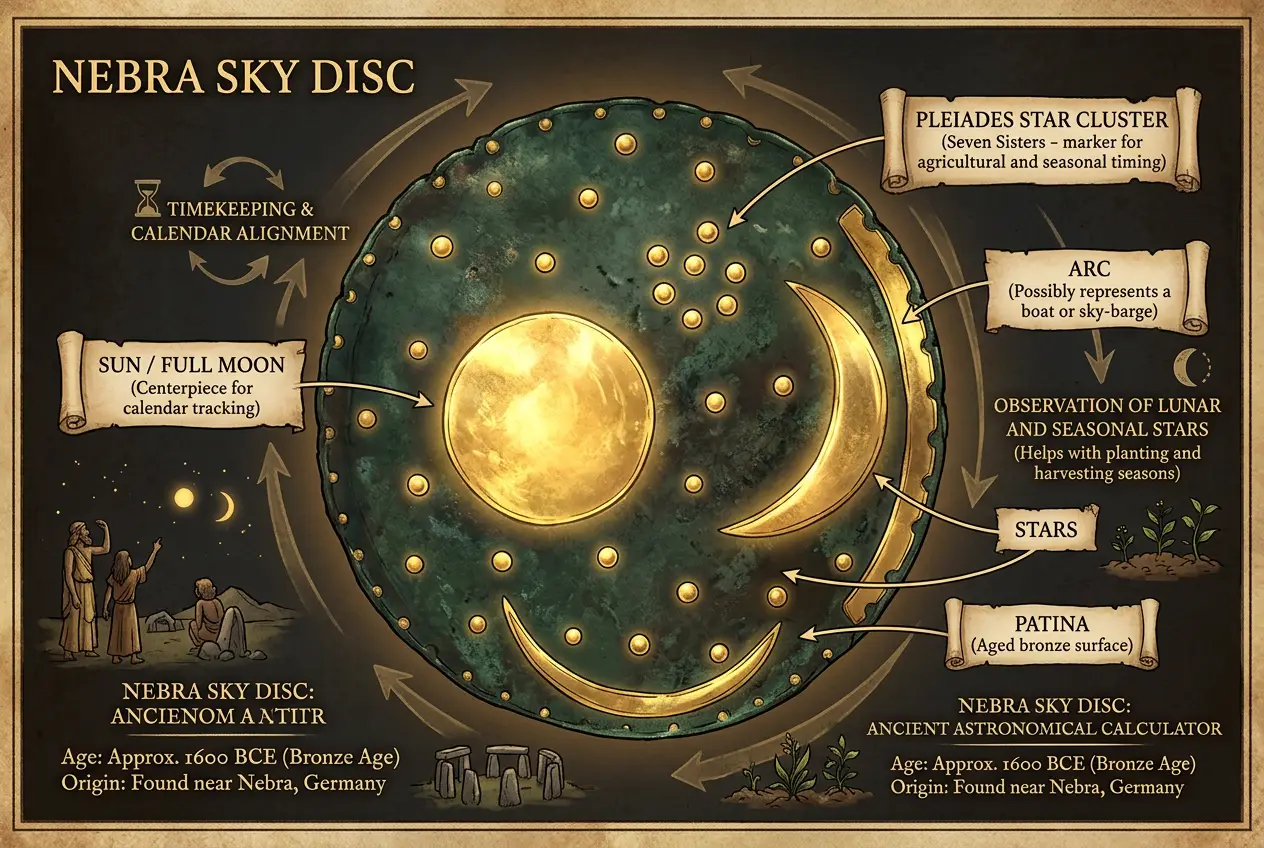
However, "observational" doesn't necessarily mean "non-predictive." Even a simple calendar based on astronomical events is, in a rudimentary sense, a predictive tool. Knowing when the sun will reach its lowest point (winter solstice) allows one to predict the return of longer days. The question becomes: how advanced were these predictive capabilities? Were they merely extrapolating patterns, or did they possess mathematical models that allowed for forecasting complex celestial phenomena like planetary conjunctions, eclipses, or even the subtle precession of the equinoxes?
### The Clues in the Carvings: Beyond Simple Observation
As I delve deeper into the subject, I keep encountering compelling evidence suggesting a more profound level of astronomical expertise. Many ancient sites, such as Stonehenge or the Egyptian temples, are famously aligned with solstices and equinoxes. These alignments demonstrate a clear understanding of the sun's annual path. But some structures, like those discussed in our previous post about whether [ancient observatories were also cosmic clocks](/blogs/were-ancient-observatories-also-cosmic-clocks-8259), hint at even more.
Consider the intricate celestial charts found in ancient Egyptian tombs, like the Denderah Zodiac. While initially seen as a mapping of constellations, further analysis suggests it could represent planetary positions over a much longer period, potentially encoding cycles of precession. Such a record would require generations of meticulous observation and complex calculations to compile, hinting at a predictive capacity far beyond simple seasonal tracking. These aren't just snapshots of the sky; they are potentially long-exposure records, revealing deep cosmic rhythms.
Similarly, the Maya civilization developed an extraordinarily complex calendar system, famously culminating in their Long Count calendar. This system not only tracked time with incredible precision but also allowed for the calculation of astronomical events far into the future and past. While their "end date" of 2012 was misinterpreted by some, the mathematical sophistication behind their calendar, which integrated cycles of the moon, Venus, and other planets, clearly demonstrates a predictive understanding. They knew when eclipses would occur, and when planetary bodies would align. In fact, our blog post on [whether ancient Maya predicted solar flares](/blogs/did-ancient-maya-predict-solar-flares-8673) delves into some of these fascinating capabilities. Their system was a grand cosmic calculator, meticulously mapping out the dance of the heavens. More on their calendrical system can be found here: [Maya Calendar](https://en.wikipedia.org/wiki/Maya_calendar).
### Decoding the Cosmic Code: Predictive Models
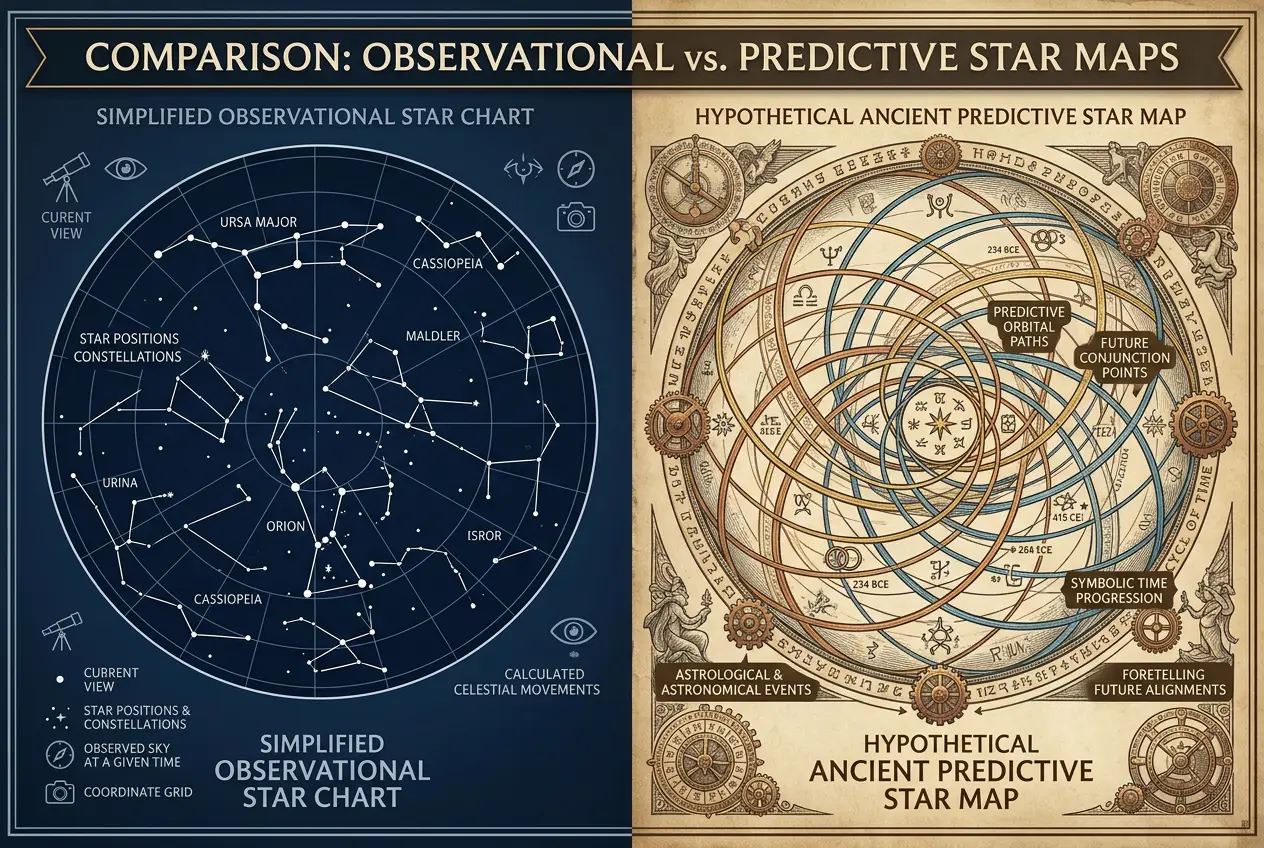
The idea that ancient star maps were predictive implies that the civilizations that created them possessed a form of "cosmic code" – mathematical algorithms or geometric principles that allowed them to forecast celestial events. This isn't necessarily about high-tech gadgets or advanced computers as we know them today. Instead, it speaks to an intellectual technology, a profound understanding of patterns and cycles.
One of the most intriguing aspects is how this "code" might have been embedded. Perhaps it was in the spacing of symbols, the angles of lines, or the geometric relationships between depicted celestial bodies. Could certain star maps have been mnemonic devices, designed to help astronomers remember complex orbital mechanics? Or were they direct graphical representations of mathematical models?
For instance, the sophisticated astronomical models developed by ancient Greeks, though not always embodied in "maps" as we might imagine, certainly were predictive. While the Antikythera mechanism, an ancient Greek analog computer, is the most famous example of a highly predictive device (and one we've covered in a previous blog, [The Antikythera: Greece's Ancient Cosmic Computer](/blogs/the-antikythera-greeces-ancient-cosmic-computer-6564)), it suggests a broader intellectual tradition capable of such complex thought. Its existence proves that the concept of calculating future astronomical events was firmly within the grasp of ancient engineers and astronomers.
The Babylonians, renowned for their advanced astronomy, compiled extensive records of celestial phenomena on cuneiform tablets. These "ephemerides" were not just records of past events but were used to predict future positions of planets and the timing of eclipses. Their mathematical methods, including arithmetic progressions, were remarkably effective. While these were tabular data rather than traditional "maps," they underscore the ancient capacity for predictive astronomy. We've also explored similar ideas in our blog about whether [ancients coded planets into stone](/blogs/did-ancients-code-planets-into-stone-3992).
### The Evidence and Its Interpretation
Interpreting ancient artifacts is a delicate balance. It's easy to project our modern understanding onto past cultures, leading to misinterpretations. However, ignoring compelling patterns and mathematical consistency would be equally remiss. The debate often centers on whether specific alignments or symbolic representations are intentional, coincidental, or simply artistic license.
A crucial aspect of determining predictive capability lies in the **accuracy** and **complexity** of the predictions. If an ancient star map consistently and accurately indicates future positions of multiple celestial bodies, or forecasts rare events like specific planetary alignments or long-period comets, the argument for predictive intent becomes much stronger.
Consider the long-term cycles, such as the precession of the equinoxes, which takes approximately 25,772 years to complete. Recognizing and encoding such a slow, subtle shift would require an immense amount of observational data, passed down and refined over millennia, or an incredibly sophisticated theoretical model. If evidence emerges that ancient maps somehow encoded this precession, it would dramatically reshape our understanding of their astronomical prowess. Such a discovery would imply not just observation, but a deep, mathematical understanding of celestial mechanics that rivals, in principle, much later scientific developments.
### The Mystery Endures
Ultimately, the question of whether ancient star maps were truly predictive remains a captivating mystery. While direct "user manuals" detailing their predictive algorithms are rare, the circumstantial evidence is mounting. The precision of ancient calendars, the alignments of monumental structures, and the mathematical sophistication implied by artifacts like the Antikythera mechanism all point towards cultures that were not merely passive observers of the cosmos.
I believe that as our archaeological techniques improve and our ability to analyze ancient data grows, we will continue to uncover hidden layers of knowledge within these venerable artifacts. Perhaps one day, a truly unambiguous "Rosetta Stone" of ancient astronomy will reveal the full extent of their cosmic understanding, confirming that these maps were indeed the blueprints of their ancient cosmic computers. Until then, the night sky, as seen through the eyes of our ancestors, continues to inspire wonder and fuel our curiosity, prompting us to ask: what else did they know that we're only just beginning to rediscover?
Keep exploring the fascinating intersection of ancient wisdom and modern inquiry with us. For more insights into historical tech and anomalies, check out our piece on [whether Gobekli Tepe was the first observatory or cosmic calculator](/blogs/gobekli-tepe-first-observatory-or-cosmic-calculator-6119).
Frequently Asked Questions
Ancient civilizations relied on naked-eye observation over generations, meticulously documenting celestial patterns. They used gnomons, observational platforms, and precise calendrical systems to track movements. Their predictive power came from recognizing cycles and developing mathematical models based on these long-term observations, rather than advanced optical instruments.
Beyond basic seasonal changes, ancient predictive maps could have forecasted lunar and solar eclipses, planetary conjunctions (when planets appear close together in the sky), the heliacal rising and setting of significant stars, and potentially even longer cycles like the precession of the equinoxes, albeit through cumulative observation rather than a single direct model.
Direct textual evidence explicitly detailing the predictive algorithms embedded in 'maps' is rare. However, cultures like the Babylonians left extensive cuneiform tablets (ephemerides) which were tables of data used for predictions. The Maya left codices explaining their calendrical calculations. The interpretation of visual star maps as predictive often relies on astronomical alignments, mathematical patterns, and comparisons with known predictive capabilities of the culture.
Scientists look for several key indicators: extreme accuracy in depicting long-term celestial cycles, representations of phenomena that couldn't be observed in a single lifetime (like precession), mathematical consistency in symbol placement, and correlation with known astronomical events that happened thousands of years ago or in the distant future. The complexity and consistency of the data are crucial.
There's evidence of parallel astronomical developments and sometimes diffusion of ideas across ancient cultures. For example, Mesopotamian astronomical knowledge influenced Greek and Indian astronomy. While a unified 'global' knowledge network is unlikely, distinct civilizations often arrived at similar understandings independently or exchanged insights through trade and cultural contact, leading to widespread sophisticated astronomical practices.
Verified Expert
Alex Rivers
A professional researcher since age twelve, I delve into mysteries and ignite curiosity by presenting an array of compelling possibilities. I will heighten your curiosity, but by the end, you will possess profound knowledge.
Leave a Reply
Comments (0)
No approved comments yet. Be the first to share your thoughts!
 Join Us



 Alex Rivers






















Leave a Reply
Comments (0)