


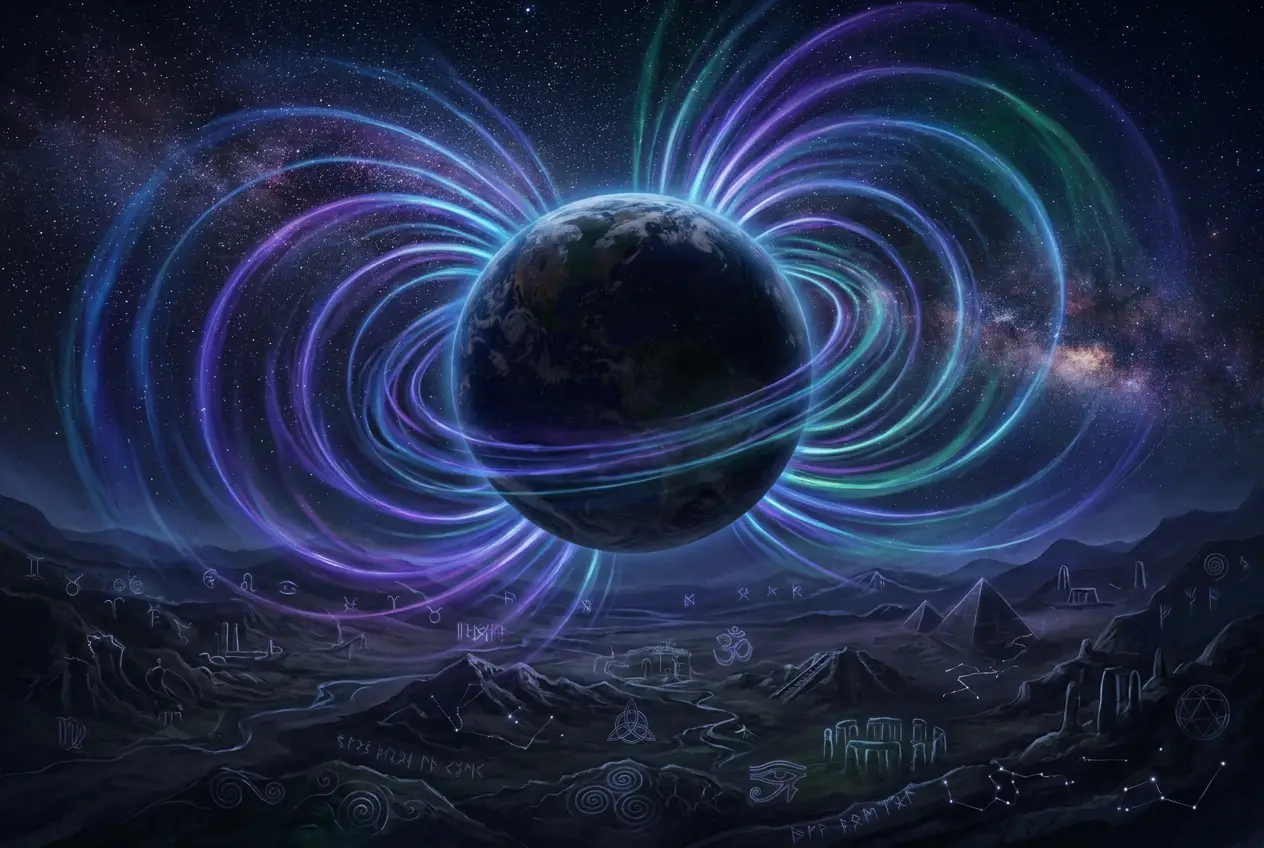
I remember staring at a globe as a child, mesmerized by the invisible lines of latitude and longitude. Little did I know, Earth is crisscrossed by another, far more dynamic and mysterious set of lines – its magnetic field. This colossal, ever-shifting force field protects us from deadly solar radiation, guides migratory animals, and even dictates the aurora borealis. But what if I told you that this field, so vital to our existence, isn't static? What if I revealed that, periodically, it weakens, flips, and then re-establishes itself in the opposite direction? And what if, just possibly, ancient civilizations not only witnessed these dramatic shifts but also understood their profound implications?
The idea that ancient cultures, without advanced scientific instruments, could have detected or even predicted something as complex as a geomagnetic reversal sounds like a plot from a sci-fi novel. Yet, as I delve deeper into the intersection of archeology, geology, and obscure historical accounts, a fascinating question emerges: are there subtle clues in myths, megalithic structures, or lost technologies that point to an awareness of Earth's greatest planetary drama?
Earth's Invisible Shield: A Primer on Our Magnetic Field
To understand the possibility of ancient awareness, we first need to grasp the phenomenon itself. Earth's magnetic field is generated by the churning, molten iron alloy in our planet's outer core – a dynamic process known as the geodynamo. Think of it as a giant, self-sustaining electrical generator deep beneath our feet. This field extends thousands of kilometers into space, forming a protective bubble, the magnetosphere, that deflects harmful charged particles from the sun and cosmic rays. Without it, our atmosphere would be stripped away, and life on Earth would be impossible.
However, this mighty shield isn't constant. Paleomagnetic studies – the study of Earth's ancient magnetic field preserved in rocks – reveal a turbulent history. Over hundreds of millions of years, the magnetic poles have wandered, weakened, and, most dramatically, flipped numerous times. The last full reversal, known as the Brunhes-Matuyama reversal, occurred about 770,000 years ago, taking thousands of years to complete. During these reversals, the field doesn't just instantaneously flip; it weakens significantly, sometimes dropping to less than 10% of its normal strength, and becomes chaotic, with multiple poles appearing and disappearing.
This transitional period is critical. A weakened magnetic field means less protection. Earth would be exposed to increased levels of solar and cosmic radiation. This could lead to:
- Increased radiation at the surface: Higher cancer rates, genetic mutations.
- Atmospheric changes: Damage to the ozone layer, altered weather patterns.
- Disruption of technology: Satellites, power grids, and communication systems would be severely impacted.
- Impact on life: Migratory species relying on the magnetic field for navigation would be disoriented.
Could Ancient Civilizations Have Noticed?
The average human lifespan is a blink in geological time. A geomagnetic reversal unfolds over thousands of years – far too long for a single generation to witness in its entirety. So, how could ancient cultures have detected such a slow-motion catastrophe? The answer might lie in their acute observational skills, their profound connection to the natural world, and their unique ways of preserving knowledge.
Navigational Cues and Migratory Disruptions
Imagine a world where seafaring was paramount, where knowing your direction relied heavily on celestial bodies and, perhaps, an innate sense of direction linked to Earth's magnetic field. While ancient mariners primarily used stars and sun for navigation, some theories suggest a more subtle understanding of geomagnetism. Early compasses, though rudimentary, predate many established timelines for complex magnetic knowledge. The Chinese "south-pointing spoon," for example, dates back to at least the Han Dynasty (206 BCE – 220 CE) and possibly earlier. While not a compass in the modern sense, it demonstrates an early awareness of magnetic properties. Could older, perhaps even pre-literate, cultures have developed ways to sense or observe shifts in magnetic north?
Birds, turtles, and other migratory animals famously use Earth's magnetic field for navigation. If the field were to weaken or become erratic during a reversal, these animals would become disoriented. I wonder if ancient hunter-gatherer societies, intimately dependent on animal movements, would have noticed mass confusion, altered migration routes, or unexplained disappearances among wildlife. Such profound ecological disruptions, repeated over generations, might have been woven into oral traditions or symbolic art. For more on how ancient mariners might have sensed subtle environmental cues, you might be interested in our blog: Did Ancient Mariners Sense Unseen Cosmic Cues?
Cosmic Radiation and Atmospheric Anomalies
A weakened magnetosphere allows more high-energy particles from space to penetrate the atmosphere. This increased cosmic radiation could have had noticeable effects. One of the most striking would be a significant increase in auroral displays, even at lower latitudes where they are rarely seen today. Imagine vibrant, dancing lights painting the night sky, far more frequently and intensely than usual, potentially lasting for centuries. These spectacular phenomena could have been interpreted as divine omens, powerful spiritual events, or manifestations of celestial dragons and gods. Many myths and ancient artworks depict celestial serpents or fiery sky phenomena that could be interpreted as auroras.
Furthermore, increased radiation could potentially affect cloud formation, leading to unusual weather patterns or persistent droughts/floods over extended periods, phenomena that would certainly not go unnoticed by agrarian societies.
Megalithic Structures and Earth Energies
This is where the speculation gets truly intriguing. Many ancient sites, from Stonehenge to the pyramids, demonstrate an uncanny alignment with celestial bodies, hinting at advanced astronomical knowledge. But what if some of these structures were also designed to resonate with or even measure Earth's unseen energies? Could megalithic builders have been aware of the geomagnetic grid?
Some researchers propose that certain stone circles or aligned structures might have acted as giant, crude instruments for detecting subtle shifts in Earth's magnetic field. While direct proof is elusive, the meticulous orientation and construction of these sites suggest an intimate understanding of their environment beyond mere shelter. For instance, the discussion around whether megaliths could tap into Earth's energies explores this fascinating idea: Did Megaliths Tap Earth's Geomagnetic Grid?
"The ancients were keen observers of the natural world, far more so than modern humans, shielded by technology. Every anomaly, every shift in the sky or the behavior of animals, would have held profound significance." — Graham Hancock, Fingerprints of the Gods (paraphrased)
Cultural Memories and Mythological Echoes
Perhaps the most compelling, albeit indirect, evidence comes from humanity's oldest stories. Many cultures across the globe share myths of catastrophic floods, cosmic resets, and periods of profound darkness or celestial upheaval. While often attributed to cometary impacts or deluges, could some of these narratives be distant, exaggerated memories of the chaotic and vulnerable period of a geomagnetic reversal?
Consider the widespread motif of "ages" or "worlds" that rise and fall, often punctuated by cataclysmic events. Hindu cosmology, for example, describes yugas – vast cycles of time – where humanity's spiritual and physical state declines and resets. Mayan calendars, with their intricate cycles and predictions of ending eras, also speak to this cyclical destruction and renewal. Could the "end of an age" in some mythologies represent the profound, protracted environmental and societal disruption caused by a geomagnetic pole flip?
The narrative of a sky turning "red" or "dark" or stars "falling" could be vivid recollections of enhanced auroral activity or increased meteor showers due to a weakened atmospheric shield. The "wandering stars" in some accounts might even reference the shifting magnetic poles themselves, or perhaps the disoriented migration of celestial bodies in a time when human observations were more sensitive to the subtle, slow changes of the cosmos. Our curiosity about how ancient cultures interpreted and recorded celestial events is a recurring theme, as explored in Did Ancient Cultures Map Invisible Skies?
The Scientific Search for Ancient Clues
Modern science is starting to look for more direct connections. Researchers study cosmogenic radionuclides like Beryllium-10, which are produced when cosmic rays hit the Earth's atmosphere. Higher levels of these isotopes found in ice cores or sediment layers correspond to periods of weaker magnetic fields. If we could correlate ancient cultural events, myths, or even archaeological "gaps" with peaks in these radionuclides, it would provide a tantalizing link.
Another avenue is studying ancient navigation systems and their precision. While most rely on celestial mechanics, I wonder if a sophisticated, yet lost, form of geomagnetic navigation was also employed, especially by cultures with extensive seafaring capabilities. Changes in the magnetic field would have rendered such systems unreliable, forcing adaptations or leading to navigational crises.
The Challenge of Proof
Of course, proving that ancient cultures understood geomagnetic reversals is an immense challenge. The evidence is circumstantial, fragmented, and open to multiple interpretations. We're looking for echoes of complex scientific understanding in symbolic language, monumental architecture, and oral traditions passed down through millennia. It's like trying to reconstruct a sophisticated computer program from scattered lines of poetry.
However, the question itself forces us to reconsider the intellectual capabilities of our ancestors. Were they merely superstitious sky-gazers, or did they possess a profound, empirical knowledge of Earth and cosmos that we, in our technological hubris, have forgotten or dismissed? The more we learn about their astronomical prowess, their engineering feats, and their deep connection to the natural world, the more plausible it seems that they might have detected, even if they couldn't fully explain, Earth's grand magnetic heartbeat.
Conclusion: Acknowledging Ancient Wisdom
The concept of ancient civilizations sensing Earth's magnetic reversals remains in the realm of intriguing possibility rather than established fact. Yet, the evidence from paleomagnetism is undeniable: our planet's protective shield has indeed shifted dramatically many times. To assume that ancient humans, who built empires, charted stars, and created enduring myths, would have been oblivious to such profound environmental and celestial changes might be a disservice to their observational genius.
Perhaps the "cosmic computer" wasn't a physical device, but rather the collective, generations-spanning observation and wisdom of cultures deeply attuned to the rhythms of their planet. As we face the prospect of another potential, albeit slow, magnetic shift in our future, I believe looking back at how our ancestors might have perceived such phenomena offers a valuable perspective – a reminder that the Earth itself communicates, and sometimes, if we listen closely enough, its deepest secrets whisper across the ages.





Conversation0
No comments yet. Be the first to share a thought — the best questions often become new stories.