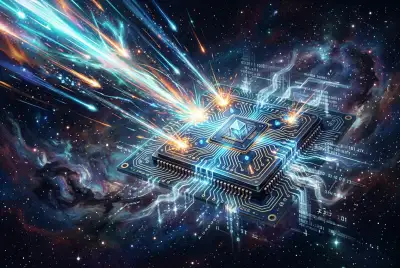
I was recently pondering a seemingly simple question: What is the fastest thing in our universe? The answer, almost universally, is light. But what if the speed of light isn't just a limit, but a fundamental property that makes light itself the ultimate computational medium? This isn't about mere optical fibers transmitting data; it's about exploring whether light, in its very essence, performs computations at a scale and speed unimaginable to our silicon-based machines.
Imagine a world where information doesn't just travel *at* the speed of light, but *is processed* by light itself. This might sound like science fiction, but the principles of physics suggest that light—photons—possess properties that could revolutionize computing, hinting that the universe might already be running on a kind of "light computer."
***
## The Inherent Speed of Information
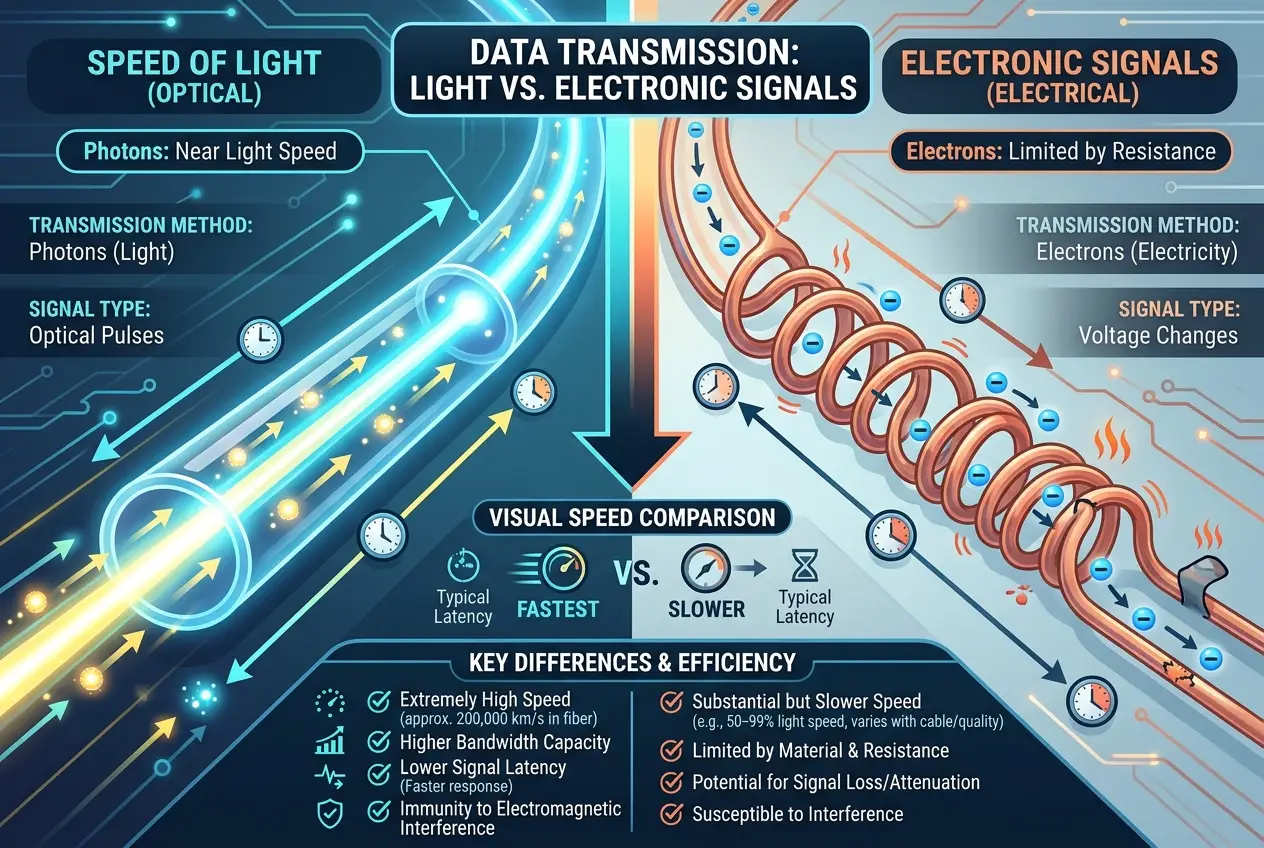
At the heart of any computer lies the processing and transmission of information. In our current digital age, this relies heavily on electrons moving through silicon chips and copper wires. These electrons, while fast, are still subject to resistance and heat, limiting their speed and efficiency. Light, however, is fundamentally different. Photons, the particles of light, travel at approximately **299,792,458 meters per second** in a vacuum, a speed considered the cosmic speed limit. But speed is only one piece of the puzzle.
When we talk about light being a "computer," we're not just fantasizing about faster signal transmission. We're delving into the concept of *optical computing*, where photons replace electrons as the primary carriers of information. Think about it: every time light interacts with matter, it changes. It reflects, refracts, absorbs, and transmits, each interaction effectively performing a physical "computation" on the light signal. The universe, in a way, is constantly computing through these interactions.
## Optical Computing: Beyond Electrons
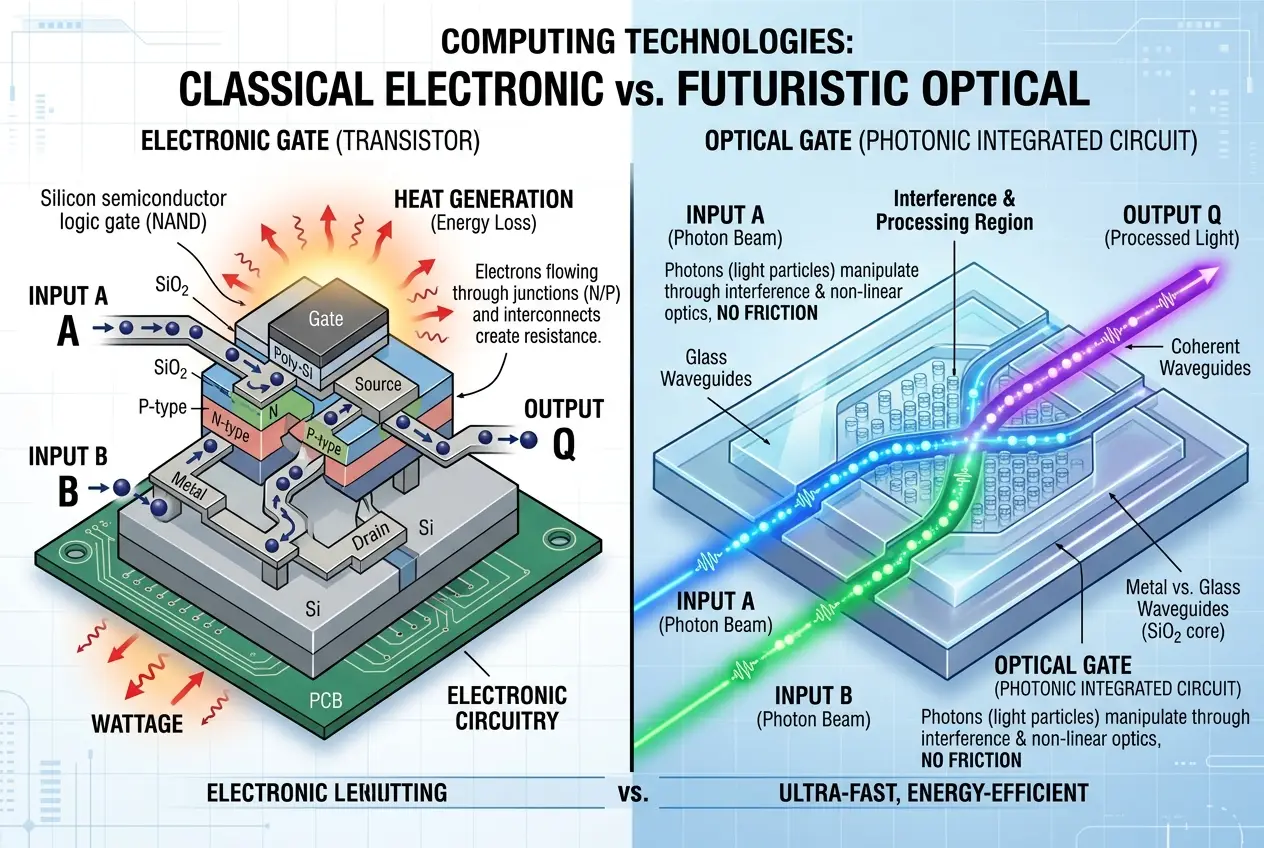
The idea of using light for computation has been around for decades. Early attempts involved complex systems of lenses, mirrors, and holographic plates to perform parallel calculations. Today, the field of optical computing is experiencing a renaissance, driven by advancements in photonics and materials science. Unlike traditional electronic computers, which use voltage levels (high/low) to represent bits (1/0), optical computers could use properties of light, such as **intensity, phase, polarization, or even color**, to encode information.
One of the biggest advantages of light is its ability to transmit information without interference. Electrons in wires generate heat and electromagnetic fields that can disrupt nearby signals, leading to energy loss and computational errors. Photons, being chargeless, can pass through each other without interaction, allowing for incredible parallelism. This means multiple computations could theoretically occur simultaneously in the same physical space without conflict.
*"The potential for optical computing lies in the fundamental physics of light, particularly its speed and ability to carry vast amounts of information without interference, which surpasses the intrinsic limitations of electron-based systems."* – Dr. John E. Midwinter, pioneer in optical communications.
This parallelism is a game-changer. Imagine a complex mathematical problem where thousands of operations need to happen at once. In a traditional computer, these might be queued up or distributed. With optical computing, a single beam of light, modulated in various ways, could potentially carry and process all that information simultaneously, leading to speeds orders of magnitude faster than anything we've conceived with silicon. For a fascinating dive into how our current tech also attempts to mimic biological processing, you might enjoy reading about [Can brain-like chips create true AI?](/blogs/can-brain-like-chips-create-true-ai-6876).
***
## The Quantum Leap: Light as Qubits
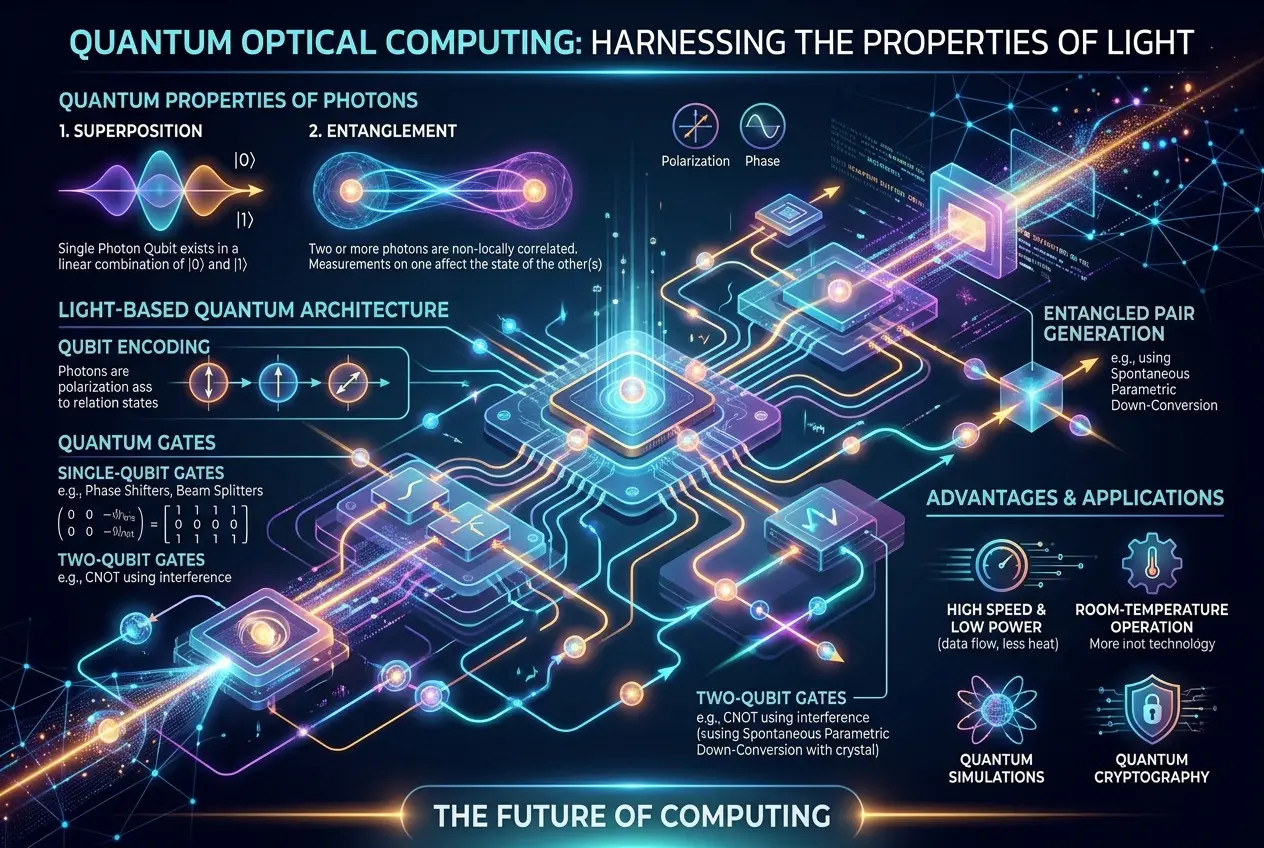
Beyond classical optical computing, lies the realm of **quantum optical computing**. Here, light isn't just a fast carrier of classical bits; it's a medium for quantum information. Quantum computers use **qubits**, which can exist in multiple states simultaneously (superposition) and be entangled with each other. Photons are ideal candidates for qubits because they are relatively easy to manipulate, interact weakly with their environment (reducing decoherence), and can travel great distances.
Researchers are developing methods to encode quantum information into individual photons. For example, the polarization of a photon (horizontal or vertical) can represent a qubit's state, or a superposition of both. Entangled photons can then be used to perform complex quantum operations. This is where light goes from being merely a fast data carrier to an actual, intrinsic computational unit, leveraging the bizarre rules of quantum mechanics.
The implications are profound. If we can harness the quantum properties of light, we could unlock computational power that makes even the fastest supercomputers look like abacuses. Tasks that are currently intractable for classical computers – like breaking advanced encryption, simulating complex molecular structures for drug discovery, or developing truly intelligent AI – could become feasible. You can learn more about the incredible speed of these future machines in our article [Can quantum computers break every encryption?](/blogs/can-quantum-computers-break-every-encryption-1438).
***
## Challenges and the Road Ahead
Despite the immense potential, optical computing, especially quantum optical computing, faces significant challenges. One major hurdle is **photon loss**. Just as electrons can dissipate energy as heat, photons can be absorbed or scattered as they travel, leading to data loss. Building robust, scalable optical circuits that can precisely control individual photons without significant loss is an engineering marvel in the making.
Another challenge is **integration**. How do we build optical processors that can interface seamlessly with our existing electronic infrastructure? Developing efficient light sources, detectors, and modulators that operate at room temperature and are small enough to be integrated into chips is critical. While there's progress, we're still some way from a desktop optical computer.
However, the rapid pace of innovation is encouraging. Companies like Intel and IBM are actively researching silicon photonics, which combines optical components with traditional silicon manufacturing processes. This hybrid approach aims to leverage the best of both worlds: the processing power of light and the mature manufacturing capabilities of silicon. This could represent a crucial step towards making light-based computation a reality. For more on cutting-edge research, consider how scientists are even pondering [Can light think? The dawn of optical computing](/blogs/can-light-think-the-dawn-of-optical-computing-3860).
***
## The Universe's Own Computations
Beyond human-made technology, it's worth reflecting on whether the universe itself is a gigantic optical computer. Every time light travels through a gravitational field, it bends, acting like a lens. Every time light interacts with particles in space, it scatters or changes wavelength. These aren't just passive observations; they are physical interactions that "process" information carried by light.
The light from distant galaxies carries information about the early universe. Its journey through cosmic dust, gas, and gravitational wells fundamentally alters its properties. In a profound sense, the universe is constantly performing calculations on light, evolving its state and revealing its history through these optical "computations." Scientists even explore if our reality itself is a construct of information, as discussed in [Is our universe a hologram? Decoding cosmic data](/blogs/is-our-universe-a-hologram-decoding-cosmic-data-8116).
This perspective transcends the idea of a traditional computer. It suggests that information processing might be a fundamental aspect of reality, with light as its primary medium. The speed of light isn't just how fast information *travels*; it's the rate at which the universe *computes* and evolves.
## The Future is Luminous
As our reliance on data grows exponentially, the limitations of electronic computing become more apparent. The push for greater speed, efficiency, and computational power naturally leads us to explore the most fundamental, fastest entity we know: light. Whether through advanced classical optical processing or the mind-bending complexities of quantum optical computing, the future of computation might literally be luminous.
The journey to build a truly light-powered computer is long and fraught with challenges, but the potential rewards are immense. Imagine a world where calculations that currently take years could be done in seconds, where AI can learn at unprecedented speeds, and where our understanding of the universe deepens with every photon-powered computation. Perhaps one day, we'll look back and realize that the universe was showing us the way all along: light isn't just fast, it *is* the ultimate computer.
## External References
* [Wikipedia - Optical computer](https://en.wikipedia.org/wiki/Optical_computer)
* [Wikipedia - Silicon photonics](https://en.wikipedia.org/wiki/Silicon_photonics)
* [Wikipedia - Quantum optics](https://en.wikipedia.org/wiki/Quantum_optics)
Frequently Asked Questions
Electronic computing uses electrons flowing through wires and semiconductors to process information, which generates heat and faces resistance. Optical computing uses photons (light particles) as information carriers, allowing for much higher speeds, reduced heat, and greater parallelism as photons do not interact with each other in the same way electrons do.
Light can encode information using various properties beyond simple intensity (on/off). This includes its phase (the position of a wave cycle), polarization (the orientation of its electric field), or even different wavelengths (colors). In quantum optical computing, individual photons can represent qubits through properties like their spin or entanglement with other photons.
The primary advantages are immense speed (due to light's inherent velocity), ultra-low energy consumption (photons don't have electrical resistance), and high parallelism (multiple light signals can cross without interference, allowing for simultaneous calculations). It also offers higher bandwidth for data transmission.
Quantum optical computing harnesses the unique properties of quantum mechanics, such as superposition and entanglement, using photons as qubits. This allows for entirely new types of calculations that are impossible for classical computers, potentially solving problems currently considered intractable, like breaking complex encryptions or simulating intricate molecular systems.
Key challenges include managing photon loss within optical circuits, integrating optical components seamlessly with existing electronic infrastructure, and developing reliable, scalable light sources and detectors that operate efficiently at practical temperatures. Miniaturization and precision control of light at the chip level are also significant hurdles.
Verified Expert
Alex Rivers
A professional researcher since age twelve, I delve into mysteries and ignite curiosity by presenting an array of compelling possibilities. I will heighten your curiosity, but by the end, you will possess profound knowledge.
Leave a Reply
Comments (0)
No approved comments yet. Be the first to share your thoughts!
 Join Us



 Unknown Author































Leave a Reply
Comments (0)