


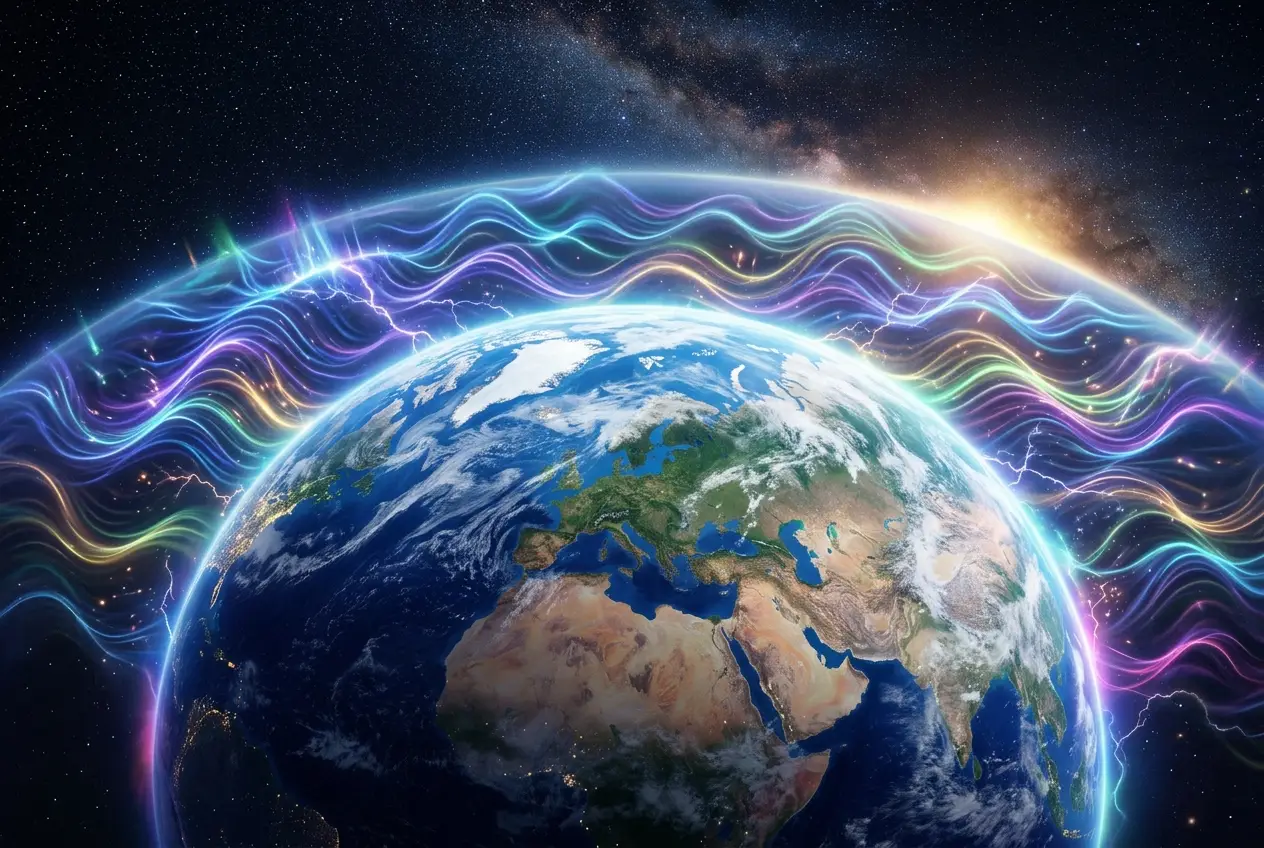
I've always been fascinated by the invisible forces that govern our world – the subtle undercurrents that we rarely perceive but that might, just might, influence us in profound ways. Imagine a planetary heartbeat, a constant, low-frequency hum emanating from the very fabric of our Earth. It sounds like something out of science fiction, doesn't it? Yet, this "heartbeat" is a very real scientific phenomenon known as the Schumann Resonance. It’s Earth’s natural electromagnetic rhythm, and for years, scientists have pondered its full implications. Could this persistent pulse genuinely shape our reality, our consciousness, or even our technology? I dive deep into this question, seeking to understand the knowns and the intriguing unknowns.
For centuries, ancient cultures spoke of a universal life force, an omnipresent energy that connected all things. They might not have had our scientific instruments, but perhaps they instinctively sensed this underlying rhythm of our planet. Fast forward to the 20th century, and German physicist Winfried Otto Schumann theoretically predicted this phenomenon in 1952. He described it as a series of resonant frequencies of the Earth's electromagnetic field, specifically within the cavity formed by the Earth's surface and the ionosphere. Think of it like a giant resonant chamber, where lightning strikes act as a natural "tuner" sending electromagnetic waves bouncing around the globe.
What Exactly Is the Schumann Resonance?
At its core, the Schumann Resonance (SR) is a set of natural electromagnetic waves that oscillate within the Earth-ionosphere cavity. This cavity, roughly 60 to 100 kilometers thick, acts as a waveguide for electromagnetic waves. When lightning discharges occur — and there are approximately 50 flashes per second globally — they excite these waves. These waves then travel around the Earth, reflecting off the conductive surface of the planet and the conductive lower boundary of the ionosphere. For specific frequencies, these waves become self-reinforcing, creating standing waves. These are the Schumann Resonances.
The primary, and most talked about, frequency is around 7.83 Hz, often referred to as Earth’s "heartbeat" or "tuning fork." However, there are also higher harmonics, like 14.3 Hz, 20.8 Hz, 27.3 Hz, and 33.8 Hz, each a distinct resonant frequency. These aren't static; they fluctuate slightly throughout the day and night due to changes in solar activity, lightning activity, and the ionosphere's properties. These fluctuations are precisely what make them so fascinating for researchers.
Measuring the Invisible: How Do We Detect It?
Detecting something as subtle as the Schumann Resonance requires incredibly sensitive equipment. Researchers typically use specialized magnetic and electric field sensors placed in quiet, electromagnetically shielded locations. These sensors pick up the minute fluctuations in the Earth’s natural electromagnetic field. The data is then processed to filter out man-made interference and isolate the specific SR frequencies. It's a testament to modern electronics that we can pinpoint such faint signals.
I remember reading about early experiments where scientists struggled with the sheer amount of electromagnetic "noise" in our modern world. Our devices, power lines, and communication systems all generate their own fields, making it a challenge to isolate Earth’s natural hum. This highlights the delicate balance between our technological progress and our ability to listen to the planet's subtler signals. For those interested in the technical details of its discovery and measurement, Wikipedia offers an excellent overview on the Schumann Resonances (opens in a new tab).
A Cosmic Connection? SR and Space Weather
The Schumann Resonance isn't just an isolated Earth phenomenon; it's intricately linked to space weather. Solar flares and coronal mass ejections (CMEs) from the Sun can dramatically impact Earth's ionosphere. When solar activity increases, the ionosphere becomes more energized and changes its electrical properties. This, in turn, affects the height and conductivity of the Earth-ionosphere cavity, leading to shifts in the Schumann Resonance frequencies and amplitudes.
These fluctuations provide valuable insights into the dynamic interplay between our Sun and our planet. Scientists can use SR measurements to infer changes in global lightning activity, monitor variations in the ionosphere, and even potentially detect subtle effects of cosmic rays. It's a natural diagnostic tool for understanding the "nervous system" of our planet and its connection to the broader cosmos. Recent research into how cosmic rays might influence our brain activity (a topic we've explored in Do Cosmic Rays Influence Our Brain Activity?) suggests how pervasive these subtle cosmic forces can be.
The "Brainwave" Hypothesis: SR and Human Consciousness
Here's where the topic takes a fascinating turn: the potential link between the Schumann Resonance and human brainwaves. The primary SR frequency of 7.83 Hz falls squarely within the alpha brainwave range (7-13 Hz). Alpha waves are associated with relaxed, meditative, and creative states. This isn't just a coincidence; it's a profound area of research.
- Alpha Waves: Often linked to states of calm alertness, creativity, and the "flow state."
- Theta Waves: (4-7 Hz) Associated with deep relaxation, dreaming, and intuition.
- Delta Waves: (0.5-4 Hz) Found during deep, dreamless sleep.
- Beta Waves: (13-30 Hz) Dominant during active thinking, problem-solving, and alertness.
- Gamma Waves: (30-100+ Hz) Linked to higher cognitive functions, perception, and consciousness.
Could our brains, evolved on Earth, be naturally tuned to the planet's fundamental frequency? Some researchers propose that prolonged exposure to environments devoid of natural SR (like deep space travel) could potentially impact human physiology and psychology. This is why some space agencies are looking into replicating the Schumann Resonance within spacecraft. The idea is that this natural frequency might act as a "stabilizer" for biological systems, maintaining equilibrium.
While direct, undeniable proof of SR shaping human reality is still emerging, the correlation with brainwaves is undeniable and has led to intriguing experiments. Some studies explore how exposure to specific electromagnetic frequencies, including those near the SR, might influence mood, stress levels, and cognitive performance. It raises the question: are we merely passive observers, or are we actively synchronized with Earth's electromagnetic pulse? This makes me wonder about other subtle energies that might influence us, like the potential for magnetic fields to store biological memory (a fascinating concept explored in Can Magnetic Fields Store Biological Memory?).
Technological Interference and Future Implications
In our increasingly interconnected and electromagnetically noisy world, the Schumann Resonance faces new challenges. Our growing reliance on wireless technologies, vast power grids, and dense urban environments creates a cacophony of artificial electromagnetic fields (EMF). This "electrosmog" can interfere with the subtle SR signals, making them harder to measure and potentially altering the natural electromagnetic environment.
While the Earth's natural resonance is incredibly robust, understanding how anthropogenic EMFs interact with it is crucial. This isn't just about measurement; it's about understanding the long-term ecological and biological impacts of a changing electromagnetic landscape. As we push the boundaries of technology, we must also consider the unseen consequences. The quest to understand how our devices might be hiding "alien echoes" is a related mystery we've explored in Are Our Devices Hiding Alien Echoes?, touching on the subtle signals that might permeate our environment.
However, the Schumann Resonance also presents opportunities for future technology. Could we develop highly sensitive sensors that leverage SR to predict seismic activity, monitor global climate patterns, or even detect unusual atmospheric phenomena? The SR could become a global passive sensor network, providing continuous, real-time data about our planet's health and its interaction with space. For a deeper dive into the physics of atmospheric electricity, including lightning and global electrical circuits, I often refer to the comprehensive articles available on Wikipedia's Atmospheric Electricity page (opens in a new tab).
Beyond the Science: The Mystical and the Practical
Beyond its scientific measurement, the Schumann Resonance has captured the imagination of many. Spiritual traditions often speak of aligning with Earth's energies, and the SR provides a tangible, measurable basis for such concepts. While science typically shies away from metaphysical claims, the very existence of Earth's resonant frequency encourages a holistic view of our planet and our place within its dynamic systems.
I find it incredibly humbling to think that while we build complex AI models and explore distant galaxies, there's a fundamental, planetary pulse influencing everything around us. It's a reminder that even in our advanced technological age, there are still profound mysteries embedded in the natural world. This echoes the ancient questions about universal hidden frequencies that we discussed in a previous blog, Did Ancients Detect Universal Hidden Frequencies?, showing a timeless human quest for understanding the unseen.
Understanding the Schumann Resonance isn't just about charting another geophysical phenomenon; it’s about acknowledging a fundamental aspect of our existence on Earth. Whether it directly shapes our individual reality or subtly influences the collective consciousness, its presence reminds us that we are deeply connected to the planet we call home. As technology advances, perhaps we'll learn to not only measure this pulse but also to live in greater harmony with it.
Ultimately, Earth's pulse, the Schumann Resonance, acts as a cosmic drumbeat that grounds us to our planetary home. It’s a profound reminder that even in an era of digital dominance, the most fundamental rhythms often originate from the very natural world we inhabit. It challenges us to look beyond the obvious, to listen to the silent hum of our planet, and to ponder the invisible threads that weave together our existence with the grand tapestry of the cosmos.





Conversation0
No comments yet. Be the first to share a thought — the best questions often become new stories.