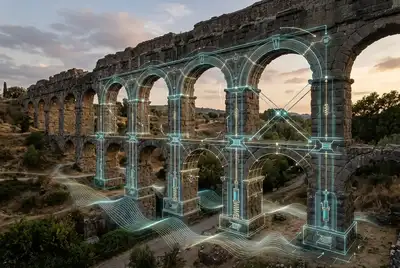
I often find myself standing in awe of ancient Roman architecture. Think about it: structures like the Pantheon, the Colosseum, or the mighty aqueducts have stood for two millennia, braving earthquakes, floods, and the relentless march of time. Their grandeur isn't just a testament to their builders' artistic vision, but also to a profound understanding of engineering and materials science that, in many ways, still baffles us today. Modern concrete, by comparison, often cracks and degrades within decades, requiring extensive maintenance and repair. This stark difference has led me to ponder: **did the Romans possess a secret, almost magical, ingredient that allowed their concrete to "heal" itself?** Recent scientific discoveries suggest that they might have done exactly that, unlocking a form of ancient self-healing technology that we're only just beginning to replicate.
The mystery of Roman concrete's incredible durability has fascinated engineers and historians for centuries. While our contemporary concrete mixes are designed for high compressive strength, they often lack the long-term resilience needed to endure for millennia. Roman concrete, or *opus caementicium*, seems to defy this limitation, showing remarkable resistance to environmental stressors, especially in marine environments where it actually grew stronger over time. This wasn't just accidental; I believe it was the result of deliberate, ingenious design.
## The Recipe for Immortality: More Than Just Sand and Stone
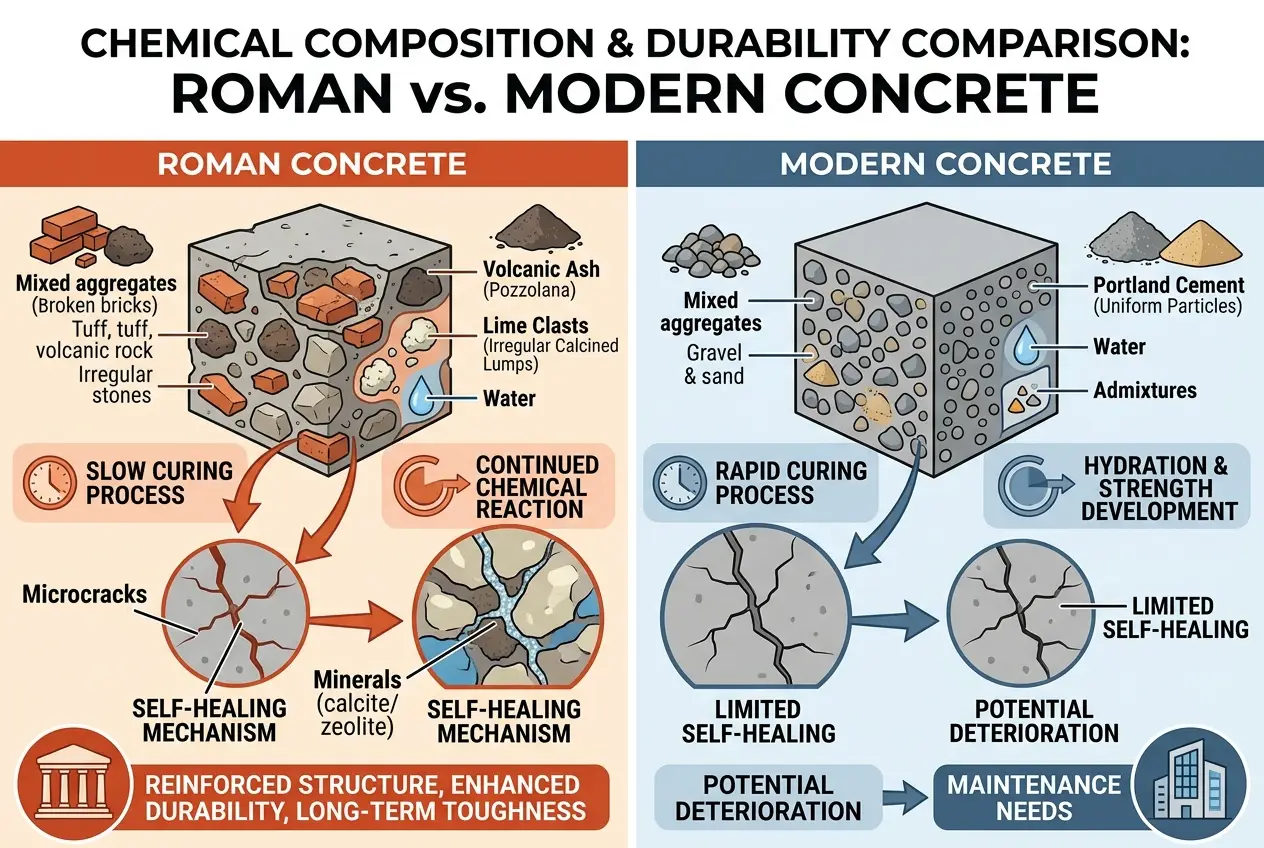
At its core, concrete is a mixture of a binder, aggregate, and water. For modern concrete, Portland cement is the primary binder. The Romans, however, used a binder composed primarily of lime and volcanic ash, specifically a type known as **pozzolana**. This ash, abundant in regions like Mount Vesuvius, was no ordinary ingredient. When mixed with lime and water, it created a highly stable, cementitious material that formed the backbone of their monumental constructions.
But the real secret, I've come to understand, might lie in the precise way they mixed these ingredients, particularly the **presence of "lime clasts."** For years, scientists believed these millimeter-sized chunks of lime were simply the result of poor mixing techniques or low-quality raw materials. However, a groundbreaking study published in *Science Advances* in 2023 by researchers at MIT and Harvard has proposed a radical new theory: these lime clasts were actually a deliberate, crucial component designed to give the concrete self-healing properties.
## Quicklime, Hot Mixing, and the Self-Repair Mechanism
The conventional wisdom held that Roman concrete was made by mixing lime (calcium hydroxide) with water to form a paste, then combining it with pozzolana and aggregates. The new theory suggests something far more sophisticated. Researchers now believe the Romans used **quicklime (calcium oxide)**, which is much more reactive. When quicklime is mixed directly into the concrete alongside volcanic ash at high temperatures, a process known as "hot mixing" occurs.
This hot mixing process has several key benefits:
1. **High Temperatures:** The exothermic reaction of quicklime with water generates significant heat, which promotes chemical reactions that might not occur with conventional cold mixing.
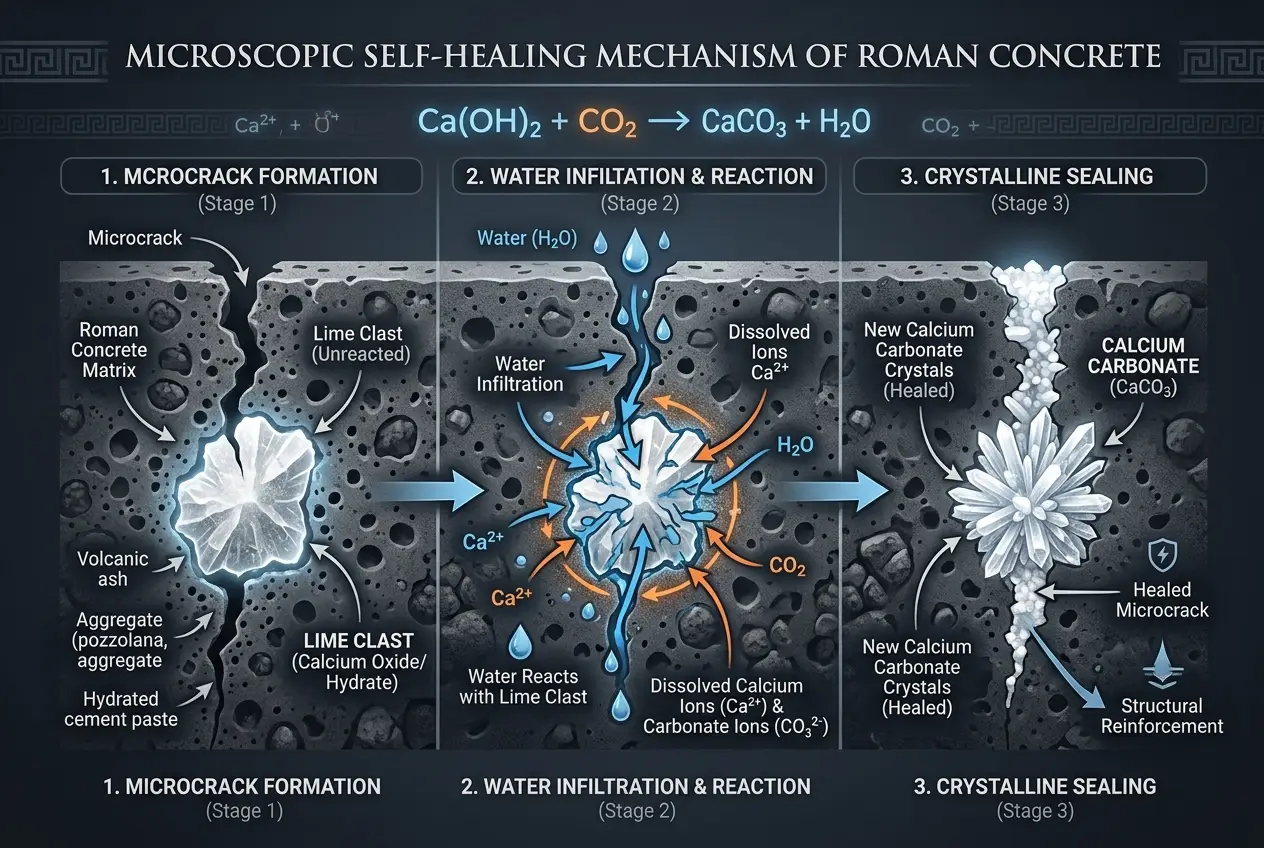
2. **Formation of Lime Clasts:** Crucially, this hot mixing leads to the formation of those distinctive lime clasts. Instead of being completely hydrated, some of the quicklime remains as calcium carbonate or calcium oxide within the matrix.
3. **Enhanced Reactivity:** These lime clasts are not inert. They are highly reactive and brittle, making them ideal candidates for a self-healing mechanism.
When micro-cracks inevitably form in the concrete over centuries – perhaps due to seismic activity, thermal expansion, or structural stress – they can propagate through these brittle lime clasts. This exposes new surfaces of the lime clasts to water, which can infiltrate the cracks. The water then reacts with the exposed lime, forming a calcium-rich solution that subsequently recrystallizes as **calcium carbonate**. This newly formed calcium carbonate effectively fills the crack, preventing further water penetration and halting the degradation process. It's like the concrete has its own internal repair crew, constantly patching up tiny injuries.
This remarkable insight into the Roman construction methods flips our understanding of "imperfections" on its head. What was once seen as a flaw now appears to be a sophisticated, intentional design choice. I think it highlights just how advanced their material science truly was. For a deeper dive into their construction prowess, you might find our blog on ["Did ancient architects use sound to move mountains?"](/blogs/did-ancient-architects-use-sound-to-move-mountains-7101) fascinating, exploring other incredible feats of ancient engineering.
## Marine Concrete: An Even Greater Enigma
While terrestrial Roman structures are impressive, their marine concrete is perhaps even more astonishing. Roman harbors, breakwaters, and piers have survived for two millennia in corrosive saltwater environments, whereas modern marine concrete struggles to last even 50 years. Research into Roman maritime concrete reveals an even more complex mix, often incorporating seawater directly and a different type of volcanic ash.
In marine settings, the lime-pozzolana reaction produces a mineral called **tobermorite**, which is incredibly stable and dense. In some instances, it even forms an aluminum-substituted tobermorite, which is exceptionally rare and possesses outstanding mechanical properties, further contributing to its longevity. The presence of these unique minerals, combined with the self-healing properties of the lime clasts, essentially allowed Roman concrete to "grow" stronger with age when exposed to the marine environment. The seawater itself became a beneficial reactant rather than a destructive force. This is a level of bio-mineralization that modern concrete engineers are still striving to achieve.
"The Romans built structures that were durable enough to last until today, and some of them are still in use," explains Marie Jackson, a research associate professor of geology and geophysics at the University of Utah, who has extensively studied Roman concrete. "The chemistry of the ancient Roman concrete is astounding. It's truly a marvel." You can read more about her work and the fascinating mineral structures in Roman concrete on its [Wikipedia page](https://en.wikipedia.org/wiki/Roman_concrete).
## Replicating Ancient Wisdom for Modern Challenges
The implications of these discoveries are profound for modern construction. We face a global infrastructure crisis, and the demand for more sustainable, durable building materials is urgent. If we can truly understand and replicate the self-healing capabilities of Roman concrete, it could revolutionize how we build everything from bridges to sea walls.
Modern efforts to create self-healing concrete often involve embedding microcapsules containing healing agents (like bacteria or polymers) within the concrete matrix. When cracks appear, these capsules rupture, releasing the agent to fill the void. While promising, these methods are often complex and expensive. The Roman approach, if accurately understood, might offer a more natural, inherently integrated, and cost-effective solution.
Imagine cities built with materials that automatically repair minor damage, significantly extending their lifespan and reducing the need for constant maintenance. This ancient technology could hold the key to a greener, more resilient future. The ability of materials to adapt and mend themselves is a theme that echoes across various scientific fields; our previous article on ["Why do some metals heal themselves?"](/blogs/why-do-some-metals-heal-themselves-unpacking-self-repairing-tech-7402) delves into similar concepts in metallurgy.
## Beyond Self-Healing: A Holistic Approach
It's important to remember that the Romans' success wasn't solely due to the self-healing concrete. Their engineering principles were holistic. They understood structural loads, site selection, and the importance of skilled craftsmanship. The massive thickness of some of their walls, the strategic use of arches and domes, and their meticulous attention to drainage all played a role in the longevity of their buildings.
However, the self-healing aspect provides a powerful answer to why their concrete has aged so gracefully. It suggests that a material doesn't have to be perfect from day one; it can be designed with an innate capacity for resilience and repair. This is a lesson I believe we are still learning in the 21st century.
As we continue to push the boundaries of materials science and sustainable engineering, I find myself continually looking back at the wisdom of the ancients. Sometimes, the most groundbreaking innovations are not entirely new, but rather forgotten insights waiting to be rediscovered. The Roman’s self-healing concrete serves as a powerful reminder that our ancestors were far more technologically sophisticated than we often give them credit for. Their legacy isn't just in the ruins they left behind, but in the lessons they continue to teach us about durability, sustainability, and the profound intelligence embedded in their ancient technology. You can learn more about the Roman Empire's vast engineering feats on [Wikipedia](https://en.wikipedia.org/wiki/Roman_Empire). For another fascinating example of ancient material science, check out our piece on ["Did the Lycurgus Cup use Roman quantum tech?"](/blogs/lycurgus-cup-did-romans-use-quantum-tech-3796).
In conclusion, the Roman concrete story isn't just about a lost recipe; it's a testament to ancient ingenuity and a blueprint for future innovation. As we grapple with environmental challenges and the need for resilient infrastructure, looking to these millennia-old "smart materials" could be our most forward-thinking step. We might just find that the future of construction has been written in the stones of the past all along.
Frequently Asked Questions
Roman concrete used a binder of lime and volcanic ash (pozzolana), often mixed with quicklime in a 'hot mixing' process, creating unique lime clasts. Modern concrete primarily uses Portland cement as a binder.
The self-healing mechanism involved highly reactive lime clasts within the concrete. When micro-cracks formed and water infiltrated, it reacted with the lime clasts to form calcium carbonate, which then filled and sealed the cracks.
Roman marine concrete, often made with specific volcanic ash and seawater, developed super-stable minerals like tobermorite. These minerals not only contributed to extreme durability but also allowed the concrete to actually strengthen over time in the harsh saltwater environment.
Yes, researchers are actively studying Roman concrete's composition and methods to understand its self-healing properties. The goal is to develop more durable, sustainable, and self-repairing modern concrete that can extend the lifespan of infrastructure.
Recent research suggests that the lime clasts, once thought to be imperfections, were likely an intentional and crucial component of the Roman concrete mix, deliberately designed to facilitate its self-healing capabilities.
Verified Expert
Alex Rivers
A professional researcher since age twelve, I delve into mysteries and ignite curiosity by presenting an array of compelling possibilities. I will heighten your curiosity, but by the end, you will possess profound knowledge.
Leave a Reply
Comments (0)
No approved comments yet. Be the first to share your thoughts!
 Join Us



 Unknown Author






























Leave a Reply
Comments (0)