


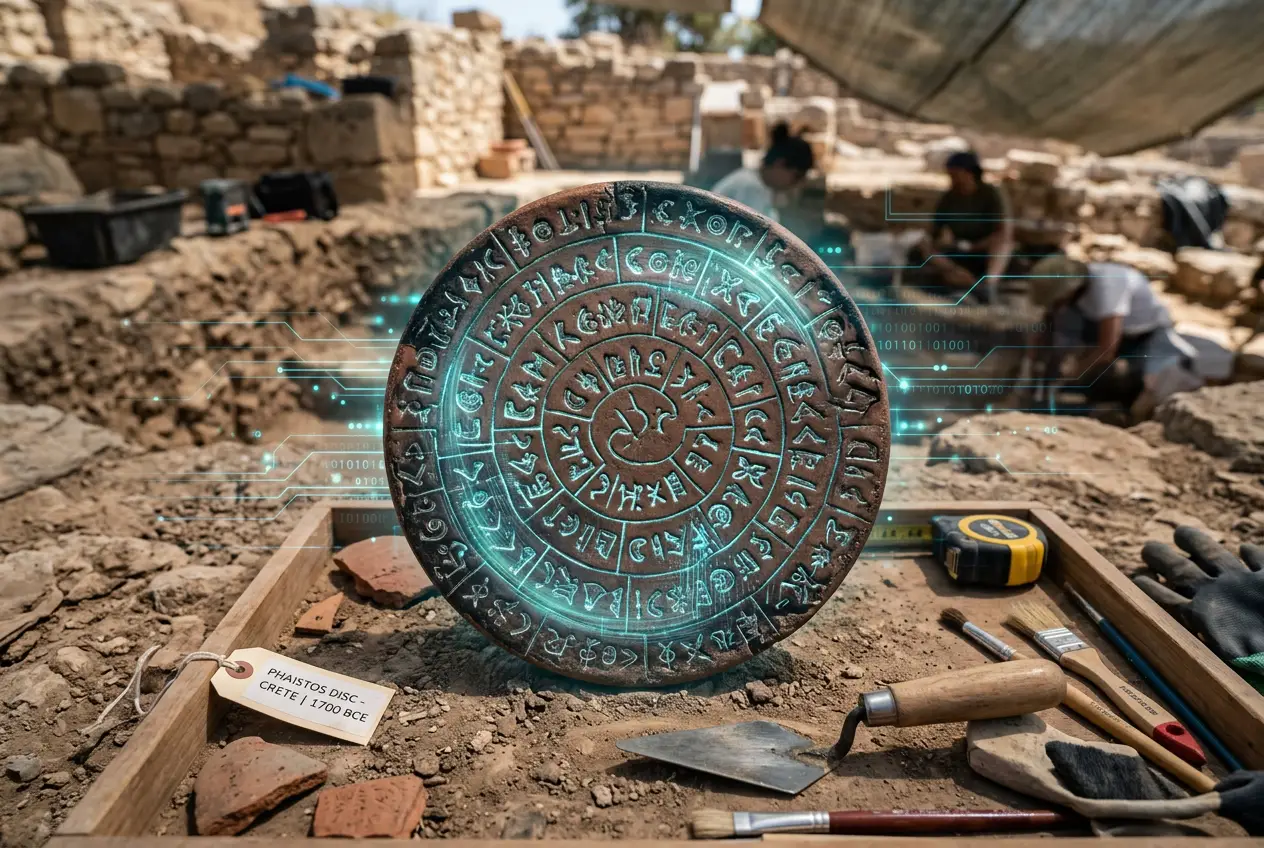
I’ve always been fascinated by humanity’s relentless drive to record information. From cave paintings to clay tablets, and now to terabytes in the cloud, our story is intrinsically linked to how we store and transmit knowledge. But what if one of history's most perplexing artifacts hints at a level of information technology far more advanced than we previously imagined for its era?
Recently, I was looking into ancient mysteries, and my mind kept circling back to the Phaistos Disc. It's an artifact that, at first glance, seems like a simple clay disc. Yet, for over a century, it has baffled archaeologists, linguists, and cryptographers alike. What if this unassuming object isn't just an undeciphered script, but an early, sophisticated attempt at data storage? Could it be a Rosetta Stone for an unknown Minoan "operating system," or merely a unique, enigmatic piece of art?
The Whispers from the Palace of Phaistos
Imagine the scene: July 3, 1908, in the ruins of the Minoan palace of Phaistos on the island of Crete. An Italian archaeological team, led by Luigi Pernier, was meticulously sifting through layers of history. In a basement room of the palace's northeastern part, amidst pottery fragments and ash, they unearthed something extraordinary. It was a perfectly preserved, flat, circular terracotta disc, roughly 15 cm (5.9 inches) in diameter and 1 cm (0.39 inches) thick. Both sides were covered with a spiral arrangement of 241 impressions, made from 45 distinct signs.
What immediately struck researchers, and continues to intrigue me, is how these signs were applied. Unlike typical ancient inscriptions that were carved or incised by hand, the Phaistos Disc's symbols were stamped onto the wet clay using individual hieroglyphic "seals." This makes it the earliest known example of a document produced with movable type printing. Yes, movable type – centuries before Gutenberg! This alone elevates the disc from a mere inscription to a marvel of early manufacturing and information replication.
A Library of One: Unpacking the Disc's Unique "Hardware"
The disc features 45 unique signs, depicting human figures, animals, plants, and tools. These signs appear 241 times in total, arranged in groups or "words," separated by vertical lines. A line of five dots or dashes appears below the last sign of each group, potentially indicating the start or end of a sequence, or perhaps even a numerical value. The spiral sequence itself flows from the rim towards the center of the disc.
To put this in perspective, think about a modern computer. Data isn't just random characters; it's organized into structured blocks, files, and sequences. The Phaistos Disc, with its repeating symbols, distinct word groups, and spiral layout, suggests a highly organized, deliberate method of information encoding. Could these repeating sequences be akin to algorithms or specific data packets?
Decipherment efforts have been exhaustive, yet fruitless. Many theories have been proposed: it’s a hymn, a legal document, a calendar, a board game, a magic spell, a military dispatch, or even a record of a ritual. Each attempt to assign phonetic or semantic values to the symbols has failed to gain widespread acceptance, largely due to the frustrating fact that the Phaistos Disc is a hapax legomenon – a unique inscription with no known parallels or context. This makes it incredibly difficult to compare it to other known Minoan scripts like Linear A or Linear B. For instance, the Voynich Manuscript, another famous undeciphered text, at least has other medieval manuscripts for contextual comparisons, however remote. You can read more about it in our blog on Voynich Manuscript: Secret Code or Ancient AI?.
The "Data Storage" Hypothesis: A Conceptual Leap
When I consider the term "data storage," I’m not just thinking about a hard drive, but the fundamental act of preserving information in an accessible, retrievable, and potentially replicable format. The Phaistos Disc fits this description remarkably well.
- Movable Type: The use of seals to stamp characters is revolutionary. This method allows for consistency, speed, and potentially mass production of copies. This isn't just writing; it's a form of early publishing, hinting at a need for rapid information dissemination or archival. Could these be templates for other discs, or was this a unique print?
- Structured Information: The organization of symbols into "word" blocks, and the overall spiral flow, isn't arbitrary. It suggests a structured format, like a database entry or a coded message. If each symbol carried a specific meaning or sound, the arrangement would convey complex information.
- Efficiency: With only 45 distinct signs used to create 241 impressions, there’s an efficiency to the system. It’s not an alphabet in the modern sense, nor purely pictographic. It might represent syllables, logograms, or even ideograms that, when combined, convey complex concepts or narratives. This is reminiscent of how early computers used punch cards to encode data, each hole or absence of a hole representing a bit of information.
Consider what early information systems looked like: clay tablets for accounting, papyrus scrolls for literature, or even the quipu of the Inca for numerical and narrative records. The Phaistos Disc stands apart due to its printing method and its enigmatic symbols. It challenges our notions of what ancient technology was capable of, leading me to wonder if it was part of a larger, now lost, information network or a unique experiment in data recording.
Beyond the Script: What If It's Not a Language?
One of the reasons for its persistent mystery is the assumption that it must be a linguistic script. What if it isn't? What if it's a very sophisticated calendar, a complex astronomical chart, or even a precursor to what we might call a "program" – a set of instructions or a sequence of operations?
A fascinating theory, although purely speculative, suggests it could be a type of "Rosetta Stone" for understanding Minoan scientific or technical knowledge. Perhaps it's a key to their observations of the cosmos, much like how ancient structures like Stonehenge or the Roman Dodecahedra (another intriguing ancient enigma, explored at /blogs/roman-dodecahedra-did-ancients-chart-stars-7244) were used to track celestial bodies. While this isn't likely, the potential connection to astronomical or mathematical data cannot be entirely dismissed.
If it were a database or a computational aid, its unique production method would have been crucial. The ability to reproduce identical copies of complex symbol sequences rapidly would have been an incredible boon for any ancient bureaucracy, religious institution, or scientific endeavor. This could represent a lost branch of historical tech where methods of information management evolved differently from the writing systems we typically study.
The Challenge of Decipherment
The primary hurdle to deciphering the Phaistos Disc is its isolation. We have no other examples of this script, no bilingual texts (like the Rosetta Stone), and no clear context from which to draw meaning. This makes it an anomaly that stands alone, much like some of the other 'impossible artifacts' discussed in our post Impossible Artifacts: Clues to Lost Ancient Tech?.
Linguists and cryptographers typically rely on statistical analysis, comparison with known languages, and understanding of cultural context. With the Phaistos Disc, all these avenues are blocked. The discovery of even one more artifact with the same script could be the key to unlocking its secrets. Until then, it remains a tantalizing puzzle, a testament to the ingenuity of an ancient civilization and a beacon for future discoveries.
Conclusion: A Glimpse into Lost Ingenuity
The Phaistos Disc is more than just an old piece of clay; it's a monument to the human desire to capture and convey information. Whether it holds a forgotten language, a cosmic calendar, or an early form of data storage, its unique method of production – movable type printing – demonstrates a level of technological sophistication far ahead of its time.
As we continue to push the boundaries of modern technology, especially in data science and AI, I find immense value in looking back at these ancient anomalies. They remind us that innovation isn't a linear progression, and that brilliant ideas can emerge in unexpected places and times. The Phaistos Disc stands as a silent challenge, a whisper from the past asking us to decode not just its message, but the very nature of ancient ingenuity itself. Perhaps one day, a new discovery or an advanced computational analysis will finally unlock the secrets held within its intricate spiral, revealing whether it was truly an ancient data storage device, or simply a beautifully complex, uncrackable code.
For further reading on the Phaistos Disc's history and various theories, you can visit its Wikipedia page: Phaistos Disc on Wikipedia (opens in a new tab). To learn more about the Minoan civilization that created it, see: Minoan Civilization on Wikipedia (opens in a new tab). For context on other undeciphered scripts, explore Linear A on Wikipedia (opens in a new tab).



Conversation0
No comments yet. Be the first to share a thought — the best questions often become new stories.