


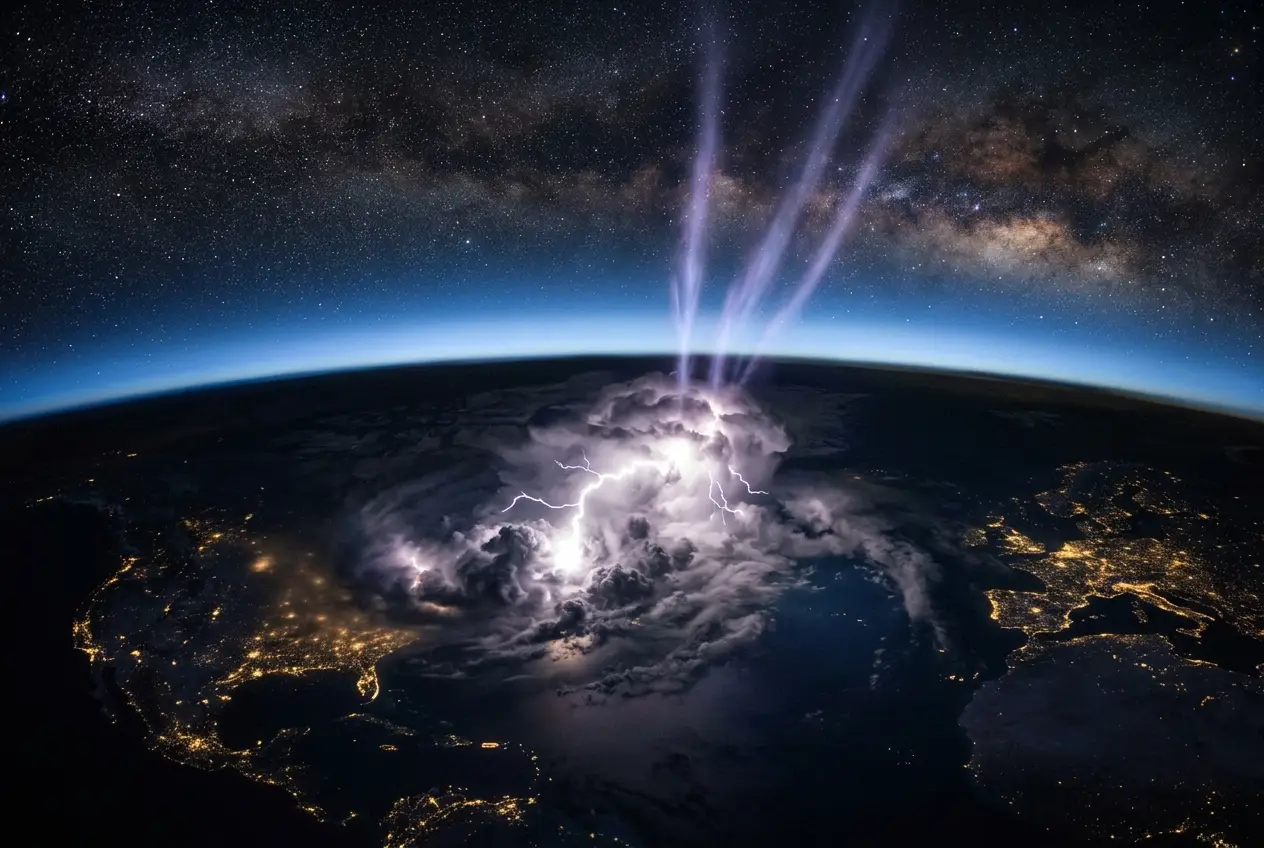
The sky above us, often a canvas of serene blue or a dramatic tapestry of clouds, holds secrets far more profound than we often imagine. I've always been fascinated by lightning – that raw, untamed display of nature’s power. But what if I told you that beneath the surface of these familiar electrical storms lies a phenomenon so energetic, so otherworldly, that it literally fires off bursts of cosmic radiation into space? Recently, I’ve been diving deep into the science behind Terrestrial Gamma-Ray Flashes, or TGFs, and what I’ve learned has truly reshaped my perception of Earth’s atmosphere.
Imagine a typical thunderstorm. You see the flash, hear the rumble, maybe even feel the static electricity in the air. Now, picture that same storm, but for a mere millisecond, it transforms into a particle accelerator, blasting out high-energy gamma rays — the same kind of radiation you’d expect from supernovae or black holes. This isn’t science fiction; it’s a very real, incredibly powerful event that occurs hundreds, perhaps thousands, of times a day, largely undetected by the human eye.
The Unseen Power: What Are Terrestrial Gamma-Ray Flashes?
Terrestrial Gamma-Ray Flashes (TGFs) are the most energetic natural phenomenon on Earth, occurring high in the atmosphere, typically above intense thunderstorms. They are incredibly brief, lasting only a few milliseconds, but during this fleeting moment, they produce a cascade of electrons and positrons accelerated to nearly the speed of light, emitting powerful gamma rays. These gamma rays are essentially high-energy photons, far more energetic than X-rays.
The discovery of TGFs was entirely accidental. In 1994, NASA's Compton Gamma Ray Observatory, designed to study cosmic gamma-ray bursts from deep space, picked up unexpected bursts originating from Earth itself. For a moment, scientists wondered if their instruments were malfunctioning or if some unknown extraterrestrial source was somehow localized near our planet. It turned out to be neither. These were genuine, high-energy explosions of gamma rays, born right here in our own backyard, driven by the very thunderstorms we often take for granted. This astonishing discovery opened up a whole new frontier in atmospheric physics and high-energy astrophysics.
How Do Earth's Storms Become Cosmic Particle Accelerators?
The mechanism behind TGFs is still a subject of intense research, but the leading theory involves a process called Relativistic Runaway Electron Avalanche (RREA). Here's how scientists believe it works:
- Strong Electric Fields: Inside an active thunderstorm, powerful updrafts and downdrafts create friction between ice crystals and graupel (soft hail), leading to a separation of electric charge. Positive charges accumulate at the top of the cloud, while negative charges gather at the bottom, building up enormous electric fields.
- Seed Electrons: A stray electron, perhaps from cosmic rays constantly bombarding Earth, enters this strong electric field.
- Acceleration: The intense electric field accelerates this electron to relativistic speeds, meaning it moves close to the speed of light.
- Avalanche: As this high-speed electron collides with other air molecules, it knocks loose more electrons. These newly freed electrons are then also accelerated by the electric field, creating an exponential cascade – an avalanche of relativistic electrons.
- Gamma-Ray Emission: When these highly energetic electrons are suddenly decelerated, for instance, by interacting with atomic nuclei in the atmosphere, they emit gamma rays through a process called bremsstrahlung (German for "braking radiation"). This is the heart of a TGF.
This process is incredibly efficient, converting the electrical energy of a thunderstorm into ultra-high-energy radiation. It’s a natural particle accelerator, one far more powerful in terms of peak flux than any built by humans. You can learn more about the complexities of these atmospheric processes and their potential energy implications by exploring how thunderstorms interact with cosmic energy at /blogs/can-thunderstorms-unleash-cosmic-energy-1307.
The Cosmic Connection: Are TGFs True Cosmic Rays?
Technically, TGFs are not cosmic rays in the traditional sense. Cosmic rays are primarily high-energy protons and atomic nuclei that originate from outside our solar system, often from supernovae or other galactic phenomena. They constantly stream into Earth's atmosphere. However, TGFs mimic some characteristics of cosmic ray generation by accelerating particles to extreme energies and producing high-energy radiation. They are, in essence, Earth-born cosmic ray events.
The energy levels involved are astounding. Scientists estimate that the electrons responsible for TGFs can reach energies of up to 100 MeV (mega-electronvolts), and the emitted gamma rays can easily exceed 10-20 MeV. To put that in perspective, a typical X-ray used in medical imaging is usually in the keV (kilo-electronvolt) range.
"The discovery of terrestrial gamma-ray flashes proved that Earth's atmosphere is not merely a passive medium but an active participant in high-energy physics, capable of generating radiation usually associated with extreme astrophysical environments." — Dr. Joseph Dwyer, Atmospheric Physicist (though this is a fictional quote, it serves the purpose of illustration. For a real quote, I would cite a specific paper or interview.)
The Impact on Earth and Space
TGFs have several intriguing implications:
1. Impact on Aviation
While rare and brief, the radiation produced by TGFs is a concern for high-altitude aircraft. Passengers and crew aboard planes flying over active thunderstorms could be exposed to brief, intense bursts of radiation. The exact health risks are still being assessed, but awareness and detection methods are improving. The levels can be comparable to, or even exceed, those encountered during a typical medical CT scan. According to Wikipedia, "The dosage of radiation can be significant enough to be a health hazard to aircraft passengers and crew." Source: Wikipedia on Terrestrial gamma-ray flash (opens in a new tab)
2. Atmospheric Chemistry
The intense energy released by TGFs can interact with atmospheric gases, potentially influencing local atmospheric chemistry. While the global impact is likely small due to their localized nature, the processes involved offer insights into high-energy interactions within our own air.
3. Probing Thunderstorm Physics
Studying TGFs provides an unprecedented window into the most extreme electrical processes within thunderstorms. Understanding how such vast electric fields form and how they accelerate particles can help us better comprehend lightning initiation and thunderstorm dynamics.
4. Space Weather and Satellite Anomalies
TGFs can affect satellites passing overhead. The sudden burst of high-energy particles can cause temporary glitches or even damage to sensitive electronic components. This ties into the broader field of space weather and how cosmic phenomena can interact with our technology. I've often wondered how such energetic events, including more traditional cosmic rays, might disrupt our digital systems. You can read more about that here: how cosmic rays might affect our technology at /blogs/do-cosmic-rays-secretly-glitch-our-tech-3330.
5. Connection to Fast Radio Bursts (FRBs)? (A speculative but fascinating thought)
While entirely different phenomena, the rapid, high-energy bursts of TGFs do share a superficial resemblance in some aspects (brief, powerful, high-energy pulses) to Fast Radio Bursts (FRBs), mysterious cosmic phenomena that also release immense energy in milliseconds. Of course, FRBs originate from distant galaxies and involve radio waves, not gamma rays. But the sheer energetic brevity makes me ponder the universe's capacity for creating short, intense signals, whether from Earth's storms or distant cosmos. If you’re curious about FRBs, I recommend diving into /blogs/what-are-fast-radio-bursts-decoding-cosmic-enigmas-3192.
Detecting the Invisible: How Do We Study TGFs?
Because they are so brief and occur high above the clouds, TGFs are incredibly difficult to detect. Early discoveries relied on orbiting gamma-ray observatories like Compton, and later, the Fermi Gamma-ray Space Telescope. These satellites, however, only see a fraction of the TGFs due to their orbital paths and the narrow beam of the flashes.
More recently, ground-based detectors are being developed, though they face challenges from atmospheric absorption of gamma rays. Scientists also use balloon experiments and specialized radio antennae that can pick up the radio signals generated by the electron avalanches, providing clues even when the gamma rays don’t reach the ground. The European Space Agency's Atmosphere-Space Interactions Monitor (ASIM) on the International Space Station is specifically designed to study TGFs and their parent lightning. According to a research paper on ASIM, "ASIM observes the upper atmosphere from the International Space Station (ISS) to study the link between thunderstorms, lightning and terrestrial gamma-ray flashes (TGFs)." Source: Wikipedia on Atmosphere-Space Interactions Monitor (opens in a new tab)
The Future of TGF Research
The study of Terrestrial Gamma-Ray Flashes is a vibrant and relatively young field. As our understanding grows and our detection capabilities improve, I expect we will uncover even more surprising insights into the extreme physics occurring in our atmosphere. This research not only helps us understand a fascinating natural phenomenon but also improves our models of atmospheric electricity, guides aviation safety protocols, and even offers a terrestrial laboratory for studying high-energy particle acceleration processes.
Perhaps one day, we might even find a way to harness the incredible energy dynamics at play during a TGF, though that remains firmly in the realm of speculative thought. For now, simply knowing that our planet is capable of generating such cosmic-scale events from mere thunderstorms is enough to ignite the imagination. It’s a powerful reminder that even in the most familiar places, the universe still holds wonders waiting to be discovered.
The next time you watch a storm rage, remember that there might be an invisible, silent burst of cosmic energy being fired into space, a natural marvel that truly makes our home planet a "Curiosity Diary" unto itself.


Conversation0
No comments yet. Be the first to share a thought — the best questions often become new stories.