


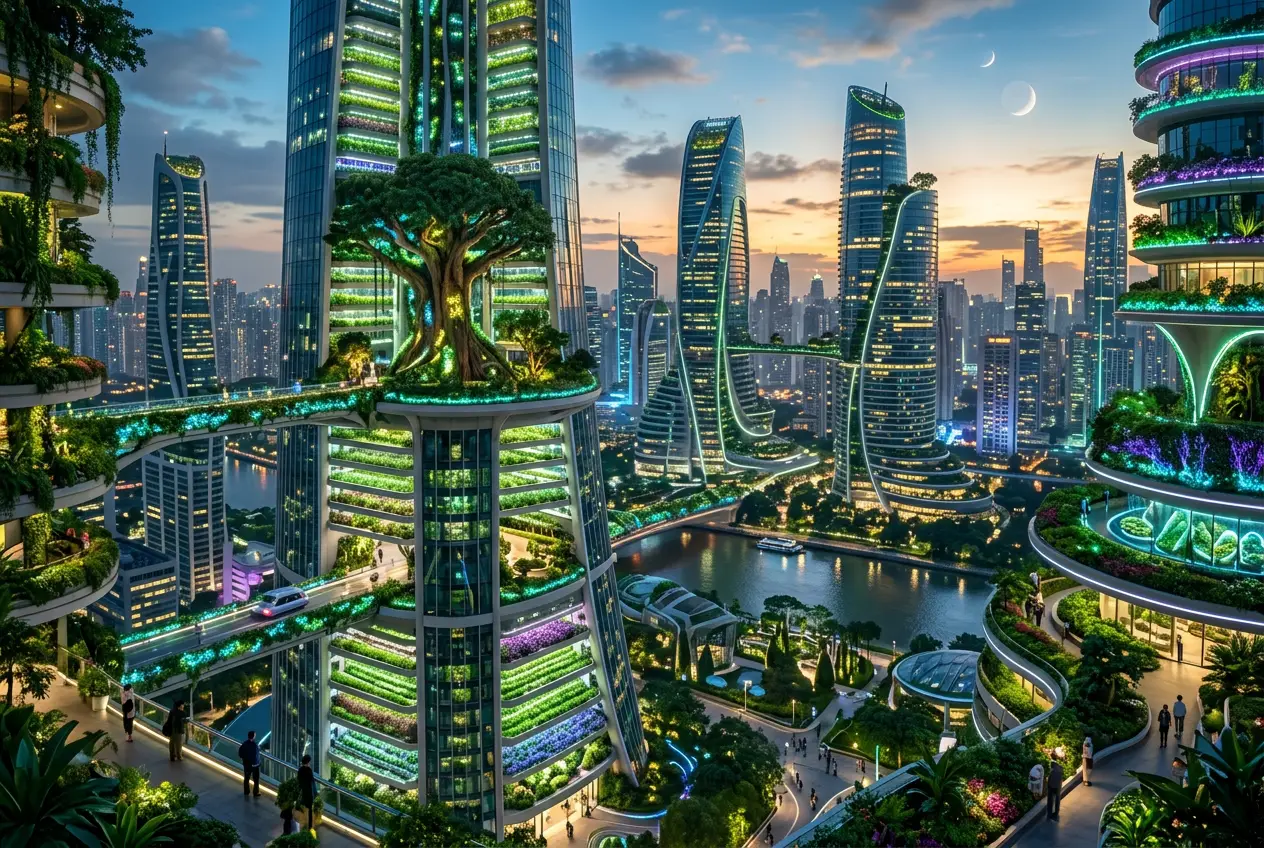
I've always been fascinated by the ingenuity of ancient civilizations. We often look at their grand structures and intricate tools and marvel at how they achieved so much with seemingly limited technology. But what if their most profound technological advancements weren't carved in stone or forged in metal, but rooted in the very earth beneath their feet? What if the secrets to powering our hyper-modern, sprawling future cities lie hidden in the ancient wisdom of plants?
Recently, I was watching a documentary about indigenous communities in the Amazon, and it struck me how deeply integrated their lives were with the plant kingdom, not just for food and medicine, but for creating sustainable systems that lasted for centuries. This made me wonder: could these ancient botanical insights, combined with cutting-edge science, offer a revolutionary pathway to sustainable urban energy? I believe the answer is a resounding yes, and the implications could truly reshape our future.
Unearthing Ancient Green Wisdom: Beyond Basic Agriculture
When we think of ancient civilizations and plants, farming usually comes to mind. But historical records and archaeological discoveries hint at a much more sophisticated understanding of botanical properties. Indigenous cultures across the globe weren't just cultivating crops; they were engineering ecosystems. Consider the Terra Preta soils of the Amazon, an incredibly fertile soil created by pre-Columbian inhabitants that retains its richness centuries later. This wasn't merely composting; it was a deliberate, technologically advanced form of ecological engineering, transforming barren land into sustainable agricultural powerhouses. Such practices ensured food security and resource abundance, a fundamental form of "energy" for a civilization.
The Mayans, for instance, developed intricate agricultural systems that included raised fields, terracing, and forest gardens, maximizing yield and sustaining large populations without depleting the environment. Their "forest cities" were not just urban centers surrounded by nature, but integral parts of a managed ecological system. This proactive approach to environmental management demonstrates a profound understanding of how to harness natural resources sustainably—a stark contrast to our current linear "take-make-dispose" model. For more on ancient ecosystems, you might find our article on whether ancient ecosystems engineered nature fascinating: ancient-ecosystems-did-they-engineer-nature-1440.
The Electrifying Potential: Plants as Living Batteries
This ancient understanding of plant power takes a quantum leap when we consider modern research into bioelectricity and bio-photovoltaics. Imagine a city where its parks and green spaces aren't just aesthetic amenities, but active power generators. This isn't science fiction; it's the promising frontier of Plant-Microbial Fuel Cells (PMFCs).
PMFCs operate on a fascinating principle: plants produce organic compounds through photosynthesis, releasing a portion of these compounds (known as exudates) into the soil through their roots. Certain soil bacteria, called electrogenic microbes, consume these exudates. In an anaerobic environment, these microbes "breathe" by transferring electrons to an external electron acceptor—in this case, an electrode. This electron flow generates electricity.
"The idea of a plant powering a light bulb sounds like a magic trick, but it's pure biology at work," notes Marjolein Helder, co-founder of Plant-e, a Dutch company pioneering PMFC technology. "Every plant is a miniature, living bioreactor." The potential here is immense. Imagine rooftops covered not just with solar panels, but with plant-filled modules generating energy day and night, regardless of sunlight, as long as the plants are alive and photosynthesizing. A single square meter of wetland plants, for example, can already generate enough electricity to charge a smartphone or power LED lights. Imagine scaling this up across entire urban landscapes.
Further exploration into this dynamic field can be found on its dedicated Wikipedia page: Plant-microbial fuel cell (opens in a new tab).
Beyond PMFCs: Biofuels and Biomass Reimagined
While PMFCs are a cutting-edge concept, the idea of deriving energy from plants has long existed in the form of biofuels and biomass. However, the modern approach often involves massive monocultures and energy-intensive processing, leading to environmental concerns and "food vs. fuel" debates. Ancient civilizations, with their integrated ecological systems, offer a different model.
- Sustainable Biofuels: Instead of vast cornfields for ethanol, future cities could leverage algae bioreactors integrated into building facades, producing biodiesel with far less land and water. Algae also consume CO2, acting as a double win for urban environments.
- Decentralized Biomass: Waste products from urban green spaces (prunings, fallen leaves) could be converted into biochar for soil enrichment, or gasified locally to generate heat and electricity, creating a circular economy within the city. This mimics ancient practices of utilizing every part of a resource.
Biomimicry: Nature's Blueprints for Sustainable Tech
The lessons from ancient plant wisdom extend beyond direct energy generation to inspiring the very design of our technologies and cities. Biomimicry, the practice of innovating solutions by emulating nature's time-tested patterns and strategies, is a powerful bridge between ancient biology and future tech.
- Efficient Architecture: The cooling systems of termite mounds inspire self-regulating buildings. The lotus leaf's superhydrophobic surface leads to self-cleaning coatings for solar panels and windows, increasing efficiency and reducing maintenance.
- Solar Energy Absorption: The intricate light-harvesting complexes within plant chloroplasts are far more efficient at capturing sunlight than many artificial solar cells. Scientists are actively studying these structures to design next-generation, highly efficient, and flexible solar panels.
- Bio-inspired Materials: Beyond energy, plants offer blueprints for sustainable materials. Spider silk, inspired by natural polymers, is stronger than steel yet biodegradable. Mycelium, the root structure of fungi, can be grown into packaging, insulation, and even building blocks, offering sustainable alternatives to plastics and concrete. Our article on whether fungi can build computers delves deeper into this: can-fungi-build-computers-mycelial-tech-power-1244.
This interdisciplinary approach recognizes that nature has already solved many of the problems we face today, often with elegant, low-energy solutions. Leveraging biomimicry ensures that our future tech is not only powerful but also inherently sustainable and harmonious with the environment. More information on biomimicry can be found here: Biomimicry (opens in a new tab).
The Future is Green: Integrating Plants into Smart Cities
Imagine a city woven with green infrastructure that actively powers its inhabitants. Vertical farms on skyscrapers not only provide fresh, local food but also harbor PMFC systems generating electricity. Parks double as bio-photovoltaic fields, and plant-inspired designs optimize energy use in every building.
This vision requires a shift in mindset, moving away from viewing nature as something separate from human infrastructure, and embracing it as an integral, dynamic component of urban living. This isn't just about aesthetics; it's about harnessing biological intelligence for systemic resilience and energy independence.
| Ancient Plant Wisdom | Modern Technological Application | Future City Impact |
|---|---|---|
| Terra Preta soils (sustainable fertility) | Biochar production, ecological engineering | Enhanced urban agriculture, carbon sequestration |
| Mayan forest gardens (integrated ecosystems) | Vertical farming, urban permaculture | Local food security, reduced carbon footprint |
| Understanding bioelectricity (indirectly) | Plant-Microbial Fuel Cells (PMFCs) | Green energy generation from parks and public spaces |
| Efficient light capture (photosynthesis) | Biomimetic solar panels | Higher efficiency, flexible, aesthetically integrated energy capture |
| Natural materials (bamboo, mycelium) | Bio-based construction, sustainable packaging | Reduced waste, eco-friendly infrastructure |
This future is not about abandoning advanced technology but about integrating it with the profound, time-tested wisdom of the natural world. It’s about recognizing that the greatest innovators might not be in our labs, but have been quietly evolving in jungles and forests for millennia. The question isn't if ancient plants can fuel tomorrow's cities, but how deeply we're willing to listen to their ancient secrets.
I believe that by consciously integrating ancient botanical knowledge with modern technological prowess, we can build cities that are not just smart, but truly sustainable and alive.
Conclusion
The journey from ancient agricultural practices to cutting-edge bio-energy solutions highlights a continuous thread of human ingenuity seeking harmony with nature. Ancient civilizations demonstrated a sophisticated understanding of plant systems for sustenance and ecological balance. Today, with tools like Plant-Microbial Fuel Cells and the principles of biomimicry, we are beginning to unlock the direct energy-generating potential and design inspiration that plants offer. As we look towards building truly sustainable and resilient future cities, perhaps the best path forward isn't to invent entirely new solutions, but to rediscover and enhance the green wisdom that has always been around us.




Conversation0
No comments yet. Be the first to share a thought — the best questions often become new stories.