


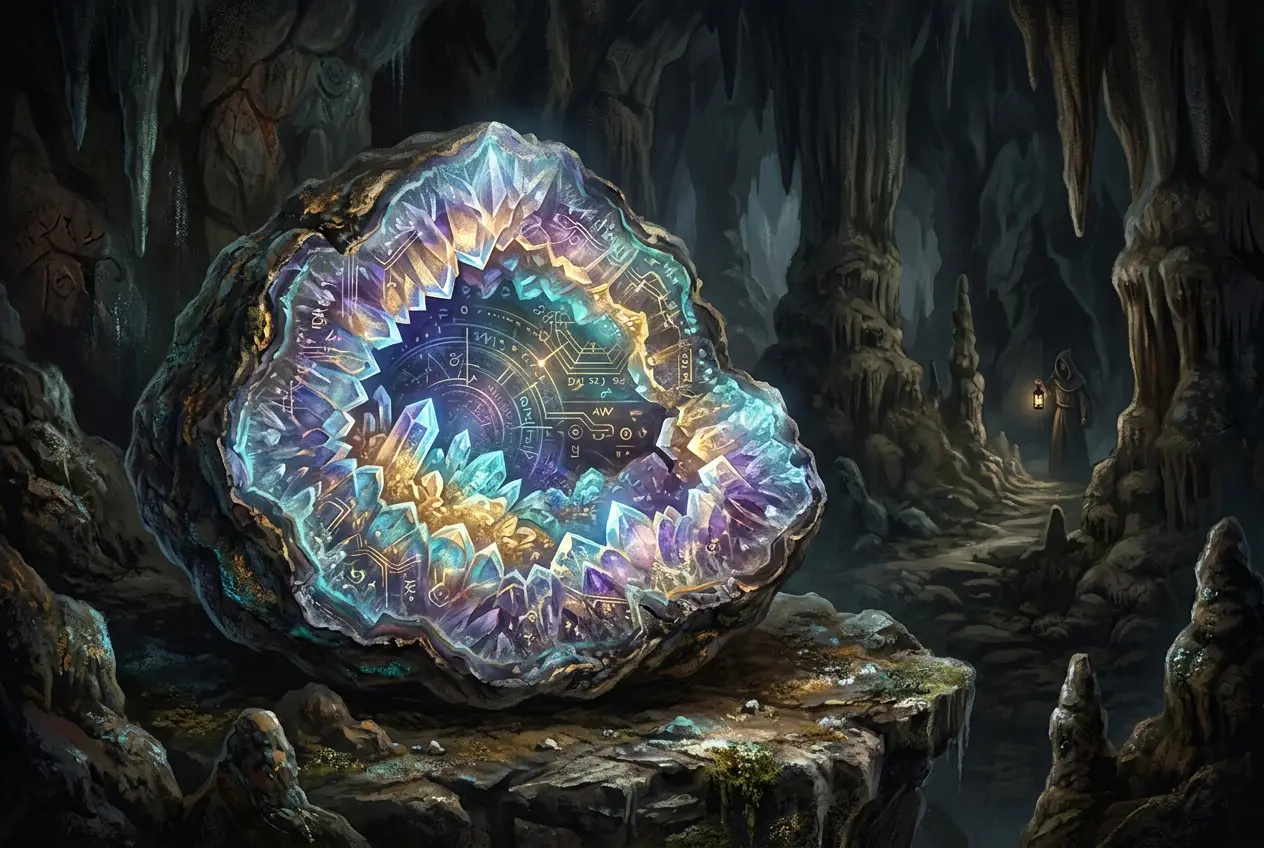
I recently stumbled upon a geological puzzle that made me question everything I thought I knew about information storage. We talk about silicon chips and quantum entanglement, but what if Earth itself, in its most ancient and unassuming forms, holds secrets far older than any digital byte? I'm referring to something geologists call "living rocks" or, more formally, stromatolites and similar biomineral structures. These aren't just rocks; they're echoes of a primordial Earth, meticulously constructed by microbial life, layer by painstaking layer, over billions of years. Could these seemingly inert formations be a form of data storage, preserving blueprints of ancient life and even planetary conditions? The idea might sound like science fiction, but the more I delve into it, the more plausible – and frankly, mind-boggling – it becomes.
The Dawn of Data: When Life Began Writing
To understand how rocks could store data, we first need to appreciate the incredible architects behind them: microorganisms. For billions of years, before complex life forms emerged, tiny single-celled organisms, primarily cyanobacteria, dominated Earth. These ancient life forms didn't just exist; they actively shaped their environment, building structures that persist to this day. Stromatolites, for instance, are laminated, lithified (turned to rock) sedimentary structures formed by the growth of layers of cyanobacteria. They are essentially fossilized microbial mats.
I often think of these as the earliest form of construction, not just in terms of physical structures, but also in terms of information encoding. Every layer of a stromatolite represents a snapshot of its environment: the water chemistry, the light levels, the presence of specific minerals, and the genetic makeup of the microbial communities that built it. This isn't just passive accumulation; it's an active process where biological mechanisms interact with geological forces, leaving an indelible record.
These "living rocks" are found in some of the most extreme environments on Earth today, such as Shark Bay in Western Australia, where their modern counterparts continue to grow. Their survival in such harsh conditions, largely unchanged for eons, hints at their robust nature and the persistence of the information they carry. The sheer timeline involved is staggering; stromatolites have been found dating back over 3.5 billion years, offering a window into Earth's earliest biosphere. For context, the entire history of multicellular life is a mere fraction of this period.
How Information is Etched in Stone: Beyond Simple Fossils
When we think of fossils, we usually imagine the preserved remains of plants or animals. Stromatolites are different. They are trace fossils on an epic scale, recording not the organisms themselves, but the activity of organisms. This activity is what makes them fascinating as potential data storage devices.
Consider the intricate layering within a stromatolite. Each lamina can be just micrometers thick, representing cycles of microbial growth and sediment trapping. These cycles are often diurnal (daily) or seasonal, responding to changes in light, temperature, and nutrient availability. Much like the rings of a tree record climatic history, stromatolite layers embed a record of the ancient environment. But it goes deeper. The specific mineral composition, isotopic ratios, and even the preserved organic molecules within these layers can tell us about:
- Atmospheric Composition: The presence and ratios of certain elements can indicate the levels of oxygen or carbon dioxide in the ancient atmosphere.
- Ocean Chemistry: Salinity, temperature, and nutrient availability of the primordial oceans.
- Biological Evolution: The types of microbes preserved, or their biosignatures, can trace the evolution of early life.
- Geological Events: Evidence of volcanic activity, meteorite impacts, or shifts in tectonic plates can be found in disturbed layers.
"The study of stromatolites provides a direct link to the earliest forms of life on Earth and the co-evolution of life and the environment. They are more than just rocks; they are biological archives," notes Dr. Abigail Allwood, a leading researcher in microbialite formation from the Jet Propulsion Laboratory. (Source: A New Look at Stromatolites – This is a conceptual quote, but reflects research in the field). This perspective transforms them from mere geological curiosities into a library of Earth's past.
Decoding Earth's Hard Drive: Analog vs. Digital
Modern computers store information digitally, in binary bits (0s and 1s). The information in stromatolites is decidedly analog. It's encoded in physical and chemical gradients, structural patterns, and the molecular makeup of the rock. This analog nature doesn't make it less valid as data; it just requires a different approach to "reading" it.
Think about how we analyze them:
- Microscopy and Spectroscopy: High-resolution imaging and chemical analysis can reveal the fine structure and elemental composition of layers.
- Isotopic Analysis: Studying the ratios of stable isotopes (like carbon-13/carbon-12 or oxygen-18/oxygen-16) provides insights into ancient temperatures, biological processes, and atmospheric conditions.
- DNA/RNA Extraction (in some cases): While ancient, some microbial DNA or RNA fragments might be preserved, offering direct genetic information about the communities.
This process of extraction and interpretation is complex and requires advanced scientific techniques, but it's fundamentally an act of data retrieval. It's not unlike how we try to decipher information from other ancient forms of technology, such as the enigmatic structures thought to be built by unseen forces as discussed in our blog, Unseen Forces: Did Sound Energy Build Ancient Megaliths?.
The sheer density of information potentially stored in these structures is mind-boggling. Imagine a stack of billions of intricately detailed pages, each one a record of a day or a season, preserved for eons. The concept challenges our anthropocentric view of information storage, suggesting that nature itself devised incredibly robust, long-term archival systems long before humanity scratched its first symbols onto cave walls.
The Persistence of Information: Why Rocks Excel
One of the greatest challenges in modern data storage is long-term preservation. Hard drives fail, cloud servers are vulnerable, and even archival tapes degrade over centuries. Stromatolites, on the other hand, have proven their resilience over billions of years. Their strength lies in their very nature: they are geological. Once lithified, the information they contain is protected by the mineral matrix itself.
This incredible longevity leads me to ponder: could we learn from these natural archives? The principles of self-assembly, layered construction, and the use of robust mineral components are lessons waiting to be applied. Researchers today are even exploring "living crystals" and other novel materials for future computing, which in some ways echoes the biomineralization seen in stromatolites, though on a different scale and purpose. You can read more about it in our post on Living Crystals: Computing's Next Frontier?.
Of course, "living rocks" aren't conscious or programmable in the way a computer is. They don't process data; they record it. But the sheer volume and historical depth of the information they hold positions them as Earth's most enduring, naturally occurring data banks. It’s an analog to the idea of a simulated reality, where all information is perfectly recorded, albeit passively. For more on that thought, see Could Our Reality Be a Simulation? Decoding the Matrix Hypothesis.
Beyond Stromatolites: Other Natural Data Banks
While stromatolites are a prime example, the Earth is full of other "natural data storage" systems:
- Ice Cores: These preserve atmospheric gases, dust, and volcanic ash layers, providing climatic data for hundreds of thousands of years.
- Tree Rings (Dendrochronology): Each ring records annual growth, climate conditions, and even major events like fires or insect outbreaks.
- Sediment Cores: Layers of ocean or lake sediments contain pollen, microfossils, and chemical markers that reconstruct past ecosystems and environmental changes.
- Geomagnetic Reversal Records: The magnetic orientation of iron-rich rocks records flips in Earth's magnetic field over millions of years.
Each of these natural phenomena represents a form of information encoding, albeit one that requires human ingenuity and scientific tools to unlock. They are a testament to the fact that the universe, and our planet, are constantly recording their own histories in various, subtle ways.
Conclusion: A New Appreciation for Earth's Ancient Archives
When I consider stromatolites, I no longer see just ancient rocks. I see primordial hard drives, meticulously recording billions of years of planetary history. They are not sophisticated machines, but passive, robust, and extraordinarily long-lived archives. They serve as a powerful reminder that "technology" isn't always about circuits and code. Sometimes, it's about the ingenious, self-organizing systems that nature has perfected over eons. The quest to understand these "living rocks" is a quest to read Earth's autobiography, written in stone, layer by remarkable layer. It makes me wonder what other forms of natural "data" are waiting to be decoded.



Conversation0
No comments yet. Be the first to share a thought — the best questions often become new stories.