I once saw a demonstration of a material that made an object disappear right before my eyes. Not a trick, not an illusionist’s sleight of hand, but a genuine scientific marvel. It wasn't full invisibility, not yet, but it was enough to make me question the very nature of light and how we perceive reality. What I witnessed was the nascent power of **metamaterials**—engineered marvels designed to bend the rules of physics, making the impossible seem, well, almost magical.
Think about it: what if we could design materials that could steer light around an object, making it invisible? Or silence a noisy room with a whisper? What if we could build lenses so perfect they could see details smaller than a wavelength of light? These aren't concepts confined to science fiction anymore. Scientists are actively researching and developing metamaterials that promise to revolutionize everything from telecommunications and medical imaging to energy harvesting and aerospace engineering.
### What Exactly Are Metamaterials?
The "magic" of metamaterials isn't about some fantastical new element; it's about **structure**. Unlike conventional materials, whose properties are derived from their chemical composition, metamaterials derive their extraordinary capabilities from their meticulously designed, sub-wavelength structures. Imagine tiny, repeating patterns—like miniature antennae, split-ring resonators, or intricate lattices—engineered at scales smaller than the wavelength of the waves they are designed to interact with. These artificial structures interact with electromagnetic waves (like light), acoustic waves (like sound), or even seismic waves in ways that natural materials simply cannot.
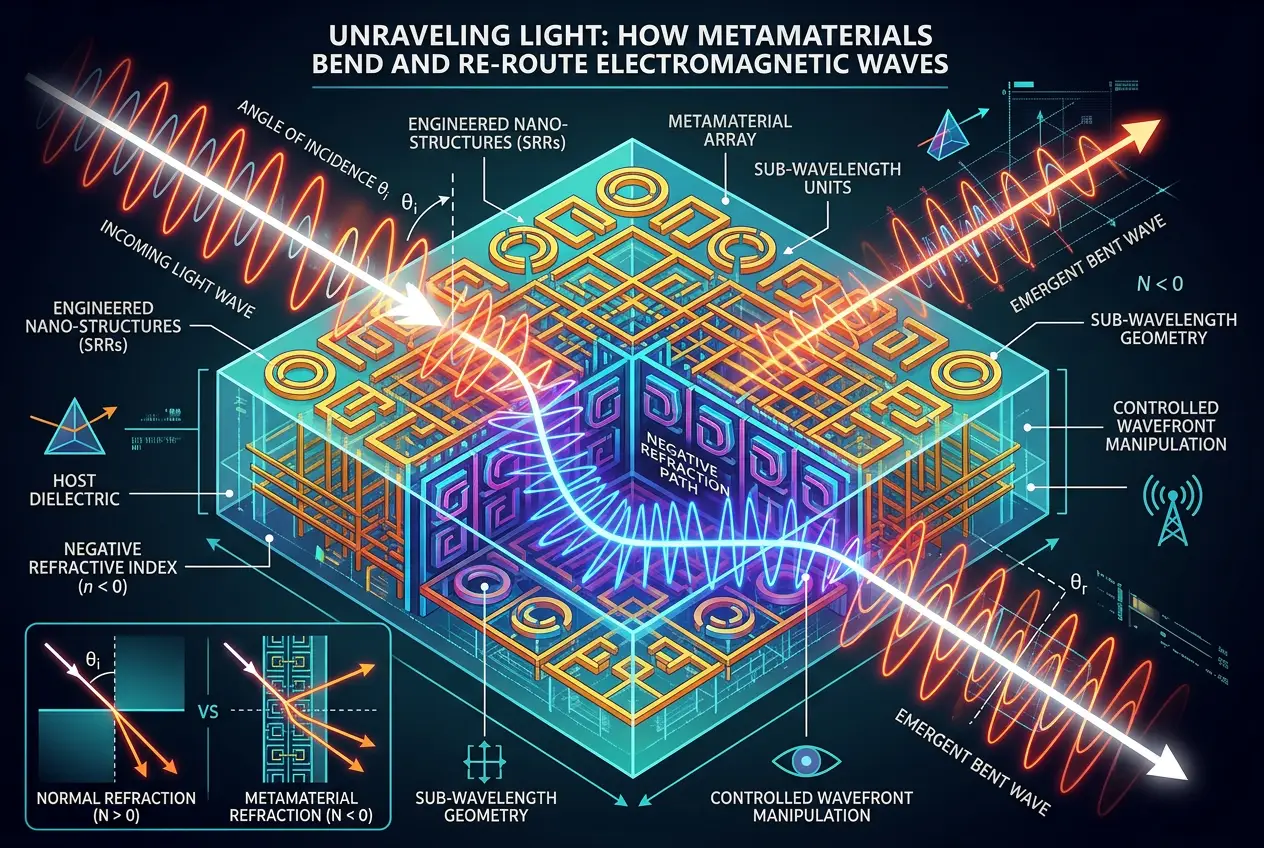
This is a crucial distinction. When light hits a regular material, its interaction is governed by the material's atomic and molecular properties. But with metamaterials, we’re essentially **engineering new effective properties** that don't exist in nature. We can make a material appear to have a negative refractive index, for instance, which completely flips how light behaves when passing through it. This capability is what opens the door to truly mind-bending applications.
### Manipulating Light: The Illusion of Invisibility and Beyond
The concept of an **invisibility cloak** is perhaps the most famous application of metamaterials. While the notion of a full, Harry Potter-style cloak remains a distant dream due to technical challenges, the underlying principle has been demonstrated. Scientists have created devices that can bend microwaves, and even some visible light, around an object, making it appear as if the object isn't there. This works by using metamaterial structures to guide the light waves smoothly around the hidden object, allowing them to recombine on the other side as if they had never been disturbed.
This ability stems from metamaterials' capacity to achieve a **negative refractive index**. In normal materials, light bends in one direction when it passes from air into the material. With a negative refractive index, it bends in the *opposite* direction. This counter-intuitive behavior is what allows for possibilities like:
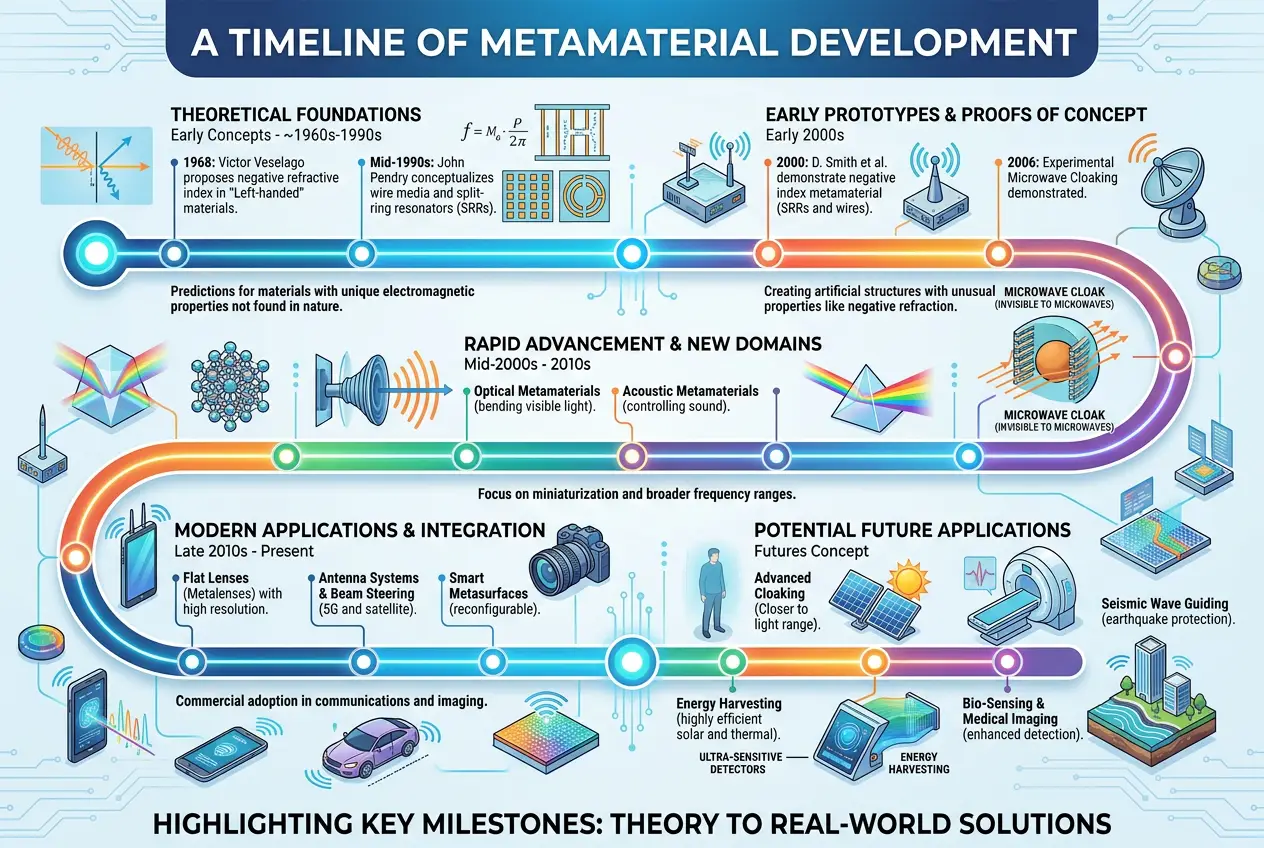
* **Perfect Lenses:** Traditional lenses are limited by the diffraction limit, meaning they can't resolve details smaller than about half the wavelength of light. Metamaterial-based "superlenses" or "perfect lenses" can overcome this barrier, potentially allowing us to see incredibly fine details currently beyond the reach of conventional optics. Imagine medical imaging with unprecedented resolution or nanoscale manufacturing with pinpoint accuracy.
* **Light Harvesting & Solar Cells:** Metamaterials can be designed to trap and absorb light more efficiently, boosting the performance of solar panels. By manipulating light at the nanoscale, they can ensure more photons are captured and converted into electricity, even from low-angle sunlight.
* **Novel Antennas:** Compact, high-performance antennas that can operate across a wide range of frequencies are already being developed using metamaterial principles, improving communication systems from Wi-Fi to satellite links. To learn more about how light manipulation could shape computing, you might enjoy our article on [Could Light Replace Silicon in Future Computers?](/blogs/could-light-replace-silicon-in-future-computers-6600).
### Manipulating Sound: Crafting Silence and Sonic Focus
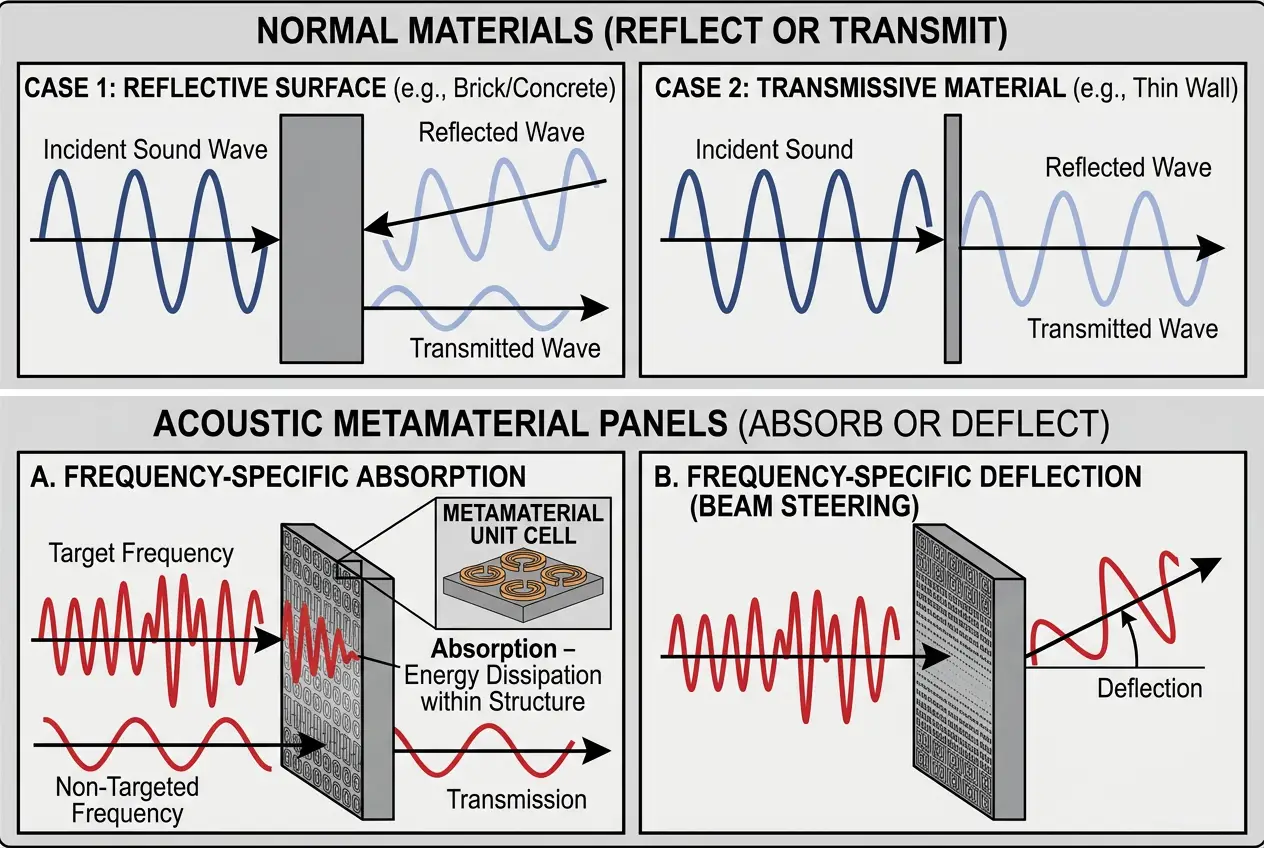
It's not just light that metamaterials can bend to their will. **Acoustic metamaterials** are designed to manipulate sound waves in equally extraordinary ways. Just as optical metamaterials interact with electromagnetic waves, acoustic metamaterials use engineered structures to control how sound propagates.
Imagine a world where noise pollution is a thing of the past. Acoustic cloaks, much like their light-bending cousins, can be designed to guide sound waves around an object or space, effectively rendering it silent to external listeners. This isn't just about muffling sound; it's about *redirecting* it entirely.
Other applications include:
* **Targeted Sound Focusing:** Metamaterials can act as "acoustic lenses," focusing sound waves with extreme precision. This could revolutionize medical diagnostics, allowing for non-invasive therapies that target specific tissues with sound waves, or advanced sonar systems with unparalleled accuracy.
* **Vibration Damping:** From earthquake-resistant buildings to quieter machinery, acoustic metamaterials can be engineered to absorb or deflect specific frequencies of vibration, leading to enhanced structural integrity and reduced noise.
* **Acoustic Diodes:** Imagine a material that allows sound to pass in one direction but blocks it in the other. This "one-way sound" could have applications in specialized audio equipment or soundproofing.
### Beyond Light and Sound: A Universe of Waves to Control
The principles of metamaterials aren't limited to visible light and audible sound. The same underlying physics can be applied to other forms of wave energy:
* **Heat (Thermal Metamaterials):** Imagine controlling the flow of heat, perhaps making an object seem to disappear from a thermal camera, or directing heat precisely where it's needed in advanced cooling systems.
* **Seismic Waves:** Metamaterial-inspired barriers could potentially divert destructive earthquake waves away from cities or critical infrastructure, acting as "seismic cloaks."
* **Radio Waves & Microwaves:** These are already being heavily explored for applications in advanced antennas, stealth technology, and more efficient wireless communication.
The possibilities truly feel limitless when you consider the fundamental control over wave phenomena that metamaterials offer. According to a Wikipedia article on metamaterials, their unique properties arise from "macroscopic composites having a manmade, three-dimensional, periodic cellular architecture designed to produce an optimized combination, not available in nature, of two or more responses to a specific excitation." [Source: Wikipedia - Metamaterial](https://en.wikipedia.org/wiki/Metamaterial)
### The Journey from Lab to Life: Challenges and the Future
While the science is breathtaking, bringing metamaterials from the laboratory to widespread commercial application presents significant challenges.
One major hurdle is **fabrication**. Creating these intricate, sub-wavelength structures, often at the nanoscale, requires highly advanced and precise manufacturing techniques. This can be complex and expensive, making mass production difficult. Another issue is **loss**. For many applications, especially in optics, metamaterials can suffer from energy loss as waves interact with their structures, reducing efficiency.
However, research is constantly advancing. New manufacturing methods, including advanced 3D printing and self-assembly techniques, are being explored to overcome these limitations. The future could see metamaterials integrated into our everyday lives in countless ways: from cloaking military vehicles and improving medical diagnostics to creating silent rooms and hyper-efficient solar panels. The journey reminds me a bit of the early days of understanding concepts like [Does Water Hold Memory: The Hydrosol Computing Mystery?](/blogs/does-water-hold-memory-the-hydrosol-computing-mystery-6692), where seemingly unconventional ideas hold hidden potential for future tech.
As we continue to push the boundaries of materials science, the "magic" of metamaterials promises to redefine what we thought was possible, giving us unprecedented control over the fundamental forces that shape our world.
### Conclusion: Engineering Reality at the Nanoscale
The ability of metamaterials to manipulate light, sound, and other waves in ways that defy natural properties is nothing short of revolutionary. By engineering structures at scales smaller than a wavelength, we are effectively designing the very fabric of how matter interacts with energy. From the elusive dream of invisibility to practical applications that promise to enhance our technology and improve our quality of life, metamaterials are pushing the boundaries of what is scientifically possible. The next few decades will undoubtedly see these engineered wonders transform from fascinating lab experiments into integral components of our technologically advanced future.
Frequently Asked Questions
Unlike conventional materials, which derive their properties from their chemical composition, metamaterials get their unique abilities from their deliberately engineered, sub-wavelength structures. These artificial structures interact with waves (like light or sound) in ways no natural material can.
Scientific prototypes of invisibility cloaks exist, but they are not yet like those seen in fiction. Scientists have successfully demonstrated bending microwaves and some visible light around objects, making them appear 'invisible' to specific frequencies. Full-spectrum, practical cloaking for humans is still a significant research challenge.
A negative refractive index means that when light passes from one medium to another, it bends in the opposite direction compared to how it behaves in all natural materials. This counter-intuitive property is crucial for many exotic metamaterial applications, including perfect lenses and invisibility devices, allowing unprecedented control over light's path.
The principles of metamaterials extend beyond light and sound. Researchers are developing metamaterials to control heat (thermal metamaterials), absorb or deflect seismic waves, and improve the efficiency of radio and microwave communication systems.
Current and near-future applications include highly efficient antennas for wireless communication, advanced sensors, improved medical imaging devices (like super-resolution lenses), enhanced solar cells for energy harvesting, and sophisticated noise cancellation and vibration damping systems.
Verified Expert
Alex Rivers
A professional researcher since age twelve, I delve into mysteries and ignite curiosity by presenting an array of compelling possibilities. I will heighten your curiosity, but by the end, you will possess profound knowledge.
Leave a Reply
Comments (0)
No approved comments yet. Be the first to share your thoughts!
 Join Us




 Alex Rivers



































Leave a Reply
Comments (0)