I remember the first time I stumbled upon the story of the Baghdad Battery. It wasn't in a dusty history book or a dry academic paper, but in a documentary that hinted at something truly extraordinary – the possibility that our ancestors, millennia ago, might have understood and even harnessed the power of electricity. The thought was electrifying, pun intended! It challenged everything I thought I knew about ancient civilizations and their technological prowess. Could something so seemingly modern have existed in a world we often imagine as primitive?
**The Unearthing of an Enigma**
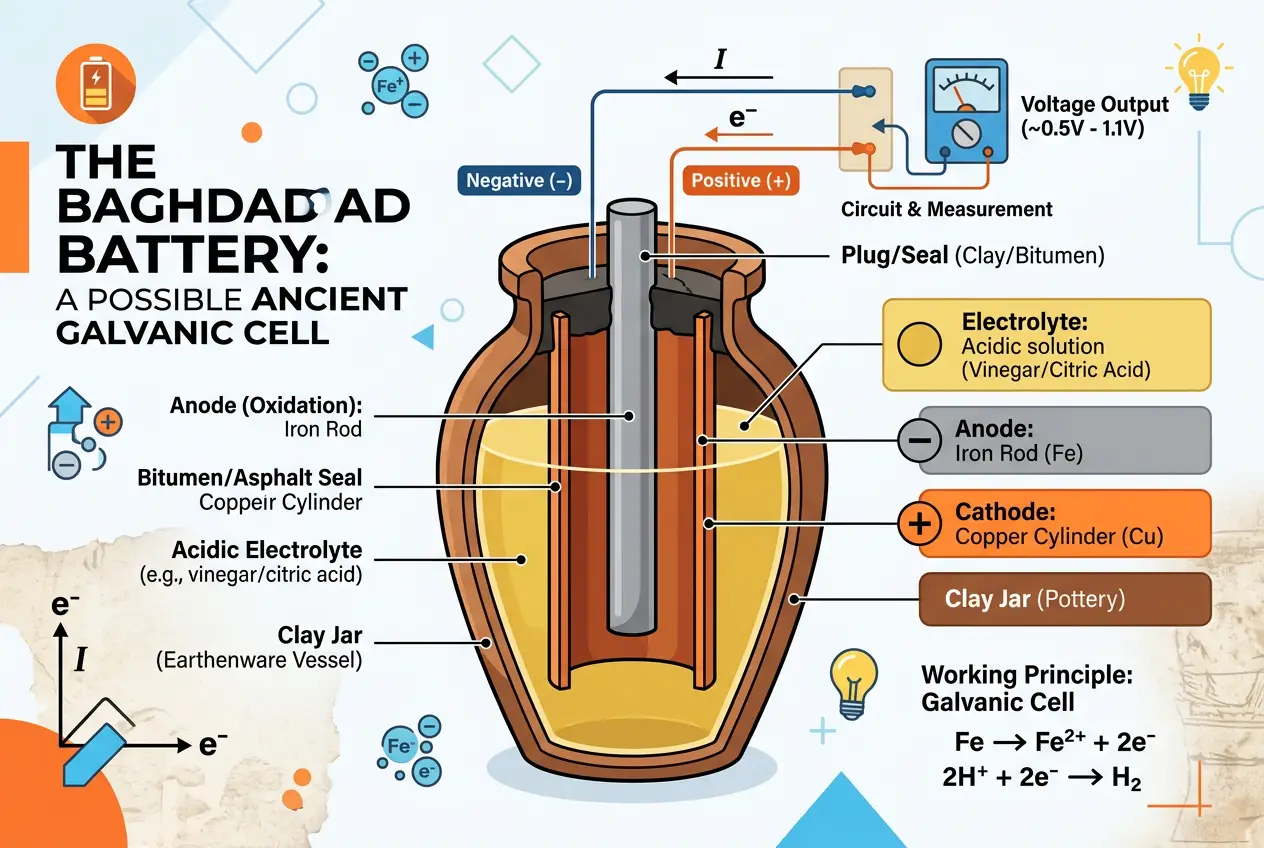
The year was 1938. German archaeologist Wilhelm König was meticulously cataloging artifacts in the Iraq Museum in Baghdad when he made a peculiar discovery. Among the pottery and relics dating back to the Parthian era (roughly 250 BC to AD 224), he found something that didn't quite fit: a small, yellowish clay jar, roughly 14 cm (5.5 inches) tall. Inside, he noted a copper cylinder, and within that, an iron rod. It sounds unremarkable, doesn't it? But König, with his sharp scientific intuition, saw something far more intriguing. He proposed that this artifact was not just a container, but an ancient electric battery.
Imagine his excitement, and perhaps a touch of disbelief, as he considered the implications. A battery, almost 2,000 years before Alessandro Volta is officially credited with inventing the first electric cell in 1800 AD! This wasn't just a curiosity; it was a potential paradigm shift in our understanding of technological history. For those who enjoy diving into similar historical tech anomalies, you might find our previous discussion on [Dendera Light: Did Egyptians Master Ancient Electric Tech?](https://www.curiositydiaries.com/blogs/dendera-light-did-egyptians-master-ancient-electric-tech-8514) equally fascinating.
**Deconstructing the "Battery": How It Works (Theoretically)**
So, what exactly makes the Baghdad Battery, or "Parthian Battery" as it's sometimes called, resemble a galvanic cell? The components found — the clay jar, copper cylinder, and iron rod — are precisely what you'd need for a basic electrochemical cell. All that's missing is an electrolyte, an acidic or alkaline liquid that would react with the metals to produce an electric current.
Common theories suggest that ancient peoples could have easily used substances like grape juice, vinegar, or even fermented fruit extracts as electrolytes. When an acidic liquid is added, it creates a chemical reaction. The iron acts as the anode, releasing electrons, and the copper acts as the cathode, accepting them. This flow of electrons is what we call electricity. While the voltage produced by a single cell would have been low (estimated at 0.5 to 2.0 volts), multiple such batteries connected in series could certainly generate a more substantial charge.
This isn't just pure speculation. Modern scientists and enthusiasts have actually replicated the Baghdad Battery using the proposed components and various electrolytes. The results? They work. They produce a measurable electric current. This practical demonstration adds significant weight to König's original hypothesis and fuels the debate surrounding its true purpose.
**What Was Its Purpose? More Than Just a Spark**
If it was indeed a battery, what would ancient Parthians have used it for? The most compelling theories revolve around two primary applications:
1. **Electroplating (Galvanic Gilding):** This is one of the most widely accepted theories. Electroplating involves using electricity to deposit a thin layer of one metal (like gold or silver) onto another (like a base metal statue or jewelry). The Baghdad Battery could have provided the necessary weak current for such a process, creating beautiful, corrosion-resistant artifacts that appear to be solid gold or silver. Imagine the aesthetic and economic advantages of making common metals look like precious ones! This intricate process showcases a sophisticated understanding of material science, much like how ancient cultures might have explored [magnetic tech](https://www.curiositydiaries.com/blogs/did-ancient-cultures-master-magnetic-tech-8268) for various applications.
2. **Medicinal or Therapeutic Use:** Ancient civilizations were often keen on exploring natural remedies. Early forms of electrotherapy, though crude, could have been perceived as having healing properties. Minor electric shocks might have been used to alleviate pain, stimulate certain body parts, or even treat specific ailments. The tingling sensation could have been interpreted as divine energy or a therapeutic force.
3. **Religious or Mystical Rituals:** Another intriguing possibility is that the batteries were used to create a "magical" effect in religious ceremonies. Priests might have touched statues or objects connected to these batteries, receiving a mild shock, which could have been interpreted as divine intervention or a manifestation of sacred power. This would have enhanced their authority and the awe surrounding their rituals. This notion of using unusual artifacts for powerful effects resonates with the broader exploration of [impossible artifacts](https://www.curiositydiaries.com/blogs/impossible-artifacts-clues-to-lost-ancient-tech-2132) that hint at lost knowledge.
**The Skeptics Weigh In: Alternative Theories**
Of course, not everyone is convinced. Skeptics argue that while the Baghdad Battery *could* function as an electric cell, that doesn't necessarily mean it *did*. Correlation, after all, isn't causation. They propose alternative explanations for the artifact:
* **Storage Jar for Sacred Scrolls:** Some scholars suggest the jars were used to store sacred papyrus scrolls. The copper cylinder and iron rod might have been part of a mechanism to hold the scrolls in place, perhaps wrapped around the copper, with the iron rod acting as a seal or a central support. The acidic residue found in some replicas could simply be from decaying organic material.
* **Containers for Pigments or Medicines:** The jars could have simply been containers for various substances, and the metal components were incidental or served another non-electrical purpose, perhaps as part of a sealing mechanism or a stirring tool.
* **Proto-Pagan Ritual Objects:** While some suggest mystical uses, others argue the components were part of a different type of ritual object, not necessarily electrical.
It’s crucial to remember that no ancient texts explicitly describe the use of these "batteries" or refer to electricity. This lack of textual evidence is a significant hurdle for proponents of the battery theory. However, the absence of evidence isn't always evidence of absence, especially when considering the sheer volume of ancient knowledge that has been lost to time.
**The Broader Context: A World of Lost Tech**
The Baghdad Battery stands as a testament to the fact that ancient civilizations might have possessed knowledge and technologies far more advanced than we typically give them credit for. While the debate continues, it forces us to re-examine our assumptions about history and innovation. Did ancient peoples experiment with principles that would only be "re-discovered" millennia later?
This artifact, whether a battery or something else entirely, serves as a powerful reminder that history is not a linear progression. There were periods of innovation, decline, and lost knowledge. It sparks our curiosity and encourages us to look beyond conventional narratives, to consider the possibility that the ancients were not just builders of pyramids and philosophers, but also ingenious technologists, experimenting with the very forces that shape our modern world. The secrets of the past, as I often find, are far more intricate and surprising than we often dare to imagine.
**The Legacy of a Mystery**
The Baghdad Battery remains one of archaeology's most captivating enigmas. It challenges us to think differently, to question the established timeline of scientific discovery, and to appreciate the ingenuity that has always been a hallmark of human civilization. Whether it produced a meager spark or powered dazzling ancient artistry, it serves as a powerful symbol of the "Curiosity Diaries" mission: to explore the untold stories, the unexplained phenomena, and the tantalizing hints of advanced knowledge from epochs long past.
**References (Wikipedia):**
* [Baghdad Battery](https://en.wikipedia.org/wiki/Baghdad_Battery)
* [Luigi Galvani](https://en.wikipedia.org/wiki/Luigi_Galvani)
* [Voltaic Pile](https://en.wikipedia.org/wiki/Voltaic_pile)

The next time you plug in your phone or flip a light switch, take a moment to consider the enduring mystery of the Baghdad Battery. Could its ancient creators have understood the fundamental principles of electricity, centuries ahead of their time, sparking a truly electric age that history forgot?
Frequently Asked Questions
No, while experiments have shown it can generate electricity, there is no definitive historical proof or textual evidence confirming its original use as a battery. It remains a fascinating archaeological anomaly and a subject of ongoing debate among scholars.
Copper was widely used by them. So, it's possible they could have formed copper into strands or rods if they needed to conduct an electrical current. But it's important to remember that there's no concrete archaeological evidence from ancient Egypt describing the use of "batteries" for electrical purposes. They can produce current but their original use is under debate.
Credit: William Fox https://www.pinterest.com/wfox1692/
Replication experiments suggest that a single Baghdad Battery could produce between 0.5 to 2.0 volts, depending on the electrolyte used. This is a low voltage, but enough for certain applications like electroplating or minor shocks.
The lack of textual evidence is a key argument for skeptics. However, many ancient technical manuals and records have been lost over millennia. It's also possible that such knowledge was confined to a select group of artisans or priests and not widely documented or understood by the general populace.
While no other identical 'batteries' have been found, some archaeologists point to other ancient artifacts, such as copper-plated objects or items with traces of gold or silver plating that might suggest early forms of electroplating. However, these connections are largely circumstantial.
The original Baghdad Battery is part of the collection at the Iraq Museum in Baghdad. It survived the looting during the 2003 Iraq War, though some parts may have been damaged or lost. It remains a prized, though enigmatic, artifact.
Verified Expert
Alex Rivers
A professional researcher since age twelve, I delve into mysteries and ignite curiosity by presenting an array of compelling possibilities. I will heighten your curiosity, but by the end, you will possess profound knowledge.
Leave a Reply
Comments (0)
No approved comments yet. Be the first to share your thoughts!
 Join Us




 Alex Rivers

































Leave a Reply
Comments (0)