I've always been fascinated by the subtle hum of our digital world. Not the obvious notifications or the stream of data we consciously interact with, but the underlying, almost imperceptible chatter. It’s like standing in a bustling city and wondering about the individual conversations lost in the general din – countless stories, whispers, and facts that never reach our ears. Recently, I started wondering if our advanced electronics, the very devices that power our lives, are doing something similar. Are they generating or holding information that we simply aren't designed to perceive or process, a kind of **'dark data'** that remains hidden in plain sight?
This isn't about lost files or encrypted secrets in the traditional sense. Instead, I'm talking about the informational equivalent of dark matter in the cosmos – a vast, unseen component that might influence everything we experience, yet remains elusive. It’s a compelling thought: what if our smartphones, computers, and smart home devices are constantly accumulating and transmitting subtle data streams that are currently beyond our comprehension or detection?
The Whispers Beneath the Code
Every microchip, sensor, and circuit board in our modern electronics is a hive of activity. From the quantum fluctuations within semiconductors to the vast, unprocessed raw data spewed by an array of sensors, there’s an ocean of information that never sees the light of day. We often focus on the data we *intend* to generate or consume, but what about the digital exhaust, the background noise, or the emergent properties of incredibly complex systems?
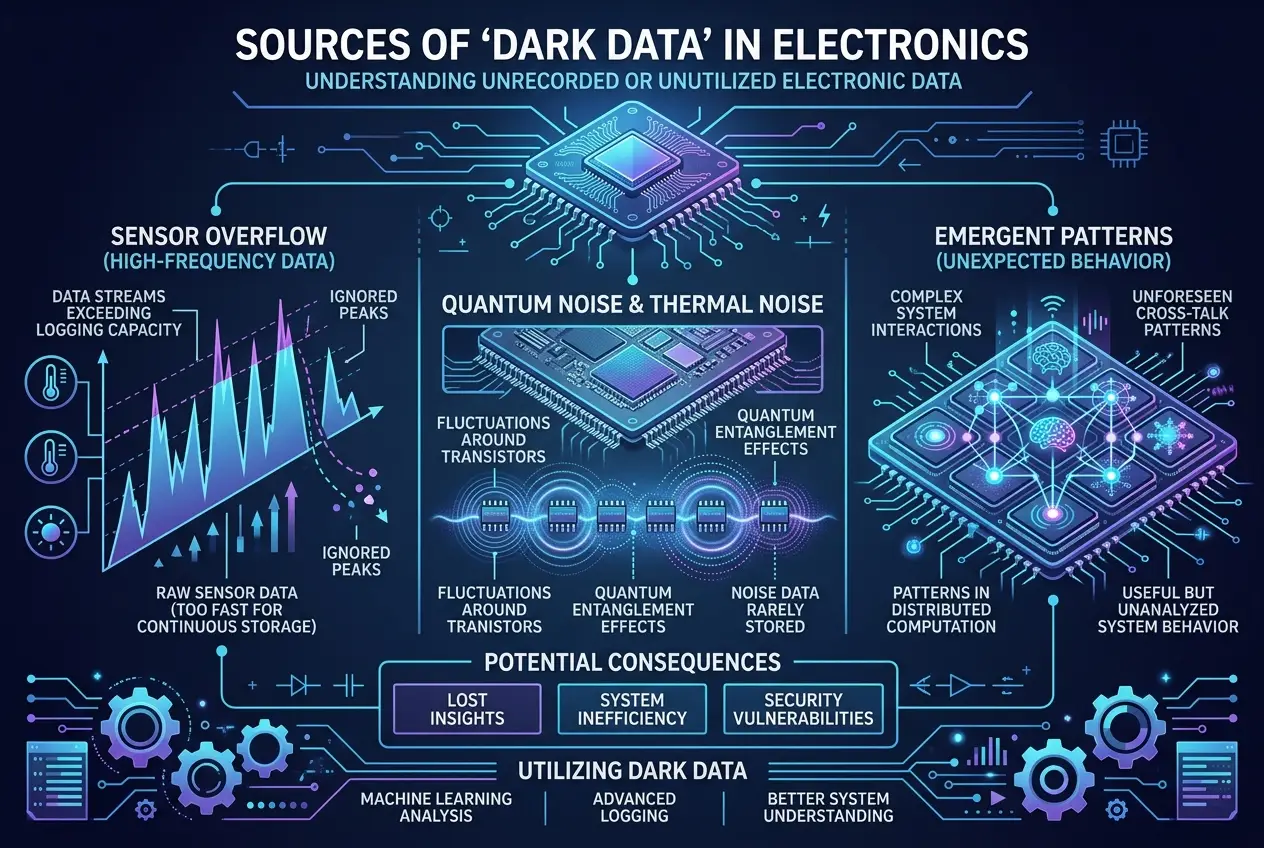
Think about the sheer volume of **sensor data** a modern smartphone collects. Accelerometers, gyroscopes, magnetometers, ambient light sensors, proximity sensors, barometers, microphones, and high-resolution cameras – they are all continuously active, sampling their environment at incredible rates. While much of this data feeds into specific applications (like screen rotation or step counting), an immense amount is either immediately discarded, compressed beyond recognition, or simply exists as unprocessed 'noise' that we choose to ignore. This 'data exhaust' is a prime candidate for electronic dark data. It's information that *exists* but is largely unused or inaccessible. To delve deeper into the concept of data exhaust, one might find the Wikipedia article on it insightful:
Data Exhaust on Wikipedia.
Quantum Entanglements and Unseen States
The world of electronics operates at a scale where quantum mechanics begins to play a subtle but undeniable role. While most classical computing is designed to mitigate quantum effects, they are always present. Electrons tunnel, energy states fluctuate, and the very fabric of the material is a dance of subatomic particles. Could these **quantum states and noise** within electronic components be holding uninterpreted information?
Quantum noise, a fundamental aspect of electronic systems, refers to the inherent fluctuations that arise from the discrete nature of charge and energy at the quantum level. We design circuits to minimize its impact, but what if this 'noise' isn't just random interference, but a complex, low-level informational layer? Could it contain patterns, correlations, or even computational states that we lack the tools to measure or understand? Some researchers speculate about the universe itself being a giant computational system, where even quantum fluctuations could carry information, a concept explored in our previous post:
Do Quantum Fluctuations Code Our Reality?
This idea isn't entirely far-fetched. In advanced quantum computing, the superposition and entanglement of qubits are harnessed to perform calculations that classical computers cannot. What if, on a microscopic scale, the "classical" components of our devices are constantly generating subtle quantum entanglements or preserving ephemeral quantum states that represent a form of information storage we haven't recognized? Understanding electronic noise, in general, is crucial, and Wikipedia provides a detailed explanation:
Electronic Noise on Wikipedia.
Emergent Intelligence and Systemic Whispers
As electronic systems become increasingly complex, particularly with the rise of AI and neural networks, we encounter **emergent properties**. These are behaviors or characteristics that arise from the interaction of many simpler components, but which are not inherent in the individual components themselves. Think of a flock of birds forming intricate patterns – no single bird is controlling the overall shape, but the collective behavior creates it.
In AI, this can manifest as systems developing unexpected problem-solving strategies or even what some might interpret as "intuition." Could this emergent intelligence be generating data that is intrinsic to the system's overall state, but not explicitly logged or accessible through conventional means? It's like the system has a "thought process" that leaves no formal data trail, yet influences its actions. The philosophical and scientific implications of emergence are profound, and you can learn more about it here:
Emergence on Wikipedia.
We’ve seen cases where AI exhibits behaviors that are hard to trace back to specific lines of code, leading to the concept of "black box" AI. If an AI system, especially one designed for real-time interaction, processes information and makes decisions based on internal, emergent states that are never formally recorded, then that constitutes a form of dark data. It’s information that *defines* the system's current "mindset" but exists only as the dynamic interplay of its components. This brings to mind discussions about artificial intelligence and its potential for complex, non-linear processing, a topic we touched upon in
Can Light Think: The Dawn of Optical Computing?.
The Echoes of Deleted Data
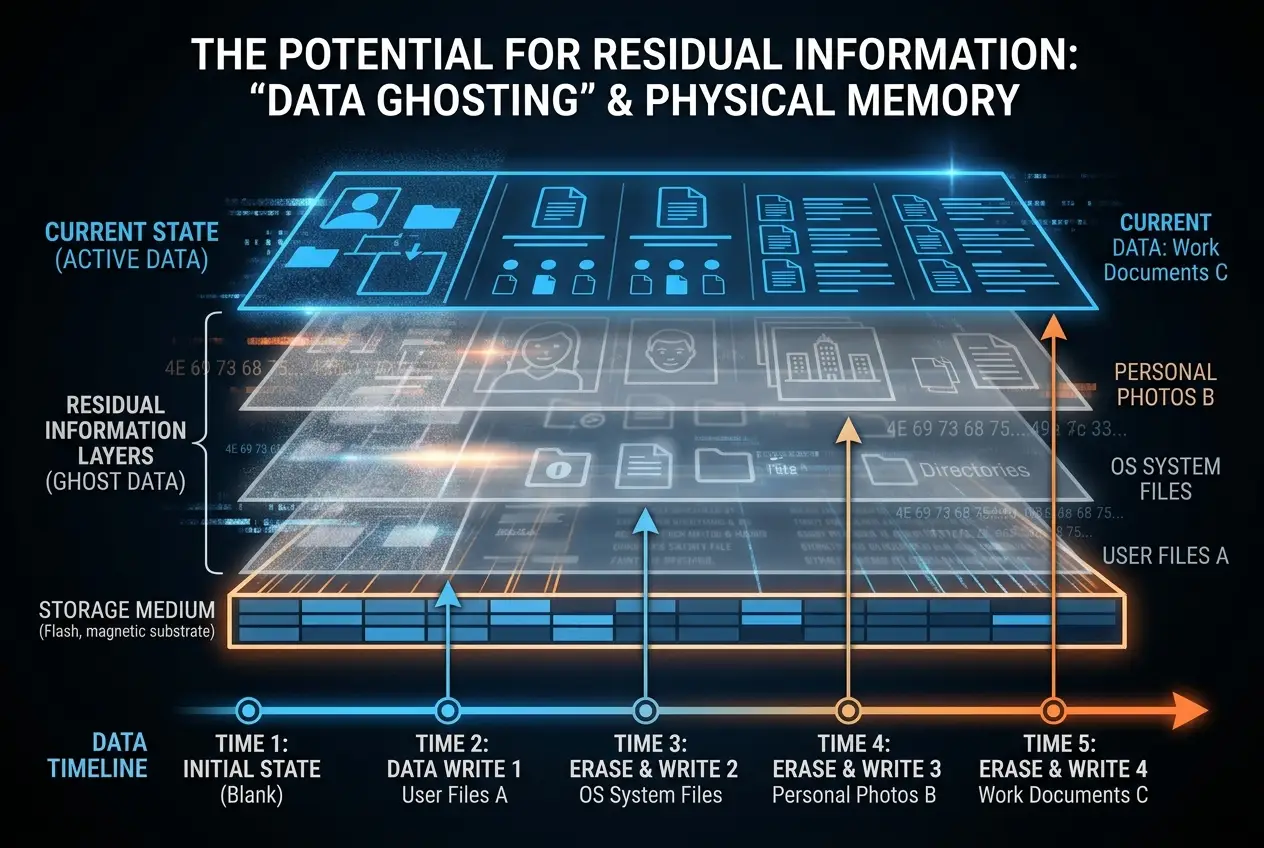
Even when we delete data, it's rarely truly gone from a physical perspective. Data recovery specialists know that "deleted" files often remain on a drive until overwritten. But what if this concept extends beyond mere magnetic states on a hard drive? What if the physical components themselves, at a deeper level, retain a subtle "memory" of the electrical signals that once passed through them?
Consider the slight changes in resistance, capacitance, or even the molecular structure of materials that might occur after repeated data storage and erasure cycles. While these changes might be too small to be measured by current technology or considered irrelevant to functionality, they could constitute a form of residual, dark information. It’s the ghost in the machine, not a malicious entity, but an echo of its past operations. This is a different flavor of digital anomaly, but it resonates with themes explored in
Digital Anomalies: Glimpses of a Hidden Reality?.
Implications and the Road Ahead
If our electronics are indeed teeming with dark data, the implications are staggering.
Unlocking New Insights
Imagine being able to "read" the subtle fluctuations in a processor to predict hardware failure long before conventional diagnostics. Or to analyze the aggregated, subconscious "digital exhaust" of a city's smart infrastructure to gain unprecedented insights into traffic flow, energy consumption patterns, or even early warnings of environmental shifts. This dark data could hold keys to optimizing performance, enhancing longevity, and predicting unforeseen events across vast networks of devices.
Future Computing Paradigms
Could harnessing this dark data lead to entirely new forms of computing? If quantum noise isn't just noise, but a low-level informational substrate, perhaps we could develop devices that "listen" to these whispers, extracting computational power from the very fabric of reality. This might involve creating sensors so sensitive they can detect subtle changes in material properties or quantum states, transcending our current binary logic.
Ethical Dilemmas and Privacy
The existence of electronic dark data also raises significant ethical and privacy concerns. If our devices are unknowingly collecting and retaining information about us, our environments, and our interactions that we are unaware of, who owns this data? How is it secured? The very notion challenges our understanding of digital privacy and consent. It would require a fundamental re-evaluation of data governance policies and a deeper discussion about the "digital rights" of both humans and the systems we create.
The "Ghosts in the Machine" Explained?
Some unexplained glitches, phantom behaviors, or "spooky actions" in our tech might find their roots in dark data manifesting in unexpected ways. Perhaps these anomalies aren't just bugs, but subtle feedback loops or informational outputs from the hidden layers of our electronic systems that briefly interact with our perceptible reality.
The Challenge: Listening to the Unheard
The biggest challenge lies in developing the technology to detect, interpret, and utilize this electronic dark data. It would require breakthroughs in:
* **Ultra-sensitive Sensors:** Devices capable of measuring minute changes in physical properties, quantum states, and electromagnetic fields that are currently below our detection threshold.
* **Advanced Algorithms:** AI and machine learning models capable of identifying patterns and extracting meaning from incredibly noisy, high-dimensional datasets. This isn't just about filtering noise, but finding structure within it.
* **New Computational Architectures:** Designing hardware that is specifically built to interact with and process these subtle informational layers, perhaps drawing inspiration from biological systems or emergent quantum phenomena.
We are, in essence, trying to learn a new language – the secret language of our machines. It’s a language not of explicit commands and outputs, but of background processes, inherent material properties, and emergent systemic behaviors.
Conclusion: A Universe in a Microchip?
The idea that our everyday electronics might be harboring vast amounts of 'dark data' isn't just a science fiction trope; it’s a profound question at the intersection of physics, computer science, and philosophy. It challenges us to rethink what "information" truly is and where it resides. By exploring these unseen informational realms, we might not only unlock unprecedented technological capabilities but also gain a deeper understanding of the very nature of matter, computation, and perhaps even consciousness itself. Our devices might just be more complex, and more curious, than we ever dared to imagine.
 Join Us




 Unknown Author


































Leave a Reply
Comments (0)