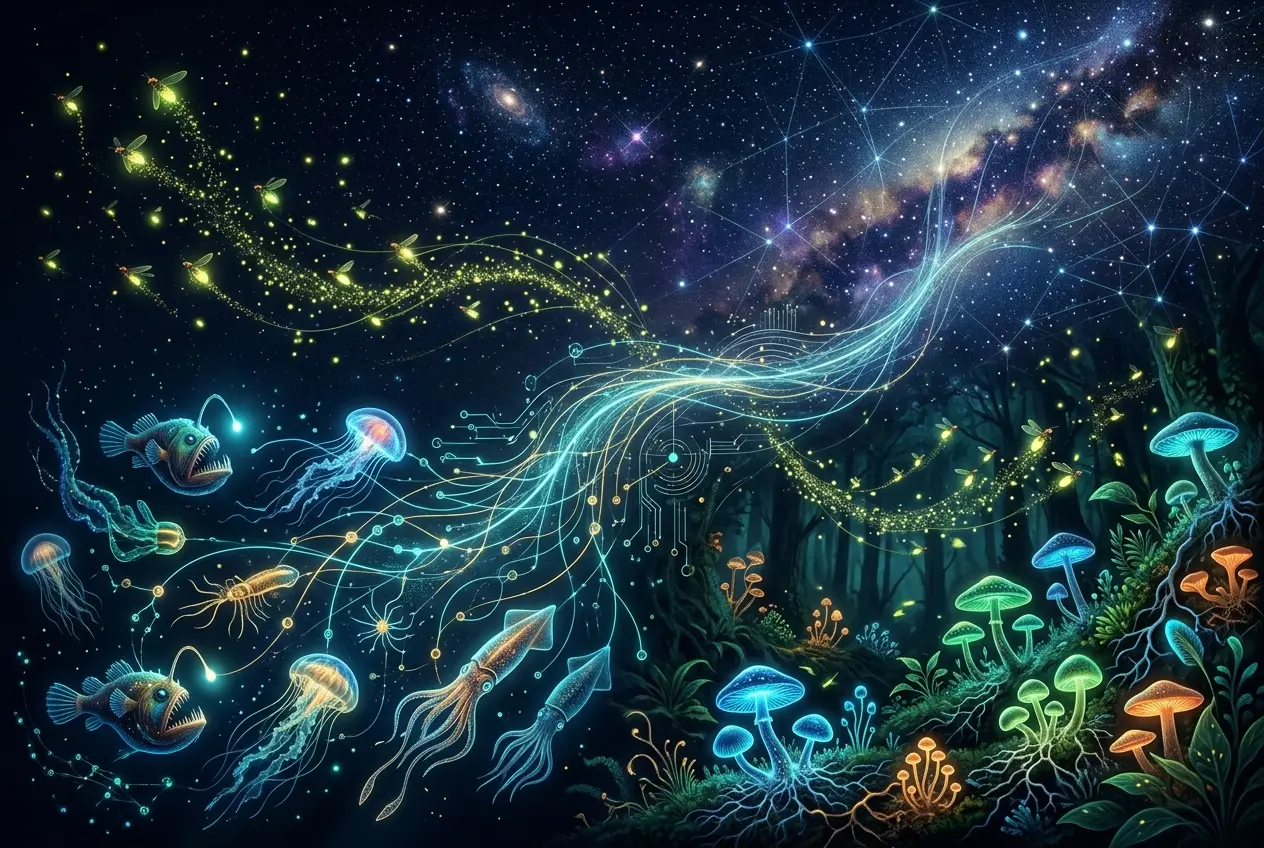
I remember a profound moment from my childhood, staring at a jar full of fireflies on a warm summer night. Their synchronized blinks seemed to tell a story, a silent conversation played out in fleeting bursts of light. Back then, it was just magic. Now, as I delve deeper into the mysteries of the natural world and cutting-edge technology, I can't help but wonder: could that fleeting light, and countless other forms of bioluminescence across our planet, be doing more than just attracting mates or startling predators? Could living light actually be encoding cosmic data, perhaps even whispering secrets from the universe itself?
It sounds like something out of science fiction, doesn't it? Yet, the more we learn about the intricate systems of nature and the fundamental principles of information, the less far-fetched the idea becomes. Our universe is awash with information, from the quantum foam to the vast cosmic web. What if life, in its most luminous forms, has found a way to not just exist within this information-rich cosmos, but to actively process, store, or even transmit aspects of it through light?
## The Luminous Language of Life: Bioluminescence Explained
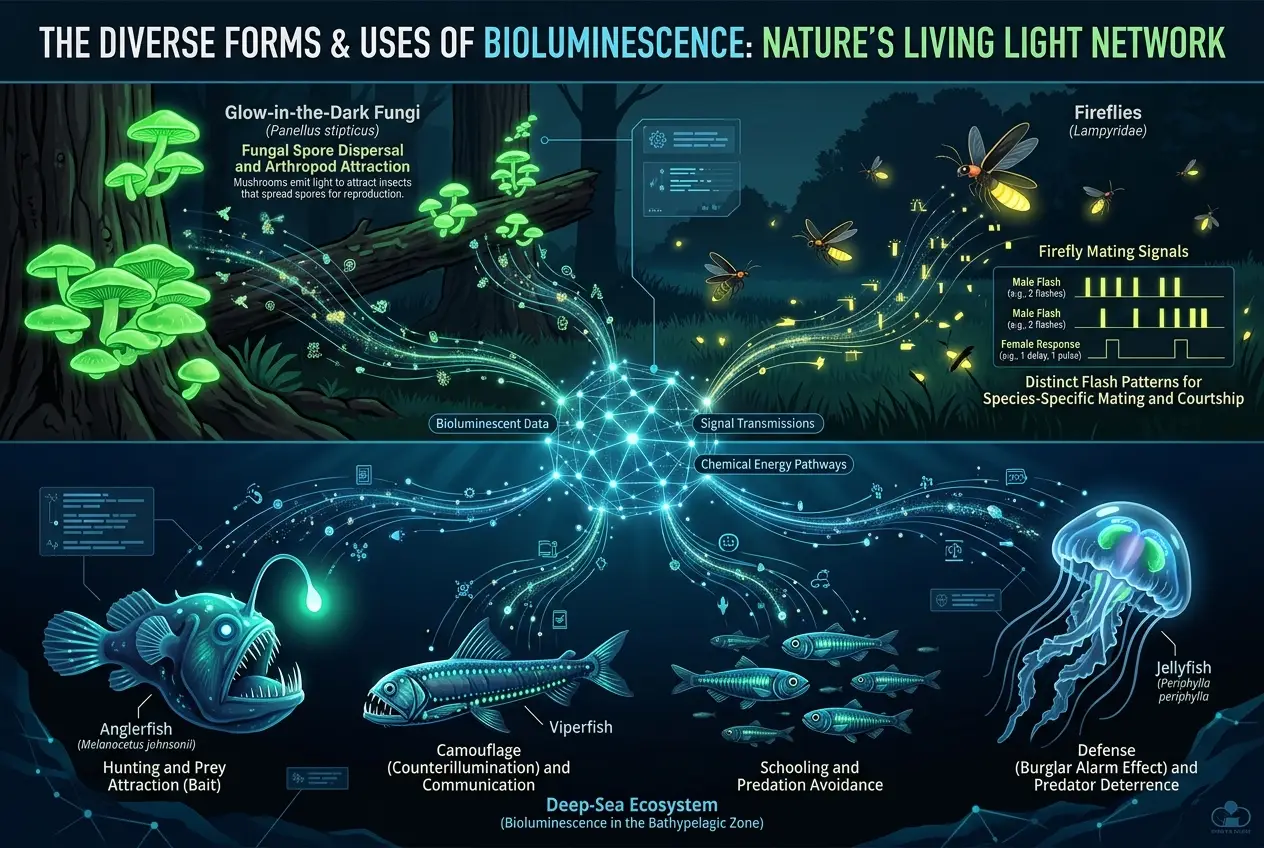
At its core, **bioluminescence** is the emission of light by a living organism. It’s a chemical reaction, typically involving a light-emitting molecule (a luciferin) and an enzyme (a luciferase), along with oxygen and other cofactors. From the mesmerizing glow of deep-sea jellyfish and fish to the flickering signals of fireflies, and even the eerie light of some fungi, this phenomenon is widespread across the tree of life. For a deeper dive into the chemical marvel of how organisms produce light, you can refer to the Wikipedia article on [Bioluminescence](https://en.wikipedia.org/wiki/Bioluminescence).
For centuries, we’ve understood bioluminescence through a purely biological lens:
* **Mating:** Fireflies use specific flash patterns to attract partners.
* **Predator Avoidance:** Some squids squirt luminous ink to escape.
* **Prey Lure:** Anglerfish use their glowing lures to attract unsuspecting fish.
* **Camouflage:** Counter-illumination in the deep sea helps creatures blend with the faint light from above.
These are all valid, well-researched biological functions. But what if there's an unseen layer, a hidden language beneath the surface of these visible interactions? What if the *patterns* of light, their frequencies, durations, and even their subtle quantum properties, hold information that transcends mere survival signals?
## Decoding Nature's Morse Code: Light as Information Carrier
The concept of light carrying information is fundamental to our modern world. From fiber optics transmitting internet data at the speed of light to quantum cryptography using photons for secure communication, we know light is an incredibly efficient information carrier. Even our own eyes function by detecting light signals.
So, it's not a stretch to consider that biological systems might also leverage light for more complex information exchange. Think about it: a specific flash pattern from a firefly isn't just "here I am." It's "I am species X, female, ready to mate, and here are my genetic fitness markers encoded in the precision of my flash." That's already quite a bit of data.
But what if these patterns could be influenced by external, non-biological factors? What if cosmic rays, subtle shifts in Earth's magnetic field, or even quantum fluctuations in their environment could subtly alter the bioluminescent output, creating a natural, living "sensor" or "recorder" of cosmic phenomena?
We’ve seen hints of how living systems interact with subtle environmental energies. For instance, some research explores how organisms might use quantum mechanics for processes like photosynthesis or bird navigation, as I discussed in a previous post about how "[Do Birds Use Quantum Physics to Navigate?](https://www.curiositydiaries.com/blogs/do-birds-use-quantum-physics-to-navigate-2473)". If biology can harness quantum effects for navigation, why not for information processing or transmission through light?
### Quantum Bioluminescence: A New Frontier?
This leads us to the fascinating, albeit speculative, realm of **quantum bioluminescence**. Could the photons emitted by living organisms possess quantum properties that allow them to carry more complex information than simple classical signals?
For example, entangled photons could, theoretically, communicate information instantaneously over distances, a concept at the heart of quantum communication. While there's no direct evidence of biological systems producing entangled photons for communication, it's a tantalizing thought. If such a mechanism existed, it would open up possibilities for a natural "quantum internet" spanning across ecosystems or even connecting our planet's living light to broader cosmic signals. This could be a natural form of biocomputing, echoing the ideas explored in "[Can Living Organisms Compute: The Rise of Biocomputing](https://www.curiositydiaries.com/blogs/can-living-organisms-compute-the-rise-of-biocomputing-5626)".
Some scientists are exploring the idea that biological systems might exhibit behaviors beyond classical physics, often termed **quantum biology**. While still a nascent field, it suggests that nature might be far more sophisticated in its use of fundamental physical laws than we currently understand. The energy states involved in bioluminescent reactions are incredibly precise; could these precision levels be fine-tuned to react to specific cosmic inputs?
## Cosmic Echoes in Living Light?
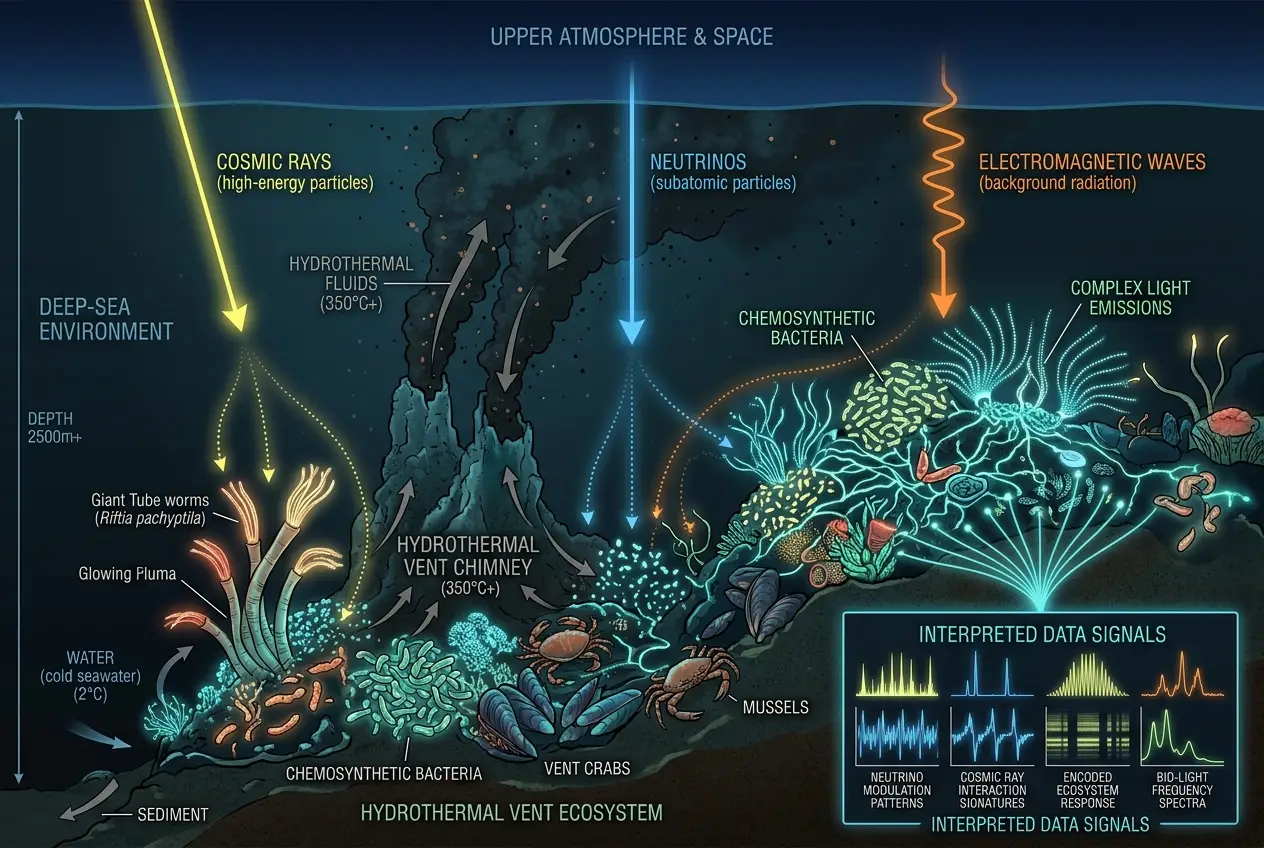
The "cosmic data" aspect is where things get truly intriguing. Our universe is constantly bombarding Earth with various forms of energy and particles: cosmic rays, neutrinos, gravitational waves, and even subtle shifts in spacetime. While many of these pass through us unnoticed, some are known to interact with matter and even biological systems.
What if bioluminescent organisms, particularly those in isolated environments like the deep ocean, have evolved to act as natural detectors for these cosmic inputs?
* **Cosmic Ray Signatures:** High-energy cosmic rays could cause minute, localized disruptions in chemical reactions, potentially altering the flash patterns or intensity of bioluminescent organisms. Imagine entire colonies of glowing bacteria reacting to a solar flare, their collective light subtly encoding the event.
* **Neutrino Interactions:** Neutrinos, often called "ghost particles," are incredibly difficult to detect, but they constantly stream through Earth. Could the highly sensitive chemical environment within bioluminescent cells be uniquely tuned to certain neutrino interactions, producing a faint, encoded flash as a result?
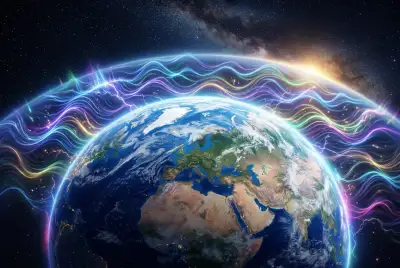
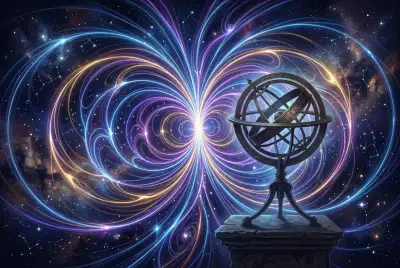
* **Electromagnetic Fields:** Earth’s magnetic field is constantly fluctuating, influenced by solar activity and deep-earth processes. We know these fields can affect animal behavior and navigation. What if they also influence the precise timing or intensity of light production in some species, turning them into living "magnetic field detectors" that communicate these cosmic variations through light?
I often find myself musing on the broader implications of such natural sensing mechanisms, particularly when considering how "[Do Planets Emit Secret Frequencies? Unpacking Cosmic Resonances](https://www.curiositydiaries.com/blogs/do-planets-emit-secret-frequencies-unpacking-cosmic-resonances-3335)". If celestial bodies can resonate, why not their inhabitants in a subtle, luminous way?
## The Challenge of Proof: How Would We Know?
Identifying such a phenomenon would be incredibly difficult. The "data" encoded in living light would likely be highly subtle, perhaps buried in noise, and require sophisticated analysis methods to detect. We would need:
1. **Ultra-sensitive Light Detection:** To measure minute variations in light intensity, frequency, and polarization.
2. **Environmental Monitoring:** To correlate light patterns with specific cosmic events or environmental shifts.
3. **Biological Modeling:** To understand how these inputs might physically or chemically alter bioluminescent pathways.
4. **Pattern Recognition Algorithms:** To sift through vast amounts of data and identify non-random, information-rich patterns that deviate from known biological functions.
Perhaps the first signs wouldn't be explicit "messages," but rather anomalous patterns that don't fit any known biological purpose. For instance, if a deep-sea bioluminescent organism consistently changed its light output in sync with distant supernovae, even if the change was barely perceptible, it would be a strong clue.
The very idea challenges our anthropocentric view of intelligence and communication. We often assume that only complex brains can process complex information, but what if life, at a much more fundamental, biochemical level, is already engaging in a cosmic dialogue through light? This isn’t to say they are "thinking" in a human sense, but rather acting as highly evolved, natural data processors and transmitters.
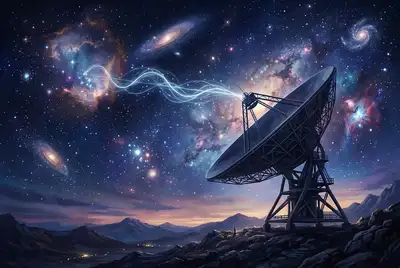
The possibility of such an ancient, biological network collecting and disseminating cosmic information is a fascinating thought. It suggests that our planet itself, through its myriad luminous life forms, could be a giant, distributed "cosmic data recorder" of sorts, silently capturing the universe's whispers in flashes of living light. For more on the concept of information within the universe itself, you might find our article on "[Is Dark Matter a Cosmic Internet? Unpacking Universal Communication](https://www.curiositydiaries.com/blogs/is-dark-matter-a-cosmic-internet-unpacking-universal-communication-1374)" thought-provoking.
## Beyond the Glow: Implications for Future Tech
If we could ever prove that living light encodes cosmic data, the implications would be staggering.
* **New Bio-Sensors:** We could develop incredibly sensitive bio-sensors for cosmic phenomena, leveraging nature's own finely tuned mechanisms. Imagine a biological observatory of glowing organisms tracking solar flares or distant gamma-ray bursts.
* **Novel Communication:** Understanding how light could be used for biological data transfer might inspire entirely new forms of optical communication or even bio-inspired computing paradigms.
* **Rethinking Life:** It would fundamentally reshape our understanding of life's intelligence and interconnectedness, suggesting a much deeper, more subtle relationship between organisms and their cosmic environment.
* **Astrobiology:** The search for extraterrestrial life often focuses on radio signals. What if other planets host luminous life forms communicating through light patterns we haven't yet learned to interpret?
The notion that the universe might be encoded in unexpected ways around us is a recurring theme in modern science. From the information paradox of black holes to the potential for the entire universe to be a quantum computer, we are constantly pushing the boundaries of what constitutes "data" and how it might manifest. The quiet, glowing organisms of Earth might just be another extraordinary chapter in this grand cosmic narrative. We can also consider the idea that even our own bodies might hold hidden clocks or data processing units, as explored in "[Do Our Bodies Harbor Hidden Quantum Clocks?](https://www.curiositydiaries.com/blogs/do-our-bodies-harbor-hidden-quantum-clocks-3312)".
## Conclusion: A Universe Written in Light
The fireflies in that jar from my childhood may have simply been seeking mates, but the wonder they sparked has never left me. The idea that living light, from the tiniest bacterium to the grandest deep-sea spectacle, might be doing more than just illuminating the darkness – that it might be subtly encoding the very fabric of our cosmos – is a testament to the profound mysteries still hidden within our natural world. As technology advances, perhaps one day we will develop the tools to truly listen to these luminous whispers and decode the cosmic data written in living light. Until then, I'll continue to look at every glowing organism with renewed awe, wondering what hidden messages their silent brilliance might hold.
Frequently Asked Questions
The idea stems from the fact that light is an excellent information carrier, and biological systems are incredibly complex and sensitive. While direct evidence is lacking, the hypothesis suggests that subtle cosmic inputs could influence the quantum or chemical processes of light emission, creating patterns that act as encoded data.
Currently, direct evidence for biological systems producing or utilizing entangled photons for communication is not confirmed. However, the field of quantum biology explores how quantum phenomena (like coherence or tunneling) might play roles in processes like photosynthesis. It's speculated that similar quantum effects could influence light emission to encode complex data.
Testing would require highly sensitive light detection systems, precise environmental monitoring (including cosmic ray flux, neutrino interactions, electromagnetic fields), sophisticated biological models of bioluminescent reactions, and advanced pattern recognition algorithms to identify non-random, information-rich signals in the light emissions.
It would likely involve subtle environmental information, such as changes in cosmic ray intensity, geomagnetic field fluctuations, or even rare neutrino interactions. The 'data' might not be a coherent message but rather a continuous stream of environmental parameters, akin to a natural, distributed sensor network.
Absolutely. If Earth's bioluminescent organisms could encode cosmic data, it suggests that similar life forms on other planets might do the same. This would broaden the scope of astrobiology beyond just radio signals, encouraging us to look for subtle light patterns as potential indicators of complex biological communication or sensing.
Verified Expert
Alex Rivers
A professional researcher since age twelve, I delve into mysteries and ignite curiosity by presenting an array of compelling possibilities. I will heighten your curiosity, but by the end, you will possess profound knowledge.
Leave a Reply
Comments (0)
No approved comments yet. Be the first to share your thoughts!
 Join Us
 Unknown Author















Leave a Reply
Comments (0)