


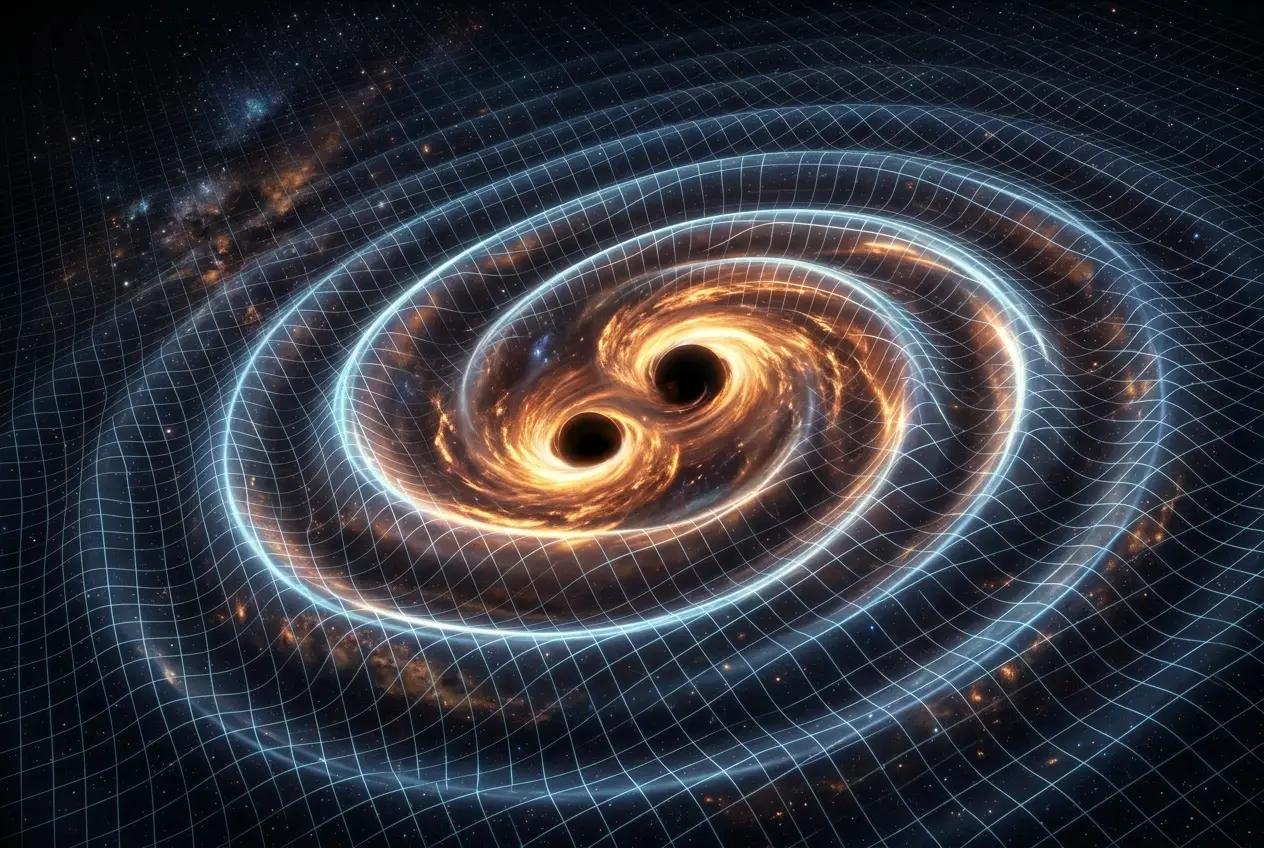
The universe, I've always found, holds secrets far grander and stranger than any fiction we could conjure. One particular mystery has fascinated me for years: the idea that the very fabric of spacetime isn't rigid but a dynamic, undulating sea, capable of being stirred by the most violent cosmic events. We've all seen images of black holes bending light or heard about the expansion of the universe, but what if these grand cosmic forces didn't just affect distance and light, but also the passage of time itself, right down to the tick of a clock?
Imagine a vast, invisible ocean upon which all of existence floats. When a massive ship—say, two colossal black holes—crashes together or a neutron star explodes, it sends powerful waves rippling across this cosmic sea. These aren't waves of water or sound, but gravitational waves, disturbances in spacetime itself. And the intriguing question isn't just whether they exist (which we now know they do, thanks to groundbreaking discoveries), but what profound effects they have, particularly on our most cherished dimension: time. Could these cosmic ripples genuinely warp time, speeding it up or slowing it down for fleeting moments as they pass?
The Fabric of Spacetime: Einstein's Revolutionary Idea
To understand how gravitational waves might warp time, we first need to grasp the concept of spacetime, a cornerstone of Albert Einstein's theory of General Relativity. Before Einstein, space and time were considered separate, immutable entities. Space was a static stage, and time a universal, unwavering clock. Einstein, however, revolutionized this view, proposing that space and time are inextricably linked, forming a single, four-dimensional fabric called spacetime.
Massive objects, like planets, stars, and black holes, don't just sit in spacetime; they warp and curve it, much like a bowling ball placed on a stretched rubber sheet. This curvature is what we perceive as gravity. Planets orbit stars not because of a mysterious "force" pulling them, but because they are simply following the curves in spacetime created by the star's immense mass. For a deeper dive into how matter can affect these fundamental forces, you might find our previous article on how quantum entanglement can defy space-time quite illuminating.
If spacetime can be curved by mass, it stands to reason that sudden, violent changes in mass-energy distribution – like the collision of two black holes – would send ripples through this fabric. These ripples are gravitational waves, traveling at the speed of light.
Gravitational Waves: A Whisper from the Cosmos
The existence of gravitational waves was predicted by Einstein over a century ago, but detecting them was another challenge entirely. They are incredibly faint, like the ghost of a ripple across an almost perfectly still pond. It wasn't until 2015 that the LIGO (Laser Interferometer Gravitational-Wave Observatory) collaboration finally made history, directly detecting gravitational waves for the first time. The signal came from the merger of two black holes, an event that released more energy than all the stars in the observable universe combined, in a fraction of a second. You can learn more about this monumental discovery on Wikipedia's page for Gravitational Waves (opens in a new tab).
So, what exactly happens when a gravitational wave passes through us? It literally stretches and compresses spacetime. Imagine drawing a perfect circle. As a gravitational wave passes, that circle would momentarily distort into an ellipse, then stretch into an ellipse in the perpendicular direction, before returning to a circle, all in a tiny fraction of a second. This stretching and squeezing isn't just a geometric trick; it affects everything within that region of spacetime.
The Time-Warping Conundrum: Does Time Flow Differently?
Here's where the question of time warping gets truly fascinating. If a gravitational wave stretches and compresses spacetime, does it also affect the rate at which time passes? The answer, according to General Relativity, is a nuanced yes.
Time dilation, the concept that time can pass at different rates for different observers, is a well-established phenomenon. It's most commonly associated with two scenarios:
- Relative Velocity: Objects moving faster experience time more slowly relative to stationary observers (special relativity).
- Gravity: Clocks tick slower in stronger gravitational fields (general relativity). GPS satellites, for example, have to account for both types of time dilation to function accurately.
When a gravitational wave passes, it doesn't just stretch and compress space; it also stretches and compresses time. As the wave passes, the local gravitational field intensity momentarily fluctuates. In regions where spacetime is compressed, the gravitational field effectively intensifies slightly, causing clocks to tick marginally slower. Conversely, in regions where spacetime is stretched, the field weakens, and clocks would tick slightly faster.
However, it's crucial to understand the scale of this effect. The distortions caused by gravitational waves, even from cataclysmic events, are incredibly tiny. For the strongest event detected by LIGO, the stretching and squeezing of spacetime amounted to less than the width of a proton over a distance of several kilometers. The corresponding time dilation effects are equally minuscule—fractions of a second over eons. You and I wouldn't feel our bodies getting stretched, nor would our watches visibly speed up or slow down. The effect is so slight that it requires detectors of extreme precision, like LIGO, to observe it.
The Symphony of Spacetime: What Gravity Waves Tell Us
Beyond the subtle time-warping effect, gravitational waves are revolutionizing our understanding of the universe. They provide a completely new "sense" with which to observe the cosmos, complementing traditional electromagnetic astronomy (light, radio waves, X-rays, etc.).
Here's what these cosmic ripples are helping us discover:
- Black Hole Mergers: Gravitational wave astronomy is the only way to directly observe black holes colliding and merging, unveiling new populations of black holes and helping us understand their formation and evolution.
- Neutron Star Collisions: In 2017, LIGO and its European counterpart, Virgo, detected gravitational waves from the merger of two neutron stars. This event was also observed across the electromagnetic spectrum, confirming the source of heavy elements like gold and platinum.
- The Early Universe: Gravitational waves are not significantly absorbed or scattered by matter, meaning they can potentially carry information from the very early universe, even before it became transparent to light. This could offer unprecedented insights into the Big Bang itself. Perhaps even shedding light on the "cosmic data" that might suggest our universe is a hologram.
- Testing General Relativity: Every detection of gravitational waves further validates Einstein's theory of General Relativity in extreme gravitational regimes, confirming its accuracy under conditions impossible to replicate in labs.
The Future of Gravitational Wave Astronomy
The field of gravitational wave astronomy is still in its infancy, yet its potential is immense. Future detectors, both on Earth and in space, promise even greater sensitivity and new discoveries. Projects like the Laser Interferometer Space Antenna (LISA), a planned space-based observatory, will be sensitive to much lower frequencies of gravitational waves, allowing us to detect supermassive black hole mergers at the centers of galaxies and potentially even events from the Big Bang era.
As technology advances, perhaps we will gain even more precise measurements of how gravitational waves distort both space and time. While we won't be building time machines based on these ripples anytime soon, understanding their subtle influence deepens our appreciation for the dynamic, interconnected nature of the cosmos. The universe isn't just expanding; it's vibrating, stretching, and compressing, singing a symphony of spacetime where even time itself dances to a cosmic tune.
It makes me wonder what other fundamental properties of reality these profound waves might be influencing, perhaps in ways we haven't even conceived yet. The journey to decode these cosmic messages has only just begun. For more on the mysteries the universe holds, consider reading about why the universe is so quiet.
Conversation0
No comments yet. Be the first to share a thought — the best questions often become new stories.