


I recently found myself staring at a photograph of the Giza Necropolis, not at the pyramids themselves, but at the astonishing precision of the granite blocks within the temples. The joints were so tight, so seamless, you couldn't slip a razor blade between them. It sparked a question in my mind, one that archaeologists and engineers have wrestled with for centuries: How did ancient civilizations achieve such incredible stonework, often with materials as hard as granite or basalt, using tools we believe were primitive?
The conventional narrative tells us that ancient builders relied on immense human labor, simple copper or bronze tools, and abrasive sands to shape colossal stones. Yet, when you look closely at many ancient sites across the globe, the evidence often defies these explanations. It’s as if a technology far beyond chisels and hammers was at play, almost as if these ancient craftsmen possessed something akin to modern laser cutters.
The Unsettling Precision of Ancient Megaliths
From the soaring heights of Egyptian obelisks to the intricate walls of Inca fortresses, examples of baffling stonework abound. In Egypt, the massive granite sarcophagi found in the Serapeum at Saqqara are crafted with interior and exterior surfaces polished to an almost mirror-like finish, and perfectly flat to within fractions of a millimeter. Consider the Pyramids of Giza, particularly the casing stones of the Great Pyramid, which were once perfectly smooth and fit together with an accuracy that astounds even today’s engineers. The exactness of these constructions, often involving granite — a stone rated 6-7 on the Mohs scale of mineral hardness, making it incredibly difficult to cut and polish — presents a monumental challenge to conventional understanding.
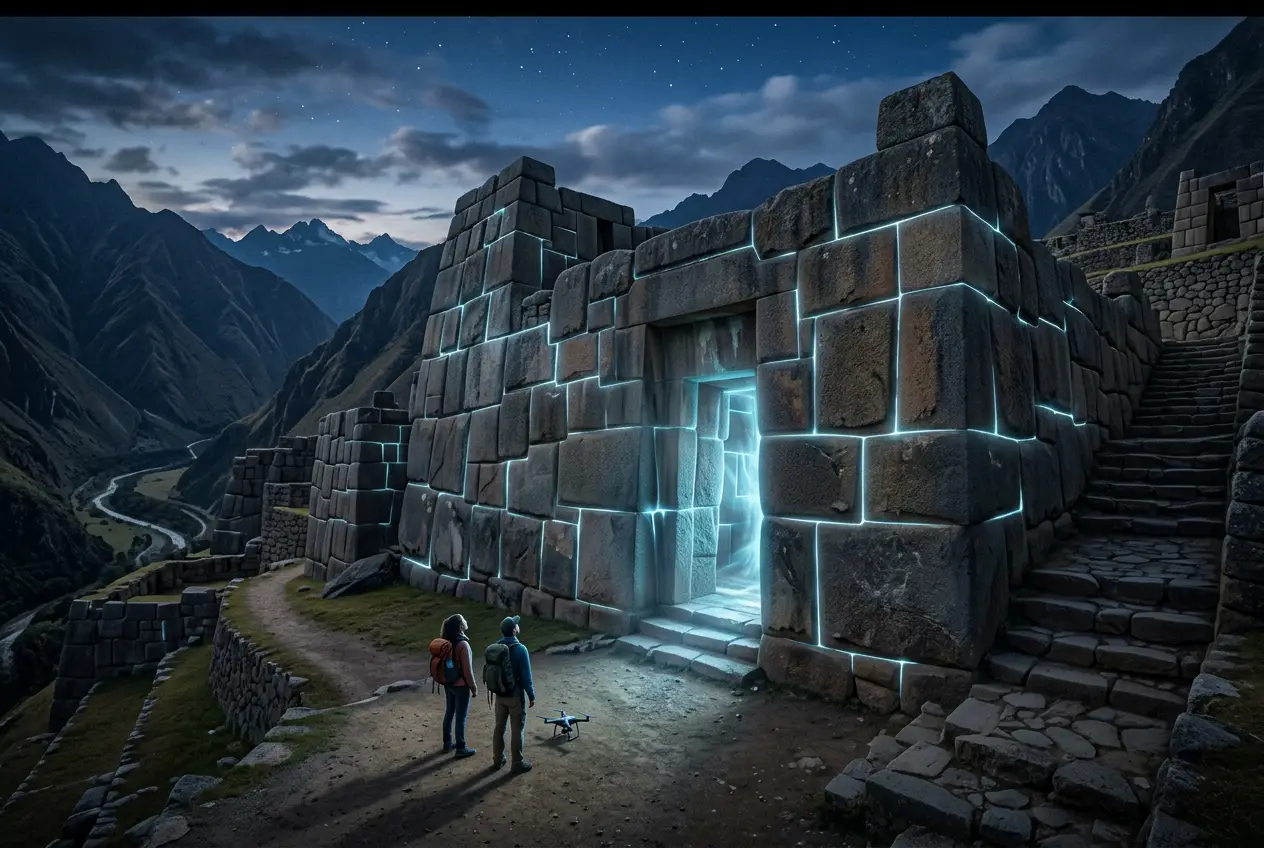
Then there's the stonework of the Inca Empire in the Andes. Sites like Sacsayhuaman, Machu Picchu, and Ollantaytambo feature colossal stones, some weighing hundreds of tons, perfectly interlocked without mortar. These aren't simple rectangular blocks; many are multi-sided and irregular, yet they fit together like pieces of a cosmic jigsaw puzzle. The angles and curvatures are so exact that it's difficult to imagine them being carved and placed by hand, let alone transported up mountainsides. The surface finishes are often incredibly smooth, especially on the inner faces of joints, suggesting a tool that could achieve a consistent, even cut across large areas. You can read more about the incredible feats of Inca architecture on Wikipedia's page for Inca Architecture (opens in a new tab).
Why Traditional Explanations Fall Short
The prevailing archaeological theories suggest that ancient peoples used a combination of brute force, simple tools, and abrasive materials. For softer stones like limestone, this approach is plausible. Copper or bronze chisels, combined with wooden mallets, could chip away at the rock, with sand and water used for polishing. However, this method faces significant hurdles when applied to harder stones like granite, diorite, or basalt.
- Tooling Limitations: Copper and bronze are relatively soft metals. While they can be hardened through alloying or work-hardening, they are still far softer than granite. Cutting granite with a copper chisel would be like trying to cut steel with a butter knife – the tool would dull or deform almost instantly. Even with constant resharpening, the sheer amount of effort and time required to make a single precise cut on a large granite block would be astronomical, pushing beyond what seems logistically feasible for the scale of these ancient projects.
- Abrasive Techniques: While quartz sand (silica) is harder than granite and could theoretically be used as an abrasive, achieving perfectly flat surfaces and tight joins over large areas with hand-held rubbing or sawing would be incredibly challenging. Imagine trying to sand a huge, perfectly flat table using only your hands and a pile of sand. The results would likely be uneven and imprecise, far from the mirror-smooth, razor-tight joints we observe.
- Scale and Scope: The sheer volume of precision stonework at sites like Giza or Sacsayhuaman beggars belief if only basic tools were available. We’re talking about millions of precisely cut blocks, not just a few ceremonial pieces. The consistency of the precision across such vast projects implies a highly standardized and efficient method, not just painstaking manual labor.
The "Impossible" Cuts: Evidence of Advanced Methods?
Beyond the general precision, specific details in ancient stonework hint at methods that defy traditional archaeology:
- Saw Marks: In some Egyptian artifacts, archaeologists have observed saw marks that penetrate deep into granite, indicating large, powerful saws. More interestingly, these marks sometimes show a slight concave profile, suggesting a circular saw of immense diameter.
- Drill Holes: Perfectly cylindrical drill holes, often several inches in diameter, have been found in granite. Some even show helical grooves within, as if a drill bit was boring into the rock while simultaneously descending. This level of mechanical precision is incredibly difficult to achieve without rotary tools and a consistent downward pressure, far beyond what manual techniques would typically allow.
- Internal Corners: Achieving a perfectly sharp, 90-degree internal corner in hard stone is exceptionally difficult, even with modern tools. Yet, such features appear in ancient Egyptian boxes and chambers. A hand chisel would inevitably leave a slight radius.
- Polished Undercuts: The undersides of some colossal stones or inside of passages show a high degree of polish and precision, suggesting access to areas that would be incredibly difficult for a human to reach and work manually.
These anomalies lead many to speculate about the existence of lost technologies, perhaps a kind of ancient advanced tooling or energy manipulation. For more on similar perplexing artifacts, consider reading our blog on Impossible Artifacts: Clues to Lost Ancient Tech (opens in a new tab).
Theories of Lost Technology: Beyond Hammer and Chisel
If not conventional methods, then what? The "laser-like" precision sparks a range of intriguing, albeit speculative, hypotheses:
- Advanced Metallurgy and Diamond Tools: Could ancient civilizations have possessed advanced knowledge of metallurgy to forge tools far superior to simple copper? Perhaps they had access to or the ability to create diamond-tipped tools. While diamonds were known and used in ancient times for engraving, larger tools capable of cutting massive stone blocks would require sophisticated engineering. The history and use of diamonds in ancient tools is a fascinating subject you can explore further on Wikipedia's article on Diamond Tools (opens in a new tab).
- Resonance and Sound Frequencies: Some theories propose that ancients could have used specific sound frequencies or resonant vibrations to soften or fracture stone, making it easier to cut. Imagine a tool that vibrates at a frequency that weakens the molecular bonds of the stone, allowing it to be cut with relative ease. While speculative, the concept of sound energy influencing matter is a real scientific field. We've explored related ideas in our post about Unseen Forces: Did Sound Energy Build Ancient Megaliths? (opens in a new tab).
- Chemical Softening (Geopolymers): Another theory suggests that ancient builders, particularly the Egyptians, might have understood geopolymer chemistry, allowing them to effectively "cast" stones or chemically soften natural rock before shaping. This would explain the ease of handling and precision. While controversial, the idea that some ancient stones aren't carved but rather "re-aggregated" from a softened slurry is compelling for some researchers. This aligns with discussions on ancient building materials like those in our article on Ancient Geopolymer Tech: Did Lost Concrete Build Pyramids? (opens in a new tab).
- High-Pressure Water or Plasma Technology: Pushing the boundaries further, some wonder if a form of high-pressure water jet cutting or even an unknown plasma-based cutting technology was at their disposal. While seemingly anachronistic, the idea of sophisticated energy manipulation isn't entirely new in historical tech speculation. Could there have been a lost understanding of electromagnetism or other forces that aided in this work? Our blog on Did Ancient Cultures Master Magnetic Tech? (opens in a new tab) delves into some of these possibilities.
Modern Replication Attempts and the Enduring Mystery
Even with all our modern technology – diamond saws, laser cutters, computer-controlled machinery – replicating some of the ancient stonework feats with the same speed, scale, and precision is incredibly difficult and expensive. Contemporary experiments to replicate specific ancient cuts often require vast amounts of time and resources, still falling short of the reported archaeological findings.
The debate continues to rage among archaeologists, engineers, and independent researchers. While many adhere to the narrative of ingenuity and tireless labor, the physical evidence at these sites repeatedly pushes the limits of what we believe was possible with the known tools of the time.
Perhaps the "lost tools" weren't physical objects in the way we envision, but rather a profound understanding of material science, acoustics, or energy principles that have since been forgotten. The precision stonework of the ancients remains one of history's most compelling tech mysteries, continually challenging us to rethink the capabilities of our predecessors and fueling our curiosity about the true extent of their forgotten innovations.
What do you think? Were these ancient master builders simply incredibly skilled and patient, or were they armed with a knowledge and technology that we have yet to rediscover? The stones themselves guard their secrets, waiting for us to unlock the true story of how they were so perfectly shaped.



Conversation0
No comments yet. Be the first to share a thought — the best questions often become new stories.