


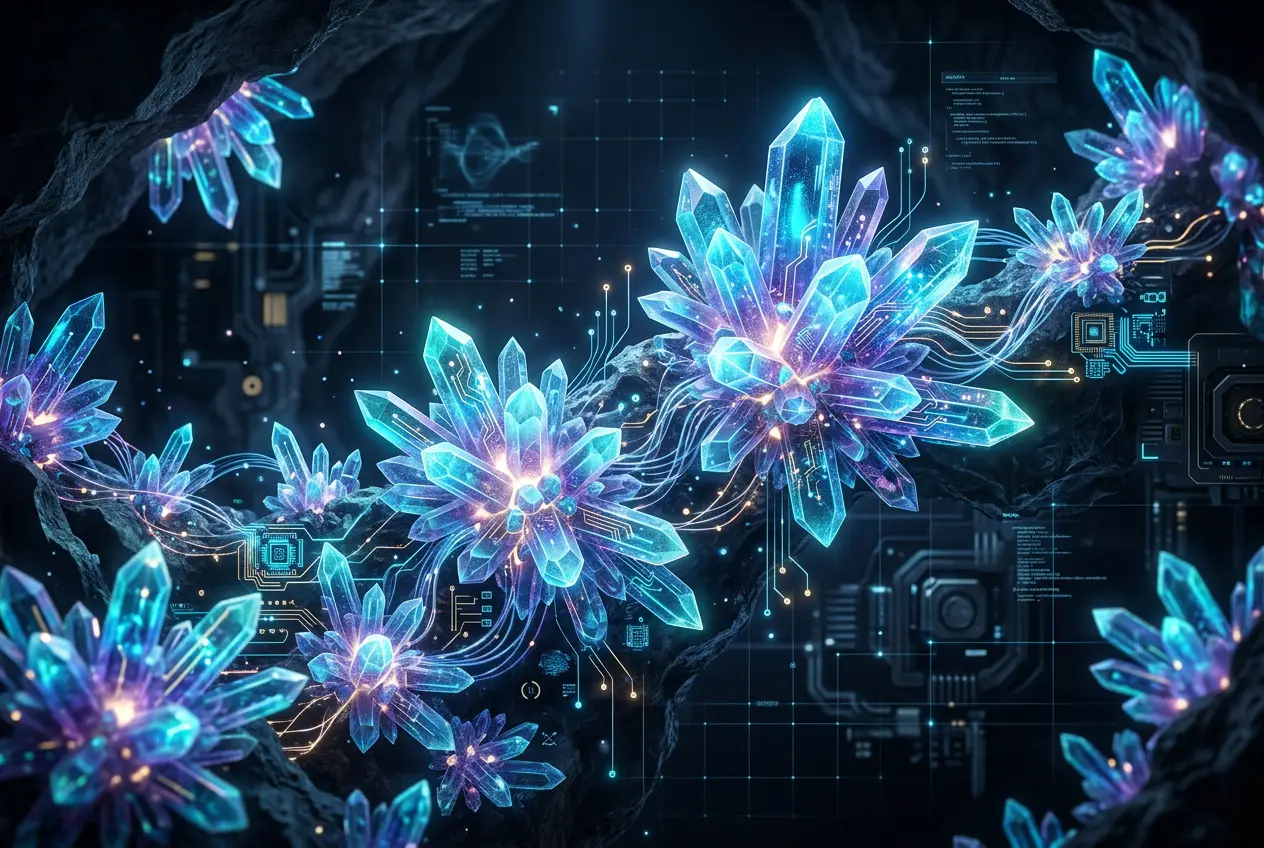
I remember the first time I truly grappled with the idea of a "living" computer. It wasn't about AI mimicking life, but about the very materials of computation themselves possessing life-like properties. It sounded like something out of a science fiction novel, where organic matter merges with silicon to create truly adaptive machines. Yet, the more I delved into it, the more I realized that this seemingly far-fetched concept of "living crystals" is not only grounded in scientific inquiry but represents a radical, potentially revolutionary shift in how we might build computers in the future.
We’re so accustomed to the rigid architecture of silicon chips, where every transistor is meticulously placed, and every connection is hard-coded. But what if our computational devices could grow, adapt, and even heal themselves, much like biological organisms? This is the tantalizing promise of living crystals – a frontier that could redefine not just computing, but our understanding of intelligence itself.
What Exactly Are "Living Crystals"?
First, let's clarify what we mean by "living crystals." We're not talking about crystals that have hearts and minds in the biological sense. Instead, we're referring to materials that exhibit self-organizing behavior, complex adaptive patterns, and often, emergent properties that resemble biological systems. Think of them as systems that can spontaneously arrange themselves into intricate structures, process information, and respond to their environment without explicit external programming.
Imagine a solution of tiny particles that, under specific conditions, start to clump together, not randomly, but forming precise, repeating patterns. Now, imagine those patterns aren't just static structures but dynamic ones that can change their configuration based on external stimuli or internal logic. This dynamic self-assembly is a hallmark of "living" materials. They blur the lines between inert matter and active, adaptive systems. For a deeper dive into self-assembly, the Wikipedia page on self-assembly (opens in a new tab) provides an excellent foundation.
Beyond Silicon: The Need for a New Paradigm
Our current computing paradigm, built on silicon, is incredibly powerful, but it's hitting fundamental limits. Miniaturization is becoming exponentially harder, power consumption is a growing concern, and the sequential, command-driven nature of traditional computing struggles with certain types of problems that biological systems handle effortlessly – like pattern recognition, complex adaptive learning, and robust fault tolerance.
This is where the allure of living crystals comes in. They offer a potential escape from these limitations by drawing inspiration from nature itself. Biological systems compute in fundamentally different ways:
- Parallel Processing: Brains don't have a single CPU; they have billions of interconnected neurons working in parallel.
- Fault Tolerance: A damaged neuron doesn't crash the whole system; others compensate.
- Learning and Adaptability: Biological systems continuously learn and evolve their structures.
Living crystals, with their capacity for self-organization and emergent behavior, could theoretically replicate some of these natural computing strengths. We've explored the incredible speed of quantum computers in a previous post, "/blogs/why-quantum-computers-are-mind-bogglingly-faster-than-supercomputers-9423", but living crystals offer a different kind of computational leap – one focused on adaptive intelligence.
How Could Living Crystals "Compute"?
The computational power of living crystals stems from their ability to form complex, dynamic patterns that can encode and process information. Researchers are exploring several mechanisms:
-
Chemical Oscillations and Reaction-Diffusion Systems: Some systems, like the Belousov-Zhabotinsky (BZ) reaction, exhibit mesmerizing oscillating patterns of chemical activity. These patterns can propagate, interact, and even store information. Imagine using the presence or absence of a wave, or the intersection of two waves, to represent binary information (0s and 1s) or even more complex logical states. These chemical reactions are a prime example of systems that can exhibit complex, self-organizing behavior. For more on the BZ reaction, check its Wikipedia page (opens in a new tab).
-
Active Matter and Swarm Intelligence: Another avenue involves "active matter" – collections of interacting particles that are individually energy-driven and collectively exhibit complex, coherent behaviors. Think of a school of fish or a flock of birds. Researchers are designing synthetic particles that can move, interact, and self-assemble based on simple rules, leading to emergent patterns that could be exploited for computation. The collective intelligence, or "swarm intelligence," of these systems can solve problems that individual components cannot.
-
Programmable Self-Assembly: Scientists are learning to design molecules and nanoparticles that have specific "sticky" patches, ensuring they only connect in predetermined ways. By carefully engineering these components, they can program a system to self-assemble into intricate, crystalline structures that perform specific functions, including logic operations. This is a form of bottom-up manufacturing at the molecular level.
Dr. Adam Stieg, a researcher in this field, once put it quite eloquently: "We're moving beyond traditional computing architectures. Instead of forcing electrons through predefined circuits, we're exploring systems where the computation itself is an emergent property of the material's dynamic organization." This vision highlights the paradigm shift away from static hardware towards dynamic, adaptive matter.
The Promise: Self-Healing, Adaptive, and Efficient Machines
The implications of computing with living crystals are profound:
- Self-Healing Capabilities: If a part of a silicon chip breaks, the chip is often ruined. A living crystal, however, could potentially rearrange its components to bypass a damaged section or even "grow" new connections to repair itself, much like biological tissues.
- Adaptive and Learning Systems: Imagine a computer that not only runs software but also fundamentally changes its physical structure to become more efficient at a particular task. Living crystals could evolve their computational architecture over time, optimizing themselves for specific problems.
- Massively Parallel Processing: Their inherent self-organizing nature lends itself to systems where countless small "computational units" are operating simultaneously, tackling complex problems in a highly distributed fashion.
- Low Power Consumption: Many of these self-organizing processes can occur at ambient temperatures and with minimal energy input, offering a path towards ultra-efficient computing. This stands in contrast to the energy demands of traditional supercomputers and even some quantum computing approaches. We've discussed other future power sources like "/blogs/atomic-batteries-powering-a-future-without-recharging-8897" which could complement such low-power computational methods.
Challenges on the Path to the Future
While the promise is exhilarating, the path to practical "living crystal" computers is fraught with challenges.
- Control and Predictability: How do we reliably program and control systems that are inherently dynamic and emergent? Ensuring predictable outcomes from self-organizing chaos is a monumental task.
- Scalability: Can these phenomena be scaled up from laboratory curiosities to complex computational machines?
- Interface with Traditional Tech: How would these organic, dynamic systems interface with our existing digital infrastructure?
- Fundamental Understanding: We are still in the early stages of understanding the complex physics and chemistry that govern these materials. Unraveling these mysteries is crucial.
Scientists are making strides, but there's a long road ahead. The field is rapidly evolving, with new discoveries pushing the boundaries of what we thought was possible for inert matter. The question of whether "/blogs/could-our-reality-be-a-simulation-decoding-the-matrix-hypothesis-4299" seems less theoretical when materials themselves start exhibiting such profound, adaptive intelligence.
Conclusion: A Glimpse into Tomorrow's Tech
The concept of living crystals isn't just a niche area of materials science; it’s a profound rethinking of computation itself. It challenges us to look beyond fixed architectures and embrace the dynamic, adaptive power of emergent systems. While we might not be booting up a "living crystal" laptop next year, the research being conducted today is laying the groundwork for a future where technology is not just smart, but alive in a whole new sense.
I find myself continually amazed by the ingenuity of researchers pushing these boundaries. The journey into living crystals promises not only more powerful and resilient computers but also a deeper appreciation for the complex, self-organizing beauty inherent in the universe around us. It’s a compelling vision where the lines between biology and technology become wonderfully, intricately blurred.



Conversation0
No comments yet. Be the first to share a thought — the best questions often become new stories.